 Nothing found for the request
Is the Casino Legal in New Zealand? The 2026 Rules Explained
Sologe September 29, 2026
Share:


Quick Summary
Land-based casinos are fully legal and regulated in New Zealand under the Gambling Act 2003, but online casinos have sat in a grey zone for years: it’s illegal to operate one from within the country, yet nothing has stopped Kiwis from playing at offshore sites. That’s changing in 2026, with the Online Casino Gambling Act creating New Zealand’s first licensed online casino regime, capped at 15 operators.
Ask around and you’ll get three different answers to whether casino gambling is legal in New Zealand. Someone will say yes, pointing to SkyCity’s glowing sign in downtown Auckland. Someone else will say no, insisting online casinos are banned outright. Both are half right, and neither tells the full story.
The truth sits in the middle, and it’s gotten more interesting this year. New Zealand has always allowed physical casinos to operate under strict licensing. Online casino gambling, though, has lived in a legal grey area since the Gambling Act 2003 was written — and 2026 is the year that grey area finally starts turning into a real, regulated market.
The Short Answer
Yes, casino gambling is legal in New Zealand — but the rules depend entirely on where the casino is based and how you’re accessing it. Physical, land-based casinos are legal, licensed, and taxed. Online casinos are a different story: it has long been illegal for a company to run an online casino from inside New Zealand, but that doesn’t stop residents from playing at offshore sites, since the law never criminalised the act of placing a bet with an overseas operator.
That patchwork is exactly why New Zealand’s government pushed through the Online Casino Gambling Act, aiming to bring offshore-style online casino gambling under a proper domestic licensing framework for the first time.
How New Zealand’s Gambling Law Actually Works
The backbone of it all is the Gambling Act 2003, administered by the Department of Internal Affairs (DIA). Instead of a single “legal or illegal” switch, the Act sorts gambling into four classes based on prize value, turnover, and who’s allowed to run it.
Class | What It Covers | Typical Examples | Regulator |
|---|---|---|---|
Class 1 | Small-scale gambling, no license required | Housie with modest prizes, small raffles | Self-managed, low oversight |
Class 2 | Low or no prize gambling for community purposes | Small society-run raffles | DIA |
Class 3 | Society-run gambling with proceeds to community purposes | Larger raffles, lotteries run by clubs | DIA |
Class 4 | Gambling on machines operated by societies for community grants | Pub and club gaming machines (pokies) | DIA, Gambling Commission |
Casinos don’t neatly fit into those four classes — they’re licensed separately, historically under the Casino Control Act 1990, with oversight now largely folded into the broader gambling regulatory framework the DIA administers. New Zealand currently has a small number of licensed, land-based casinos, including operations run by SkyCity in Auckland, Hamilton, and Queenstown, plus independently run casinos in Christchurch and Dunedin.
Why Online Casinos Were Never Simply “Illegal”
Here’s the thing though — the Gambling Act 2003 never said New Zealanders can’t gamble online. What it said was that it’s illegal to operate, promote, or advertise an online casino from within New Zealand. That’s a narrower rule than most people assume.
Because the law targeted operators based in the country rather than players, offshore online casinos — licensed in places like Malta, Curaçao, or the UK — could legally accept New Zealand customers without breaching local law. New Zealanders weren’t breaking any rule by signing up, depositing, and playing. The operators just couldn’t be headquartered on New Zealand soil.
That loophole is exactly why so many international casino brands built a big New Zealand player base without ever holding a New Zealand license. It also meant none of that gambling revenue was taxed locally, and none of those operators were bound by New Zealand’s consumer protection or problem-gambling rules.
What Changed: The Online Casino Gambling Act 2026
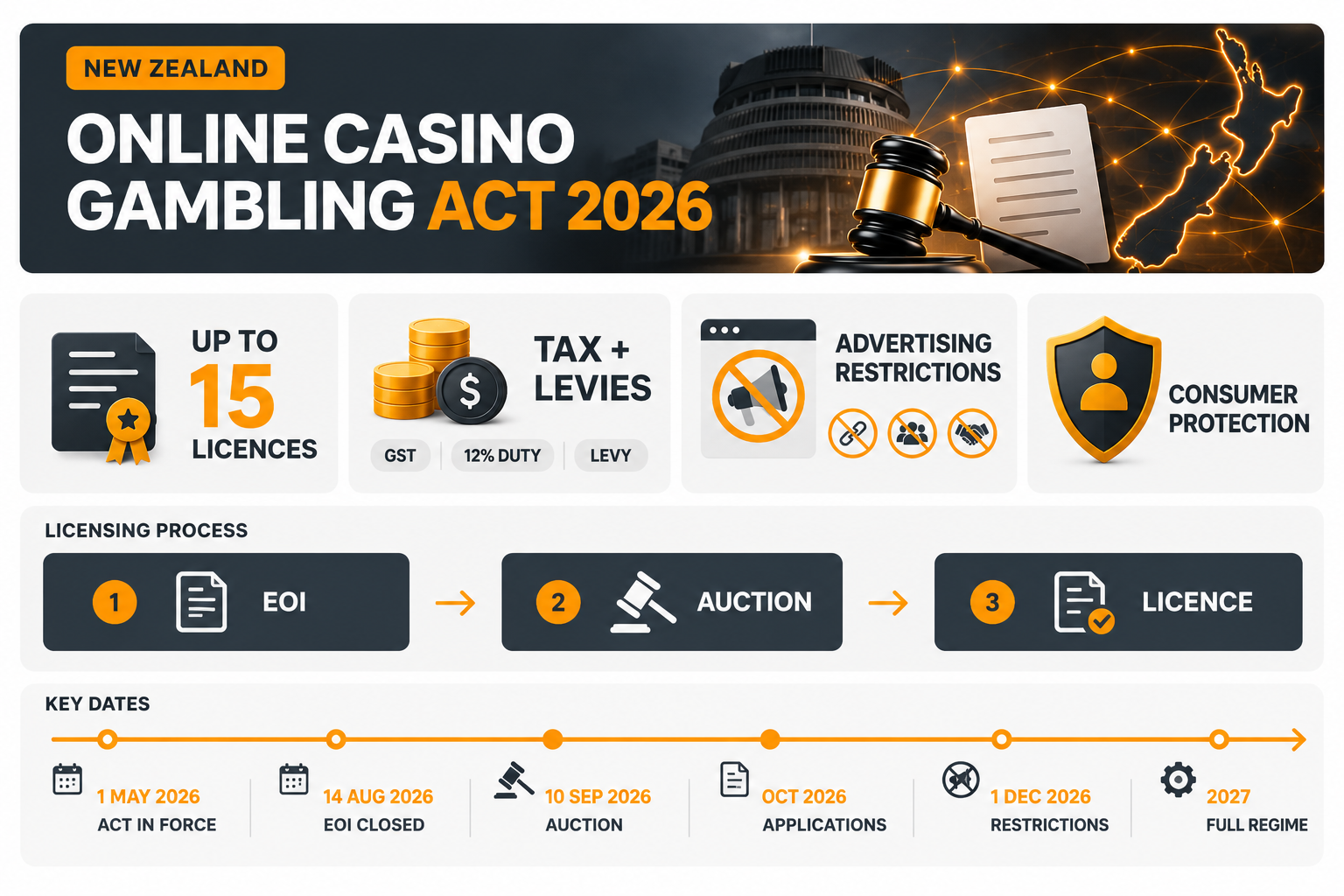
The government’s answer to that gap is the Online Casino Gambling Act 2026, which received Royal Assent in late April 2026 and came into force on 1 May 2026. Supporting regulations followed on 3 July 2026. Rather than continuing to tolerate an unregulated offshore market, the Act creates New Zealand’s first formal licensing system specifically for online casinos.
The core mechanics of the new regime include:
- A cap of up to 15 licences, allocated through a competitive process run by the Department of Internal Affairs (expression of interest, auction, then full licence application).
- A requirement that licensed operators pay tax on New Zealand-facing revenue — including GST, online gambling duty and a problem-gambling levy — closing the gap that let offshore sites operate without paying New Zealand tax.
- Tighter rules on gambling advertising and a ban on affiliate marketing, paid endorsements and similar promotion, building on the existing Gambling Act 2003 ban on advertising overseas gambling.
- Consumer-protection and harm-minimisation duties modelled on rules already applied to land-based casinos and gaming machines, with DIA enforcement tools that include take-down notices and penalties of up to $5 million.
Licensing is being phased in rather than switched on overnight. Existing offshore operators that were already serving New Zealand customers on 1 May 2026 may continue until 1 December 2026, but must not advertise to people in New Zealand. From 1 December 2026, only auction winners with licence applications under assessment may keep serving the market; other operators must exit. DIA expects to start issuing licences from early 2027, with the system fully operational later that year.
Anyone wanting the definitive, current status should check the Department of Internal Affairs’ official online casino gambling pages, since application windows, auction dates and licence decisions sit with DIA as the rollout continues.

Reach iGaming Buyers with Sologe
AtSologe, we give iGaming vendors a dedicated marketplace for gaming software, platforms, payment solutions, sports betting products, equipment, services, and other industry offers. We help you present your business to people already searching for iGaming suppliers, products, and solutions.
Looking to Put Your Offer in Front of More Buyers?
With Sologe, you can:
- add your company and solutions to an iGaming-focused marketplace
- choose the category that best matches what you provide
- make your offer easier for potential buyers to discover
- give interested partners a clear way to learn more about your business
👉Get in touch with us to add your offer to Sologe.
Old Regime vs. New Regime
Feature | Before the Act | Under the New Licensing Regime |
|---|---|---|
Who can operate | Only offshore-licensed operators, informally | Up to 15 DIA-licensed operators |
Tax paid in NZ | None from offshore operators | Licensed operators pay NZ tax on local revenue |
Advertising rules | Largely unregulated, offshore ad standards | Restricted advertising, affiliate marketing curbs |
Consumer protection | Governed by operator’s home jurisdiction | NZ-specific harm-minimisation requirements |
Legal certainty for players | Grey area, tolerated but unregulated | Clear legal status under NZ law |
What This Means for Players Right Now
For everyday players, the practical experience of playing online hasn’t flipped overnight. Offshore sites that New Zealanders have used for years are still operating, and the new licensing system takes time to roll out fully as operators apply, get vetted, and go through DIA’s compliance process.
What does shift, though, is the direction of travel. Once licensed operators are up and running, New Zealand-facing online casino gambling moves from an informal, tolerated arrangement into a properly regulated market — closer to how land-based casinos already work. That’s a meaningful change for anyone who cares about dispute resolution, responsible gambling tools, or simply knowing an operator answers to New Zealand regulators rather than a distant offshore authority.
Land-based casino gambling, meanwhile, hasn’t changed at all. It remains straightforwardly legal, taxed, and licensed the way it has been for decades — age restrictions apply: 20+ to enter the gambling area of a licensed land-based casino. The minimum age is 18 for Class 4 pokies, TAB betting and lottery products.
Poker, Pokies, and Other Grey Areas
Online Poker
Online poker sits in roughly the same legal space online casinos occupied before the new act: illegal for a New Zealand-based company to run a real-money poker platform, but historically not something that stopped residents from playing on offshore poker sites.
Pokies in Pubs and Clubs
Pub and club “pokies” (gaming machines), by contrast, are tightly regulated under Class 4 gambling rules, with proceeds required to fund community purposes and strict limits on machine numbers per venue.
Sports Betting
Sports betting occupies its own lane too, run domestically through the TAB (Entain-operated under New Zealand Racing Industry Act arrangements), which is a separate regulatory track from casino-style gambling entirely.
Frequently Asked Questions
Is it illegal for a New Zealander to play at an online casino?
Historically, no – the Gambling Act 2003 targeted operators running online casinos from within New Zealand, not individual players using offshore sites. The new licensing regime doesn’t criminalise players either; it simply creates a proper local licensing path for operators.
Are land-based casinos legal in New Zealand?
Yes. New Zealand has a small number of licensed, land-based casinos operating legally under long-standing gambling and casino control legislation, overseen by the Department of Internal Affairs.
Will offshore casinos still be accessible after the new law?
Unlicensed offshore operators are expected to face tighter restrictions once the licensing regime is fully active, since the point of the act is to channel New Zealand-facing online casino activity through licensed, taxed operators rather than unregulated offshore sites.
Is online poker legal in New Zealand?
It’s illegal for a company based in New Zealand to operate an online poker platform for real money, similar to the old rule for online casinos. Players have generally been able to access offshore poker sites without breaching New Zealand law.
What age do you need to be to gamble at a New Zealand casino?
Licensed land-based casinos in New Zealand require players to be at least 20 years old to enter the gaming floor.
Does New Zealand tax online casino winnings?
Individual gambling winnings generally aren’t taxed as personal income in New Zealand. The new licensing framework instead taxes operator revenue, not player winnings directly.
The Bottom Line
So, is the casino legal in New Zealand? Land-based, absolutely — it always has been, tightly licensed and taxed. Online is where things get interesting: what used to be an unregulated grey zone, tolerated but never properly licensed, is being replaced by a formal system capped at 15 licensed operators under the Online Casino Gambling Act.
For anyone playing online right now, the smart move is to keep an eye on the Department of Internal Affairs’ official updates as licensing rolls out through 2026 and into 2027. Rules, timelines, and which operators actually secure a licence are still settling — and that’s exactly the kind of detail worth checking directly at the source rather than relying on outdated guides.
Related Articles

September 29, 2026Is Sports Betting Legal in Kazakhstan? The...

September 29, 2026Is Sports Betting Legal in Mexico? The...