 Nothing found for the request
Is the Casino Legal in Gambia? What the Law Actually Says
Sologe September 29, 2026
Share:


Quick Summary
Casino gambling in Gambia sits in a legal gray zone. Land-based casinos operate legally under licenses from the Gambia Gaming Board, but the Betting and Gaming Act makes it a criminal offense for Gambian citizens to gamble at them — tourists and foreign residents are the intended customers. Online gambling has no dedicated law either way, leaving Gambians to rely on offshore sites at their own risk, while a 2015 presidential ban on gambling is still cited but rarely enforced.
Walk along the Senegambia strip in Kololi at night and it’s hard to miss the neon glow of a casino sign. Slot machines hum, blackjack tables fill up, and tourists cash in dalasi for chips like it’s the most normal thing in the world. So why does a quick search for “is gambling legal in Gambia” turn up conflicting answers within seconds?
The short answer? It depends entirely on who’s asking. Gambia’s gambling laws draw a hard line between foreign visitors and Gambian citizens, and that distinction explains almost every contradiction floating around online. This guide breaks down what’s actually legal, who it applies to, and what’s changed heading into 2026.
The Legal Status of Casinos in Gambia, Explained
Gambia does have a functioning legal framework for casinos — it’s called the Betting and Gaming Act, and it’s overseen by the Gambia Gaming Board (GGB). Under this law, licensed casinos are allowed to operate on Gambian soil, provided they hold the correct permits and pay the required fees and taxes.
Here’s the catch, though. The law was never written with locals in mind. It specifically criminalizes gambling by Gambian nationals, while leaving the door wide open for tourists and foreign residents. So the casinos dotted around Kololi and Kotu aren’t operating illegally at all — they’re licensed businesses. What’s illegal is a Gambian citizen walking through the door and placing a bet.
Why the Nationality Split Exists
Gambia is overwhelmingly Muslim — roughly 95% of the population — and gambling is broadly viewed as incompatible with Islamic teaching. Lawmakers essentially built a two-tier system: welcome foreign currency and tourism revenue through casino licensing, but shield citizens from what’s considered a socially corrosive activity. It’s a pragmatic compromise, even if it creates a strange legal patchwork.
The 2015 Presidential Ban — Still Relevant?
In March 2015, then-President Yahya Jammeh issued a presidential directive banning lotteries, casinos, and all forms of gambling nationwide, citing concerns about household income being wagered away and children spending lunch money on betting slips. Operators were ordered to shut down immediately.
That ban didn’t stick the way it sounded like it would. Reports since 2017 indicate the directive was effectively walked back, and betting shops, sports betting kiosks, and casinos have continued operating with government tolerance — and in many cases, formal licensing. So while the 2015 ban still gets cited by some sources as “proof” gambling is illegal in Gambia, the reality on the ground looks very different today.
Casinos vs. Online Gambling: Two Very Different Legal Pictures
Land-based and online gambling in Gambia aren’t governed the same way, and lumping them together is where a lot of confusion online comes from.
Form of Gambling | Legal Basis | Who Can Legally Play | Enforcement |
|---|---|---|---|
Land-based casinos | Betting and Gaming Act, GGB licensing | Tourists, foreign residents | Actively licensed and taxed |
Land-based casinos (citizens) | Betting and Gaming Act (prohibition clause) | Nobody — offence for Gambians | Rarely enforced, but legally on the books |
Sports betting shops | Regulated post-2017 | Generally open to the public | Widely operated, licensed premises |
Online casinos/betting | No dedicated law either way | Unclear — no official permission or ban | Unregulated, offshore sites used informally |
Online gambling occupies the murkiest space of all. There’s no official licensing regime for online casinos operating out of Gambia, and no explicit law banning Gambians from playing on offshore platforms either. In practice, that means Gambians who want to gamble online typically sign up with international operators licensed elsewhere — Curaçao, Malta, or the UK, for example — since there’s no domestic online casino industry to speak of.

Reach More iGaming Buyers with Sologe
AtSologe, we help iGaming vendors present their products and services in a marketplace built around the industry. Our catalog covers gaming software, platforms, payment solutions, sports betting products, equipment, services, and more. If Gambia is a market you are considering, Sologe gives you another way to get your offer in front of relevant buyers.
Looking to Make Your Business Easier to Discover?
With Sologe, you can:
- list your products or services in an iGaming-specific marketplace
- place your offer in the most relevant category
- help interested buyers understand what your company provides
- create a clear path for potential partners to find your business
👉Contact us to get your offer listed on Sologe.
The Gambling Age and Entry Rules
Regardless of nationality, licensed gambling premises in Gambia enforce a minimum age of 18. It’s illegal to permit anyone under 18 to even enter a licensed gambling venue, let alone place a wager. This age restriction applies uniformly across casinos and betting shops and is one of the clearer, less-contested rules in Gambia’s gambling framework.
The 50% Gambling Tax: A Major 2026 Development
One thing that’s changed the conversation around gambling in Gambia recently isn’t about legality at all — it’s about tax. Finance Minister Seedy Keita confirmed, as part of the 2026 national budget approved by the National Assembly, that the tax on gambling winnings would climb from 40% to 50%, effective January 1, 2026. That’s on top of a jump from 30% to 40% that took effect in 2025, and an earlier increase from 10% to 30% before that.
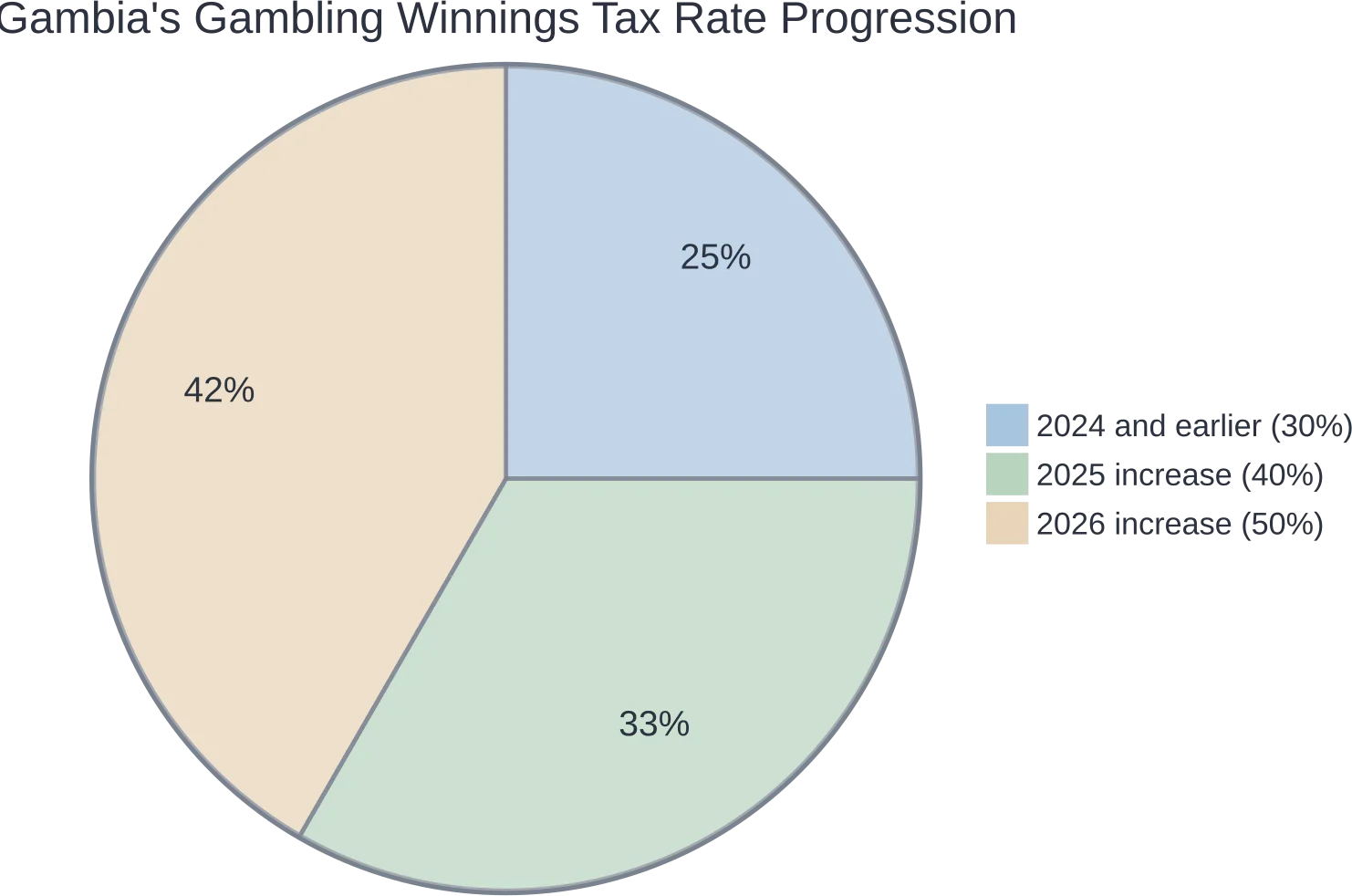
Successive hikes to Gambia’s tax on gambling winnings, culminating in a 50% rate from 2026.
That trajectory puts Gambia among the highest gambling-winnings tax rates on the continent. The government’s stated rationale is straightforward: discourage excessive betting while squeezing more revenue out of an industry it’s not eager to promote but also can’t fully suppress. Licensed operators are now required to file and remit this tax monthly, with compliance deadlines rolling out through early 2026.
What does this mean practically? For tourists playing at Dunes or Kololi Casino, the tax mostly affects the operator’s bottom line rather than a visitor’s personal winnings withdrawal process, though house edges and payout structures can shift in response. For any Gambian citizen wagering informally, it’s yet another signal that the government treats gambling as a revenue lever to manage carefully, not an activity to normalize.
Risks of Gambling in an Unregulated Gray Zone
Because so much of Gambia’s gambling landscape — especially online — operates without clear rules, players face real risks that wouldn’t exist in a fully regulated market:
- No consumer protection for Gambians using offshore online casinos; if a dispute arises, there’s no domestic regulator to appeal to.
- Legal exposure for citizens gambling at local land-based casinos, even though enforcement is inconsistent.
- Payment and banking friction, since many international payment processors treat Gambia cautiously due to the regulatory ambiguity.
- Uncertain future rules, as tax hikes suggest the government is paying closer attention to the sector than it has in years past.
Frequently Asked Questions
Is it legal for tourists to gamble at casinos in Gambia?
Yes. Licensed casino such as Kololi Casino is open to tourists and foreign residents, and gambling there as a non-citizen doesn’t violate Gambian law.
Can Gambian citizens legally gamble at casinos?
No. The Betting and Gaming Act makes it an offence for a Gambian national to gamble at a licensed casino, even though the venues themselves operate legally. Enforcement, however, is inconsistent.
Is online gambling illegal in Gambia?
There’s no specific law banning or permitting online gambling in Gambia. Without an official regulatory framework for it, Gambians who gamble online typically use offshore, internationally licensed platforms, doing so in a legal gray area rather than under clear domestic rules.
Did Gambia really ban all gambling in 2015?
A presidential directive in March 2015 did order a nationwide ban on lotteries, casinos, and gambling. That ban was effectively reversed in practice from around 2017 onward, with betting shops and casinos resuming licensed operations.
What is the minimum gambling age in Gambia?
18. It’s illegal to allow anyone under 18 to enter a licensed gambling premises, regardless of whether they intend to gamble.
How high are gambling taxes in Gambia right now?
As of January 1, 2026, the tax on gambling winnings rose to 50%, up from 40% in 2025 and 30% before that – among the steepest such rates in Africa. Always check the Gambia Gaming Board or Ministry of Finance for the latest confirmed rate.
Are sports betting shops treated differently from casinos?
Sports betting has become widely available and openly operated across Gambia since regulation resumed post-2017, and unlike casino gambling, it doesn’t carry the same explicit citizen-only prohibition – though the same evolving tax rules apply to winnings.
The Bottom Line
Casinos in Gambia aren’t illegal — far from it. They’re licensed, taxed, and openly operating in tourist zones like Kololi and Kotu. What’s illegal is a Gambian citizen stepping up to the blackjack table, a rule rooted in the Betting and Gaming Act and rarely enforced with any real consistency. Online gambling remains a legal blank space, leaving citizens to navigate offshore platforms without domestic protection. And with gambling taxes now sitting at 50%, the government’s message is clear even where the law itself isn’t: tolerate it, tax it heavily, but don’t encourage it.
Anyone planning to gamble in Gambia — as a tourist or otherwise — should check current rules directly with the Gambia Gaming Board before playing, since tax rates and enforcement patterns have shifted more than once in the past decade and could shift again.
Related Articles

September 29, 2026Is the Casino Legal in Cambodia? 2026 Rules...

September 29, 2026Is the Casino Legal in China? The Real Rules...