 Nothing found for the request
Is the Casino Legal in Japan? The Real Answer for 2026
Sologe September 29, 2026
Share:


Quick Summary
Casinos are legal in Japan, but only in tightly regulated form. A 2018 law allows a small number of licensed integrated resorts to operate physical casinos, with Osaka’s MGM-led project set to become the country’s first when it opens in 2030. Online casinos, however, remain fully illegal, and most other forms of gambling are banned under Japan’s Criminal Code with a handful of narrow exceptions.
Ask most people whether casinos are legal in Japan and you’ll get a confident “no.” That answer used to be right. It isn’t anymore, at least not entirely.
Japan’s relationship with gambling is a patchwork of strict prohibition and carefully carved-out exceptions. Pachinko parlors glow on nearly every street corner, horse racing draws massive crowds, and yet walking into a card room and playing blackjack for cash has been a criminal act for most of the country’s modern history. So what changed, and where does the law actually stand heading into 2026 and beyond? Here’s the full picture.
The Short Answer: Yes, But With Heavy Restrictions
Casinos are legal in Japan under a specific 2018 statute known as the Integrated Resort (IR) Implementation Act. That law created a licensing framework allowing a limited number of large-scale resort complexes — combining casinos, hotels, convention space, and entertainment — to operate legally under national oversight.
None of these resorts are open yet. Japan hasn’t had a functioning legal casino floor at any point in its history until construction catches up with the legislation. The first one, MGM Osaka, is under construction on the man-made island of Yumeshima and is scheduled to open in autumn 2030, according to reporting from Japanese outlets tracking the project. Until then, “legal casino in Japan” is more of a future-tense statement than a present-day reality..
Why Gambling Was Illegal in the First Place
Japan’s Penal Code, specifically Chapter 23, criminalizes most gambling activity. It’s been on the books in some form since the late 19th century, and the logic behind it hasn’t really shifted: gambling is treated as a public order offense, not just a private vice. Both playing and operating unlicensed gambling can carry criminal penalties, at least in theory, though enforcement varies wildly depending on the activity.
That blanket ban is why pachinko, Japan’s wildly popular pinball-slot hybrid, technically doesn’t pay out cash. Players exchange winning balls for prizes, then walk those prizes to a separate, technically unaffiliated shop nearby to convert them into money. It’s a legal workaround that’s existed for decades and one regulators have largely tolerated.
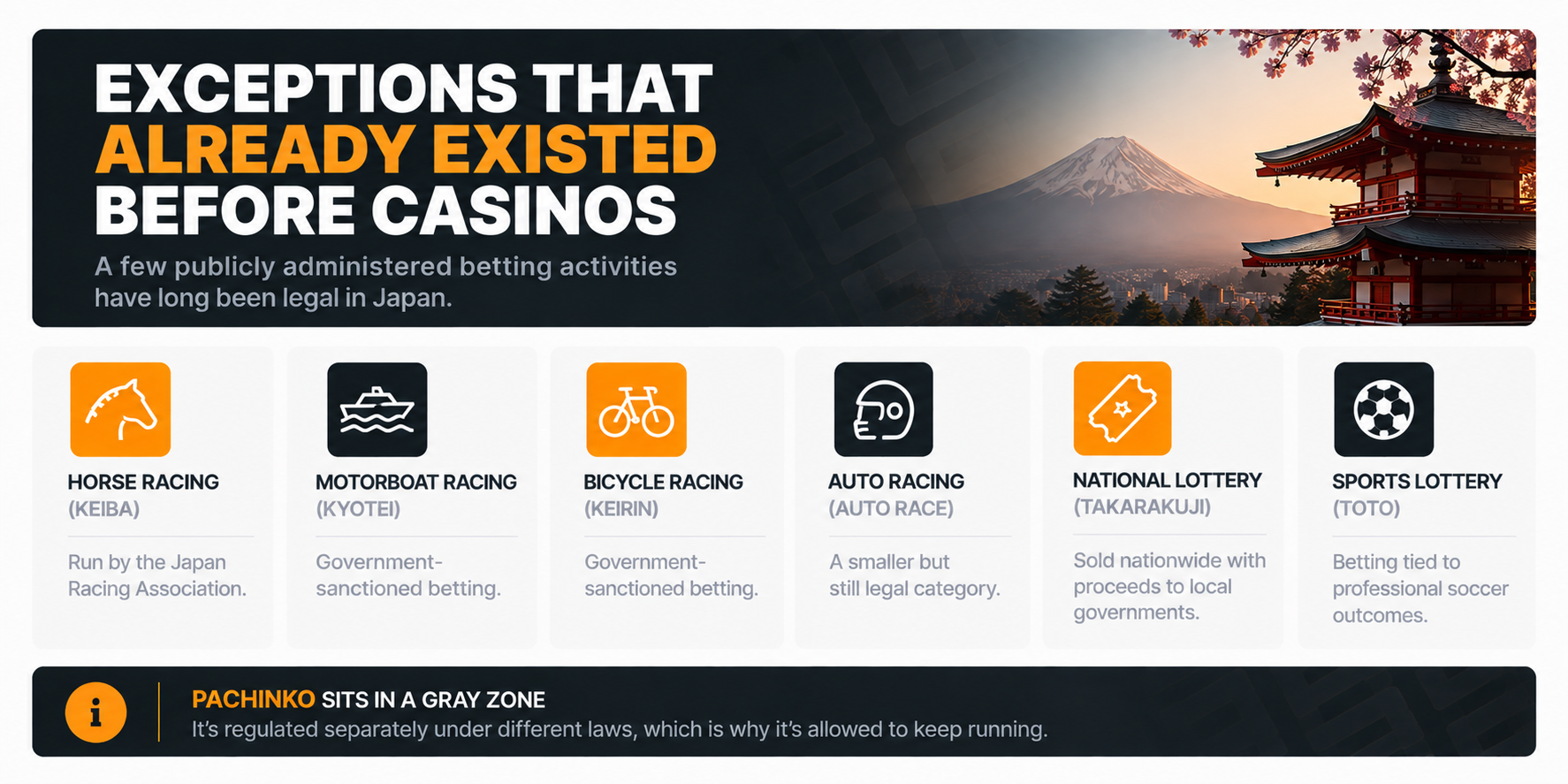
Exceptions That Already Existed Before Casinos
Long before the IR law, Japan carved out exceptions for a handful of publicly administered betting activities. These are run by government bodies or licensed public corporations, which is precisely what keeps them on the legal side of the line.
- Horse racing (keiba) — overseen by the Japan Racing Association, with tracks like Tokyo Racecourse and Oi Racecourse drawing huge weekend crowds.
- Motorboat racing (kyotei) and bicycle racing (keirin) — both government-sanctioned betting sports.
- Auto racing (auto race) — a smaller but still legal public betting category.
- The national lottery (takarakuji) — sold nationwide with proceeds funneled to local governments.
- Sports lottery (toto) — betting tied to professional soccer outcomes.
Pachinko sits in a gray zone rather than a true exception — it’s regulated separately under different laws entirely, which is exactly why it’s allowed to keep running while a poker table in a private club would get shut down.
What the 2018 Integrated Resort Law Actually Allows
The IR Implementation Act didn’t just legalize “casinos” in a general sense. It built a narrow, heavily supervised structure around them. Understanding that structure matters more than the headline.
Limited Number of Licenses
Japan capped the initial rollout at just three integrated resort locations nationwide. Osaka is so far the only site to receive national approval; Nagasaki’s bid was rejected, Wakayama withdrew, and Tokyo stayed out of the first formal bidding process. Applications for the remaining slots are expected to reopen in 2027.
Casino Floor Space Is Capped
Casino gaming space inside any IR can’t exceed 3% of the total floor area of the integrated resort. The rest has to be hotels, conference centers, shopping, and entertainment — the “integrated” part of integrated resort isn’t marketing fluff, it’s a legal requirement.
Entry Fees and Visit Limits for Residents
This is where Japan’s approach to problem gambling really shows up in the law’s fine print. Japanese citizens and residents have to pay an admission fee — split between national and local government — to enter, and the visit frequency is capped.
Rule | Detail |
|---|---|
Entry fee (Japanese residents) | 3,000 yen national + 3,000 yen local = 6,000 yen total, valid for 24 hours |
Visit frequency cap | Up to 3 times per week, no more than 10 times in a 28-day period |
Foreign tourists | No entry fee and no visit limit, only a valid passport required |
Casino floor limit | Maximum 3% of total integrated resort floor area |
Number of licensed sites | Capped at 3 in the initial national rollout |
Foreign visitors get a noticeably easier path in — no fee, no cap, just identification at the door. It’s a deliberate design choice: Japan wants tourist revenue from casinos without normalizing gambling for its own population.

Put Your iGaming Product in Front of Buyers with Sologe
AtSologe, we provide iGaming vendors with a dedicated place to present software, platforms, payment solutions, sports betting products, equipment, services, and other industry solutions. We make it easier for potential buyers to discover and compare your offer while researching iGaming suppliers.
Want More Relevant Buyers to Discover Your Business?
With Sologe, you can:
- add your company to a marketplace focused on iGaming
- select the category that best fits your product or service
- make your offer easier to find during vendor research
- give potential buyers a direct way to explore what you provide
👉Get in touch with us to list your product on Sologe.
Where Things Stand Going Into 2030
Osaka’s project, backed by MGM Resorts and Orix Corporation, broke ground in 2025 after repeated delays and cost revisions. Original opening targets slipped from 2029 to autumn 2030, a shift regulators attributed to construction costs and site preparation on the reclaimed Yumeshima island.
Once open, MGM Osaka will be Japan’s first operating legal casino — a genuinely historic moment for a country that criminalized the activity for well over a century. Other cities have watched closely; some considered bids and pulled back, wary of public opposition and the addiction-prevention obligations baked into the licensing framework.
Pros and Cons of Japan’s Casino Framework
Pros | Cons |
|---|---|
Strong addiction-prevention safeguards for residents | Extremely limited number of licensed venues (3 initially) |
Integrated resorts bring tourism, jobs, and infrastructure | Years-long delays before any facility opens |
Clear national licensing and regulatory oversight | High entry fees and visit caps discourage local players |
Foreign tourists get frictionless access | Online gambling remains entirely off-limits |
Frequently Asked Questions
Are casinos legal in Japan right now?
Legally, yes – a 2018 law authorizes licensed casinos inside integrated resorts. Practically, none are open yet; MGM Osaka, the first, is scheduled for autumn 2030.
Can Japanese citizens gamble at these casinos once they open?
Yes, but with conditions: a 6,000 yen entry fee per 24-hour visit and a cap of three visits in any seven-day period, up to ten visits in any 28-day period.
Do foreign tourists face the same restrictions?
No. Tourists showing a valid passport can enter without a fee and without any visit limit.
Is online gambling legal in Japan?
No. Playing at online casinos, including offshore-licensed sites, is considered illegal gambling under Japan’s Penal Code.
Why is pachinko allowed if gambling is illegal?
Pachinko operates under separate regulations and avoids direct cash payouts through a prize-exchange system, keeping it technically outside the criminal gambling statutes.
Which cities will have Japan’s first legal casinos?
Osaka is furthest along, with its MGM-led resort under construction. Other regions explored bids, but Osaka remains the clearest first mover as of 2026.
Is horse racing betting legal in Japan?
Yes. Horse racing, along with motorboat racing, keirin, and auto racing, falls under long-standing government-run betting exceptions.
The Bottom Line
Casinos in Japan occupy a strange middle ground right now: legal on paper, absent in practice. That will change once Osaka’s integrated resort opens, but the framework surrounding it is designed to keep gambling tightly controlled rather than wide open. Anyone tracking this space should watch official announcements from Japan’s Casino Regulatory Commission rather than relying on outdated headlines, since licensing details and opening timelines have shifted more than once already. For now, the safest bet — pun intended — is treating unlicensed online casinos as off-limits and waiting for 2030 for the real thing.
Related Articles

September 29, 2026Is Sports Betting Legal in Kazakhstan? The...
September 29, 2026Is Sports Betting Legal in Mexico? The...