 Nothing found for the request
How to Start a Sports Betting Company in Kenya (2026)
Sologe June 5, 2026
Share:


Quick Summary
Quick Summary: Starting a sports betting company in Kenya requires registering a Kenyan corporate entity with at least 30% Kenyan shareholding, securing approximately 6.75 million KES in capital, obtaining a license from the Gambling Regulatory Authority of Kenya (GRAK), paying an annual fee of 500,000 KES, and maintaining ongoing compliance with the 2025 Gambling Control Act including a 15% GGR tax and 5% excise duty on deposits.
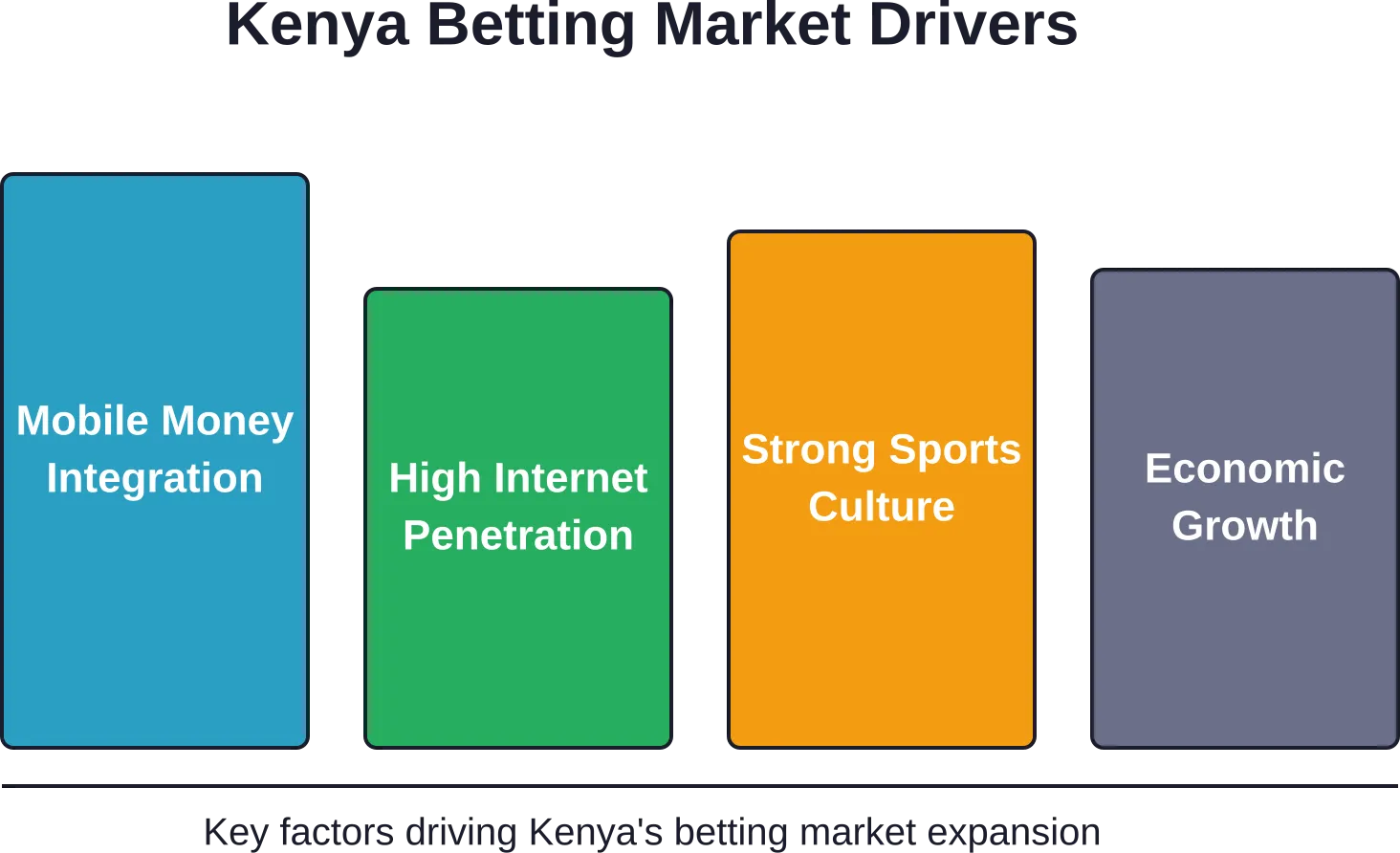
Kenya has emerged as one of Africa’s most promising markets for sports betting. With mobile money adoption near-universal and economic growth in Kenya, the conditions are ripe for new operators.
But here’s the thing: starting a betting company in Kenya isn’t just about picking software and launching a website. The regulatory framework changed fundamentally in 2025, replacing decades-old legislation with modern requirements.
This guide walks through every practical step—from understanding the new Gambling Control Act to securing capital, choosing technology partners, and maintaining compliance once operational.
Understanding Kenya's Gambling Regulatory Framework
Kenya’s betting industry operated under the Betting, Lotteries and Gaming Act (Chapter 131) from 1966 until 2025. That year marked a complete overhaul.
The Gambling Control Act, 2025 repealed the old legislation and established a modern framework. The Betting Control and Licensing Board (BCLB), which governed the industry for 60 years since its formation in 1966, was replaced by the Gambling Regulatory Authority of Kenya (GRAK).
What GRAK Does
GRAK handles all gambling oversight in Kenya. Its mandate includes developing gambling standards, licensing operators, monitoring compliance, maintaining a register of all gambling machines and devices, and establishing a central real-time monitoring system.
The authority also combats illegal cross-border gambling—a growing concern as offshore operators attempt to serve Kenyan customers without proper authorization.
Why the 2025 Act Matters for New Operators
The new law introduces several provisions that didn’t exist before. Online gambling now has explicit recognition and specific requirements. Player protection measures are codified. Capital requirements are standardized. And dispute resolution has a formal mechanism through the Gambling Appeals Tribunal.
Anyone starting a betting company now operates under this modern framework. There’s no grandfathering of old approaches.
Core Requirements for Starting a Betting Company in Kenya
The 2025 Act lays out non-negotiable requirements. Miss any of these, and the application won’t proceed.
Corporate Structure and Kenyan Ownership
Operators must be registered as corporate bodies in Kenya. A minimum of 30% of shares must be held by Kenyan citizens—this supports domestic participation and is strictly enforced.
The company must have a registered physical address in Kenya. Post office boxes don’t satisfy this requirement. GRAK needs a verifiable location where the business operates.
At least one director must be an individual (not another corporate entity), and the organization must have a local representative who can liaise with regulators.
Capital Requirements
According to Law & Trust International, the minimum capital requirement starts from 6,750,000 KES (approximately 52,000 USD). This represents the baseline—online gambling operators typically need to demonstrate access to more substantial capital given the security deposit requirements.
Proof of capital must accompany the license application. This typically means audited financial statements or bank letters confirming fund availability.
Security Deposits and Bank Guarantees
Beyond capital, operators must provide insurance security bonds or bank guarantees. The amounts vary by license category:
License Type | Security Deposit Required |
|---|---|
Online Gambling (Sports Betting) | 200 million KES |
Casinos | 20 million KES |
National Lottery | 100 million KES |
Totalisator / Prize Competitions | 5 million KES |
Non-Online Gambling | 20 million KES |
Online Gambling Shops/Premises | 500,000 KES |
Amusement with Prizes | 200,000 KES |
For most sports betting operators launching online platforms, the 200 million KES security deposit is the relevant figure. This doesn’t mean spending 200 million—a bank guarantee ties up far less capital but provides GRAK with recourse if the operator fails to meet obligations.
Banking Requirements
Operators must maintain a dedicated bank account with an authorized Kenyan financial institution. This account handles all betting transactions.
Player funds must be kept in separate accounts from operational funds. This segregation protects customers if the company faces financial difficulties.
The Licensing Process: Step-by-Step
Now, this is where it gets practical. Here’s how the actual licensing process unfolds.
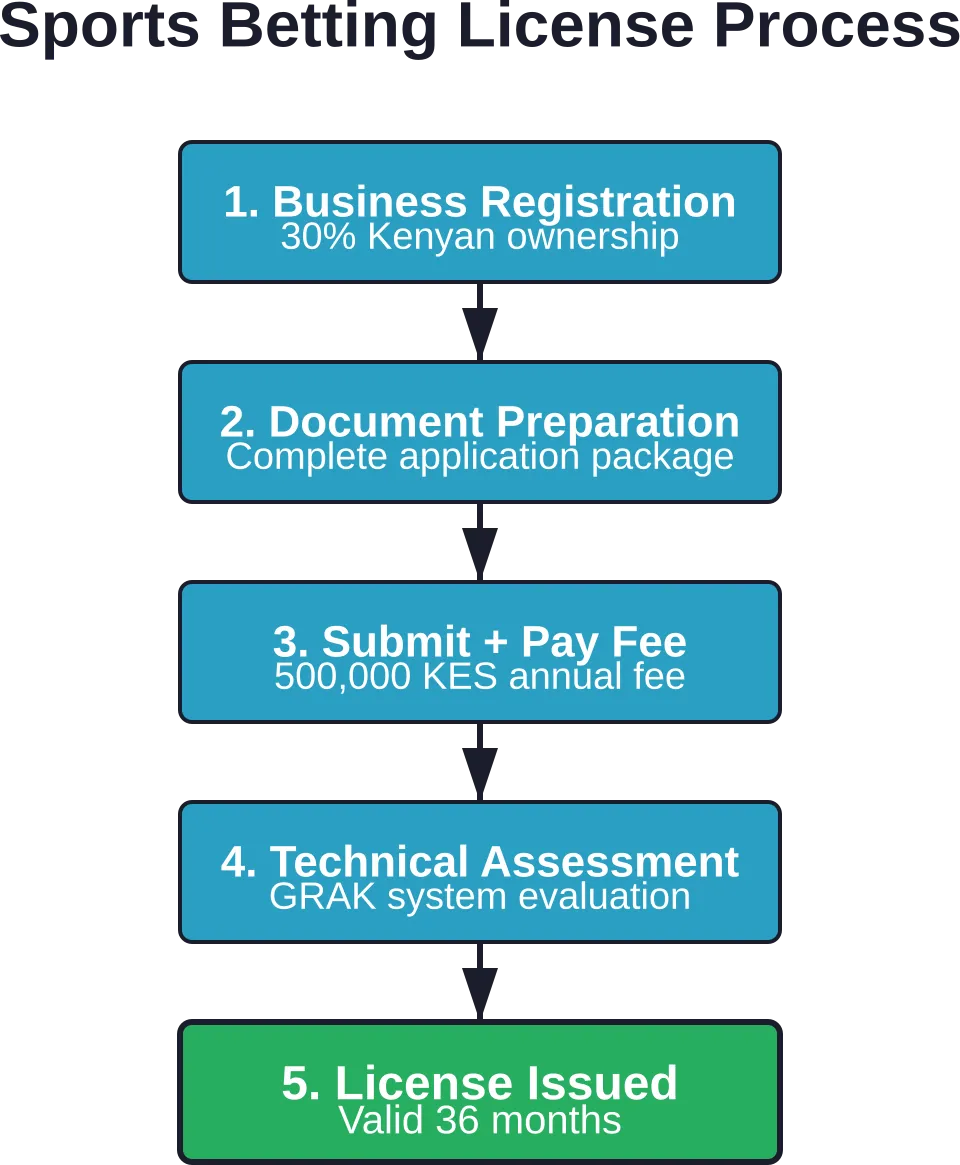
Step 1: Business Registration
Before approaching GRAK, register the company with Kenya’s Companies Registry. This establishes the legal entity that will hold the gambling license.
During incorporation, structure the shareholding to meet the 30% Kenyan citizen requirement. Document this clearly—GRAK will verify ownership.
Step 2: Document Preparation
The application requires substantial documentation:
- Certificate of incorporation and company registration documents
- Memorandum and Articles of Association
- Proof of Kenyan shareholding (share certificates, shareholder register)
- Directors’ identification and background checks
- Proof of capital (audited financials, bank statements)
- Bank guarantee or insurance bond documentation
- Details of the gambling control system (software specifications)
- Server location information
- Telecommunications license (if operating online platforms)
- Risk management and anti-money laundering policies
- Player protection measures and responsible gambling protocols
- Data protection and security documentation
Each document must be current and properly certified. Incomplete applications get rejected outright.
Step 3: Application Submission and Fees
Submit the complete application package to GRAK along with the application fee. The annual license fee is 500,000 KES (approximately 3,900 USD) according to Law & Trust International.
GRAK evaluates applications based on several criteria: solvency, governance structures, compliance history of directors and shareholders, internal controls, and technical system adequacy.
Step 4: Technical Assessment
GRAK conducts technical evaluations of gambling systems. The authority needs to verify that platforms can integrate with Kenya’s central real-time monitoring system.
Software must support:
- Real-time transaction logging
- Player registration with age verification
- Secure payment processing
- Account maintenance for all players
- Deposit and withdrawal controls
- Compliance reporting functions
Operators typically work with established gambling software providers who understand these requirements and build them into their platforms.
Step 5: Approval and License Issuance
Once GRAK completes its assessment and the operator satisfies all requirements, the license is granted. Licenses remain valid for 36 months and require renewal before expiry.
License holders must reapply using the current framework when renewal comes due—there’s no automatic extension.
Choosing the Right Technology and Software Partners
Technology decisions shape everything from user experience to regulatory compliance. Get this wrong, and even a valid license won’t save the business.
Core Platform Requirements
Sports betting platforms need several integrated components:
- Sportsbook management system (odds compilation, risk management, bet acceptance)
- Player account management and registration
- Payment processing integrated with Kenyan mobile money (M-Pesa is essential)
- Compliance and reporting tools
- Customer relationship management
- Responsible gambling tools (deposit limits, self-exclusion, reality checks)
- Mobile-responsive or native app interfaces
Turnkey vs. Custom Development
Most new operators choose turnkey solutions rather than building platforms from scratch. Turnkey providers deliver fully integrated systems that already meet regulatory requirements.
Building custom platforms offers more control but requires significantly more capital and time. Development can take 12-18 months, while turnkey solutions can launch in 8-12 weeks after licensing.
Many experts suggest turnkey makes more sense for first-time operators. Once established, companies can invest in custom features.
Sports Data and Odds Provision
Betting operators need reliable sports data feeds covering markets Kenyan bettors care about—football dominates, but basketball, tennis, and rugby matter too.
Options include purchasing data feeds from specialized providers or white-label solutions where the software partner supplies both platform and data.
Payment Integration
M-Pesa integration isn’t optional in Kenya—it’s the primary payment method for most customers. High internet penetration and widespread mobile money services make gambling accessible, and operators must support this ecosystem.
Beyond M-Pesa, integration with other mobile money services (Airtel Money) and traditional banking methods provides flexibility.
Compliance Features
GRAK requires real-time monitoring integration. Software must log every transaction and make this data accessible to regulators.
Age verification, identity confirmation, anti-money laundering checks, and fraud detection systems aren’t nice-to-haves—they’re license requirements.
Find Reliable iGaming Business Vendors With Sologe

Starting an iGaming business requires the right mix of software, payments, operations, and supplier relationships. Sologe is a B2B marketplace for iGaming companies, suppliers, and software vendors. It brings together business-side categories such as gaming software, platforms, sports betting software, payment solutions, traffic providers, analytics tools, affiliate software, licensing-related services, and operational support.
For companies researching the Kenyan market, Sologe can be useful as a place to compare vendors and understand what types of providers are available before making decisions around product setup, compliance, payments, and technical infrastructure.
Sologe can help businesses review:
- sports betting software providers
- iGaming platform vendors
- payment solution providers
- traffic and affiliate software options
- licensing-related and operational services
👉Contact Sologe to find relevant iGaming vendors, compare business-side solutions, or discuss listing your company on the marketplace.
Tax Structure and Ongoing Costs
Operating costs extend well beyond the initial license fee. Kenya’s tax structure for gambling changed significantly with recent Finance Acts.
Gross Gaming Revenue Tax
The standard tax on Gross Gaming Revenue (GGR) is 15% according to multiple authoritative sources. GGR represents total wagers minus winnings paid to players.
This tax applies to licensed operators and is calculated on actual gaming profits, not total handle (the total amount wagered).
Excise Duty on Deposits
A 5% excise duty applies to betting stakes, specifically to customer betting wallet deposits according to Gofaizen & Sherle. This tax shifted from stakes to deposits through the Finance Act 2025, changing how operators account for taxation.
The deposit-based approach means taxation occurs when customers fund accounts rather than when they place individual bets.
Value Added Tax
VAT may apply to certain services depending on how they’re structured. Professional advice on VAT treatment prevents costly mistakes.
Annual Operating Costs
Beyond taxes, operators face ongoing expenses:
- Annual license renewal: 500,000 KES
- Software licensing and platform maintenance
- Sports data feeds
- Payment processing fees (M-Pesa and other channels charge transaction fees)
- Marketing and customer acquisition
- Staff salaries (customer service, compliance officers, marketing team)
- Office premises
- Professional services (legal, accounting, compliance consultants)
Cost Category | Frequency | Approximate Amount |
|---|---|---|
License Fee | Annual | 500,000 KES |
GGR Tax | Monthly | 15% of GGR |
Excise Duty | Per Deposit | 5% of deposits |
Platform Software | Monthly | Varies by provider |
Sports Data Feeds | Monthly | Varies by coverage |
Payment Processing | Per Transaction | 1-3% typical |
Security Deposit | One-time (tied up) | 200 million KES guarantee |
Compliance and Ongoing Obligations
Getting licensed is one milestone. Staying licensed requires continuous compliance.
Player Protection Requirements
Operators must verify player age and identity before allowing account registration. Accounts must be maintained for all players with detailed records of transactions.
Responsible gambling tools are mandatory:
- Deposit limits (daily, weekly, monthly)
- Self-exclusion mechanisms
- Reality checks and session time limits
- Access to problem gambling resources
Transaction Rules
The 2025 Act specifies transaction requirements. Minimum bets must be at least 20 KES. Winnings must be paid within 2 days for monetary prizes or 7 days for non-monetary prizes.
Player funds in segregated accounts can’t be used for operational expenses—this segregation protects customers if the company faces insolvency.
Reporting and Monitoring
GRAK requires regular reporting on operations, financial performance, and compliance metrics. The central real-time monitoring system provides regulators with continuous visibility into betting activity.
Operators must maintain detailed records for audit purposes. Record retention requirements typically span several years.
Anti-Money Laundering Obligations
Betting operators fall under anti-money laundering regulations. Know-your-customer procedures, transaction monitoring, and suspicious activity reporting are mandatory.
Compliance officers should receive training on AML requirements specific to gambling operations.
Advertising and Marketing Restrictions
Marketing must adhere to responsible gambling principles. Advertising can’t target minors, make misleading claims about winning odds, or promote gambling as a solution to financial problems.
Social responsibility messaging should appear in marketing materials.
Market Opportunity and Competitive Landscape
Understanding the market helps shape business strategy and investment decisions.
Market Size and Growth
In 2025, the market was valued at approximately 100 million USD with projections showing continued growth according to Altenar’s market analysis. The combination of mobile money penetration, young demographics, and sports enthusiasm drives expansion.
Kenya’s economic growth in Kenya provides a stable macroeconomic environment for betting operations.
Customer Preferences
Mobile-first design is non-negotiable. Most Kenyan bettors access platforms through smartphones rather than desktop computers.
Football betting dominates, particularly the English Premier League, Spanish La Liga, and local Kenyan leagues. Basketball, tennis, and rugby have dedicated followings.
Live betting (in-play wagering) has grown significantly. Customers want to bet on matches as they unfold, requiring platforms that handle real-time odds updates and rapid bet acceptance.
Competitive Dynamics
Several established operators dominate market share. New entrants face challenges acquiring customers in a crowded market.
Differentiation strategies might include:
- Better odds on popular markets
- Superior mobile user experience
- Faster payment processing
- Innovative betting products (jackpots, accumulator bonuses)
- Strong customer service
- Community engagement and sponsorships
Customer Acquisition Costs
Marketing spend determines visibility. Digital channels (social media, search engines, affiliate partnerships) and traditional media (radio, TV, outdoor) all play roles.
Customer acquisition costs in Kenya’s competitive market can be substantial. Budget accordingly—many operators find that marketing consumes 30-50% of early-stage expenses.
Risk Management and Business Considerations
Every betting operation carries risks. Understanding and mitigating them protects the investment.
Regulatory Risk
Regulatory frameworks evolve. Tax rates change, compliance requirements expand, and enforcement priorities shift.
Staying informed about regulatory developments and maintaining strong relationships with legal advisors helps navigate changes proactively rather than reactively.
Financial Risk
Betting operators face unusual financial dynamics. Customer wins represent liabilities that must be paid quickly—within 2 days for most winnings.
Poor risk management (accepting bets with inadequate hedging or risk controls) can lead to catastrophic losses during unexpected outcomes.
Maintaining adequate liquidity ensures the business can pay winners even during losing weeks.
Technology Risk
Platform downtime during major sporting events costs revenue and damages reputation. Redundancy, reliable hosting, and proven software partners mitigate this risk.
Cybersecurity threats target betting operators because they handle financial transactions and customer data. Robust security measures aren’t optional.
Reputational Risk
Betting companies operate in a sensitive industry. Payment delays, customer service failures, or compliance breaches generate negative publicity quickly in Kenya’s connected social media environment.
Building trust through transparency, fair treatment of customers, and prompt issue resolution protects reputation.
Competition Risk
Established operators have brand recognition, large marketing budgets, and economies of scale. New entrants must find differentiation rather than competing directly on the same terms.
Niche strategies—focusing on specific sports, regions, or customer segments—can work better than broad approaches.
Timeframes and Capital Planning
Realistic planning prevents running out of capital mid-launch.
Timeline from Start to Launch
The complete process typically takes 4-8 months:
- Business registration: 2-4 weeks
- Document preparation: 4-6 weeks
- License application processing: 2-4 months
- Platform setup (turnkey): 6-10 weeks
- Testing and compliance verification: 2-4 weeks
- Marketing preparation: ongoing during other phases
These phases overlap. Platform selection and setup can proceed while waiting for license approval, though operators shouldn’t commit to expensive contracts until confident of licensing success.
Capital Requirements Summary
Based on available data, starting a sports betting company in Kenya requires capital allocation across several categories:
Capital Need | Amount (KES) | Notes |
|---|---|---|
Minimum Capital | 6,750,000 | Regulatory minimum |
Security Deposit | 200,000,000 | Bank guarantee for online betting |
License Fee | 500,000 | Annual payment |
Platform Setup | Variable | Depends on provider, turnkey vs. custom |
Marketing Launch | Variable | Customer acquisition budget |
Operating Reserve | Variable | 6-12 months expenses recommended |
The security deposit is typically a bank guarantee rather than cash outlay, but arranging it requires demonstrating financial strength to the issuing bank.
Analysis suggests operators need between 500,000 to 2 million USD equivalent to compete effectively in established markets when accounting for all costs.
Revenue Considerations
Sports betting businesses typically measure performance using several metrics:
- Handle: Total amount wagered by players
- GGR (Gross Gaming Revenue): Wagers minus winnings paid
- NGR (Net Gaming Revenue): GGR minus taxes, bonuses, and direct costs
Typical sports betting GGR margins run 6-10% of handle. So if customers wager 100 million KES, the operator retains roughly 6-10 million KES as GGR before taxes and expenses.
After the 15% GGR tax and other costs, net profitability requires substantial scale.
Working with Professional Advisors
The complexity of licensing and compliance makes professional support valuable.
Legal Services
Lawyers specializing in gambling regulation help navigate the Gambling Control Act, prepare applications, ensure corporate structures meet requirements, and advise on ongoing compliance.
Firms like Gofaizen & Sherle and Law & Trust International offer comprehensive licensing support specifically for Kenya’s gambling market.
Compliance Consultants
Compliance isn’t a one-time checkbox—it’s an ongoing operational requirement. Consultants help establish systems, train staff, conduct audits, and liaise with GRAK.
Technology Consultants
Selecting the right platform provider is critical. Technology consultants evaluate providers, negotiate contracts, and oversee implementation.
For operators without deep technical expertise, this guidance prevents costly mistakes.
Accounting and Tax Advisors
Kenya’s tax structure for gambling has specific nuances. Accountants familiar with the industry ensure correct tax treatment, timely filings, and optimization of tax positions within legal boundaries.
Alternative Approaches: Betting Shops and Hybrid Models
Not every operator needs to launch a purely online platform immediately.
Physical Betting Shops
Betting shops remain popular in Kenya despite mobile growth. Some customers prefer in-person experiences, and shops serve areas with lower smartphone penetration.
The security deposit for online gambling shops/premises is 500,000 KES—significantly less than the 200 million KES for pure online operators.
Shop operators still need licenses and must comply with the 2025 Act, but capital requirements are more accessible.
Hybrid Models
Many successful operators combine physical presence with online platforms. Shops build brand awareness and trust while the online platform provides scale and convenience.
This approach requires both license types but can leverage strengths of each channel.
Common Mistakes to Avoid
Learning from others’ errors saves time and money.
Underestimating Capital Requirements
Many entrepreneurs focus on the license fee and minimum capital but overlook the security deposit, marketing costs, and operating reserves needed to reach profitability.
Running out of capital six months into operations is a common failure mode.
Choosing Inadequate Technology
Cheap software that can’t integrate with GRAK’s monitoring systems, crashes during high traffic, or lacks mobile money integration creates operational nightmares.
Technology is core infrastructure—invest appropriately.
Ignoring Compliance
Treating compliance as a formality rather than an ongoing operational priority invites regulatory action. License suspension or revocation ends the business.
Poor Customer Service
Betting customers are vocal when problems arise. Slow payment processing, unresponsive support, or unfair treatment generates bad reviews that spread quickly.
Customer retention is cheaper than acquisition—treat players well.
Inadequate Marketing Budget
Launching with a great platform but minimal marketing leaves operators invisible in a competitive market. Budget for sustained customer acquisition campaigns.
Future Outlook and Strategic Positioning
Kenya’s gambling market continues evolving. Positioning for future developments matters.
Regulatory Trends
The 2025 Act represents modernization, but regulation will continue adapting. Player protection emphasis is increasing globally, and Kenya will likely follow international best practices.
Operators who build strong compliance cultures now position themselves well for future requirements.
Technology Evolution
Mobile capabilities will deepen. Features like biometric login, AI-powered personalization, and enhanced live betting experiences will differentiate platforms.
Cash-out options (settling bets before events conclude) and bet builders (custom combinations) have proven popular elsewhere and are growing in Kenya.
Market Consolidation
Smaller operators may struggle against well-capitalized competitors. Partnership opportunities, white-label arrangements, or focusing on specific niches offer survival strategies.
Regional Expansion
Kenya-licensed operators sometimes expand to other East African markets. Tanzania, Uganda, and Rwanda have their own regulatory frameworks, but operational experience in Kenya provides advantages.
Frequently Asked Questions
How much does it cost to start a sports betting company in Kenya?
Starting a sports betting company in Kenya requires approximately 6.75 million KES in minimum capital, a 200 million KES security deposit, usually a bank guarantee, a 500,000 KES annual license fee, plus platform costs, marketing budget, and operational reserves. Total capital requirements typically range from the equivalent of 500,000 to 2 million USD depending on scale and ambition.
How long does it take to get a gambling license in Kenya?
The licensing process typically takes 2-4 months from application submission to approval, assuming complete documentation. The entire process from business registration through launch usually spans 4-8 months, including platform setup and compliance verification.
What is the minimum Kenyan ownership requirement for betting companies?
The Gambling Control Act, 2025 requires that at least 30% of shares in any gambling operator must be held by Kenyan citizens. This requirement supports domestic participation in the regulated market and is strictly enforced by GRAK.
What taxes do sports betting companies pay in Kenya?
Sports betting operators pay a 15% tax on Gross Gaming Revenue and a 5% excise duty on customer betting wallet deposits. Additional taxes may include corporate income tax and VAT on certain services. The tax structure changed with the Finance Act 2025, shifting excise duty from individual stakes to deposits.
Can foreign companies operate sports betting businesses in Kenya?
Foreign companies can participate but must register a corporate entity in Kenya with at least 30% Kenyan shareholding. The company must maintain a registered physical address in Kenya and have local directors and representatives. Foreign operators without Kenyan registration cannot legally serve Kenyan customers.
What happens if a betting license expires in Kenya?
Licenses issued under the Gambling Control Act, 2025 are valid for 36 months. When a license expires, the holder must reapply under current regulations, as there is no automatic renewal. Operating without a valid license is illegal and subject to penalties. Licenses issued under the old Act remained valid until expiry, after which holders had to reapply under the 2025 framework.
Is M-Pesa integration required for sports betting platforms in Kenya?
While not explicitly mandated by regulation, M-Pesa integration is practically essential. The vast majority of Kenyan bettors use mobile money for deposits and withdrawals. Platforms without M-Pesa integration face severe competitive disadvantages and dramatically reduced market access.
Conclusion: Is Starting a Sports Betting Company in Kenya Worth It?
Kenya offers genuine opportunities for sports betting operators. The regulatory framework is modernizing, the market is growing, mobile money infrastructure is excellent, and sports enthusiasm runs deep.
But the barriers to entry are real. Capital requirements are substantial, competition is fierce, and compliance demands ongoing attention.
Success requires adequate capitalization, strong technology partners, disciplined compliance practices, differentiated market positioning, and sustained marketing investment.
For entrepreneurs with industry knowledge, sufficient capital, and commitment to building compliant operations, Kenya’s betting market presents viable opportunities. The key is approaching it with realistic expectations and thorough preparation.
Start by consulting with legal specialists who understand Kenya’s Gambling Control Act, 2025. Engage technology providers early to understand platform options and costs. Develop detailed financial projections that account for all licensing, security, operational, and marketing expenses.
Most importantly, recognize that obtaining the license is just the beginning. Building a sustainable, profitable betting business requires excellent execution across technology, customer experience, marketing, and compliance—every single day.
The Kenyan sports betting market rewards operators who combine regulatory compliance, customer focus, and business discipline. For those willing to meet these standards, the opportunity is real.
Related Articles

February 18, 2026Digital Marketing Services Companies for...

January 26, 2026Exploring Best Gambling Affiliate Software in 2026