 Nothing found for the request

Live Casino for European Market: 2026 Licensing Guide
Sologe March 30, 2026
Share:


Understanding the European Live Casino Landscape in 2026
Live casino gaming—where real dealers operate physical tables streamed in real-time to players’ devices—has become the fastest-growing segment of European online gambling. The appeal is straightforward: authentic casino atmosphere without leaving home.
Market data shows that while slots still dominate, with 61.55% revenue share in 2025, live dealer games are capturing an increasingly large portion of player attention and spending.
What makes Europe particularly attractive? Several factors converge.
First, high internet penetration and mobile adoption rates create ideal conditions for live streaming casino content. Second, established gambling culture across many European nations means lower customer acquisition costs. Third, despite regulatory complexity, the legal framework provides clarity—operators know what’s required for compliance.
The market isn’t homogeneous, though. Northern European markets trend toward regulated monopolies or highly restrictive licensing. Southern European countries show more diverse approaches. Eastern European markets remain in various stages of regulatory development.
Key Market Drivers Shaping Live Casino Growth
Technology improvements have made live dealer experiences remarkably smooth. Latency issues that plagued early implementations have largely disappeared. Multi-camera angles, interactive features, and mobile optimization now come standard.
Consolidation is reshaping the competitive field as national champions pursue cross-border acquisitions to gain scale and compliance expertise in a region that remains legally fragmented.
Player expectations have evolved too. The same users who demand Netflix-quality streaming and instant payment processing from other digital services expect nothing less from live casino platforms.
The Regulatory Framework: Navigating 21 Licensing Jurisdictions
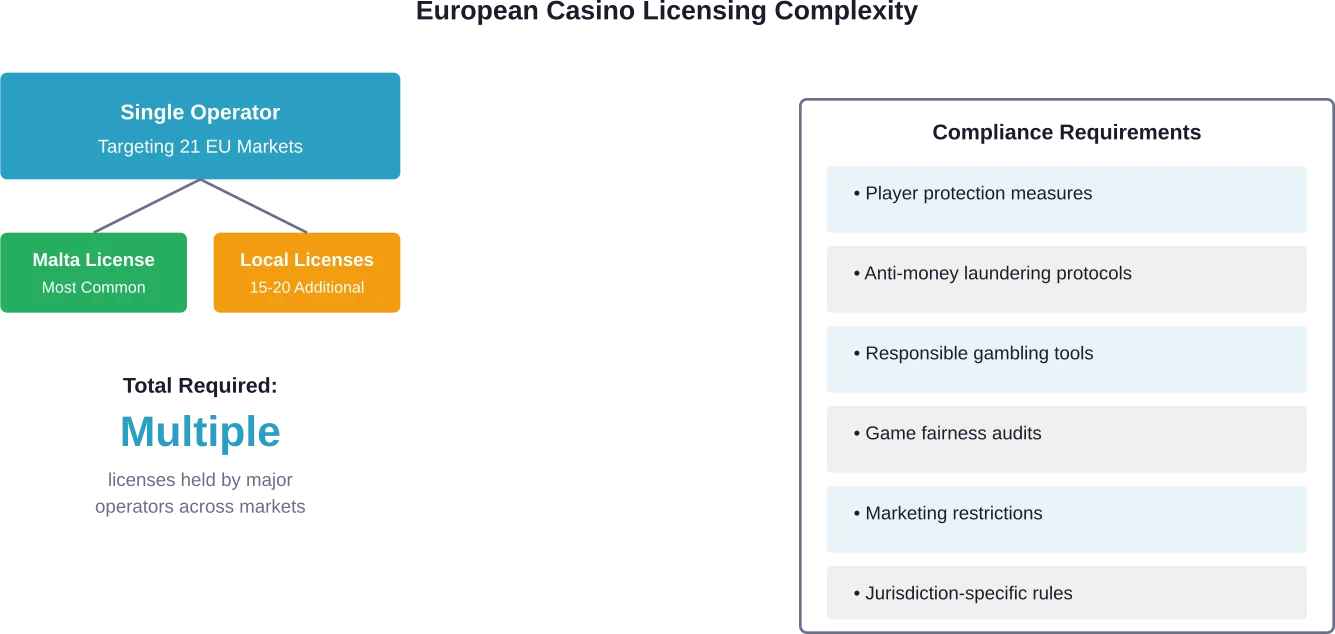
Here’s where things get complicated. There’s no such thing as a pan-European casino license. The European Union hasn’t harmonized gambling regulations across member states.
Each country maintains sovereign control over gambling legislation within its borders. Some have opened their markets to competition. Others maintain state monopolies. Many sit somewhere in between.
For live casino operators, this creates a strategic puzzle: Which markets justify the investment in obtaining separate licenses? Where can you operate under existing credentials? What’s the compliance burden versus revenue opportunity?
Malta Gaming Authority: The European Standard
The Malta Gaming Authority has become the most common regulator among European casino operators. There’s a good reason for that dominance.
Malta established comprehensive online gambling regulations early, creating a well-understood legal framework. The MGA’s licensing process is rigorous but transparent. Operators know what’s expected.
More importantly, MGA licenses are recognized and respected across European markets. While an MGA license alone doesn’t grant legal access to every European country, it provides credibility and demonstrates commitment to regulatory compliance.
The Malta Gaming Authority’s player protection requirements set industry standards. Licensed operators must implement effective self-exclusion mechanisms allowing players to exclude themselves for definite or indefinite timeframes. Recommended definite self-exclusion periods include 24 hours, 48 hours, and 7 days.
Beyond Malta, operators serious about European market penetration typically pursue licenses in their primary target markets. Germany, Sweden, the Netherlands, Spain, and Denmark each represent significant revenue opportunities—but each demands separate licensing.
Player Protection Standards: Non-Negotiable Requirements
Player protection isn’t optional in European markets. It’s baked into every serious regulatory framework.
The Malta Gaming Authority emphasizes that gambling is a form of entertainment and should never be perceived as a means of generating income. While most individuals treat gambling as a recreational activity and spend only what they can afford to lose, others struggle with control.
That’s why responsible gaming and player protection rank high on the agenda for licensed gaming operators. The Authority’s overriding objectives are to promote responsible gaming and safeguard players.
What does this mean in practice for live casino operators?
Mandatory Responsible Gambling Tools
Every licensed platform must offer comprehensive tools allowing players to manage their gambling behavior. These aren’t suggestions—they’re requirements.
Deposit limits let players set daily, weekly, or monthly maximums. Loss limits work similarly. Time limits help players control session duration. Reality checks interrupt play at regular intervals to remind players how long they’ve been active.
Self-exclusion represents the most serious intervention. Players must be able to exclude themselves immediately and effectively. The exclusion must apply across all games and platforms operated by the licensee.
Live casino operators face additional considerations. The real-time nature of live dealer games creates different risk profiles than automated slots. Dealers receive training to identify potentially problematic behavior patterns.
European Safer Gambling Week and Industry Initiatives
The European Gaming and Betting Association organizes annual European Safer Gambling Week, bringing together industry stakeholders to promote safe and sustainable play. The fifth annual event, held November 17-23, 2025, achieved record participation and impact.
Beyond regulatory minimums, leading operators implement additional safeguards. EGBA members maintain pledges and standards on responsible practices including influencer marketing transparency and player protection.
An overwhelming majority of national standardization bodies voted in favor of player protection standards, representing a significant milestone for player protection in Europe.
EGBA has also launched a pledge on responsible influencer marketing, recognizing that marketing practices directly impact player behavior and expectations.
Market Size and Growth Projections: The Numbers Behind the Opportunity
Let’s talk specifics. The Europe casino gambling market was worth USD 80.13 billion in 2025. By 2026, that figure will reach USD 91.31 billion. By 2031, projections show the market hitting USD 175.42 billion.
That’s a compound annual growth rate of 13.95% from 2026 through 2031—significantly higher than most traditional entertainment sectors.
Year | Market Size (USD) | Year-over-Year Growth |
|---|---|---|
2025 | $80.13 Billion | — |
2026 | $91.31 Billion | 13.95% |
2031 (Projected) | $175.42 Billion | 13.95% CAGR |
These aren’t speculative figures. They reflect concrete trends: increasing digital adoption, mobile penetration, improved payment infrastructure, and regulatory maturation.
Market concentration remains low, meaning opportunity exists for well-positioned operators. No single company dominates across all European markets. Regional champions hold strong positions in their home territories, while international operators compete for cross-border players.
Game Type Distribution and Player Preferences
Slots led with 61.55% revenue share in 2025. But that statistic masks important nuances.
Live dealer games generate higher player lifetime value despite representing a smaller share of total gaming revenue. Players who engage with live casino offerings tend to be more loyal, deposit more frequently, and maintain longer-term relationships with platforms.
Popular live casino games in European markets include live blackjack, live roulette (particularly European roulette variants), live baccarat, and live poker variants. Game shows and unique live dealer experiences have also gained traction.
Real talk: live casino isn’t for every operator. It requires significant infrastructure investment, dealer recruitment and training, studio facilities, and streaming technology. But for operators capable of executing well, it represents a high-value market segment.
Licensing Requirements by Major European Markets
Each European market presents unique licensing challenges and opportunities. Understanding these differences is critical for strategic market entry planning.
Country | Legal Status | Primary Regulator | Key Considerations |
|---|---|---|---|
Malta | Legal & Regulated | Malta Gaming Authority | Most common EU license; recognized across Europe |
Germany | Legal & Regulated | State authorities | Complex federal structure; recent regulatory changes |
United Kingdom | Legal & Regulated | UK Gambling Commission | Strict advertising rules; high compliance costs |
Sweden | Legal & Regulated | Spelinspektionen | Bonus restrictions; mandatory limits |
Netherlands | Legal & Regulated | Kansspelautoriteit | Recently opened market; strict entry requirements |
Spain | Legal & Regulated | DGOJ | Ring-fenced liquidity; local licensing required |
This table represents just a snapshot. Each of the 21 European countries where major operators exist has distinct requirements, fee structures, and ongoing compliance obligations.
Application Fees and Ongoing Costs
Licensing isn’t cheap. Malta’s application processes include various fee structures depending on license type and scope. Commercial communication game permits, for example, require an application fee of €25 or 0.5% of the total monetary or retail value of the prize, whichever is higher.
But application fees represent just the beginning. Ongoing compliance costs include regular audits, technical testing, staff training, reporting obligations, and potential compliance consultants.
Operators must factor these costs into market entry calculations. A small market with high licensing and compliance costs might not justify investment, while larger markets with similar costs become attractive despite the burden.
Technical Requirements for Live Casino Operations
Operating live dealer casinos demands robust technical infrastructure that meets regulatory standards while delivering excellent player experiences.
Stream quality must be consistently high. Latency needs to stay minimal—players won’t tolerate delays between dealer actions and screen updates. Mobile optimization is mandatory, as significant portions of European players access live casino games via smartphones.
Game Fairness and Random Number Generation
While live dealer games use physical cards, dice, or roulette wheels, many incorporate digital elements requiring random number generation. These systems must meet strict fairness standards and undergo regular independent testing.
Regulators typically mandate that RNG systems be certified by approved testing laboratories. Results must be truly random and unpredictable. Operators must maintain detailed logs for audit purposes.
For pure live dealer games without digital RNG components, other fairness measures apply. Card shuffling procedures must prevent pattern prediction. Dealers follow strict protocols. Multiple cameras capture all game action to prevent disputes.
Data Protection and Privacy Compliance
European markets fall under GDPR—the General Data Protection Regulation. This creates extensive obligations around how operators collect, store, process, and protect player data.
Live casino operations collect particularly sensitive information. Streaming video captures player interactions. Payment processing requires financial data. Identity verification demands personal documents.
Operators must implement appropriate technical and organizational measures to ensure data security. This includes encryption, access controls, regular security audits, and incident response procedures.
Data breaches can be catastrophic. Beyond regulatory penalties, they destroy player trust and damage brand reputation. The Malta Gaming Authority has identified breaches within its systems and activated incident response protocols—demonstrating how seriously regulators take these issues.
Payment Methods and Financial Infrastructure
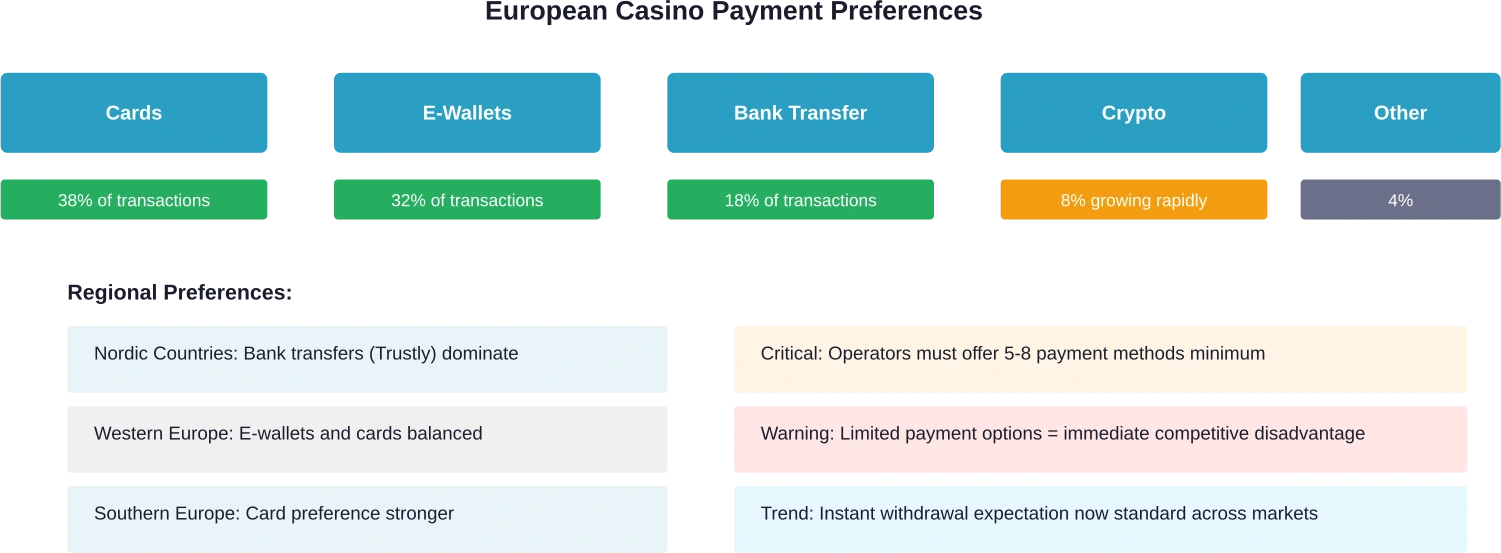
European players expect diverse payment options. What’s popular in Sweden differs from preferences in Spain or Poland.
Credit and debit cards remain widely used, but digital wallets have gained substantial market share. E-wallets like Skrill, Neteller, and PayPal serve large European player bases. Regional payment methods matter too—iDEAL in the Netherlands, Trustly in Nordic countries, Sofort in Germany.
Cryptocurrency Adoption in European Markets
Cryptocurrency payments are gaining traction, though regulatory treatment varies dramatically across jurisdictions.
Some European markets have embraced crypto, allowing operators to accept Bitcoin, Ethereum, and other digital currencies. Others remain skeptical or explicitly prohibit cryptocurrency gambling transactions.
For operators, crypto offers advantages: faster settlements, lower transaction fees, pseudonymity for privacy-conscious players. But it also brings challenges: price volatility, regulatory uncertainty, and anti-money laundering complexities.
The rise of crypto payments in European casinos reflects broader trends toward digital finance. Operators who navigate the regulatory complexity successfully can access a growing player segment that prefers cryptocurrency transactions.
Marketing and Player Acquisition Challenges
Acquiring players in European markets has become increasingly complex and expensive. Gone are the days of unrestricted gambling advertising.
Most European jurisdictions now impose strict limits on casino marketing. Time-of-day restrictions prevent advertising during hours when children might be watching. Content requirements mandate responsible gambling messages. Celebrity and sports sponsorships face scrutiny or outright bans.
The European Gaming and Betting Association’s pledge on responsible influencer marketing addresses growing concerns about social media promotion. Operators must ensure that influencer partnerships don’t target underage audiences or promote irresponsible gambling behavior.
Bonus Restrictions and Promotional Limitations
Welcome bonuses and promotional offers drive player acquisition—but European regulators have taken notice.
Sweden, for instance, has implemented significant bonus restrictions. Germany’s new regulatory framework similarly limits promotional activities. These restrictions aim to prevent operators from encouraging excessive gambling through generous offers.
For live casino operators specifically, bonus structures need careful design. Live dealer games often contribute less toward wagering requirements than slots due to lower house edges. This creates complexity in bonus terms that must be clearly communicated to avoid regulatory issues.
Customer Acquisition Costs and Lifetime Value
The combination of marketing restrictions and intense competition has driven up customer acquisition costs across European markets. Operators must think carefully about unit economics.
Live casino players tend to have higher lifetime values than slot-only players, justifying higher acquisition costs. But the math must work. Operators need robust analytics to track player behavior, optimize marketing spend, and identify valuable player segments.
Competitive Landscape: Who's Operating in European Markets
The European casino market features a mix of operators: pan-European companies, regional champions, and market-specific players.
The European Gaming and Betting Association represents major operators across European markets.
Tipico, Germany’s leading sports betting and online gambling operator, joined the European Gaming and Betting Association. This signals the growing importance of industry collaboration on regulatory matters.
Technology Providers Powering Live Casino Experiences
Behind successful live casino operations stand specialized technology providers supplying streaming platforms, studio equipment, game variants, and dealer training.
Leading providers have invested heavily in European-focused content. This includes native-language dealers, game variants popular in specific markets, and localized user interfaces.
The quality gap between top-tier and second-tier providers has narrowed, but differences remain. Streaming stability, mobile performance, and feature richness still vary. Operators must carefully evaluate provider partnerships—these relationships fundamentally shape the player experience.
Mobile Optimization and User Experience Requirements
Mobile has moved from nice-to-have to mandatory. European players increasingly access live casino games via smartphones and tablets.
This creates technical challenges. Live video streaming consumes significant bandwidth. Screen real estate on mobile devices is limited. Touch interfaces require different design approaches than desktop point-and-click.
Successful mobile live casino implementations prioritize several elements: adaptive bitrate streaming that adjusts to connection quality, simplified user interfaces that don’t overwhelm small screens, and responsive design that works across device sizes.
App vs. Mobile Web: Strategic Considerations
Should operators build native apps or rely on mobile-optimized websites? The answer varies by market and target audience.
Native apps offer performance advantages and can provide superior user experiences. But they require significant development resources and ongoing maintenance. App store approval processes add complexity, particularly for gambling applications.
Mobile web implementations reach broader audiences without download friction. Modern web technologies enable app-like experiences through progressive web apps. For markets with high player acquisition costs, reducing barriers to first-time engagement makes strategic sense.
Anti-Money Laundering and KYC Requirements
Anti-money laundering compliance is non-negotiable in European markets. Operators must implement robust systems to detect and prevent financial crime.
Know Your Customer procedures require operators to verify player identities before allowing withdrawals. This typically involves document submission—government-issued ID, proof of address, and sometimes payment method verification.
The European Gaming and Betting Association’s industry standards include specific codes on anti-money laundering that go beyond regulatory minimums. Leading operators treat AML compliance as competitive advantage, not merely a regulatory burden.
Transaction Monitoring and Suspicious Activity Reporting
Operators must monitor player transactions for patterns suggesting money laundering. Unusually large deposits, minimal game play followed by withdrawal requests, or structured transactions designed to avoid reporting thresholds all raise red flags.
When suspicious activity is detected, operators have legal obligations to report to appropriate authorities. This requires clear internal procedures, trained compliance staff, and documented decision-making processes.
For live casinos specifically, certain behaviors warrant extra scrutiny. Players who bet heavily on both sides of games with low house edges might be using the platform to clean funds rather than genuinely gambling.
Emerging Trends Shaping European Live Casino Markets
Several trends are reshaping the European live casino landscape heading into the latter half of this decade.
First, game show-style live dealer games have exploded in popularity. These combine gambling with entertainment elements, creating experiences that appeal to younger demographics and casual players.
Second, virtual reality and augmented reality experiments are beginning to reach the market. While still niche, these technologies could fundamentally change how players experience live dealer games within the next few years.
Third, regulatory harmonization efforts continue, albeit slowly. Industry groups like EGBA push for more consistent standards across European markets. Complete harmonization remains unlikely, but incremental progress could reduce compliance complexity.
Sustainability and ESG Considerations
Environmental, social, and governance factors are gaining attention in European gambling regulation. Malta’s ESG Code of Good Practice reflects growing emphasis on corporate responsibility beyond immediate gambling-related concerns.
For live casino operators, this touches multiple operational areas: energy consumption of streaming infrastructure, labor practices for dealer employment, responsible supply chain management, and transparent corporate governance.
Players and regulators increasingly expect operators to demonstrate genuine commitment to social responsibility. Checkbox compliance won’t suffice—operators must embed responsible practices throughout their organizations.
Practical Steps for Entering European Live Casino Markets
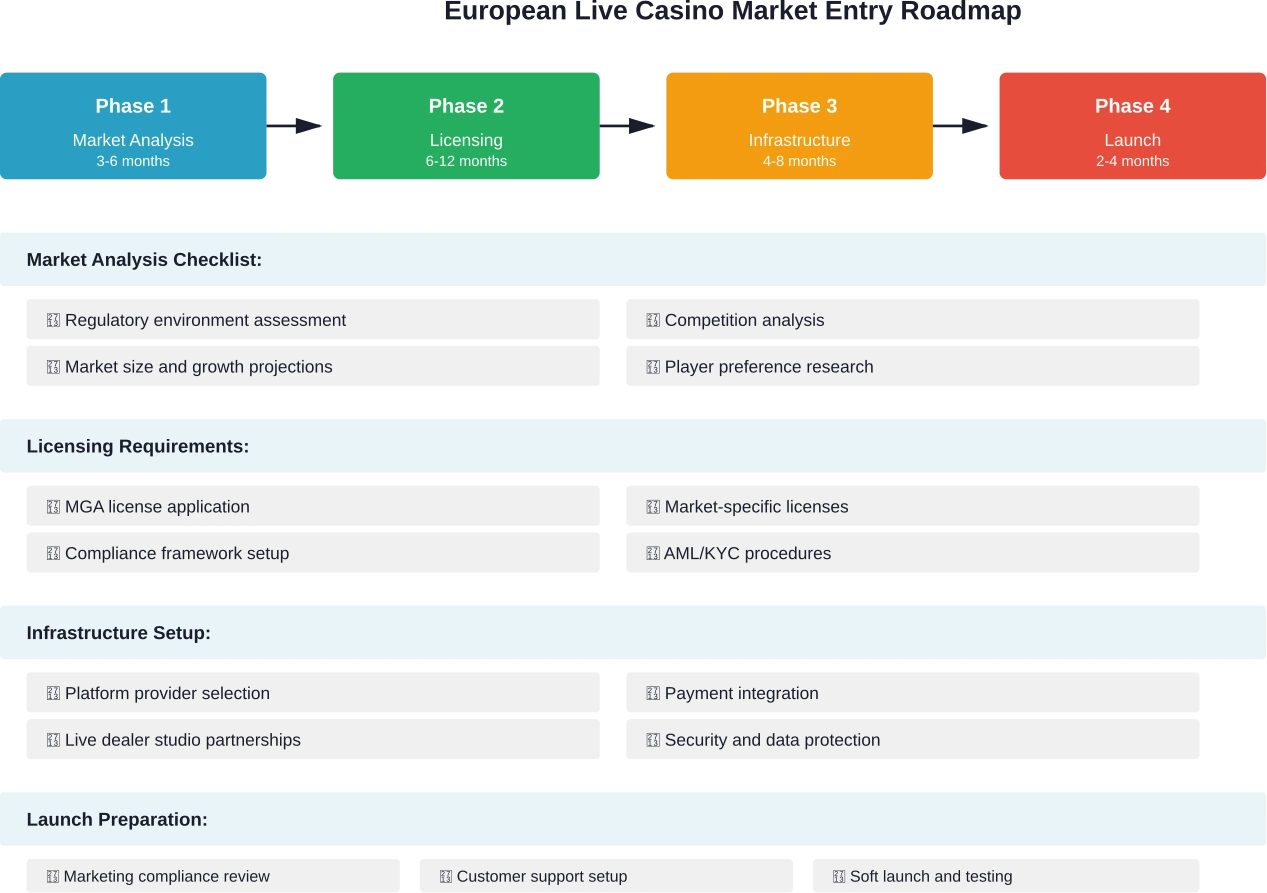
So what’s the practical pathway for operators looking to enter or expand in European live casino markets?
Start with market prioritization. Not every European market makes sense for every operator. Analyze market size, regulatory complexity, competition intensity, and your company’s capabilities.
Secure appropriate licensing. For most operators, an MGA license provides the foundation. Layer on market-specific licenses based on your priority markets. Budget generously—licensing is expensive and time-consuming.
Build or partner for technical infrastructure. Most operators partner with established platform providers rather than building from scratch. Evaluate providers based on European market experience, mobile performance, and compliance capabilities.
Compliance Team and Ongoing Operations
Compliance isn’t a one-time checkbox. It’s an ongoing operational requirement demanding dedicated resources.
Operators need compliance professionals who understand European gambling regulations and can navigate the complexity of multi-jurisdictional operations. These staff monitor regulatory developments, ensure ongoing adherence to license conditions, and manage relationships with regulators.
Regular audits are mandatory in most jurisdictions. Operators must maintain detailed records, produce reports for regulators, and demonstrate continuous compliance with all applicable requirements.
Common Pitfalls and How to Avoid Them
European market entry is littered with cautionary tales. Understanding common mistakes helps operators avoid expensive errors.
Underestimating regulatory complexity ranks as the most common mistake. Operators familiar with less-regulated markets sometimes assume European compliance is straightforward. It’s not. Budget more time and resources than initial estimates suggest.
Treating Europe as a single market represents another frequent error. Each country has distinct characteristics, player preferences, and regulatory requirements. Cookie-cutter approaches fail.
Neglecting responsible gambling tools until regulators demand them creates problems. Build player protection into operations from day one—it’s easier than retrofitting compliance onto existing systems.
Insufficient payment method diversity drives players to competitors. European players expect options. Offer comprehensive payment choices or lose market share.
Set Up the Right Partners for Live Casino Launch

Launching a live casino in Europe usually means dealing with multiple layers at once – licensing, platform providers, game studios, payments, and compliance. The process gets fragmented quickly when each part is sourced separately. Sologe helps structure that process by acting as a B2B marketplace where operators and developers can find, compare, and connect with licensing providers and other key partners in one place.
If you’re already mapping out your launch or reviewing how everything fits together, this is the stage where coordination either works or starts slowing things down. Instead of piecing it together step by step, you can approach it with a clearer structure from the start. Reach out to the Sologe team, review your options, and line up the partners you actually need for your setup.
Future Outlook: Where European Live Casino Markets Are Heading
Looking ahead to the remainder of this decade, several developments seem likely to shape European live casino markets.
Regulatory frameworks will continue evolving toward stricter player protection. Expect more markets to implement deposit limits, mandatory reality checks, and enhanced self-exclusion systems. Operators who view these as opportunities rather than burdens will gain competitive advantage.
Technology will keep advancing. Streaming quality will improve. Mobile experiences will become even more seamless. Emerging technologies like VR might finally find mainstream adoption in gambling contexts.
Market consolidation appears inevitable. The regulatory burden favors larger operators with compliance expertise and resources. Smaller operators will face increasing pressure to merge, be acquired, or exit markets.
The market size projections—reaching USD 175.42 billion by 2031—reflect confidence in continued growth despite regulatory challenges. This growth will be unevenly distributed across countries and operators, but the overall trajectory points upward.
Frequently Asked Questions
What licenses do I need to operate live casino games across Europe?
Operators need multiple licenses, starting with Malta and expanding to country-specific approvals.
How large is the European live casino market in 2026?
The market is valued at over USD 91 billion and growing rapidly.
What player protection measures are mandatory?
Tools like self-exclusion, deposit limits, and reality checks are required across regulated markets.
Which payment methods do European players prefer?
Cards, e-wallets, and instant bank transfers dominate, depending on region.
How long does European market entry take?
Market entry usually takes between 15 and 30 months.
What are the biggest challenges for operators?
Challenges include regulation, compliance, marketing restrictions, and payment complexity.
How does Europe differ from other markets?
Europe has stricter rules, higher player protection standards, and fragmented regulations.
Conclusion: Navigating Opportunity in European Live Casino Markets
The European live casino market offers extraordinary opportunities for operators willing to embrace regulatory complexity and prioritize compliance.
With market size reaching USD 91.31 billion in 2026 and growth projections pointing toward USD 175.42 billion by 2031, the financial opportunity is clear. But success demands more than recognizing market potential.
Operators must approach European markets strategically. That means understanding the nuanced differences between jurisdictions, investing in robust compliance infrastructure, and building operations around player protection from day one.
The Malta Gaming Authority and other European regulators have created clear frameworks for legal operation. The path to compliance is well-defined, even if demanding. Organizations like the European Gaming and Betting Association provide industry collaboration on standards and best practices.
Technology continues advancing, creating opportunities for operators who can deliver exceptional live casino experiences across desktop and mobile. Player expectations keep rising, but so do the tools available to meet those expectations.
The next five years will see continued market growth, ongoing regulatory evolution, and likely consolidation among operators. Those who establish strong positions now—with proper licensing, comprehensive compliance, and player-focused operations—will be well-positioned to capture market share.
For operators considering European market entry or expansion, the time to act is now. Market dynamics favor early movers who can navigate complexity and build sustainable operations. But success requires realistic assessment of the challenges, adequate resource commitment, and genuine dedication to responsible gambling principles.
The European live casino market isn’t easy. But for operators who approach it seriously, the opportunity is substantial and growing.
Related Articles

September 29, 2026Is the Casino Legal in Japan? The Real Answer...

September 29, 2026Is the Casino Legal in Gambia? What the Law...