 Nothing found for the request

Casino Management System Market Trends 2026
Sologe March 30, 2026
Share:


Market Size and Growth Projections
The numbers tell a clear story of robust expansion across multiple forecast horizons.
Grand View Research estimates the market at USD 10.87 billion in 2025, climbing to USD 21.82 billion by 2030. That’s a 14.9% compound annual growth rate over five years. Market Research Future projects growth from USD 3,616.06 million in 2024 to USD 13,873.45 million by 2035 at a 13.0% CAGR.
Different research firms use varying methodologies and regional scopes, which explains the range in absolute figures. What’s consistent across all forecasts? Double-digit annual growth sustained for at least half a decade.
Regional Market Distribution
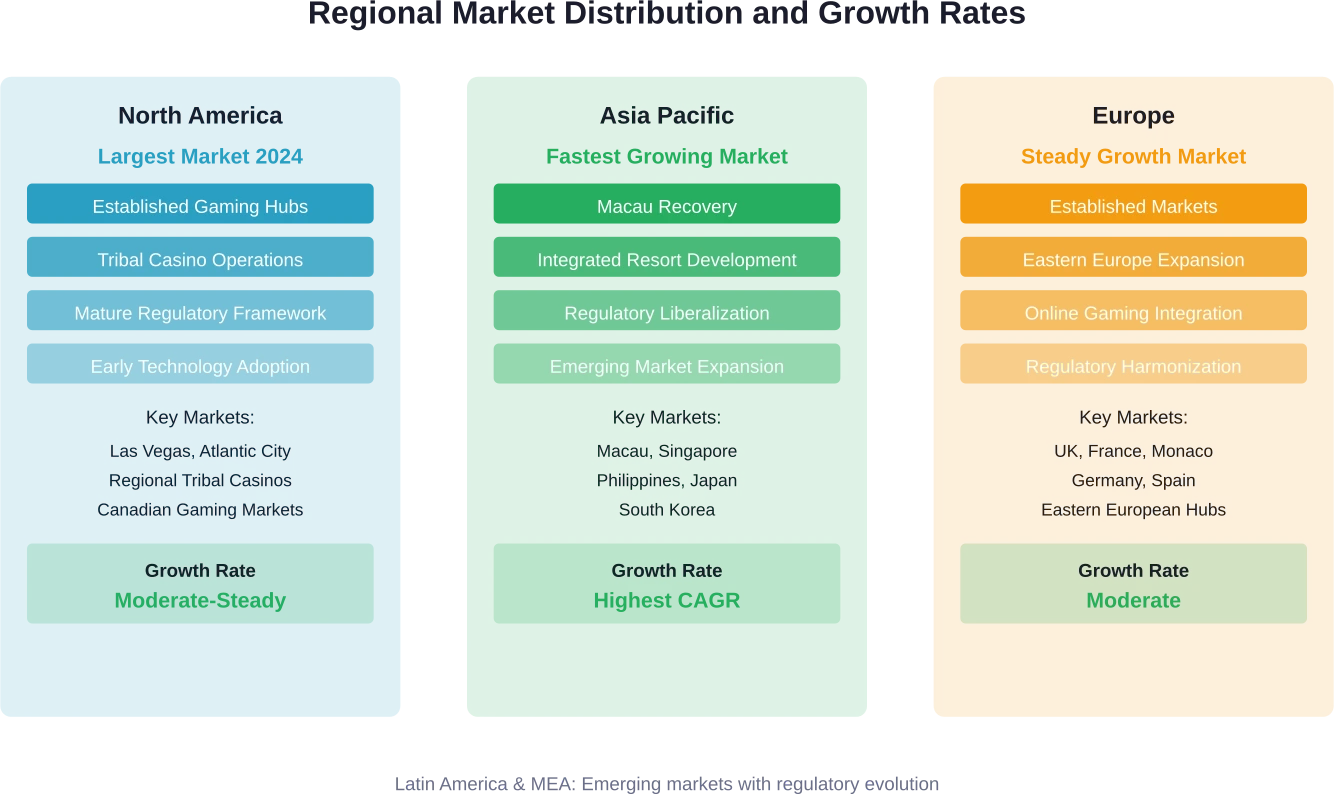
North America holds the largest market share in 2024, driven by Las Vegas and Atlantic City’s established gaming hubs plus tribal casino operations across multiple states. The region benefits from mature regulatory frameworks and early technology adoption.
But Asia Pacific is the fastest-growing market according to Mordor Intelligence. Macau’s recovery post-pandemic, integrated resort development in Singapore and the Philippines, and emerging markets in Japan and South Korea are fueling expansion. Regulatory liberalization in select markets creates new opportunities for sophisticated management systems.
Europe maintains steady growth with established markets in the UK, France, and Monaco complemented by Eastern European expansion. Latin America and the Middle East represent smaller but emerging segments as regulatory environments evolve.
Key Technology Trends Reshaping the Market
Several technological shifts are driving market evolution beyond simple digitization.
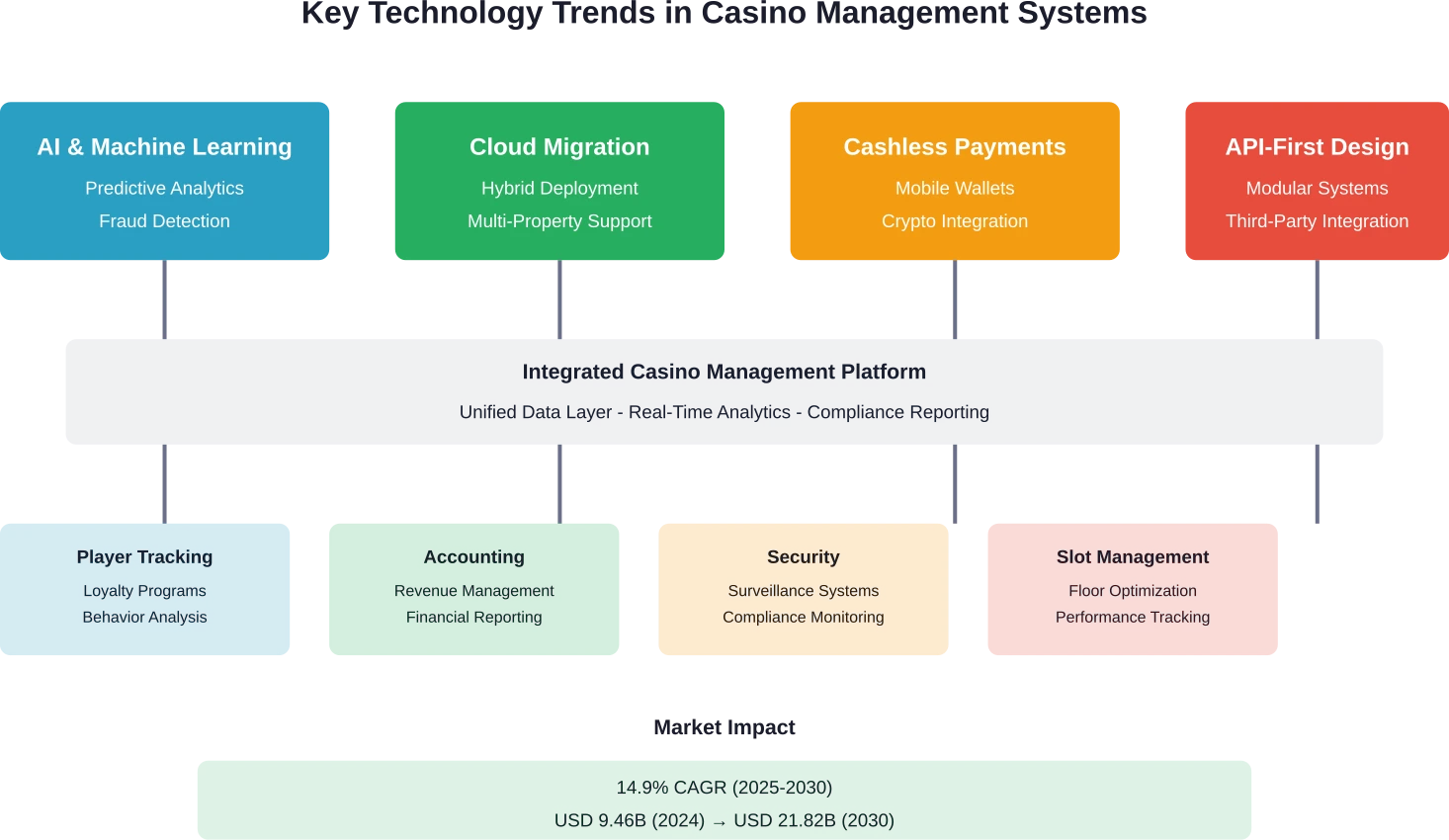
AI and Machine Learning Integration
Analytics represents the fastest-growing application segment according to Grand View Research. AI-powered systems now predict player behavior, optimize slot floor layouts, detect fraud patterns, and personalize marketing campaigns in real-time.
Machine learning algorithms analyze millions of data points from player tracking systems to identify high-value customers, forecast gaming revenue by time period, and flag potential problem gambling behaviors. This moves casino management from reactive to predictive operations.
Computer vision technology enhances security and surveillance capabilities. Systems can now detect card counting techniques, identify banned players through facial recognition, and monitor dealer errors—all without constant human oversight.
Cloud Migration and Hybrid Deployments
Cloud adoption is accelerating across the industry. Mordor Intelligence notes that competitive dynamics favor vendors offering hybrid deployment options that balance cloud elasticity with on-premise data sovereignty requirements.
Tribal casinos particularly value this flexibility. Many operate under specific data governance requirements that mandate certain information stays within tribal jurisdiction while still leveraging cloud scalability for analytics and reporting functions.
Cloud infrastructure reduces upfront capital expenditure, enables faster deployment of new features, and supports multi-property operations from centralized dashboards. But security concerns and regulatory compliance needs mean pure cloud solutions don’t work for everyone—hence the hybrid model gaining traction.
Cashless and Mobile Wallet Integration
The shift toward cashless gaming represents one of the most significant operational changes in decades. Digital payment systems, mobile wallets, and even cryptocurrency-enabled slots are moving beyond pilot programs into mainstream deployment.
Younger demographics show clear preference for cashless transactions. The Slot Machine Market report from Mordor Intelligence indicates that changes in player demographics reinforce momentum because younger visitors prefer omnichannel experiences that blend on-premise slots with mobile wallets and online progression systems.
Cashless systems provide operational benefits too—reduced cash handling costs, improved player tracking accuracy, faster transaction processing, and enhanced security. Integration with casino management platforms creates seamless experiences where players can fund accounts, track rewards, and manage spending from mobile devices.
API-First Architecture
Modern casino management systems are moving toward API-first designs that enable integration with third-party solutions. This architectural shift allows properties to build customized technology stacks rather than relying on monolithic vendors for all functionality.
Mordor Intelligence highlights that competitive dynamics favor vendors offering API-first suites with outcome-based pricing models. This modular approach lets casinos integrate best-of-breed solutions for specific functions—player loyalty from one vendor, table game management from another, and slot accounting from a third—all orchestrated through a central platform.
Open APIs also facilitate integration with online gaming platforms, creating truly omnichannel experiences where players move seamlessly between physical and digital environments.
Application Segment Analysis
Casino management systems serve multiple operational functions, each contributing differently to overall market growth.
Analytics Leading Growth
According to Grand View Research, analytics represents the most lucrative application segment registering the fastest growth during the forecast period. This makes sense given the shift toward data-driven decision making across the gaming industry.
Modern analytics platforms process data from slot machines, table games, hotel operations, food and beverage outlets, and entertainment venues to create comprehensive property performance dashboards. Operators can identify underperforming assets, optimize staffing levels, adjust comp strategies, and forecast revenue with unprecedented accuracy.
Real-time analytics enable dynamic floor management. If certain slot banks show declining play, managers can trigger targeted promotions to players in proximity. When high-value table game players arrive, hosts receive instant notifications with current play patterns and preferred amenities.
Security and Surveillance
Security and surveillance systems remain foundational components of casino management platforms. These systems have evolved far beyond basic video recording to incorporate facial recognition, behavior analysis, and automated alert systems.
Integration with other casino management modules creates powerful capabilities. When a player’s card activity suggests potential fraud, surveillance systems automatically pull video from relevant cameras. When dealers show unusual patterns that might indicate collusion, supervisors receive alerts with supporting footage.
Cybersecurity concerns are also driving investment. As Forrester notes in their building security research, hyperconnected buildings face risks where criminals can gain access through a thermostat or door lock. Casino management systems must protect against both physical and digital threats as operational technology converges with information technology.
Accounting and Cash Management
Accurate financial tracking is non-negotiable in gaming operations given strict regulatory requirements. Casino management systems automate cash reconciliation, track fills and credits, generate required regulatory reports, and maintain audit trails.
Integration with cashless payment systems is transforming this segment. As more transactions become digital, accounting modules must track player funds across multiple channels—cage transactions, mobile wallet deposits, online gaming transfers, and slot vouchers—while maintaining the precision regulators demand.
Player Tracking and Loyalty
Player tracking functionality has expanded from basic comp calculations to sophisticated customer relationship management. Modern systems build detailed player profiles that inform marketing campaigns, guide floor design decisions, and drive revenue optimization strategies.
Omnichannel integration connects on-premise play with online activity, creating unified player views regardless of channel. This enables truly personalized experiences where a player’s online slot preferences influence floor promotions when they visit the physical property.
Application Segment | Primary Functions | Growth Drivers | Key Benefits |
|---|---|---|---|
Analytics | Revenue optimization, player behavior prediction, floor performance | AI/ML adoption, data-driven decisions | Fastest-growing segment, predictive insights |
Security & Surveillance | Facial recognition, fraud detection, compliance monitoring | Computer vision, cybersecurity threats | Risk reduction, regulatory compliance |
Accounting & Cash | Financial reporting, cash reconciliation, audit trails | Cashless integration, regulatory requirements | Operational efficiency, accuracy |
Player Tracking | Loyalty programs, CRM, personalized marketing | Omnichannel experiences, mobile integration | Customer retention, targeted promotions |
Component Segmentation: Software vs Services
The casino management system market divides into software licenses, hardware components, and professional services.
According to Mordor Intelligence, services accounted for 40% of revenue in 2025 and are forecast to grow and are forecast to grow as implementations become more complex. Cloud migrations, API integrations, and custom analytics development all require professional services beyond initial software licensing.
Software represents the largest component by revenue, including both perpetual licenses and subscription models. The shift toward SaaS pricing is accelerating—outcome-based pricing models tie vendor compensation to measurable operational improvements rather than simple seat counts.
Hardware components include servers, networking equipment, point-of-sale terminals, and kiosk systems. While hardware generates significant revenue, growth rates lag behind software and services as cloud adoption reduces on-premise infrastructure requirements.
Deployment Models: Cloud, On-Premise, and Hybrid
Deployment preference varies significantly by operator type, property size, and regulatory environment.
Large multi-property operators increasingly favor cloud deployments that enable centralized management across geographically distributed casinos. Cloud platforms facilitate rapid deployment of new features, simplified disaster recovery, and scalability that matches business growth without massive upfront capital investment.
But pure cloud solutions don’t work for every operator. Regulatory requirements in certain jurisdictions mandate on-premise data storage. Tribal casinos often require hybrid architectures that respect data sovereignty while leveraging cloud capabilities for analytics and reporting.
Network connectivity concerns also influence deployment decisions. Properties in remote locations with limited bandwidth may require on-premise systems to ensure operational continuity even if internet connections fail.
The trend? Hybrid architectures that balance these competing requirements are gaining traction according to Mordor Intelligence’s analysis of competitive dynamics.
Major Market Players and Competitive Landscape
The casino management system market shows medium concentration with several dominant vendors and numerous specialized providers.
According to Mordor Intelligence, major companies operating in the market include International Game Technology PLC, Aristocrat Leisure Ltd., Novomatic AG, Scientific Games Corp., and Konami Gaming Inc. These established players leverage deep industry relationships, comprehensive product portfolios, and proven regulatory compliance to maintain market position.
But competitive dynamics are shifting. API-first architectures enable smaller specialized vendors to compete by offering best-in-class solutions for specific functions rather than complete suites. A property might deploy player tracking from one vendor, analytics from another, and accounting from a third—all integrated through APIs.
This modular approach reduces switching costs and increases competition. Vendors must differentiate through superior functionality, better integration capabilities, or outcome-based pricing rather than relying on proprietary lock-in.
Innovation areas where vendors compete include AI-powered analytics capabilities, mobile-first user experiences, cashless payment integration quality, and cloud infrastructure reliability. Customer support and professional services capabilities also drive competitive differentiation as implementations grow more complex.
Regulatory Environment and Compliance Requirements
Gaming regulations profoundly influence casino management system requirements and deployment options.
As noted in SEC filings on gaming regulatory overview, casino operations are subject to pervasive regulation under the laws and rules of each jurisdiction. Gaming laws are based upon declarations of public policy designed to ensure gaming is conducted honestly, competitively and free of criminal and corruptive elements.
Casino management systems must support compliance with diverse requirements across jurisdictions—financial reporting standards, player protection rules, anti-money laundering protocols, responsible gaming mandates, and data privacy regulations.
The Nevada Gaming Control Board updates gaming statutes and regulations that influence how systems must track transactions, maintain audit trails, and report suspicious activity. Systems operating in Nevada must accommodate these specific requirements while also supporting different rules in other jurisdictions.
Regulatory complexity creates both challenges and opportunities. Vendors that build flexible compliance frameworks can serve multiple markets with adaptable platforms. Those that hard-code specific rules struggle when entering new jurisdictions.
Data sovereignty requirements particularly impact deployment architecture. Some jurisdictions mandate that certain gaming data never leave specific geographic boundaries. This drives demand for hybrid deployments that can segregate sensitive data while still leveraging cloud capabilities for non-regulated functions.
Integration With Online Gaming Platforms
The boundary between land-based and online gaming continues blurring, driving demand for integrated casino management systems that span both channels.
According to Grand View Research, the online casino market was valued at USD 19.11 billion in 2024 and is projected to reach USD 38.00 billion by 2030, growing at a 12.2% CAGR. The U.S. online gambling market specifically reached USD 12.68 billion in 2024 with projected 9.8% CAGR through 2030.
This online growth creates both opportunity and complexity for casino management systems. Players expect unified experiences—earning comp points online that work at physical properties, accessing the same loyalty tier benefits across channels, and seamless fund transfers between land-based and digital wallets.
Omnichannel integration requires sophisticated identity management, cross-platform player tracking, unified accounting systems, and regulatory compliance frameworks that address both physical and digital operations. Systems built for land-based operations alone struggle to accommodate these requirements without major architectural changes.
The most successful implementations treat online and land-based operations as complementary rather than competitive. Mobile apps extend the physical casino experience before and after visits. Online play becomes a marketing channel that drives property visitation. Integrated systems make this synergy possible.
Challenges Facing Market Growth
Despite strong growth projections, several factors could constrain market expansion.
Implementation Complexity
Modern casino management systems involve dozens of integrated components, multiple vendor products, and connections to hundreds of gaming devices. Implementations often take months and require significant technical expertise that many properties lack internally.
Cloud migrations add additional complexity. Moving operational systems with strict uptime requirements and massive data volumes requires careful planning and execution. Properties risk operational disruptions if migrations aren’t managed properly.
Cybersecurity Vulnerabilities
As Forrester notes in their endpoint security research, hyperconnected buildings create new attack surfaces where cybercriminals can gain access through IoT devices like thermostats or door locks. Casino management systems connect to slot machines, surveillance cameras, HVAC systems, door locks, and numerous other endpoints—each representing a potential vulnerability.
Ransomware attacks on casino operations can shut down gaming floors, lock surveillance systems, and compromise player data. The interconnected nature of modern casino management platforms means a breach in one component can cascade across the entire system.
Regulatory Fragmentation
Gaming regulations vary significantly across jurisdictions, creating challenges for vendors serving multiple markets. What’s compliant in Nevada may violate rules in Macau or Australia. Building systems flexible enough to accommodate these differences without maintaining completely separate codebases requires careful architecture.
Regulatory changes also create ongoing adaptation requirements. When jurisdictions modify reporting requirements or implement new player protection rules, systems must update to maintain compliance. Vendors serving many markets face continuous development demands to keep pace with regulatory evolution.
Skills Gap
The convergence of gaming operations with advanced IT capabilities creates demand for professionals who understand both domains. Finding personnel who can manage cloud infrastructure, configure AI analytics, and comprehend gaming regulations proves challenging for many properties.
This skills gap slows adoption of advanced capabilities. Properties may license sophisticated analytics platforms but lack internal expertise to fully leverage them. Vendor professional services can fill gaps, but at additional cost that constrains ROI.
Future Outlook and Emerging Opportunities
Looking beyond current trends, several emerging developments could reshape the casino management system market over the next decade.
Skill-Based Gaming Integration
According to Mordor Intelligence’s Slot Machine Market analysis, skill-based and arcade-style slots represent an emerging product category. As gaming attracts younger demographics more accustomed to video games, skill-based elements are appearing in casino games.
Casino management systems will need to accommodate these new game types with different tracking requirements, varied payout structures, and unique player engagement metrics. Analytics platforms must evolve to measure skill-based gaming performance alongside traditional probability-based games.
Cryptocurrency and Blockchain
Some jurisdictions are beginning to permit cryptocurrency transactions at casinos. Blockchain technology offers potential applications in player identity verification, transparent audit trails, and automated compliance reporting.
While still nascent, cryptocurrency-enabled slots are emerging according to Mordor Intelligence. Casino management systems that can seamlessly handle both fiat and crypto transactions will have competitive advantages as regulatory acceptance grows.
Advanced Personalization
AI capabilities will enable hyper-personalized gaming experiences that adapt in real-time to individual player preferences. Slot machines could adjust volatility profiles based on detected player preferences. Table game limits might dynamically adjust based on predicted bankroll and risk tolerance.
This level of personalization requires sophisticated data integration, real-time analytics, and automated decision systems—all orchestrated through casino management platforms. The technology exists; regulatory acceptance and implementation best practices are still developing.
Sustainability and Energy Management
Gaming operations consume significant energy through 24/7 lighting, HVAC for large spaces, and thousands of electronic gaming devices. Casino management systems are beginning to incorporate energy monitoring and optimization capabilities.
Integration with building management systems enables coordinated control that maintains guest comfort while minimizing energy waste. Analytics identify inefficient equipment and optimal maintenance schedules that extend asset lifespans while reducing environmental impact.
Find and Connect with the Right Providers

The casino management system space is getting crowded, with more platforms, integrations, and service layers to choose from. The issue is not access – it is figuring out which pieces actually fit together without creating extra work later. Sologe brings this into one place as a B2B marketplace, helping operators and developers discover and connect with CMS providers and supporting partners across the stack.
If you are planning a new setup or reworking an existing one, this is where clarity matters most. Instead of going through providers one by one, take a more direct route. Reach out to the Sologe team and line up the partners that match your system and goals.
Frequently Asked Questions
What is the current size of the casino management system market?
The market exceeds $8 billion globally, with steady expansion driven by digitalization.
How fast is the CMS market growing?
Growth is strong at around 13–15% annually.
Which region dominates the market?
North America leads, while Asia-Pacific is growing the fastest.
What technologies are driving growth?
AI, cloud computing, cashless payments, and API-based systems are key drivers.
Who are the main CMS providers?
Leading companies include IGT, Aristocrat, Novomatic, Light & Wonder, and Konami.
What challenges does the CMS market face?
Key issues include cybersecurity risks, complex implementation, and regulatory differences.
How does online gaming impact CMS systems?
It drives demand for unified omnichannel systems connecting online and land-based operations.
Conclusion
The casino management system market is in the midst of a significant transformation driven by technology innovation and changing operational requirements. With projected growth rates around 14-15% annually through 2030-2031, the market should reach USD 17-22 billion depending on forecast methodology.
AI-powered analytics, cloud infrastructure, cashless payment systems, and API-first architectures represent the technological pillars supporting this growth. North America maintains market leadership while Asia Pacific shows the fastest expansion as regulatory frameworks evolve and integrated resorts proliferate.
But growth isn’t automatic. Implementation complexity, cybersecurity risks, regulatory fragmentation, and skills gaps present real challenges that vendors and operators must address. Success requires systems flexible enough to accommodate diverse regulatory requirements while delivering measurable operational improvements that justify investment.
The convergence of land-based and online gaming creates both opportunity and complexity. Properties that successfully implement omnichannel strategies supported by integrated management systems gain competitive advantages through superior player experiences and operational efficiency.
Looking ahead, skill-based gaming, cryptocurrency transactions, hyper-personalization through AI, and sustainability initiatives represent emerging opportunities that could further accelerate market growth beyond current projections.
For casino operators evaluating management system investments, focus on vendors offering proven analytics capabilities, flexible deployment models, strong cybersecurity frameworks, and open APIs that prevent lock-in. The right system doesn’t just automate existing processes—it enables entirely new operational models that weren’t previously possible.
Related Articles

September 29, 2026Is the Casino Legal in Japan? The Real Answer...

September 29, 2026Is the Casino Legal in Gambia? What the Law...