 Nothing found for the request

Mexico Online Casino Operators: Market Guide 2026
Sologe March 31, 2026
Share:


Market Size and Growth Trajectory
The numbers tell a compelling story. Mexico’s online gambling market reached $0.84 billion in 2025 and is projected to hit $0.97 billion in 2026, climbing to $1.96 billion by 2031 at a compound annual growth rate of 15.11%.
That’s not the only projection making waves. Alternative market analyses suggest even more aggressive growth, with some forecasts indicating the broader gambling market could reach $40.64 billion by 2033, growing at a 15.71% CAGR from 2025-2033.
The online gambling industry specifically is expected to reach a projected revenue of US$ 3,156.5 million by 2030, with an 11.9% compound annual growth rate from 2025 to 2030. Another estimate suggests the market could hit $2.56 billion by 2033, fueled by rising smartphone usage and a growing acceptance of online gaming.
Projection Source | 2026 Market Size | End Year | Final Valuation | CAGR |
|---|---|---|---|---|
Market Intelligence Report | $0.97 billion | 2031 | $1.96 billion | 15.11% |
Industry Analysis | N/A | 2030 | $3.16 billion | 11.9% |
Broader Gambling Market | N/A | 2033 | $40.64 billion | 15.71% |
Real talk: these projections vary based on what segments they include.
Show Your Offering to Online Casino Operators in Mexico

For vendors targeting online casino operators in Mexico, visibility often comes down to showing up where buyers already search. Sologe is built for that. It is a dedicated iGaming marketplace where operators and gaming businesses search for suppliers, software, platforms, and service partners, while vendors use the platform to present their offering in one place.
Want More Gaming Buyers in Mexico to Find You?
Use Sologe to:
- reach operators and buyers searching for vendors
- present your company profile and offering in one place
- stay visible beyond events and short-term campaigns
👉 Get in touch with Sologe to discuss becoming a vendor on the platform.
Regulatory Landscape for Operators
Here’s where things get complicated. Mexico’s gambling regulations create a dual-edged environment that operators must navigate carefully.
The gross gaming revenue tax sits at 50%—a substantial tax burden that shapes operator profitability. This rate applies to licensed operators who’ve completed the regulatory process and maintain compliance with government standards.
But wait. The fragmented regulatory regime creates both opportunity and uncertainty. Compliant operators face higher tax outlays while unlicensed sites retain cost advantages, creating an uneven playing field that impacts market dynamics.
The regulatory framework established after 2004 legalization continues to evolve, but operators working in Mexico must account for:
- Licensing requirements that vary by gaming type
- Tax obligations that significantly impact margin calculations
- Compliance standards for responsible gaming and player protection
- Payment processing restrictions and requirements
The concentration level in the market is medium, meaning while major players dominate, there’s still room for new entrants who can navigate regulatory complexities and differentiate their offerings.
Sports Betting Dominance
Sports betting isn’t just a segment in Mexico’s online gambling market—it’s the driving force. The category led with 56.41% revenue share, making it the clear market leader.
This dominance reflects broader Latin American trends where sports culture, particularly soccer, drives gambling engagement. The popularity of both domestic leagues and international competitions creates consistent betting volume throughout the year.
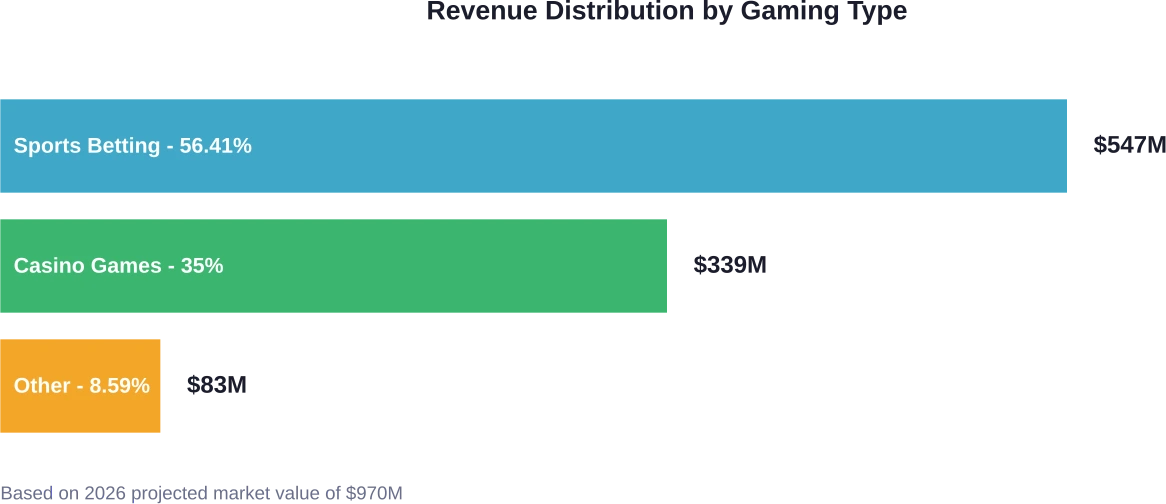
Within sports betting, operators offer multiple product types:
- Fixed odds sports betting (the largest segment)
- Pari-mutuel betting for horse and dog racing
- In-play/live betting (growing rapidly with mobile adoption)
- Exchange betting
- Spread betting
The shift toward mobile platforms has accelerated in-play betting growth, allowing operators to capture impulse bets and increase overall betting frequency. This trend aligns with smartphone penetration rates that continue climbing across Mexican demographics.
Major Operators and Market Players
The competitive landscape features both international giants and regional powerhouses. Major companies operating in Mexico’s online gambling market include:
- Grupo Caliente (dominant regional player with strong brand recognition)
- Codere Online Luxembourg S.A. (established European operator with Mexican presence)
- Bet365 Group Ltd (global leader leveraging international expertise)
- Novibet USA Inc. (expanding North American operator)
- Super Group Ltd. (multi-brand international operator)
These operators compete across different dimensions—brand recognition, product variety, mobile experience, payment options, and customer service. The medium concentration level means no single player controls the market, creating competitive pressure that benefits consumers through better odds, bonuses, and user experiences.
Local operators like Grupo Caliente benefit from established land-based casino networks and brand trust, while international players bring technological sophistication and cross-market promotional capabilities.
Mobile Gaming Revolution
Mobile platforms don’t just complement desktop gambling in Mexico—they’re increasingly the primary access point. Rising smartphone usage directly correlates with market growth projections.
The surge of mobile gaming in Mexico reflects infrastructure improvements and device affordability. Operators prioritizing mobile-first development gain competitive advantages in user acquisition and retention.
Mobile advantages for operators include:
- Lower customer acquisition costs through app-based marketing
- Higher engagement frequency (users check mobile devices 50+ times daily)
- Push notification capabilities for promotions and live betting alerts
- Location-based services for geofencing and compliance
- Simplified payment integration through mobile wallets
Tech advances promise safer play through biometric authentication, responsible gaming controls integrated into mobile apps, and AI-driven problem gambling detection. These features address regulatory concerns while improving user experience.
Casino Gaming Segment
While sports betting leads, casino games represent substantial market share. Traditional and modern casino offerings include:
- Blackjack and baccarat (table game staples)
- Teen Patti, Three Card Poker, Four Card Poker (card variants)
- Red Dog and other specialty games
- Slot machines and video poker
- Live dealer games (growing category)
Live dealer gaming deserves special attention. This category combines online convenience with the social experience and trust of real dealers, addressing player concerns about random number generator fairness.
Casino operators differentiate through game variety, software providers, progressive jackpot networks, and bonus structures. The rise of social features—chat functions, multiplayer tables, tournaments—builds vibrant communities that increase player lifetime value.
Growth Drivers and Market Dynamics
Several factors propel Mexico’s online gambling market forward at double-digit growth rates.
Government incentives play a role, though the regulatory framework remains complex. Strategic partnerships between operators and payment providers, media companies, and sports organizations expand market reach and legitimacy.
Growing acceptance of online gaming shifts cultural perceptions. What was once viewed skeptically gains mainstream acceptance, particularly among younger demographics comfortable with digital transactions and entertainment.
The popularity of virtual assistants and AI-powered customer service reduces operational costs while improving player support. Operators leveraging these technologies gain efficiency advantages in a price-competitive market.
Payment infrastructure improvements—digital wallets, cryptocurrency options, faster withdrawals—remove friction from the player experience. Each improvement in payment speed and convenience correlates with higher deposit frequency and player satisfaction.
Challenges and Opportunities for Operators
Operating in Mexico’s online gambling market isn’t without obstacles. Security concerns remain paramount as cyber threats evolve. Operators invest heavily in encryption, fraud detection, and secure payment processing to protect player data and maintain trust.
Player protection regulations will likely tighten as the market matures. Responsible gaming features—deposit limits, self-exclusion tools, reality checks—transition from differentiators to requirements. Forward-thinking operators build these into product design rather than bolting them on later.
New regulations create uncertainty but also opportunity. As the framework solidifies, compliant operators gain competitive advantages over unlicensed sites. The 30% tax burden becomes less punitive when enforcement increases against non-compliant competitors.
Market consolidation may accelerate as smaller operators struggle with compliance costs and larger players seek regional expansion. This creates acquisition opportunities and partnership possibilities for operators with complementary strengths.
Future Outlook and Market Projections
What’s next for Mexico’s online gambling industry? The trajectory points upward across all projections, though the path involves both expansion and evolution.
By 2031, the market should reach $1.96 billion based on current growth patterns. Extended projections suggesting $2.56 billion to $3.16 billion by 2030-2033 depend on regulatory developments, market maturation, and economic conditions.
Innovation will shape competitive dynamics. Operators experimenting with social gaming features, cryptocurrency integration, esports betting, and gamification find new revenue streams beyond traditional sports and casino products.
Year | Projected Market Value | Growth from 2026 | Key Milestone |
|---|---|---|---|
2026 | $0.97 billion | Baseline | Market acceleration phase |
2028 | ~$1.28 billion | +32% | Mobile dominance solidifies |
2031 | $1.96 billion | +102% | Market doubles in 5 years |
2033 | $2.56 billion (alt.) | +164% | Mature market phase begins |
The broader gambling market projections reaching $40.64 billion by 2033 include land-based casinos, lottery systems, and electronic gaming machines—segments that will also benefit from digital transformation and improved regulations.
Strategic Considerations for Market Entry
Operators considering Mexico must evaluate several strategic factors before committing resources.
Licensing strategy comes first. Will the operator pursue full compliance from day one, or test market appetite with a softer approach? The 30% GGR tax makes margin calculations critical—operators need sufficient scale to achieve profitability after tax obligations.
Product mix matters tremendously. Given sports betting’s 56.41% market share, any serious operator needs competitive sports offerings. But casino games, live dealer options, and potentially lottery-style games provide diversification and appeal to different player segments.
Payment partnerships determine market penetration. Operators must support popular local payment methods while maintaining fraud protection and fast withdrawals. The best payment strategy balances local familiarity with operational efficiency.
Marketing and customer acquisition in a medium-concentration market require both scale and precision. Mass-market brand building competes with targeted digital campaigns. Operators with cross-market experience can leverage learnings from other Latin American territories.
Frequently Asked Questions
What’s the current size of Mexico’s online gambling market?
The Mexico online gambling market is valued at approximately $0.97 billion in 2026, growing from $0.84 billion in 2025. The market is projected to reach $1.96 billion by 2031 at a compound annual growth rate of 15.11%, making it one of Latin America’s fastest-growing iGaming markets.
What tax rates do online casino operators pay in Mexico?
Licensed online gambling operators in Mexico face a 30% gross gaming revenue (GGR) tax. This substantial tax burden affects operator profitability and creates competitive challenges versus unlicensed sites that avoid these costs. Operators must build this tax obligation into their margin calculations and pricing strategies.
Which gaming segment generates the most revenue in Mexico?
Sports betting dominates Mexico’s online gambling market with a 56.41% revenue share, making it the largest segment. This reflects strong sports culture, particularly around soccer, and growing acceptance of mobile betting platforms. Casino games represent the second-largest category, followed by lottery-style games and other offerings.
Who are the major online gambling operators in Mexico?
The leading operators include Grupo Caliente, Codere Online Luxembourg S.A., Bet365 Group Ltd, Novibet USA Inc., and Super Group Ltd. The market shows medium concentration, meaning while these major players hold significant market share, there is still room for new entrants and smaller operators to compete effectively.
How important is mobile gaming in Mexico’s market?
Mobile platforms are increasingly the primary access point for online gambling in Mexico. Rising smartphone usage and improving mobile infrastructure drive market growth. Operators prioritizing mobile-first development, in-play betting features, and app-based experiences gain competitive advantages in user acquisition and retention.
What regulatory challenges do operators face in Mexico?
The fragmented regulatory regime creates both opportunity and uncertainty. Licensed operators face the 30% GGR tax and compliance requirements, while unlicensed sites retain cost advantages. As regulations evolve and enforcement potentially increases, compliant operators may gain competitive benefits, but the current environment creates an uneven playing field.
What growth drivers will shape Mexico’s online gambling market through 2031?
Key growth drivers include increasing mobile adoption, strong sports culture driving betting demand, payment infrastructure improvements, growing cultural acceptance of online gaming, strategic partnerships between operators and local companies, and technological advances in security and player protection. These interconnected factors support the projected 15.11% CAGR through 2031.
Conclusion: Navigating Mexico's Growing Market
Mexico’s online gambling market presents compelling opportunities for operators willing to navigate its complexities. The path from $0.97 billion in 2026 to $1.96 billion by 2031 isn’t automatic—it requires strategic positioning, regulatory compliance, product differentiation, and operational excellence.
Sports betting will continue driving revenue, but savvy operators build diversified product portfolios. Mobile-first development isn’t optional—it’s the foundation of competitive market participation. And the regulatory landscape, while challenging, will likely favor compliant operators as enforcement evolves.
The medium market concentration creates space for both established international operators and innovative new entrants. Success depends on understanding local player preferences, building trust through security and responsible gaming features, and delivering seamless experiences across devices.
For operators evaluating Latin American expansion, Mexico represents one of the region’s most attractive growth markets. The combination of market size, growth trajectory, and digital infrastructure development creates a favorable environment for the next five years and beyond.
Whether entering the market or expanding existing operations, operators should prioritize mobile optimization, sports betting excellence, payment flexibility, and regulatory compliance. These fundamentals, combined with local market understanding, position operators to capture share in Mexico’s expanding online gambling industry.
Related Articles

September 29, 2026Is the Casino Legal in Japan? The Real Answer...

September 29, 2026Is the Casino Legal in Gambia? What the Law...