 Nothing found for the request
Is the Casino Legal in Argentina? 2026 Guide
Sologe July 9, 2026
Share:


The Foundation: Federal Law and Provincial Power
Argentina’s federal gambling restrictions and criminal provisions were eventually codified under Article 301 bis of the National Criminal Code.
But here’s the thing—that federal ban didn’t last. Over the decades, provinces gained authority to regulate gambling within their borders. The federal government retained oversight of certain anti-money laundering requirements, but the actual licensing and operation of casinos? That’s provincial territory.
As of 2026, each of Argentina’s 23 provinces plus the autonomous City of Buenos Aires controls its own gambling regulations. Some provinces embrace casino gambling fully. Others restrict it heavily or ban certain forms altogether.
No nationwide casino license exists. Foreign gambling licenses aren’t recognized. An operator licensed in Buenos Aires can’t automatically operate in Córdoba or Mendoza.
How Provinces Structure Their Casino Laws
Most provinces that allow casinos have created dedicated regulatory agencies. These organizations—often called provincial lottery and casino institutes—handle licensing, oversight, tax collection, and enforcement.
For example:
- Buenos Aires operates through the Lotería de la Ciudad de Buenos Aires
- Mendoza created the Instituto Provincial de Juegos y Casinos (Law 6362, passed in 1995)
- Córdoba uses the Lotería de la Provincia de Córdoba
Each province sets its own license terms, tax rates, operational requirements, and prohibited activities. That fragmentation means operators need separate licenses for each provincial market they want to enter.
Land-Based Casinos: Provincial Licensing and Operations
Traditional brick-and-mortar casinos operate across much of Argentina. Major casino destinations include Buenos Aires, Mendoza, Córdoba, and the coastal resort areas.
Land-based casino licenses typically last 5 to 15 years, depending on the province. Renewal processes vary, but most require demonstrating continued compliance with provincial regulations.
The provinces collect substantial tax revenue from casino operations. Tax rates on gross gaming revenue typically range from 10% to 30%, depending on the jurisdiction.
Ownership and Partnership Requirements
Many provinces require or strongly prefer local ownership participation in casino operations. Some explicitly mandate that Argentine entities hold a minimum ownership stake.
Foreign operators wanting to enter the market typically need to form joint ventures with local partners. These partnerships help navigate provincial regulatory systems and satisfy local ownership preferences.
The regulatory agencies scrutinize ownership structures carefully. Background checks, financial audits, and proof of operational competence are standard requirements for licensing.
Online Gambling: The Provincial Patchwork
Online casino gambling represents Argentina’s fastest-growing gambling segment. But like land-based casinos, online gambling operates under provincial rather than federal regulation.
Over 16 of Argentina’s 24 jurisdictions have enacted specific online gambling regulations as of 2026. Each province decides which online gambling activities to permit, how to license operators, and what consumer protections to enforce.
The City of Buenos Aires operates through the Lotería de la Ciudad de Buenos Aires (LOTBA), which regulates online gambling based on specific modern frameworks such as Resolution No. 80/LOTBA/2019.
No Nationwide Online License
Here’s what trips up many operators: Argentina has no federal online gambling license. An operator must obtain separate licenses from each province where it wants to offer services.
Foreign gambling licenses carry no weight in Argentina. An operator licensed in Malta, Curaçao, or Gibraltar can’t legally serve Argentine customers without obtaining provincial licenses within Argentina.
That creates substantial compliance complexity. Different provinces impose different requirements for:
- Responsible gambling tools and age verification
- Payment processing and financial controls
- Game fairness testing and certification
- Data protection and server location
- Advertising restrictions and marketing practices
Operators must adapt their platforms to meet each province’s unique requirements.
The Foreign-Local Partnership Model
Provinces that allow online gambling typically require foreign operators to partner with local entities. The local partner must hold at least 15% ownership in the joint venture.
This partnership requirement serves multiple purposes. It ensures local economic participation in gambling profits. It gives provinces a domestic entity to regulate and hold accountable. And it helps operators navigate Argentina’s complex regulatory environment.
In provinces like Córdoba and Buenos Aires, licenses are granted for 15-year terms. The Córdoba province, for instance, taxes online gambling operators at 10% of gross gaming revenue.
Compare iGaming Suppliers with Sologe
When a market has different rules for casino activity, businesses often look beyond the legal answer and review the supplier ecosystem that supports licensed gaming operations. Sologe brings together iGaming providers across technology, payments, traffic, sports betting, and business services, giving companies a clearer way to compare available options.
Sologe helps businesses review:
- Casino and gaming platforms
- Sports betting solutions
- Game aggregator solutions
- Payment providers
- Traffic and affiliate services
- Operations management services
- Analytics and marketing software
- Additional gaming software
👉Contact Sologe to compare gaming platforms, software providers, payment solutions, traffic services, sports betting solutions, and other B2B iGaming suppliers in one marketplace.
Federal Tax Obligations for Casino Operators
While provinces handle licensing, casino operators face federal tax obligations that apply across all jurisdictions.
At the federal level, operators encounter several tax categories:
Tax Type | Rate | Tax Base |
|---|---|---|
Corporate Income Tax | 41.5% | Net income |
Value-Added Tax (VAT) | 21% | Fees charged to players |
Bank Transaction Tax | 0.6% | Credits and debits |
Dividend Withholding | 7% | Distributed dividends |
The 41.5% corporate income tax rate applies to operators’ net income. Dividends resulting from that already-taxed income don’t face additional withholding at the federal level, though a 7% dividend withholding tax may apply in certain circumstances.
The 21% VAT rate applies when operators charge fees to participants or players. The 0.6% credits and debits tax hits transactions flowing through operators’ bank accounts.
Provincial Gross Gaming Revenue Taxes
Separate from federal taxes, provinces levy their own taxes on gross gaming revenue. These provincial GGR taxes typically range from 10% to 25% for online gambling and 10% to 30% for land-based operations.
For example, online gambling operators in Córdoba pay a 10% GGR tax. Other provinces set different rates, creating substantial variation in total tax burden depending on where an operator is licensed.
The combination of federal income tax and provincial GGR taxes creates a layered tax structure. Operators need sophisticated accounting to manage multi-jurisdictional tax compliance.
Obtaining a Gambling License: The Córdoba Case Study
Understanding how one province structures its licensing system illuminates the broader Argentine approach. Córdoba provides a useful example.
Córdoba regulates online gambling through provincial law, with the Lotería de la Provincia de Córdoba serving as the regulatory authority. The province allows online casinos, sports betting, and other gambling products.
Application Requirements in Córdoba
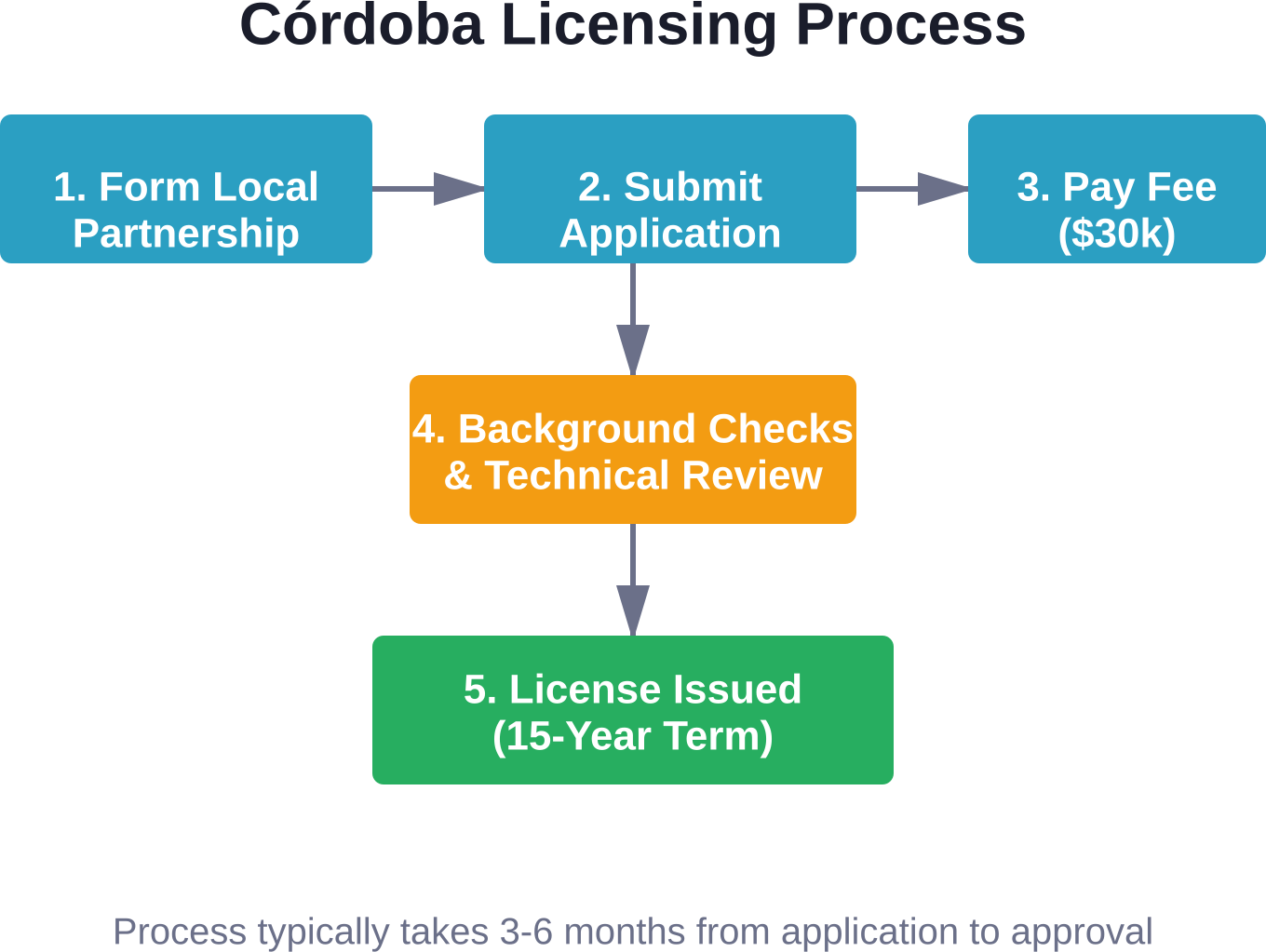
To obtain a gambling license in Córdoba, operators must:
- Form a joint venture with a local Argentine partner holding at least 15% ownership
- Pay the state application fee (approximately $30,000)
- Demonstrate technical capability to operate a compliant gambling platform
- Prove financial solvency and adequate capitalization
- Submit to background checks on all key personnel and owners
- Provide detailed business plans and operational procedures
The licensing process isn’t quick. Expect several months from initial application to final approval, assuming no complications arise.
Once licensed, operators must maintain servers and infrastructure within Argentina. Cross-border server arrangements typically aren’t permitted—provinces want physical control over the technical infrastructure serving their residents.
Ongoing Compliance Obligations
Holding a license creates continuous obligations. Operators must:
- Submit regular financial reports and audits to the regulatory authority
- Implement robust age verification to prevent underage gambling
- Provide responsible gambling tools including deposit limits, self-exclusion, and reality checks
- Comply with anti-money laundering (AML) regulations and report suspicious transactions
- Maintain player funds in segregated accounts
- Use certified random number generators and undergo regular game fairness testing
Córdoba licenses last for 15 years. Renewal requires demonstrating continued compliance with all regulatory requirements and may involve updated background checks and financial audits.
Anti-Money Laundering Requirements
Argentina takes anti-money laundering (AML) and counter-financing of terrorism (CFT) obligations seriously in the gambling sector.
The federal Financial Information Unit (Unidad de Información Financiera, or UIF) sets AML/CFT standards for gambling operators nationwide. Resolution UIF 199/2011, which was replaced by updated regulations in December 2023, brought Argentine requirements into closer alignment with international standards from the Financial Action Task Force (FATF).
All gambling operators—whether land-based or online, occasional or habitual—must implement comprehensive AML/CFT programs. These programs must:
- Conduct customer due diligence and know-your-customer (KYC) checks
- Monitor transactions for suspicious patterns
- Report suspicious transactions to the UIF
- Maintain detailed transaction records
- Train staff on AML/CFT recognition and reporting
- Appoint a compliance officer responsible for AML/CFT oversight
The regulations recognize that gambling operations face material money laundering risks. Large cash transactions, cross-border payment flows, and the ability to rapidly move value make casinos attractive to money launderers.
Biometric Identification Requirements
Many Argentine provinces now require biometric identification for casino patrons. The federal RENAPER (Registro Nacional de las Personas) system provides biometric ID verification capabilities.
Players must verify their identity using government-issued identification before gambling. Online operators typically integrate with RENAPER or approved provincial identification systems to verify players remotely.
These identification requirements serve dual purposes: preventing underage gambling and creating audit trails for AML/CFT compliance.
Online Gambling Taxes and the RCOSA Registry
Argentina introduce additional online gambling tax measures through Decree No. 293/2022, which created the RCOSA registry (Registro de Contratación de Operadores de Servicios de Apuestas).
The RCOSA registry affects how the tax authority treats payments between Argentine residents and gambling operators. Operators registered in RCOSA face reduced withholding rates compared to unregistered operators.
The online gambling indirect tax rates under the RCOSA framework range from 2.5% to 15%, depending on the operator’s registration status and compliance level:
- 15% for operators not in the RCOSA registry
- 5% for operators incorporated in the registry
- 2.5% for operators registered before submitting their initial request
This tax structure creates strong incentives for online gambling operators to register with RCOSA and maintain good standing with Argentine tax authorities.
Taxes on Foreign Gambling Sites
Argentine residents who use foreign gambling sites face punitive tax treatment. The national online gambling tax (often called “Impuesto PAIS”) imposes a 30% tax on payments to foreign gambling operators.
Additionally, an 8% credit and debit card surcharge applies to transactions with foreign gambling sites. Combined, these measures make unlicensed foreign sites substantially more expensive for Argentine players.
The tax structure clearly aims to push players toward provincially licensed operators rather than offshore sites. Whether that strategy succeeds depends partly on the competitiveness of licensed operators’ offerings.
Advertising and Marketing Restrictions
Argentine provinces impose various restrictions on gambling advertising and marketing. These restrictions have tightened in recent years amid concerns about gambling’s social impact, particularly on young people.
Updated guidance from March 2024 emphasizes preventing adolescent online gambling. Provincial authorities recognize that online gambling platforms are easily accessible to minors and have implemented stronger controls.
Common advertising restrictions include:
- Prohibitions on marketing to minors or using content that appeals to children
- Bans on gambling advertising during certain broadcast hours
- Requirements for responsible gambling messages in all marketing
- Restrictions on celebrity endorsements and influencer marketing
- Limitations on bonus offers and promotional claims
Some provinces ban online gambling advertising almost entirely. Others allow it but impose substantial restrictions on content, placement, and messaging.
Operators need legal review of all marketing materials before launch to ensure compliance with the specific rules in each province where they hold licenses.
Payment Methods and Banking
Payment processing represents both an operational necessity and a compliance challenge for Argentine casino operators.
Popular payment methods in Argentina include:
- Credit and debit cards (Visa, Mastercard)
- Bank transfers
- E-wallets (Mercado Pago is particularly popular domestically)
- Prepaid cards and vouchers
- Cryptocurrency (adoption is growing but regulatory treatment varies)
Operators must maintain player funds in segregated accounts separate from operational funds. This segregation protects player deposits if an operator faces financial difficulties.
Cryptocurrency in Argentine Gambling
Cryptocurrency adoption in Argentine gambling is growing, driven partly by Argentina’s history of currency instability and capital controls.
But cryptocurrency payment processing exists in a gray area. Provinces haven’t uniformly addressed whether licensed operators may accept crypto deposits and withdrawals. Some operators offer crypto options; others stick to traditional payment rails to avoid regulatory uncertainty.
AML requirements apply to cryptocurrency transactions just as they do to fiat currency. Operators accepting crypto must implement robust transaction monitoring and suspicious activity reporting.
Responsible Gambling and Player Protection
Argentine gambling regulations increasingly emphasize responsible gambling and player protection. Provincial regulatory agencies require licensed operators to implement multiple safeguards.
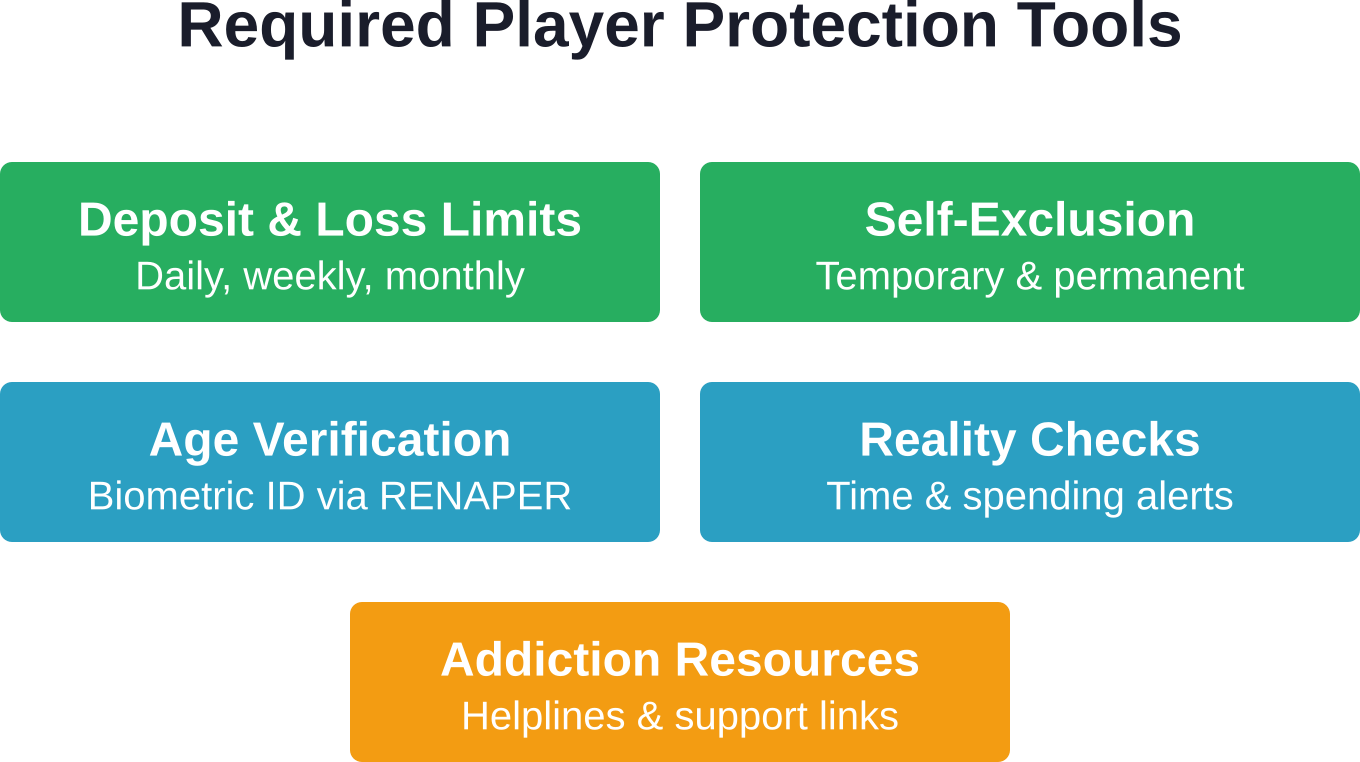
Standard responsible gambling tools include:
- Deposit limits (daily, weekly, monthly)
- Loss limits
- Session time limits and reminders
- Self-exclusion options (temporary and permanent)
- Access to gambling addiction resources and helplines
- Reality checks that interrupt play to display time and spending
Operators must make these tools easily accessible and clearly explain how to use them. Marketing materials must include responsible gambling messages.
Protecting Minors from Online Gambling
Preventing underage gambling is a priority for Argentine regulators. Online platforms must implement robust age verification before allowing any real-money play.
Integration with RENAPER or provincial identification systems helps verify that players meet the legal gambling age (typically 18, though some provinces set it at 21 for certain gambling forms).
Operators face severe penalties for allowing underage gambling, including license suspension or revocation. The March 2024 updated guidance specifically addresses protecting adolescents from online gambling access.
Enforcement and Penalties
Provincial regulatory agencies have substantial enforcement powers. They can investigate operators, audit records, inspect facilities, and interview personnel.
Common penalties for violations include:
- Monetary fines (amounts vary by province and violation severity)
- License suspension (temporary)
- License revocation (permanent)
- Criminal prosecution for serious violations
Violations that typically trigger enforcement action include:
- Operating without a valid license
- Allowing underage gambling
- Failing to report suspicious transactions
- Using uncertified or rigged games
- Violating advertising restrictions
- Failing to implement required responsible gambling tools
- Commingling player and operational funds
Provincial authorities also coordinate with federal agencies on AML/CFT enforcement and tax compliance. The UIF can impose penalties separately for AML/CFT violations.
The Fragmented Market Reality
Argentina’s provincial regulatory structure creates a fragmented gambling market. That fragmentation affects operators and players differently.
For operators, fragmentation means:
- Higher compliance costs (multiple licenses, multiple regulatory relationships)
- Platform complexity (different rules require different configurations)
- Delayed market entry (securing licenses takes time in each province)
- Uneven market access (some provinces remain closed or highly restrictive)
For players, fragmentation means:
- Inconsistent access (legal options vary by location)
- Confusion about legality (what’s legal in one province isn’t in another)
- Varying consumer protections (not all provinces enforce equally robust standards)
Industry participants and some policy analysts argue for greater federal coordination or harmonization. But provincial autonomy remains a core principle of Argentine governance, and provinces protect their gambling regulatory authority.
Market Size and Growth
Argentina represents one of Latin America’s most substantial gambling markets. Both land-based and online gambling have grown steadily.
Online gambling growth has been particularly strong. Mobile internet adoption is high in Argentina, and younger demographics increasingly prefer online over land-based gambling.
Football and horse racing dominate betting activity. Sports betting—both retail and online—attracts substantial participation. Casino games, particularly slots and table games like blackjack and roulette, also enjoy popularity.
The regulatory expansion into online gambling has brought previously gray-market activity into legal, taxed channels. Provinces benefit from increased tax revenue, though enforcement against unlicensed operators remains challenging.
Looking Ahead: Anticipated Regulatory Developments
Argentine gambling regulation continues to evolve. Several trends seem likely through 2026 and beyond.
First, more provinces will probably adopt online gambling regulations. The 16 provinces that have already done so demonstrate that online gambling can be regulated effectively at the provincial level while generating tax revenue.
Second, regulatory harmonization might gradually increase. While full federalization seems unlikely, provinces may adopt more consistent standards for licensing, AML/CFT, and responsible gambling. Interstate cooperation could reduce compliance costs without eliminating provincial autonomy.
Third, enforcement against unlicensed operators will likely intensify. Payment blocking, ISP-level domain blocking, and advertising restrictions make it harder for offshore operators to serve Argentine customers profitably.
Fourth, responsible gambling requirements will probably tighten further. Public concern about gambling addiction and underage gambling access creates political pressure for stronger consumer protections.
Practical Considerations for Operators
Operators considering the Argentine market should approach it strategically.
Start by selecting target provinces. Not all 24 jurisdictions offer equal opportunities. Buenos Aires, Córdoba, and a handful of other provinces account for most gambling activity. Focus on obtaining licenses in the largest, most accessible markets first.
Form local partnerships early. The 15% minimum local ownership requirement means foreign operators can’t go it alone. Finding reliable local partners with regulatory knowledge and operational experience is critical.
Budget for multi-jurisdictional compliance. Operating across multiple provinces means multiple regulatory relationships, multiple audits, and platform configurations that accommodate different requirements. Compliance isn’t cheap.
Invest in robust AML/CFT and responsible gambling systems. These aren’t optional add-ons—they’re core regulatory requirements that agencies monitor closely.
Prepare for a long-term commitment. Licenses last 10-15 years. Building a profitable operation takes time. Operators should view Argentina as a medium-to-long-term market opportunity, not a quick win.
Frequently Asked Questions
Is online gambling legal in Argentina?
Yes. Online gambling is legal in Argentina, but it is regulated at the provincial level rather than nationally. More than 16 of the country’s 24 jurisdictions have adopted online gambling regulations, and operators must obtain separate licenses for each province where they wish to offer services.
Can foreign gambling companies operate in Argentina?
Yes. Foreign gambling companies may operate in Argentina by partnering with local Argentine businesses. Most provinces require a local partner to hold at least a 15% ownership stake, and foreign licenses are not recognized in place of provincial licensing.
What taxes do casino operators pay in Argentina?
Casino operators in Argentina pay both federal and provincial taxes. These include federal corporate income tax, VAT on certain gambling-related services, and bank transaction taxes, along with provincial taxes on gross gaming revenue. The overall tax burden varies depending on the provinces in which an operator is licensed.
How long do gambling licenses last in Argentina?
License terms differ by province. Land-based casino licenses generally remain valid for 5 to 15 years, while some online gambling licenses, including those issued in Buenos Aires and Córdoba, are granted for 15-year periods. Renewals require continued compliance with applicable regulations.
Are there restrictions on gambling advertising in Argentina?
Yes. Gambling advertising is regulated by individual provinces and commonly includes restrictions on marketing to minors, mandatory responsible gambling messages, limits on promotional offers, and rules governing advertising times. The exact requirements vary by jurisdiction.
What responsible gambling measures are required in Argentina?
Licensed operators must provide responsible gambling tools such as deposit and loss limits, session time controls, reality checks, self-exclusion options, and access to support resources. Age verification, often using biometric identification systems, is also required to prevent underage gambling.
Can Argentine residents use cryptocurrency for online gambling?
Cryptocurrency gambling is not regulated consistently across Argentina. Some licensed operators accept cryptocurrency, while others use only traditional payment methods. Operators offering crypto transactions must still comply with anti-money laundering and financial reporting requirements.
Conclusion
So, is the casino legal in Argentina? Absolutely—but “legal” comes with provincial strings attached.
Argentina’s decentralized gambling regulation creates a complex landscape. Each province writes its own rules. What’s permitted in Buenos Aires might be prohibited in the next province over.
For operators, that fragmentation means navigating multiple regulatory systems, obtaining separate licenses, and adapting platforms to meet varying requirements. The market opportunity is substantial, but success requires local partnerships, significant compliance investment, and strategic province selection.
For players, provincial regulation means access and consumer protections vary by location. Licensed operators in most major provinces now offer legal online gambling with responsible gambling tools and dispute resolution mechanisms.
Argentine gambling regulation continues evolving. More provinces are adopting online gambling frameworks. Responsible gambling requirements are tightening. Enforcement against unlicensed operators is intensifying.
The bottom line? Casinos are legal in Argentina. But legal means licensed, compliant, and operating within the specific framework each province establishes. There’s no shortcut around provincial regulation—and operators who try to sidestep it face enforcement action and market access barriers.
For those willing to do it right, Argentina offers one of Latin America’s most dynamic gambling markets.
Related Articles

September 3, 2026Is the Casino Legal in Denmark? 2026 Guide

September 3, 2026Is the Casino Legal in Angola? What the 2026...