 Nothing found for the request

Is the Casino Legal in Angola? What the 2026 Law Says
Sologe September 3, 2026
Share:


Quick Summary
Yes, casinos are legal in Angola. Land-based casinos have operated openly for decades, mostly in Luanda, and online gambling became legal in 2020 through a presidential decree. Angola’s newer Gaming Activity Law tightens licensing rules and gives the Gaming Supervisory Institute (ISJ) authority over who can legally operate, so the real question for players isn’t “is gambling legal” but “is this specific operator licensed.”
Short answer first: casinos are legal in Angola. That’s true whether the conversation is about a physical gaming floor in Luanda or an online sportsbook accessed from a phone in Benguela. What trips people up isn’t the legality itself — it’s the layer underneath it, the licensing rules that decide which operators are allowed to take Angolan players’ money and which ones are simply operating in a grey zone nobody bothers to police closely.
Angola’s gambling framework has moved fast over the past few years. A 2020 decree opened the door to online betting, a newer Gaming Activity Law reorganized the whole sector, and regulators have been rolling out a transitional licensing window to bring existing operators into compliance. This guide walks through what’s actually legal, who regulates it, where the casinos physically are, and how to tell a properly licensed platform from one that isn’t.
What Does Angolan Law Actually Say About Casinos?
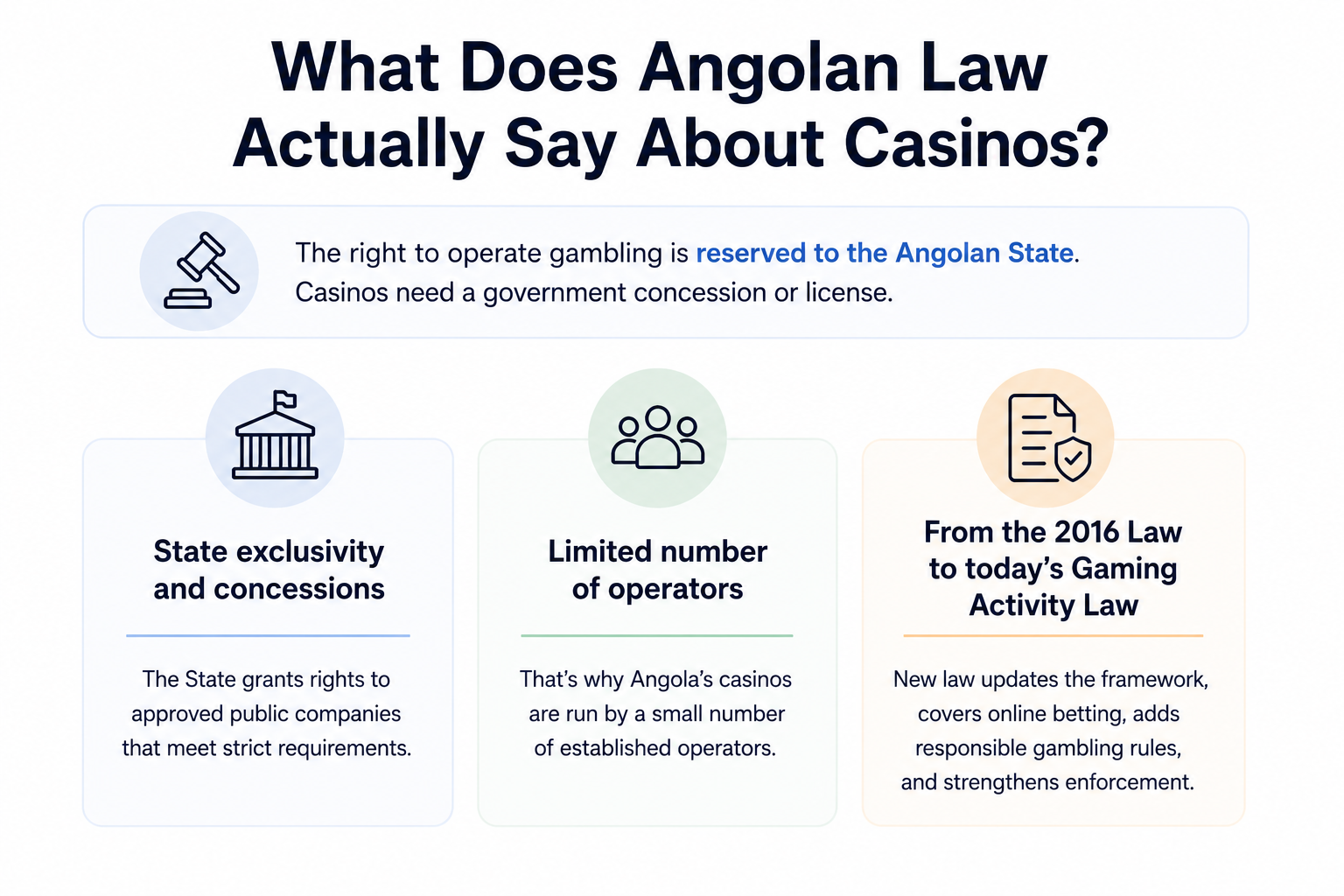
Gambling in Angola sits under a general legal framework rather than one single, standalone “casino act” that covers everything. The core principle running through Angolan gaming law is straightforward: the right to exploit gambling activities is reserved to the Angolan State. Private companies don’t get to open a casino just because they have capital and a building — they need a concession or license granted by the government.
State Exclusivity and Concessions
This state-reserved-rights model isn’t unusual in Portuguese-speaking jurisdictions; Angola inherited a lot of its legal structure from Portugal, and gambling regulation reflects that. In practice, the State grants exploitation rights to public limited companies (sociedades anónimas) that meet capital, ownership, and operational requirements. That’s why casinos in Angola tend to be run by a small number of established operators rather than a wide field of independent small businesses.
From the 2016 Law to Today’s Gaming Activity Law
For years, the sector operated under Law No. 5/16, Angola’s general gambling law from 2016. It covered land-based gaming reasonably well but said little about online betting, which barely existed commercially in Angola at the time. President João Lourenço’s administration later pushed through a broader Gaming Activity Law designed to replace that older framework, separate sports betting from lottery-style concessions, add responsible gambling requirements, and strengthen enforcement.
Land-Based Casinos in Angola: Where They Actually Are
Land-based casinos aren’t a rumor or a legal technicality in Angola — they’re a visible, functioning part of the hospitality and entertainment scene. There are roughly a dozen operating casinos across the country, ranging from modest slot halls to full-scale luxury properties attached to hotels. Most of them cluster in Luanda, the capital, with a couple of properties further south in Lubango.
Region | Approximate Number of Casinos | Typical Format |
|---|---|---|
Luanda | Majority of the total (around 9-10) | Hotel-based luxury casinos and standalone gaming halls |
Lubango | Two | Smaller regional gaming venues |
Other provinces | Occasional single venues | Limited gaming halls, slots-focused |
These are legal, licensed businesses operating under Angolan gaming concessions, not underground operations. Tourists and residents alike can walk into them without breaking any law, provided they meet standard age and identification requirements that most casinos enforce as a matter of house policy.
Online Gambling in Angola: Legal, But the Details Matter
Here’s the thing though — online gambling is where most of the confusion actually lives. Land-based casinos are easy to verify; you can see the building. Online platforms are harder to pin down, and that’s exactly where licensing status starts to matter a lot more.
The 2020 Presidential Decree
Online betting and gambling became formally legal in Angola through a presidential decree issued in 2020. Before that, the legal status of internet-based betting was murky at best. The decree opened a path for licensed operators — structured as public limited companies, same as their land-based counterparts — to offer online sports betting and casino games to Angolan residents.
The Transitional Licensing Window
Under the newer Gaming Activity Law, existing and prospective online operators have had to go through a compliance process, often described as a transitional licensing window, to keep operating legally or to enter the market for the first time. Companies already holding licenses under the older framework were typically given a defined grace period — commonly discussed as around 180 days in industry coverage — to bring their operations up to the new law’s standards once it took effect. New applicants, meanwhile, submit licensing requests tied to the specific type of gaming they intend to offer.
The number of officially licensed online operators in Angola has historically been small — reporting has pointed to roughly ten licensees at various points — which tells you the market is tightly controlled rather than wide open. That’s a meaningfully different situation from countries where dozens of international brands compete freely.

Bring Your iGaming Product to the Angolan Market
Sologe is built around products and services for the gaming industry, from software and platforms to payments, sports betting, equipment, traffic, and related services. If Angola is part of your target market, Sologe gives your offer a place where people are already looking specifically for gaming solutions.
Ready to Add Your Offer?
Sologe lets you:
- list your product under the right iGaming category
- show buyers what type of solution you provide
- keep your offer visible in an industry-specific marketplace
👉Get in touch with Sologe to start your listing.
Is It Legal for Angolans to Access Foreign Online Casinos?
This is where the law gets genuinely permissive compared to many neighboring countries. There isn’t a specific rule in Angolan law that prohibits individuals from visiting or playing at foreign-licensed online casinos. The licensing regime targets operators — the companies that need permission to offer games inside Angola — rather than individual players choosing to access an offshore site.
That doesn’t mean playing on an unlicensed offshore platform is risk-free. It just means the legal exposure sits mostly with the operator, not the player. Anyone doing it should still weigh the practical risks discussed below.
Licensed vs. Unlicensed Operators: What Actually Changes for Players
Factor | ISJ-Licensed Operator | Unlicensed / Offshore Operator |
|---|---|---|
Legal accountability inside Angola | Subject to Angolan law and ISJ oversight | Operates outside Angolan jurisdiction, little local recourse |
Dispute resolution | Formal complaint channel through the regulator | Depends entirely on the foreign license’s own process, if any |
Payment security | Subject to local financial compliance rules | Varies widely, often unregulated |
Responsible gambling tools | Required under the Gaming Activity Law | Optional, inconsistent across operators |
Availability of local payment methods | Generally better integrated | Often limited to international cards or crypto |
None of this means offshore platforms are automatically scams. Plenty are licensed elsewhere — Malta, Curaçao, Gibraltar — and run legitimate operations. But when something goes wrong with a payout dispute, an Angolan player has essentially no local authority to lean on, since that operator was never accountable to the ISJ in the first place.
Risks Worth Knowing About Before Playing Online
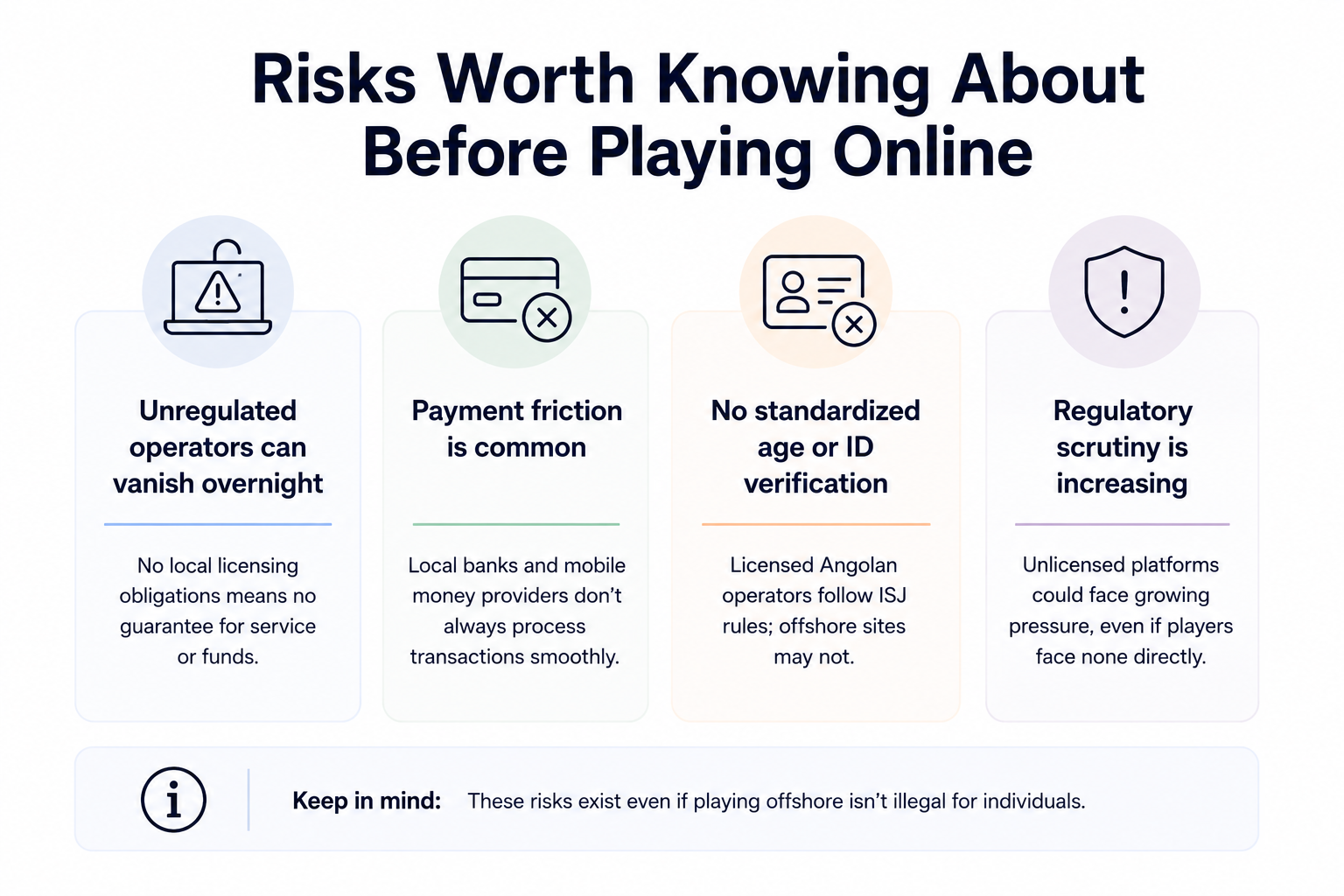
- Unregulated operators can vanish overnight. Without local licensing obligations, there’s no guaranteed continuity of service or funds.
- Payment friction is common. Local banks and mobile money providers don’t always process transactions to offshore gambling sites smoothly.
- No standardized age or identity verification. Licensed Angolan operators must follow ISJ rules on this; offshore sites may not enforce anything close to local standards.
- Regulatory scrutiny is increasing. As Angola tightens its licensing regime, unlicensed platforms serving Angolan users could face growing pressure, even if the individual player faces none directly.
How to Check If an Operator Is Legally Licensed in Angola
Verifying license status doesn’t take long, and it’s worth doing before depositing money anywhere.
A simple check to confirm whether an online casino holds an Angolan license.
- Look for a license number and the issuing body cited on the operator’s site.
- Cross-check that number against the Gaming Supervisory Institute’s public information, when available.
- If the operator only cites a foreign license (Curaçao, Malta, etc.), understand it isn’t Angolan-regulated, even if it’s technically legitimate elsewhere.
- Be cautious of platforms that don’t disclose any licensing information at all — that’s a bigger red flag than an offshore-only license.
FAQ: Casinos and Gambling Legality in Angola
Is gambling legal in Angola?
Yes. Both land-based casinos and licensed online gambling are legal in Angola, subject to the country’s general gambling law and the newer Gaming Activity Law framework overseen by the Gaming Supervisory Institute.
How many casinos are there in Angola?
Roughly a dozen physical casinos operate in the country, with the majority concentrated in Luanda and a couple located in Lubango. Formats range from simple gaming halls to large hotel-based establishments.
Is online gambling legal in Angola?
Yes, since a 2020 presidential decree formally opened the door to licensed online betting and casino gaming. Operators still need a license from the Gaming Supervisory Institute to legally offer services to Angolan players.
Can Angolans legally play at foreign online casinos?
There’s no specific law banning individuals from accessing foreign-licensed online casinos. Angola’s licensing rules focus on the operators offering services locally, not on individual players choosing offshore platforms – though doing so carries practical risks around payment security and dispute resolution.
Who regulates casinos and gambling in Angola?
The Gaming Supervisory Institute (ISJ) is the regulatory body responsible for licensing and overseeing gambling operators, both land-based and online, under Angola’s Gaming Activity Law.
What is the transitional licensing window?
It refers to the grace period given to existing and new gambling operators to bring their licenses and operations into compliance with Angola’s updated Gaming Activity Law, replacing the older 2016 legal framework.
Are unlicensed online casinos illegal to use in Angola?
Using an unlicensed offshore casino isn’t clearly illegal for the individual player under current Angolan law, but the operator itself would be operating outside Angola’s licensing regime, which carries its own risks for the player around accountability and recourse.
The Bottom Line
Casinos are legal in Angola — that part isn’t in question, whether it’s a hotel gaming floor in Luanda or a licensed sportsbook app. What matters more in 2026 is licensing status, not legality in the abstract. Angola’s Gaming Activity Law and its transitional licensing window have pushed the market toward tighter oversight, fewer but more accountable operators, and clearer rules for responsible gambling. Anyone planning to gamble online in Angola should take the extra few minutes to confirm an operator holds an actual ISJ license rather than assuming legality from a slick website alone. And for anything time-sensitive — current license lists, specific tax rates, or newly approved operators — the Gaming Supervisory Institute’s official publications remain the most reliable source.
Related Articles

September 29, 2026Is the Casino Legal in Japan? The Real Answer...

September 29, 2026Is the Casino Legal in Gambia? What the Law...