 Nothing found for the request
Is the Casino Legal in Peru? 2026 Laws & Regulations
Sologe July 10, 2026
Share:


A Brief Legal History: How Peru Built Its Gambling Framework
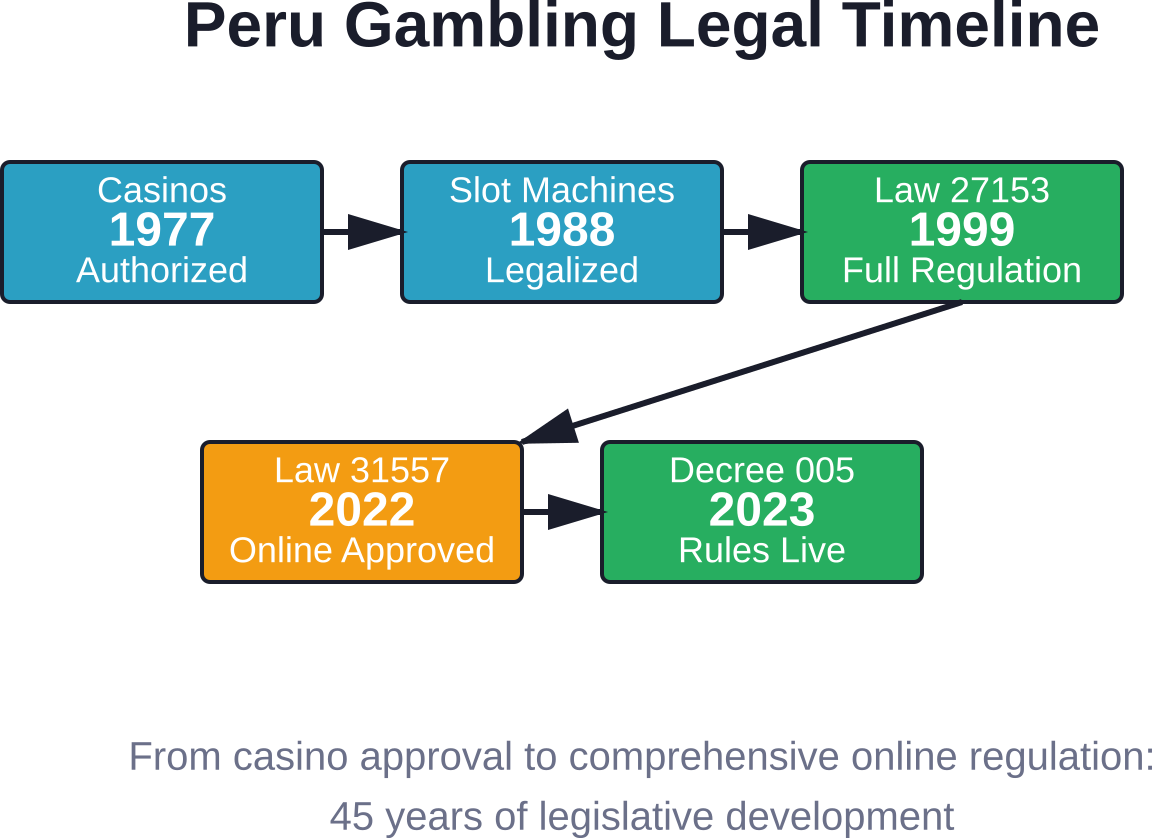
Peru’s modern gambling regulation started in 1977 when the government first authorized casinos. But the framework was skeletal. Oversight was weak, enforcement inconsistent, and most activity happened in a legal twilight.
Real structure arrived in 1988 when slot machines received official legal approval. Early rules imposed a 3% tax rate on slot machine operations—a modest figure designed to encourage formalization. From 1992 onward, that tax jumped to 20%, signaling a shift toward tighter fiscal control.
Then came the watershed moment.
Law No. 27153: The Foundation for Land-Based Gambling
In 1999, Peru enacted Law No. 27153, which established comprehensive regulations for casinos and slot machines. This legislation clarified who could operate, where establishments could be located, and what technical standards applied to gaming equipment.
The law introduced several critical provisions:
- Casinos and slot machine venues could not operate within 150 meters of schools, hospitals, or places of worship in Lima and Callao; in other provinces, the distance is 100 meters.
- Machines had to meet a minimum return-to-player (RTP) threshold of 85%
- Operators face a 19% tax on gross gaming revenue from casino games and slot machines
- Licensing authority was centralized under what is now the Dirección General de Juegos de Casino y Máquinas Tragamonedas (DGJCMT)
According to university studies cited by ENV Media, Peruvians spent around USD 100 million on casino and slot games circa 1999-2000. Those numbers have grown considerably since.
Land-based gambling was mature, regulated, and economically significant. Online gambling? That took another two decades.
Law No. 31557: Online Gambling Finally Gets Legal Status
In 2022, Peru passed Law No. 31557, which brought online casino games and sports betting under formal regulation. The law was later refined by Law No. 31806, which clarified definitions, tightened compliance language, and addressed tax ambiguities.
The implementing decree—Supreme Decree No. 005-2023-MINCETUR—was approved on October 13, 2023. It outlined the technical and operational requirements for online operators and set the licensing framework into motion. The regulations were set to enter effect 120 days from the issuing of the regulations, with the regulations going into effect on 9 February 2024.
Peru’s Ministry of Foreign Trade and Tourism (MINCETUR) oversees both land-based and online gambling through its DGJCMT division. This consolidation ensures consistent enforcement across channels.
Who Regulates Gambling in Peru?
Three entities share responsibility for Peru’s gambling sector:
Ministry of Foreign Trade and Tourism (MINCETUR)
MINCETUR holds ultimate regulatory authority. It drafts legislation, approves regulatory decrees, and sets national policy. The ministry’s involvement reflects Peru’s broader strategy: treating gambling as an economic activity tied to tourism and hospitality infrastructure.
Dirección General de Juegos de Casino y Máquinas Tragamonedas (DGJCMT)
The DGJCMT is the operational arm. According to official government sources, it’s responsible for formulating, supervising, and enforcing administrative rules—both for land-based casinos and online platforms. The agency conducts on-site inspections, verifies technical compliance, issues licenses, and imposes sanctions.
Between January and August 2022, MINCETUR carried out 1,346 inspections of more than 700 authorized slot machine gaming rooms and issued over 30 fines for various violations, signaling active enforcement.
SUNAT (National Superintendence of Tax Administration)
SUNAT enforces tax compliance. For licensed operators, it’s the authority that collects the 12% net revenue tax on online gambling, the 19% tax on land-based gaming revenue, and the selective consumption tax (ISC) that applies to online turnover. Financial discipline is a core measure of credibility during the licensing process.
What Types of Gambling Are Legal in Peru?
Peru’s regulatory framework covers four main categories:
Land-Based Casinos
These include traditional table games—roulette, blackjack, poker, baccarat—and are governed by Law No. 27153. Operators must secure venue-specific licenses and meet strict location requirements (no casinos within 150 meters of schools, hospitals, or places of worship in Lima and Callao; 100 meters in other provinces).
Slot Machines (Tragamonedas)
Slot machines operate both in dedicated venues and within licensed casinos. Machines must be certified by authorized testing laboratories and maintain a minimum RTP of 85%. Each machine model and its underlying software require separate registration and approval.
Online Casino Games
Law No. 31557 legalized online casino games, including digital slots, table games, and live dealer offerings. Operators must use certified Random Number Generators (RNGs), geofence services to Peruvian territory, and implement player verification systems.
Sports Betting (Land-Based and Online)
Sports betting was formalized alongside online casino games in 2022. Both physical betting shops and online sportsbooks are permitted. Operators must register approved betting models, comply with anti-match-fixing protocols, and integrate responsible gambling tools.
Lottery products are also legal but operate under a separate regulatory track managed by different authorities.
Explore iGaming Business Solutions with Sologe
Market research often extends beyond legal considerations. Businesses may need to understand which suppliers, technologies, and support services are commonly used across the gaming industry. Sologe is a B2B iGaming marketplace that helps companies navigate different provider categories and review available solutions.
Sologe’s marketplace features:
- Casino and gaming platforms
- Gaming software providers
- Payment providers
- Analytics software
- Marketing software
- Mobile application solutions
- Certification services
- Operations management services
Contact Sologe to learn more about gaming platforms, software vendors, payment providers, and other B2B solutions for the iGaming industry.
How to Get a Gambling License in Peru
Peru issues unified licenses covering both online casino games and sports betting. The process is structured but demanding.
Eligibility Requirements
Applicants must meet several baseline criteria:
- Legal entity registered in Peru or with a local subsidiary/branch
- No criminal convictions related to gambling, financial crimes, or money laundering
- Technical infrastructure capable of geolocation, player verification, and real-time reporting to DGJCMT
- Certified gaming software from approved testing laboratories
- Responsible gambling measures, including self-exclusion tools, deposit limits, and session reminders
International operators can apply, but they must establish a legal presence in Peru—either through a local subsidiary or a registered branch office.
Financial Requirements
The financial guarantee (colateral/garantía) is set at the greater of 2,970,000 Peruvian Soles (or 200 UIT) or 3% of the annual net income. This amount is not a license fee, but a mandatory bank guarantee/bond required to secure operations and prize payouts under Law No. 31557 (as amended by Law No. 31806).
Technical and Compliance Standards
Operators must submit detailed technical documentation:
- Server architecture and data hosting plans (servers must be physically located in Peru or in jurisdictions with data-sharing agreements)
- RNG certification from an accredited testing lab
- Integration plans for geolocation technology to restrict access to Peruvian territory
- Anti-money laundering (AML) and counter-terrorism financing (CTF) compliance protocols
- Player identity verification systems meeting KYC (Know Your Customer) standards
The DGJCMT reviews applications on a case-by-case basis. There’s no fixed approval timeline, but the process typically takes several months.
License Duration and Renewal
Online gambling licenses are valid for 6 years. Operators must apply for renewal at least 180 days before expiration. Renewal is not automatic—the DGJCMT evaluates compliance history, financial performance, and any outstanding violations before granting extensions.
Tax Rates and Financial Obligations
Peru’s tax structure varies by gambling type and has evolved significantly in recent years.
Land-Based Casinos and Slot Machines
Operators of land-based casinos and slot machines pay a 19% tax on gross gaming revenue. This rate applies to net gaming income after payouts but before operational expenses.
Online Gambling: Net Revenue Tax
Online casino and sports betting operators pay a 12% tax on net revenue. Net revenue is defined as total wagers minus player winnings, but before deducting bonuses, promotional costs, or operational expenses.
This 12% rate is considerably lower than land-based rates, reflecting Peru’s intent to stimulate online market growth while maintaining fiscal oversight.
Selective Consumption Tax (ISC)
In addition to the net revenue tax, online operators face a tiered ISC applied to total turnover (not just net revenue):
- From 20 January 2025 to 30 June 2025: 0.3% ISC on turnover
- From 1 July 2025 onwards: 1% ISC on turnover
The ISC is a consumption tax designed to capture a share of total economic activity, not just profit. It increases the effective tax burden but remains manageable compared to many European jurisdictions.
Annual Operational Guarantee Maintenance
Licensed operators must maintain an active financial guarantee equivalent to 3% of their annual net income or 600 UIT, whichever is greater, throughout the duration of the license.
Tax Type | Rate | Applied To | Notes
|
|---|---|---|---|
Land-Based Gaming | 19% | Gross gaming revenue | Casinos and slot machines |
Online Net Revenue | 12% | Wagers minus winnings | Applies to casino and sports betting |
ISC (Jan–Jun 2025) | 0.3% | Total turnover | Temporary introductory rate |
ISC (Jul 2025+) | 1% | Total turnover | Permanent rate |
Operational Guarantee Maintenance | 3% or 600 UIT | Net income / minimum | Whichever is greater |
Enforcement and Compliance: What Happens If Operators Break the Rules?
Peru’s regulatory environment is not passive. The DGJCMT conducts regular inspections, monitors real-time data feeds from licensed operators, and imposes sanctions for violations.
Common Violations and Penalties
Enforcement actions focus on several areas:
- Operating without a valid license (immediate shutdown, criminal referral)
- Technical non-compliance (e.g., uncertified RNGs, inadequate geofencing)
- AML/CTF failures (missed reports, insufficient KYC checks)
- Failure to implement responsible gambling tools
- Tax underreporting or late payments
Penalties range from financial fines to license suspension or permanent revocation. In 2022, MINCETUR issued more than 30 fines following on-site inspections of slot machine operators, demonstrating that enforcement is active and not merely symbolic.
Real-Time Reporting Obligations
Online operators must integrate their platforms with DGJCMT’s monitoring systems. This includes transmitting real-time data on:
- Player registrations and identity verifications
- Wagering activity (bets placed, outcomes, payouts)
- Financial transactions (deposits, withdrawals, bonus credits)
- Responsible gambling interventions (deposit limits triggered, self-exclusions initiated)
Failure to maintain reliable data feeds or delays in reporting can trigger audits and potential sanctions.
Player Protections and Responsible Gambling Measures
Peru’s regulatory framework mandates several player protection mechanisms.
Self-Exclusion Programs
All licensed operators must offer self-exclusion tools. Players can voluntarily block themselves from accessing gambling services for defined periods (30 days, 6 months, 1 year, or permanently).
Self-exclusion requests must be honored within 24 hours, and operators are prohibited from marketing to self-excluded individuals.
Deposit Limits and Session Timers
Platforms must allow players to set daily, weekly, or monthly deposit limits. Once set, limits can only be increased after a cooling-off period (typically 24–72 hours).
Session reminders (pop-up notifications showing time spent and money wagered) are required after continuous play exceeds a threshold set by the operator, typically 60–90 minutes.
Age Verification
Gambling is restricted to individuals 18 years and older. Operators must verify age and identity before allowing real-money play, typically through national ID cross-checks or third-party verification services.
Ludopatía (Gambling Addiction) Resources
The DGJCMT maintains resources on ludopatía (problem gambling) and requires operators to display helpline numbers and links to support organizations prominently on their websites.
Popular Payment Methods for Online Gambling in Peru
Peru’s payment ecosystem blends traditional banking with emerging digital wallets. Licensed operators must support a range of methods to comply with accessibility requirements.
Credit and Debit Cards
Visa and Mastercard are widely accepted. Card payments are convenient but face occasional declines from banks with conservative gambling policies.
Bank Transfers
Direct bank transfers are common for larger deposits. Major Peruvian banks include Banco de Crédito del Perú (BCP), Banco de Comercio, Banco Interamericano de Finanzas (BanBif), Banco Pichincha, and BBVA Peru.
E-Wallets
Digital wallets like Neteller and Skrill are popular among online bettors due to faster processing times and added privacy. Some platforms also integrate local e-wallets, though adoption varies.
Cash Vouchers and Prepaid Cards
Some operators partner with retail networks to offer cash deposit vouchers, allowing players without bank accounts to fund their accounts at convenience stores or kiosks.
The Market Opportunity: Why Peru Attracts Operators
Despite stringent licensing requirements, Peru’s gambling market holds appeal for several reasons.
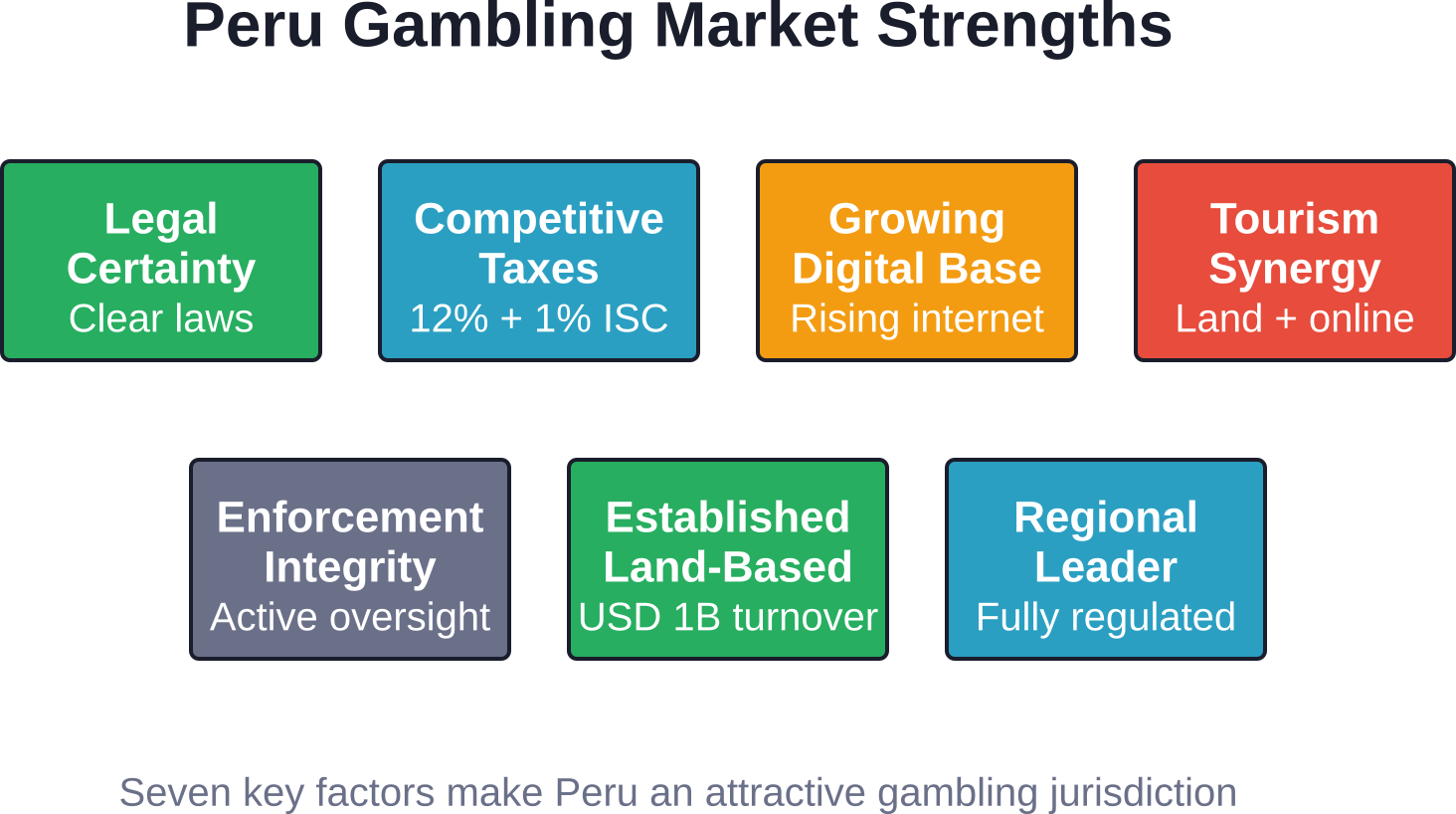
Clear Legal Framework
Unlike many Latin American countries where online gambling exists in regulatory limbo, Peru offers legal certainty. Operators can enter with confidence that licenses are legitimate, enforceable, and recognized by payment processors and banks.
Moderate Tax Burden
A 12% net revenue tax plus a 1% ISC on turnover is competitive globally. Many European jurisdictions impose gross gaming revenue taxes exceeding 20–30%, making Peru’s structure relatively favorable for profitability.
Growing Digital Economy
Peru’s internet penetration and smartphone adoption have risen steadily. Urbanization, expanding middle-class income, and improved fintech infrastructure all support online gambling growth.
By 2019, offline gambling turnover reached approximately USD 1 billion (per industry figures cited by ENV Media), and the online segment is expected to grow rapidly as licensing stabilizes.
Tourism and Land-Based Synergy
Peru’s tourism sector—anchored by attractions like Machu Picchu, Lima’s culinary scene, and coastal resorts—creates natural synergy between land-based casinos and online platforms. Operators with integrated offerings can capture both local players and international visitors.
Challenges and Risks for Operators
No market is without obstacles. Peru presents several challenges that operators must navigate carefully.
High Entry Costs
The license fee alone (approximately USD 800,000) is a significant barrier. Smaller operators or startups may struggle to justify the upfront investment, especially given the 6-year license term and no guarantee of renewal.
Compliance Complexity
Real-time reporting, AML protocols, RNG certifications, geofencing—these requirements demand robust technical infrastructure and ongoing maintenance. Operators without experience in heavily regulated markets may find the compliance burden daunting.
Market Maturity and Competition
Peru’s land-based sector is mature, with established brands and loyal customer bases. Online gambling is newer, but as more licenses are issued, competition will intensify. Customer acquisition costs could rise, and differentiating brands will require investment in localization, marketing, and player experience.
Payment Processing Friction
While Peru’s banking system is relatively developed, some banks remain cautious about gambling transactions. Operators may face deposit declines, withdrawal delays, or limited payment method availability, particularly for international cards.
Economic Volatility
Peru’s economy has shown resilience, but currency fluctuations, inflation, and political instability can impact consumer spending on discretionary activities like gambling. Operators must build flexibility into financial models to absorb macro shocks.
Comparing Peru to Other Latin American Markets
How does Peru stack up against regional peers?
Country | Land-Based Legal? | Online Legal? | Tax Rate (Online) | Regulatory Clarity
|
|---|---|---|---|---|
Peru | Yes | Yes | 12% + 1% ISC | High |
Colombia | Yes | Yes | 15% GGR | High |
Argentina | Yes (provincial) | Mixed (provincial) | Varies by province | Moderate |
Brazil | Limited | In progress (2024 law) | 18% GGR (proposed) | Moderate (evolving) |
Chile | Yes | No (proposed) | N/A | Low (no online framework) |
Mexico | Yes | Yes | 30% GGR | Moderate |
Peru’s combination of legal clarity, moderate taxation, and unified land-based/online oversight places it among the top-tier markets in Latin America. Colombia offers similar clarity but with a 15% gross gaming revenue tax on online gambling. Brazil’s massive population makes it attractive, but regulatory uncertainty and high proposed tax rates introduce risk. Argentina’s fragmented provincial system complicates multi-jurisdiction operations.
For operators seeking a stable, predictable entry point into South America, Peru is a strong contender among regional markets.
What’s Next for Peru’s Gambling Sector?
Peru’s online gambling framework is still young. Several trends are likely to shape the market’s evolution over the next few years.
Increased License Issuance
As the regulatory process matures, MINCETUR is expected to approve additional licenses. More operators mean more competition, but also greater player choice and potentially higher marketing spend that benefits the overall ecosystem.
Enhanced Enforcement
The DGJCMT’s active inspection regime will likely intensify. Expect more frequent audits, stricter AML enforcement, and harsher penalties for non-compliance. Operators that cut corners will face swift consequences.
Responsible Gambling Evolution
As the market grows, so will public and political scrutiny around problem gambling. Peru may introduce mandatory spend limits, expanded self-exclusion databases, or advertising restrictions modeled after European markets.
Regional Integration
Peru could explore mutual recognition agreements with other Latin American jurisdictions, allowing operators licensed in one country to fast-track licensing in another. Such frameworks exist in Europe (e.g., within the European Gaming and Betting Association) and could reduce entry costs across the region.
Technological Innovation
Geofencing, real-time analytics, blockchain-based transparency tools—Peru’s regulatory infrastructure is built to accommodate emerging technologies. Operators that innovate responsibly may gain competitive advantages and preferential treatment from regulators.
Frequently Asked Questions
Is online gambling legal in Peru?
Yes. Peru legalized online casino games and sports betting through Law No. 31557 in 2022. The framework was later refined by Law No. 31806, with implementing regulations taking effect in 2023. Licensed operators must comply with technical, financial, and regulatory requirements enforced by MINCETUR through the DGJCMT.
How much does a gambling license cost in Peru?
Peru requires online gambling operators to provide a financial guarantee equal to the greater of 2,970,000 Peruvian Soles or 3% of projected annual net income. This guarantee secures player payouts and regulatory compliance rather than serving as a government license fee. Licensed operators must also maintain the required guarantee throughout the license period and pay applicable gambling taxes.
Who regulates gambling in Peru?
The Ministry of Foreign Trade and Tourism (MINCETUR) is Peru’s primary gambling regulator. Its Dirección General de Juegos de Casino y Máquinas Tragamonedas (DGJCMT) oversees licensing, inspections, and enforcement, while SUNAT is responsible for tax administration and collection.
What types of gambling are legal in Peru?
Peru allows licensed land-based casinos, slot machines, online casino games, and sports betting offered both online and at physical locations. Lotteries are regulated under separate legislation. All gambling operators must obtain the appropriate licenses and comply with technical and consumer protection requirements.
Are players taxed on gambling winnings in Peru?
No. Individual players are not taxed on gambling winnings in Peru. Gambling taxes are imposed on licensed operators, including taxes on online net revenue, land-based gross gaming revenue, and the applicable Selective Consumption Tax for online gambling activities.
How long does a Peru gambling license last?
Online gambling licenses in Peru are valid for six years. Operators must submit a renewal application at least 180 days before the license expires. Renewals are subject to a regulatory review of compliance, financial performance, and licensing history.
Can international operators get a license in Peru?
Yes. International operators may obtain a Peruvian gambling license by establishing a registered local subsidiary or branch office and meeting all financial, technical, and compliance requirements, including maintaining the required financial guarantee and connecting their systems to the DGJCMT’s reporting framework.
Conclusion: Peru Offers Legal Certainty in a Complex Region
So, is the casino legal in Peru? Absolutely—and not just legal, but comprehensively regulated.
Peru’s gambling framework combines decades of land-based experience with forward-thinking online legislation. The country offers clear licensing pathways, moderate taxation, active enforcement, and robust player protections. For operators willing to meet the financial and technical requirements, Peru represents one of Latin America’s most stable and attractive markets.
But stability doesn’t mean simplicity. Licensing is expensive, compliance is demanding, and competition will intensify as more operators enter. Success requires more than capital—it requires operational excellence, regulatory fluency, and a long-term commitment to responsible gambling practices.
For players, Peru’s regulated market means safer, fairer gaming experiences. Licensed operators are accountable. Games are certified. Protections are enforceable.
For investors and operators, Peru’s legal certainty reduces risk. There’s no regulatory limbo, no ambiguous grey markets. The rules are clear, the authorities are active, and the market is open.
If Latin America’s gambling sector continues its current trajectory—consolidation, digitalization, regional integration—Peru is positioned to play a leading role. The legal foundation is solid. The market fundamentals are sound. The question isn’t whether Peru’s gambling sector will grow. It’s who will capture that growth.
Looking to enter Peru’s regulated gambling market? Start by reviewing the full text of Law No. 31557, Supreme Decree No. 005-2023-MINCETUR, and the DGJCMT’s published licensing guidelines. Consult with local legal counsel experienced in gaming regulation. Budget for compliance infrastructure from day one. And build relationships with regulators early—transparency and communication matter as much as technical compliance.
Peru’s doors are open. But only to operators who respect the rules.
Related Articles

September 3, 2026Is the Casino Legal in Denmark? 2026 Guide

September 3, 2026Is the Casino Legal in Angola? What the 2026...