 Nothing found for the request
Is the Casino Legal in Iran? 2026 Laws & Penalties
Sologe July 10, 2026
Share:


The Legal Framework: Why Casinos Are Banned in Iran
Iran’s prohibition on casinos stems directly from its foundation as an Islamic Republic. The 1979 Islamic Revolution didn’t just change Iran’s government—it fundamentally restructured the country’s legal system around Sharia principles.
Immediately following the revolution, all existing casinos were shuttered. Gambling of any kind became classified as haram (forbidden) under Islamic law, joining activities like alcohol consumption and usury on the list of prohibited practices.
The legal teeth behind this prohibition came with the Islamic Penal Code, Book Five, passed on May 22, 1996, specifically Article 705, which criminalizes all forms of gambling. This wasn’t symbolic legislation—it established concrete penalties including imprisonment and corporal punishment for violators.
Here’s the thing though—Iran’s judiciary has consistently upheld these restrictions even as neighboring countries have softened their stance on certain forms of gaming. The country maintains one of the strictest anti-gambling positions in the Middle East.
What Exactly Counts as Illegal Gambling?
Iranian law doesn’t distinguish between casino types or gambling formats. All of the following are equally prohibited:
- Land-based casinos and gaming halls
- Online casinos and betting platforms
- Sports betting and prediction markets
- Poker rooms and card games for money
- Lotteries and raffles with prizes
- Slot machines and gaming devices
The prohibition extends to both operating gambling establishments and participating as a player. Iranian authorities prosecute both sides of the transaction.
Interestingly, Supreme Leader Ayatollah Ali Khamenei recently issued a ruling stating that predicting sports outcomes for prizes isn’t inherently forbidden, creating a minor theological loophole. But Iran’s judiciary continues treating all gambling-related activities as criminal offenses regardless of this nuance.
Penalties and Enforcement: What Happens if You Gamble?
Iran doesn’t mess around with gambling violations. The penalties range from harsh to severe depending on the offense’s scale and the offender’s role.
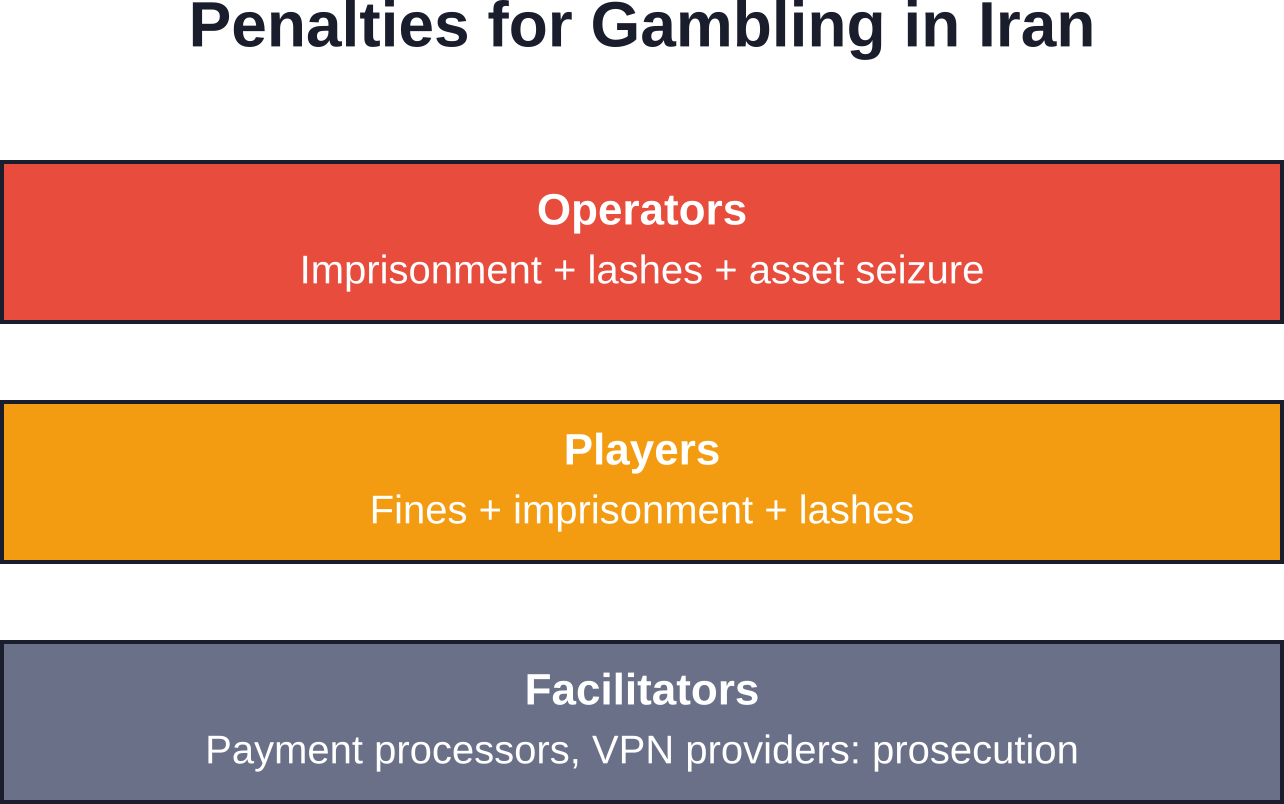
For operators running illegal gambling platforms, the consequences escalate dramatically. A 2021 legislative proposal sought the death penalty for illegal online gambling operators, but was not enacted.
Still, current penalties remain severe. Operators face lengthy prison sentences, corporal punishment through lashing, and complete asset forfeiture. Authorities have frozen 72 billion tomans in suspected gambling funds in enforcement actions.
Players caught gambling face their own set of penalties. These include fines, potential imprisonment, and in some cases, lashes as corporal punishment. The exact penalty depends on the amount wagered and whether it’s a first offense.
Aggressive Government Crackdowns
Iran’s enforcement hasn’t remained static. Since 2021, major government crackdowns have targeted illegal online gambling networks, culminating in high-profile arrests and the dismantling of large operations.
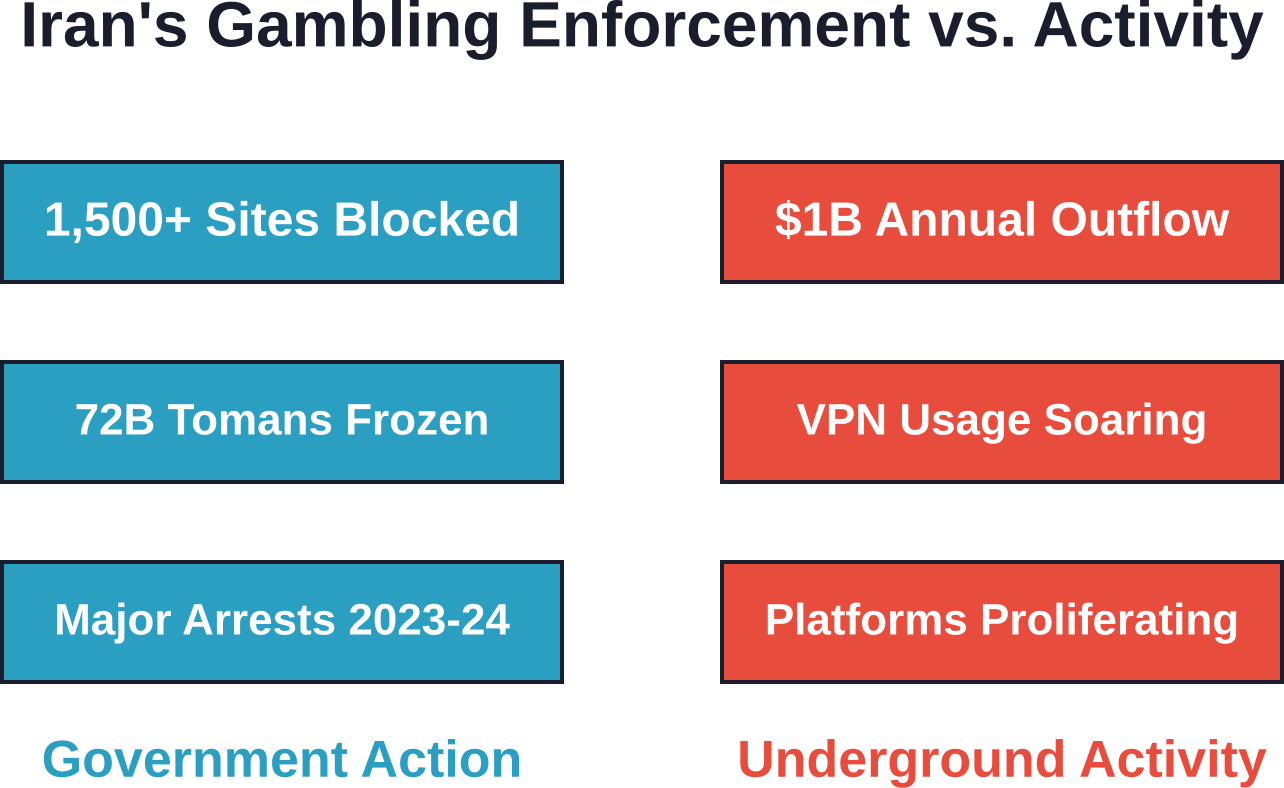
The Cyber Police division (FATA) has been particularly active. Since 2021, authorities have shuttered over 1,500 gambling websites and frozen 72 billion tomans in suspected gambling funds.
Authorities have also identified unregistered point-of-sale systems throughout Iran, which investigators believe serve as conduits for illicit cash flows including gambling proceeds.
Real talk: these numbers show Iran isn’t just paying lip service to anti-gambling laws. The government actively dedicates significant resources to tracking, prosecuting, and dismantling gambling operations.
The Underground Gambling Boom: Why It Persists
So if enforcement is this aggressive and penalties this severe, why does gambling continue?
The answer lies in Iran’s devastating economic conditions. Crippling inflation, international sanctions, and currency devaluation have left many Iranians financially desperate. For some, gambling represents what they perceive as their only chance at meaningful financial gain.
According to some reports, an estimated $1 billion in gambling profits exited Iran annually. That’s a staggering sum flowing to offshore platforms despite all legal prohibition.
One Iranian gambler interviewed by Iran International explained the economic calculation: “You save 100 million rials today, and in six months, it buys half as much.” For him and others, gambling in dollars or cryptocurrency through offshore sportsbooks becomes a financial hedge against inflation and sanctions.
But wait. How do Iranians access these platforms when they’re illegal?
The VPN Workaround
Virtual Private Networks (VPNs) have become the primary tool Iranians use to circumvent both internet censorship and gambling restrictions. By masking their location and encrypting their connection, Iranian users can access offshore casino sites and sports betting platforms.
These international platforms typically accept cryptocurrency or dollar transactions, allowing Iranians to gamble while simultaneously protecting their savings from rial devaluation.
Many platforms operate in plain sight despite their illegality, advertising through social media and messaging apps. The sheer volume of sites makes complete enforcement virtually impossible despite the Cyber Police’s best efforts.
Explore Gambling Providers with Sologe
When researching markets where casino activity is highly restricted or prohibited, businesses may still want to understand the broader technology ecosystem that supports the global gaming industry. Sologe is a B2B iGaming marketplace that connects companies with providers across software, payments, platforms, and other operational categories.
Sologe supports supplier research for:
- Casino platform providers
- Gaming software vendors
- Payment solutions
- Analytics software
- Marketing software
- Mobile application solutions
- Certification services
- Additional gaming software
👉Contact Sologe to learn more about software providers, payment solutions, technology vendors, and other B2B iGaming services.
The Religious and Cultural Context
Understanding Iran’s casino prohibition requires grasping its religious foundation. Islamic law views gambling as morally corrupting and economically destructive.
Traditional Islamic scholarship argues that gambling creates wealth transfer without productive work, violating principles of fair economic exchange. It’s also seen as encouraging greed, addiction, and family destruction.
In 2019, Iran’s state television temporarily banned game shows after Supreme Leader Ayatollah Ali Khamenei warned that such programs endanger the “culture of hard work and productivity.” A senior Shia cleric issued a religious ruling declaring the cash prizes on shows like “Be a Winner” (Iran’s equivalent of Who Wants to Be a Millionaire) as problematic under Islamic principles.
This incident illustrates how seriously Iranian religious authorities take even the appearance of gambling-like activities. If a television game show draws condemnation, actual casinos stand no chance of legalization.
Historical Perspective: Pre-Revolution Casinos
Before 1979, Iran had a different relationship with gambling. During the Pahlavi monarchy, particularly in the 1970s, Iran became one of the first Middle Eastern nations to establish legal casinos catering to wealthy Iranians and international tourists.
These establishments operated openly in Tehran and other major cities, representing the country’s more secular orientation under the Shah. The Islamic Revolution abruptly ended this era, closing all casinos and criminalizing the industry overnight.
This historical context matters because it shows Iran’s gambling prohibition isn’t rooted in ancient tradition but rather in the specific ideological choices made after 1979. The current legal framework represents a deliberate rejection of the previous regime’s social policies.
Comparison with Regional Gambling Laws
Iran’s strict stance isn’t unique in the Middle East, but it’s among the most rigidly enforced. Most Muslim-majority countries prohibit gambling to varying degrees, though enforcement and severity differ significantly.
Country | Casino Legality | Online Gambling | Enforcement Level
|
|---|---|---|---|
Iran | Completely illegal | Completely illegal | Very strict with harsh penalties |
Saudi Arabia | Completely illegal | Completely illegal | Very strict |
UAE | Illegal for Muslims | Illegal but loosely enforced | Moderate enforcement |
Turkey | Land casinos banned | Licensed sites only | Moderate enforcement |
Egypt | Allowed for tourists only | Illegal | Light enforcement |
While countries like the UAE have found ways to accommodate gambling for tourists (though not for Muslim citizens), Iran has shown zero interest in such compromises. The prohibition remains absolute regardless of participant nationality or religion.
Risks for Visitors and Foreign Nationals
Tourists and foreign visitors should understand that Iran’s gambling laws apply equally to everyone within its borders, regardless of nationality or religious background.
Attempting to gamble in Iran—even through online platforms on your phone—exposes you to arrest, prosecution, and potential imprisonment. Iranian authorities don’t grant exceptions for foreigners who claim ignorance of local laws.
Foreign nationals caught gambling have faced deportation after serving sentences, creating criminal records that can impact future travel to other countries.
The bottom line? If you’re visiting Iran, treat gambling the same way you’d treat any serious criminal activity—don’t do it, don’t discuss it, and don’t assume your foreign passport provides protection.
The Future Outlook: Any Chance of Legalization?
Will Iran ever legalize casinos? The short answer is: extremely unlikely in the foreseeable future.
Casino legalization would require fundamental changes to Iran’s Islamic legal framework and ideological foundation. Given that the current regime derives its legitimacy from Islamic governance, such changes would undermine its core identity.
No significant political faction in Iran currently advocates for gambling legalization. Even reformist politicians who push for social liberalization in other areas avoid this issue given its religious sensitivity.
What’s more likely is that Iran will continue its current pattern: maintaining strict prohibition while struggling to contain underground activity that economic conditions continue fueling.
Unless Iran undergoes regime change or fundamental ideological transformation, casinos will remain firmly illegal for the foreseeable future.
Frequently Asked Questions
Are there any legal casinos operating in Iran today?
No. There are no legal casinos operating anywhere in Iran. Casino gambling has been prohibited since the 1979 Islamic Revolution, and operating a casino is a criminal offense under Iranian law.
Can tourists gamble legally in Iran?
No. Iran’s gambling laws apply equally to citizens and foreign visitors. Tourists are not exempt from the country’s gambling prohibition and may face legal consequences if they participate in illegal gambling activities.
What happens if someone is caught using an online casino in Iran?
Online gambling is illegal in Iran. Individuals who participate may face criminal penalties under Iranian law, including fines and imprisonment. Authorities actively investigate illegal gambling activity and monitor online gambling operations.
Why do some Iranians continue to gamble despite strict laws?
Various economic and personal factors contribute to the continued use of illegal gambling platforms despite the legal risks. Financial pressures and the hope of quick financial gains are commonly cited as reasons, although gambling remains prohibited under Iranian law.
Has Iran ever considered legalizing gambling for economic reasons?
No significant proposals to legalize casino gambling have been advanced in Iran. The country’s legal framework is based on Islamic law, under which gambling remains prohibited, making legalization highly unlikely under the current system.
Are lottery and game shows legal in Iran?
Lottery-style activities and prize-based television programs have faced ongoing legal and religious scrutiny in Iran. Their status has varied over time, and activities that resemble gambling may be restricted or prohibited depending on regulatory and religious interpretations.
How does Iran enforce online gambling bans?
Iran enforces online gambling restrictions through its Cyber Police (FATA), which blocks gambling websites, investigates operators, monitors financial transactions, and takes enforcement action against illegal gambling networks and related activities.
Conclusion
Casinos are unequivocally illegal in Iran under Islamic law, with comprehensive prohibitions enforced through serious criminal penalties. Since the 1979 Islamic Revolution, Iran has maintained one of the world’s strictest anti-gambling stances, treating all forms of betting, casino gaming, and wagering as criminal offenses.
Despite aggressive enforcement that has blocked over 1,500 websites and frozen billions in suspected gambling funds, underground activity persists. Economic hardship drives many Iranians toward illegal offshore platforms accessed through VPNs, creating a cat-and-mouse game between authorities and desperate citizens.
For visitors, foreign nationals, and Iranians alike, the message is clear: gambling in Iran carries substantial legal risks with no exceptions. The penalties aren’t theoretical—they’re actively enforced through Iran’s judicial and law enforcement systems.
Legalization remains extremely unlikely given Iran’s religious legal foundation. Understanding these restrictions isn’t just academic—it’s essential for anyone living in, visiting, or doing business with Iran to avoid serious legal consequences.
Related Articles

September 3, 2026Is the Casino Legal in Denmark? 2026 Guide

September 3, 2026Is the Casino Legal in Angola? What the 2026...