 Nothing found for the request
Is the Casino Legal in Brazil? 2026 Status & Laws
Sologe July 10, 2026
Share:


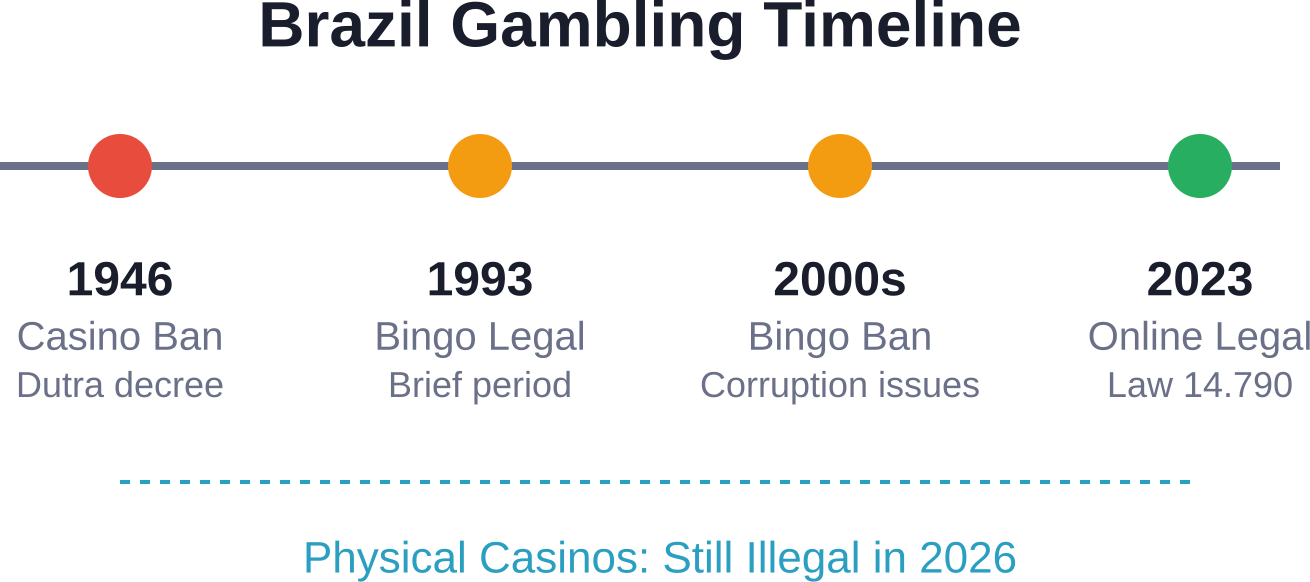
The 1946 Casino Ban: How Brazil Outlawed Casinos
On April 30, 1946, President Eurico Gaspar Dutra signed a decree that would fundamentally alter Brazil’s entertainment industry. Eighty years later, that decision still shapes the country’s gambling landscape.
The ban closed down luxury casinos across Brazil virtually overnight. These weren’t back-alley operations—they were glamorous establishments that attracted international celebrities, generated substantial tax revenue, and employed thousands of Brazilians in formal jobs.
Why Did Brazil Ban Casinos?
Historical accounts suggest President Dutra’s wife, Carmela Teles Dutra, played a significant role in the decision. Known for her strong Catholic religiosity, she reportedly influenced her husband to view gambling as morally corrupting.
But was that the whole story?
The ban came amid post-World War II political realignment. Brazil was transitioning away from the Estado Novo dictatorship, and Dutra sought to establish a new moral framework. Religious principles became the official justification for prohibiting casinos.
Critics argue the ban drove gambling underground rather than eliminating it. Without government oversight, illegal operations flourished—collecting no taxes and creating no formal employment.
The Economic Impact of the Casino Ban
Before 1946, Brazil’s casino industry supported a thriving tourism sector. Luxury hotels in Rio de Janeiro, São Paulo, and other major cities built their business models around casino entertainment.
When the ban took effect, these establishments lost their primary draw. Thousands of jobs disappeared. Tax revenues evaporated.
The regulated operation generated significant economic activity. After the ban, that activity didn’t stop—it just moved to illegal channels where the government couldn’t regulate, tax, or monitor it.
What Changed in 2023? The Online Gambling Revolution
Here’s where things get interesting. While physical casinos remain illegal, Brazil made a dramatic policy shift in December 2023.
Online sports betting and gambling regulation were legalized in late 2023 through legislation. This wasn’t a minor regulatory tweak—it represented a fundamental change in Brazil’s approach to gambling regulation.
What the 2023 Legislation Actually Permits
The legislation created a framework for regulated online betting. Sports betting became explicitly legal. Online casino games—slots, poker, and table games operated through digital platforms—entered a gray area that tilted toward legality under proper licensing.
But physical casino establishments? Still banned.
The law established strict requirements for operators. Companies must obtain licensing from the Ministry of Finance. The license carries a cost of BRL 30 million (approximately USD 6 million) for a five-year authorization.
That’s not a small barrier to entry. Brazil designed the system to favor established, well-capitalized operators who could demonstrate compliance capabilities.
Regulatory Requirements for Online Operators
The regulatory framework established by Ordinance SPA/MF 827/2024 sets clear requirements for operators seeking a license to offer sports betting and online gaming in Brazil.
Requirement | Specification |
Business Establishment | Must be a legal entity incorporated in Brazil |
Brazilian Ownership | At least 20% of the share capital must be held by Brazilian shareholders |
Authorization Fee | BRL 30 million (approximately USD 5.3–6 million) |
License Duration | 5 years, renewable upon compliance verification |
Tax on Player Winnings | 15% withholding tax on net winnings above the exemption threshold |
GGR Tax (Gambling-Specific) | 12% in 2025, increasing to 13% from 2026 (Complementary Law No. 224) |
Corporate Taxes | Standard rates apply (IRPJ 15%, CSLL 9%, plus PIS/COFINS and other contributions) |
These requirements are designed to ensure that only serious, well-capitalized operators enter the Brazilian market. In addition to the one-time authorization fee, operators must pay a specific Gross Gaming Revenue (GGR) tax on top of standard corporate taxation. This combined fiscal regime reflects the government’s goal of generating significant revenue while maintaining strong regulatory control.
When Did Operations Actually Begin?
The law passed in late 2023, but regulated operations didn’t begin immediately. The regulatory framework needed development. Compliance systems required implementation.
The regulated operation began in early 2025. By then, operators had navigated the licensing process and demonstrated their ability to meet Brazil’s stringent requirements.
According to industry reports, Brazil levied nearly BRL 10 billion in taxes in 2025. That’s substantial revenue that was previously flowing to offshore operators or illegal domestic operations.
Compare iGaming Providers with Sologe
Brazil is one of the most closely watched gaming markets in Latin America, and businesses evaluating this sector often need more than legal information. Sologe brings together iGaming vendors from multiple categories, making it easier to compare solutions without researching each segment separately.
Sologe helps businesses review:
- Casino platform providers
- Sports betting software
- Game aggregator solutions
- Payment solutions
- Affiliate marketing and traffic providers
- Marketing software
- Analytics software
- B2B and B2C licensing services
👉Contact Sologe to compare providers and explore software, payment, licensing, traffic, analytics, and sports betting solutions for gaming businesses.
Physical Casinos in 2026: Still Prohibited
So online betting is legal. What about walking into a physical casino in Rio or São Paulo?
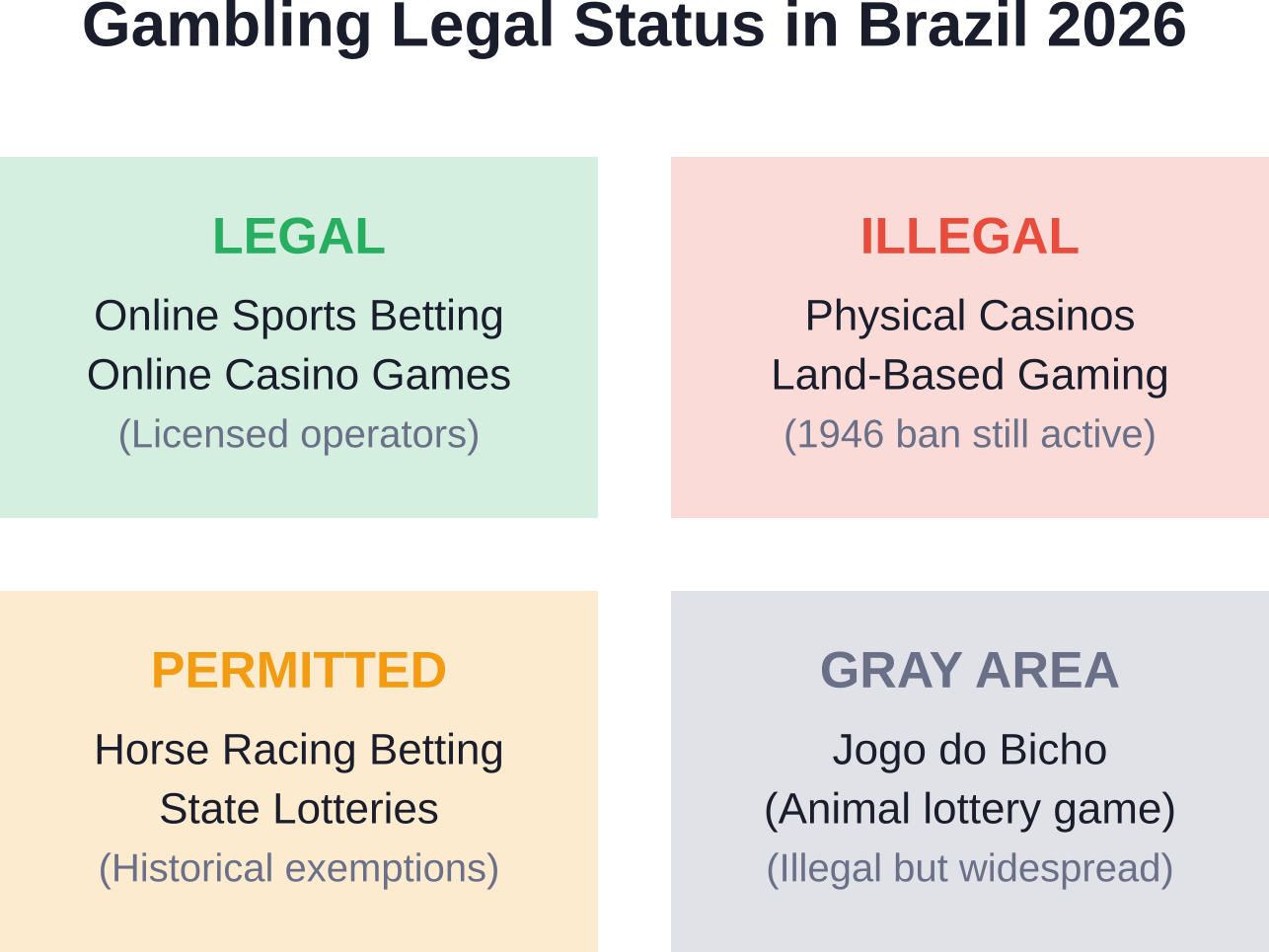
That’s still illegal. The 1946 ban remains in effect for land-based casino operations.
Brazil stands as one of only three G-20 countries—alongside Saudi Arabia and Indonesia—that currently prohibits non-state provision of gambling products in physical establishments.
Why the Split Treatment?
Why legalize online gambling but keep physical casinos banned? The rationale involves several factors.
Online gambling regulation offers more sophisticated monitoring capabilities. Digital platforms create transaction records. Player behavior can be tracked. Problem gambling interventions can be automated.
Physical casinos present different regulatory challenges. They require premises licensing, in-person age verification, and local law enforcement coordination. They’re more visible politically, which matters in a country where religious opposition to gambling remains strong.
The online-first approach also reflects global trends. Research from Harvard Kennedy School found that 80% of countries now allow some form of legal gambling, with online platforms leading expansion.
The Underground Casino Reality
Legal prohibition hasn’t eliminated physical gambling. Luxury establishments continue operating across Brazil without government oversight, tax collection, or formal employment creation.
These illegal operations exist in a regulatory void. They pay no taxes. They create no official jobs. They operate beyond consumer protection laws.
That’s exactly what the 1946 ban was supposed to prevent. Instead, it created an unregulated underground market that persists 80 years later.
Legislative Efforts to Legalize Physical Casinos
The online gambling legalization wasn’t an isolated event. It’s part of ongoing legislative discussions about broader gambling reform.
Multiple bills have been introduced in Brazil’s National Congress proposing casino legalization. These proposals typically include integrated resort concepts—luxury hotel-casino complexes similar to those in Singapore or Macau.
What’s Holding Back Casino Legalization?
If online gambling could be legalized, why not physical casinos?
Religious opposition remains strong. Catholic and evangelical groups actively lobby against casino legalization, arguing it would increase problem gambling and social harm.
Corruption concerns also persist. Brazil’s bingo legalization experiment in the 1990s provides a cautionary tale. After bingo was legalized in 1993 to fund sports development, the industry quickly became associated with corruption allegations. By the mid-2000s, enabling legislation was abandoned and bingo returned to illegality.
That experience makes legislators cautious. Brazilian judges played an active role during bingo’s legal period, issuing contradictory rulings that reflected the contentious nature of gambling regulation in a setting where corruption concerns run deep.
Economic Arguments for Legalization
Proponents point to substantial economic benefits. Regulated casinos would create formal employment, generate tax revenue, and boost tourism.
The underground casino market already exists. Legalization would bring it into the regulated economy rather than eliminating activity that occurs anyway.
International tourism could receive a significant boost. Brazil competes with other Latin American destinations, many of which offer legal casino entertainment. Uruguay, Argentina, and Chile all permit casino operations.
The Jogo do Bicho Exception
Any discussion of gambling in Brazil must address the elephant in the room: jogo do bicho, the “animal lottery game.”
This numbers game has operated continuously since the 1890s despite being officially illegal. It’s deeply embedded in Brazilian culture, particularly in Rio de Janeiro.
Millions of Brazilians participate regularly. The game operates through informal networks of bicheiros (bookmakers) who take bets on numbers associated with animals.
Why Does Jogo do Bicho Persist?
The game exists in a peculiar legal gray area. It’s technically illegal, but enforcement is inconsistent. Community discussions often describe it as a tolerated illegal activity.
Research on gambling disorders in Brazil has examined jogo do bicho’s prevalence. The game’s accessibility and cultural acceptance make it a significant factor in gambling behavior despite its illegal status.
This creates an odd situation where a historically illegal game operates more openly than newly legal online gambling platforms that must navigate complex regulatory requirements.
Problem Gambling Concerns and Public Health
Brazil’s gambling expansion hasn’t happened in a vacuum. Global research increasingly treats problem gambling as a public health concern.
A four-year study by a public health commission found that net global losses by gamblers could exceed $700 billion by the year 2028, creating serious public health concerns worldwide. Research on gambling harms indicates that problem gambling contributes significantly to operator revenues.
This relationship highlights important considerations for regulation. It suggests the industry’s business model may depend substantially on people experiencing gambling harm.
Brazil’s Approach to Problem Gambling
The 2023 gambling legislation includes consumer protection provisions. Operators must implement responsible gambling tools—deposit limits, self-exclusion options, and reality checks.
Anti-money laundering (AML) compliance represents another regulatory priority. Licensed operators must maintain robust AML systems to prevent gambling platforms from being used for financial crime.
Whether these protections prove adequate remains to be seen. Brazil entered the regulated online gambling market relatively late, which offers the advantage of learning from other jurisdictions’ experiences.
Global Context: Gambling Expansion and Harm
Brazil’s situation reflects global trends. According to research from Harvard Kennedy School, legalized gambling has exploded across the globe, turbocharged by internet and mobile technology.
This expansion leaves behind consequences—ruined lives, broken families, and financial hardships that often go unmeasured when legislators consider tax revenue potential.
Brazil has the opportunity to implement stronger consumer protections than many jurisdictions that legalized gambling before these harms were well understood. The question is whether economic incentives will outweigh public health considerations.
Horse Racing: The Historical Exception
While casinos have been banned since 1946, horse racing betting has maintained legal status throughout Brazil’s gambling prohibition.
This exemption created a precedent showing that gambling isn’t categorically prohibited—certain forms have always been permitted under Brazilian law.
Horse racing betting operates under specific regulatory frameworks managed by state authorities. The activity continues at hippodromes across the country.
State lotteries represent another historical exception. These government-run operations have functioned continuously, providing a revenue stream for public programs.
These exceptions reveal the selective nature of Brazil’s gambling prohibition. The issue isn’t gambling per se—it’s about which forms are politically and socially acceptable.
What International Visitors Need to Know
Tourists often ask whether they can gamble legally while visiting Brazil. The answer depends on what type of gambling.
Physical casinos remain off-limits. Any land-based casino operation is illegal, regardless of whether it targets tourists or locals.
Online sports betting and casino games are accessible through licensed operators. Visitors can legally participate in these activities while in Brazil, provided they use properly licensed platforms.
Horse racing betting is permitted at authorized venues. State lotteries are also accessible.
The Enforcement Reality
Enforcement of gambling laws varies. Illegal physical establishments exist, but participating carries legal risk. Foreign visitors aren’t exempt from Brazilian law.
Licensed online platforms offer the safest legal option for visitors who want to gamble during their stay. These operators comply with regulatory requirements and provide consumer protections.
The Future of Casinos in Brazil
Will physical casinos ever be legal in Brazil? The momentum suggests it’s possible, but not imminent.
The success of online gambling legalization may build political support for broader reform. If the regulated online market generates substantial tax revenue without catastrophic social consequences, it strengthens the economic case for physical casino legalization.
However, opposition remains organized and vocal. Religious groups, public health advocates, and corruption watchdogs all raise legitimate concerns that legislators must address.
Integrated Resort Proposals
Most current legislative proposals focus on integrated resorts rather than standalone casinos. This approach packages casino gambling with hotels, convention facilities, and entertainment venues.
The integrated resort model has proven successful in jurisdictions like Singapore, which implemented strong regulatory frameworks alongside legalization.
For Brazil, this approach might offer political advantages. It emphasizes tourism and economic development rather than pure gambling expansion.
Regional Competition
Brazil’s neighbors are watching closely. If Brazil legalizes physical casinos, it could shift Latin American tourism patterns.
The country already attracts millions of international visitors annually. Adding casino resorts could capture gambling tourism currently flowing to other destinations.
That competitive pressure may ultimately drive policy change as much as domestic economic arguments.
Frequently Asked Questions
Can I visit a casino in Brazil in 2026?
No. Land-based casinos remain illegal in Brazil as of 2026. While illegal gambling venues may exist, they operate outside the law. Licensed online gambling platforms are currently the only legal way to access casino games in Brazil.
Is online gambling legal in Brazil?
Yes. Online sports betting and online casino games are legal in Brazil under the country’s regulated gambling framework. Licensed operators must obtain authorization from the Ministry of Finance and comply with financial, technical, and responsible gambling requirements.
Why are casinos banned in Brazil?
Brazil banned land-based casinos in 1946 under a decree issued by President Eurico Gaspar Dutra. The decision was influenced by political and moral considerations of the time, and the prohibition on physical casinos has remained in place ever since.
What forms of gambling are legal in Brazil?
Legal gambling in Brazil includes licensed online sports betting, regulated online casino games, horse racing betting, and state-run lotteries. Traditional land-based casinos remain prohibited under current law.
How much does a gambling license cost in Brazil?
Operators seeking a federal online gambling license must pay a BRL 30 million grant fee for a five-year authorization. They must also establish a Brazilian company and comply with ownership, financial, and regulatory requirements.
Will physical casinos be legalized in Brazil soon?
The legalization of land-based casinos remains uncertain. Several legislative proposals have been discussed, but no law has been passed. While the success of the regulated online gambling market has renewed debate, there is currently no confirmed timeline for legalizing physical casinos.
What are the tax rates on gambling in Brazil?
Players generally pay a 15% withholding tax on qualifying net gambling winnings. Licensed operators pay a gross gaming revenue tax, which increased from 12% to 13% in 2026, in addition to applicable corporate taxes and other statutory obligations.
Conclusion: A Divided Gambling Landscape
So, is the casino legal in Brazil? For physical establishments, the answer remains no—the 1946 ban persists in 2026. But Brazil has opened the door to online gambling, creating a split regulatory approach that reflects both economic opportunity and continuing social concerns.
The legalization of online sports betting and casino games represents a significant shift. It acknowledges the reality that Brazilians were gambling anyway, often through unregulated offshore operators. Bringing that activity into a regulated framework allows government oversight, consumer protection, and tax collection.
Physical casinos remain in legal limbo. Legislative proposals continue circulating, but religious opposition, corruption concerns, and public health considerations create substantial political obstacles.
Brazil’s gambling landscape will continue evolving. The success or failure of the online gambling market will likely determine whether physical casinos eventually gain legal status. For now, the answer to “is the casino legal in Brazil?” depends entirely on whether you mean physical or online operations.
If you’re interested in legally gambling in Brazil, stick to licensed online platforms that comply with Ministry of Finance regulations. For those hoping to walk into a Brazilian casino resort, patience remains necessary—that door hasn’t opened yet.
Related Articles

September 3, 2026Is the Casino Legal in Denmark? 2026 Guide

September 3, 2026Is the Casino Legal in Angola? What the 2026...