 Nothing found for the request
Is the Casino Legal in South Korea? 2026 Laws Explained
Sologe July 10, 2026
Share:


The Legal Framework: Understanding South Korea's Gambling Laws
South Korea’s gambling regulations stem primarily from the Tourism Promotion Act, which governs casino operations, and various other laws covering different gambling activities.
Under Korean law, gambling is considered a criminal offense. But the government has carved out specific exceptions for tourism development and state revenue generation.
What the Tourism Promotion Act Says About Casinos
The Tourism Promotion Act explicitly allows casino operations, but with tight controls. According to the law, casinos must obtain licenses from either the Ministry of Culture, Sports and Tourism (MCST) or the Jeju Special Self-Governing Province, depending on location.
The legislation divides casinos into two categories: those restricted to foreigners and the single exception at Kangwon Land, where Korean citizens can gamble.
This isn’t some loophole. It’s an intentional policy.
The government views foreigner-only casinos as economic tools to boost tourism revenue without exposing Korean citizens to gambling risks. But the existence of Kangwon Land—opened in 2000 in a former coal-mining region—shows the government also recognized the need for at least one legal domestic outlet.
Additional Gambling Regulations
Beyond casinos, South Korea regulates gambling through several laws:
- The National Sports Promotion Act governs Sports Toto (legal sports betting)
- The Horse Racing Act controls horse racing operations
- The Bicycle Racing and Motorboat Racing Acts manage those respective sports betting activities
- The Lottery and Lottery Fund Act oversees state-run lotteries
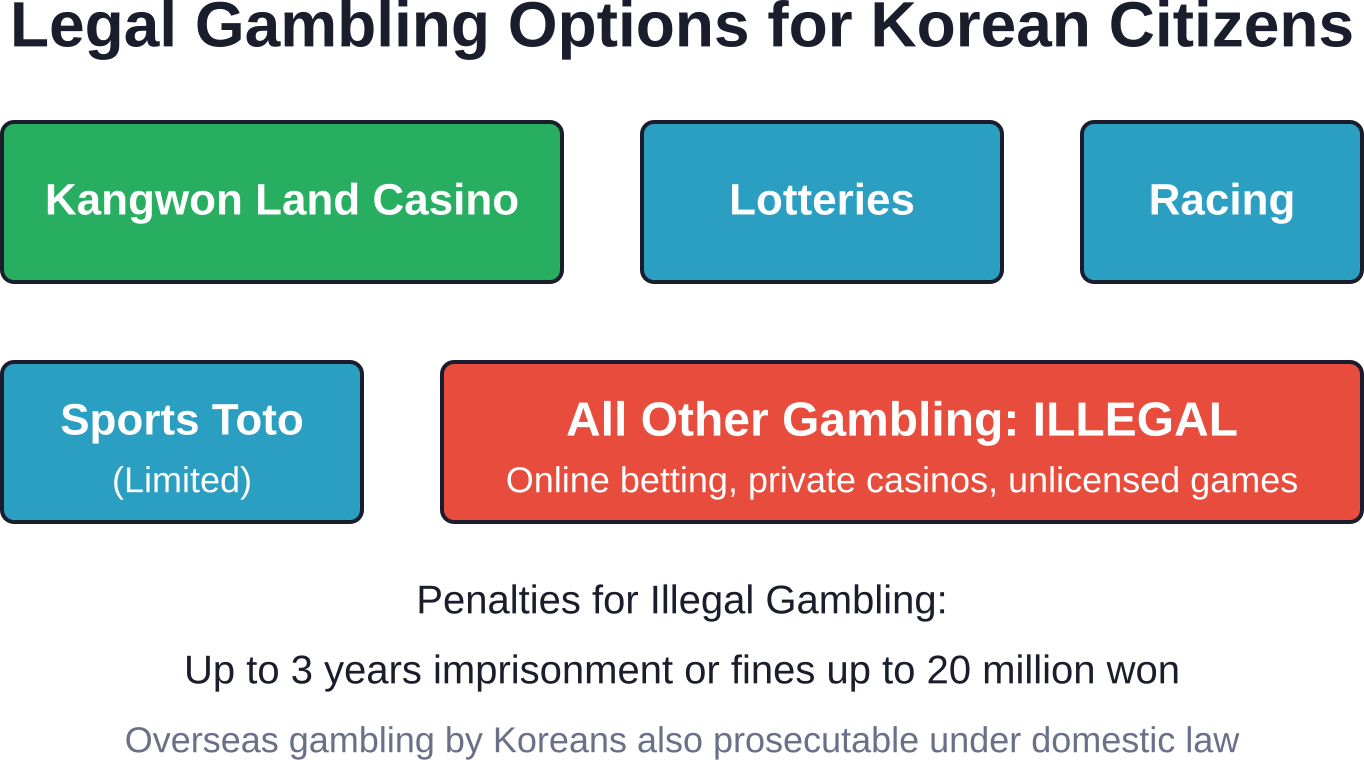
These represent the complete list of legal gambling options for Korean citizens. Everything else? Prohibited.
The Foreigner-Only Casino System
South Korea currently operates 17 casinos exclusively for foreign passport holders. Korean citizens are strictly barred from entry.
These establishments exist in major cities and tourist destinations including Seoul, Busan, Incheon, and Jeju Island. Most are located inside luxury hotels, positioning themselves as amenities for international business travelers and tourists.
How the Foreigner-Only Policy Works
Entry requirements are straightforward but rigidly enforced. Foreign visitors must present a valid passport at the entrance. No passport, no entry. Korean citizens attempting to enter face criminal prosecution.
As one USA Today report noted, the government wants to build a casino industry where “all are welcome but Koreans.” This policy reflects deep cultural concerns about gambling addiction and social harm.
The contradiction is striking. The government acknowledges gambling as problematic enough to ban for its own citizens, yet simultaneously promotes it as an economic development tool through tourism.
Major Foreigner-Only Casinos
The largest and most prominent foreigner-only casinos include:
- Paradise City (Incheon) – integrated resort near Incheon Airport
- Grand Korea Leisure casinos in Seoul, Busan, and Jeju
- Seven Luck casinos in Seoul and Busan
- Multiple smaller operations in Jeju
These casinos generated substantial revenue pre-pandemic, primarily from Chinese tourists. But the COVID-19 pandemic and subsequent restrictions on Chinese group tours hit the industry hard.
Kangwon Land: The One Exception
Kangwon Land stands alone as the only casino in South Korea where Korean citizens can legally gamble.
Located in Jeongseon County in Gangwon Province, this casino opened in 2000 as part of an economic revitalization project for a declining coal-mining region. The government reasoned that former miners and local residents needed economic opportunities after mine closures devastated the area.
Why Kangwon Land Is Different
The Tourism Promotion Act specifically carved out this exception. Unlike the foreigner-only establishments designed to attract international tourism revenue, Kangwon Land serves domestic demand.
And serve it does. The casino has become enormously popular—sometimes problematically so.
Before implementing entry restrictions, visitors often waited hours for access to gaming tables. The facility struggles with capacity issues and has implemented various control measures including admission fees, advance reservations, and entry limits.
The Dark Side of the Exception
Some observers have noted serious concerns about problem gambling at the facility. Korean citizens desperate to gamble sometimes travel to Kangwon Land repeatedly, leading to addiction problems.
The casino’s location in a remote mountain area means problem gamblers often travel significant distances. Anecdotal reports suggest some individuals wait extended periods for access.
This concentration of gambling activity in a single location creates visible social problems that reinforce government skepticism about expanding legal gambling access for citizens.
What Gambling Is Legal for South Koreans?
Korean citizens face limited legal gambling options. Here’s what’s actually permitted:
Gambling Type | Legal Status | Regulatory Body | Key Restrictions |
|---|---|---|---|
Kangwon Land Casino | Legal | Ministry of Culture, Sports and Tourism | One location only, entry limits, ID verification |
State Lotteries | Legal | Korea Lottery Commission | Government-operated only, age restrictions (19+) |
Horse Racing | Legal | Korea Racing Authority | Licensed tracks only, age restrictions |
Bicycle Racing | Legal | Korea Cycle Racing Authority | Licensed tracks only, age restrictions |
Motorboat Racing | Legal | Korea Motorboat Racing Authority | Licensed tracks only, age restrictions |
Sports Toto | Legal | Korea Sports Promotion Foundation | Government-controlled, limited sports, betting caps |
Online Gambling | Illegal | N/A | All forms prohibited, heavy penalties |
Notice a pattern? Every legal option is either government-operated or heavily government-controlled. South Korea doesn’t permit private gambling businesses to serve Korean citizens.
State Lotteries
State-run lotteries represent the most accessible legal gambling for Koreans. These include traditional number-drawing lotteries and instant scratch-off games.
Revenue from lottery sales funds various government programs, providing justification for their continued operation despite general anti-gambling policy.
Racing and Sports Betting
Horse racing, bicycle racing, and motorboat racing all operate under strict government oversight at designated tracks. Betting is only legal at these official venues or through authorized channels.
Sports Toto allows legal sports betting, but with significant restrictions. Bettors can only wager on approved sporting events, betting amounts are capped, and the system operates through government-licensed outlets.
These limitations distinguish legal sports betting from the expansive options available through illegal online bookmakers, which offer far more betting opportunities and higher limits—albeit with legal risk.
Online Gambling: Completely Prohibited
Here’s where South Korea draws an absolute line: all online gambling is illegal for Korean citizens.
This includes online casinos, poker rooms, sports betting sites, and any other form of internet-based wagering. The prohibition applies regardless of where the gambling site is based.
The Legal Reality
South Korean law considers online gambling a criminal offense. Penalties include fines up to 20 million won and imprisonment up to three years.
But here’s what makes enforcement particularly aggressive: South Korea prosecutes its citizens for gambling online even when they use foreign-based websites while physically in South Korea.
The government blocks access to thousands of gambling websites. Internet service providers receive orders to prevent Korean users from accessing known gambling domains.
Yet illegal online gambling persists. Many Koreans access offshore gambling sites through VPNs and other workarounds. The government continues a cat-and-mouse game, identifying and blocking sites while new ones appear.
Why the Total Ban?
The government’s stance reflects concerns about gambling addiction, money laundering, and the difficulty of regulating cross-border online operations.
Unlike physical casinos where the government can control entry and monitor activity, online gambling happens in private, making problem gambling harder to detect and intervene.
Financial controls also play a role. The Specialized Credit Finance Business Act restricts credit card use for gambling transactions, and financial institutions are required to report suspicious transfers that might relate to illegal gambling.
Penalties and Enforcement
South Korea doesn’t just prohibit illegal gambling—it actively enforces these laws with real consequences.
Criminal Penalties for Gamblers
Korean citizens caught gambling illegally face:
- Fines up to 20 million won
- Imprisonment up to three years
- Criminal record affecting employment and travel
- Social stigma in a country where criminal records are taken seriously
The severity depends on factors like the amount wagered, frequency of gambling, and whether the person was merely participating or organizing gambling activities.
Harsher Penalties for Operators
Running an illegal gambling operation brings far more serious consequences. Operators face significantly higher fines and longer prison sentences.
The government particularly targets online gambling operations and illegal private casinos. Authorities have prosecuted individuals running gambling websites, organizing private poker games for profit, and facilitating illegal sports betting.
Enforcement in Practice
Police conduct regular crackdowns on illegal gambling. These operations target both physical establishments and online operations.
The government also monitors financial transactions. Large or suspicious money movements trigger investigations. Banks and financial institutions must report transactions that might relate to gambling.
One Korea-focused news report noted the government clamping down on “gambling businesses exploiting legal loopholes,” showing continued vigilance about gray-area operations.
The Cultural Context: Why South Korea Restricts Gambling
Understanding South Korea’s strict gambling laws requires understanding cultural attitudes toward gambling and its social consequences.
Gambling Addiction Concerns
South Korea views gambling addiction as a serious public health issue. The concentration of problem gambling at Kangwon Land—the only legal casino for Koreans—reinforces government concerns about what would happen with broader access.
Community discussions reveal real struggles. Some individuals reportedly visit Kangwon Land repeatedly, traveling long distances and spending beyond their means.
The government fears that legalizing more gambling options would multiply these problems across the country.
Confucian Cultural Influences
Traditional Confucian values emphasizing hard work, frugality, and family responsibility influence policy. Gambling contradicts these values by offering wealth without productive labor and risking family finances on chance.
This cultural backdrop makes gambling politically unpopular beyond the limited, controlled forms currently permitted.
The Economic Contradiction
Yet here’s the tension: the government simultaneously restricts gambling for its citizens while promoting casino tourism to generate foreign revenue.
This creates what some see as a hypocritical system. The government essentially says gambling is harmful for Koreans but welcomes foreign tourists to gamble freely.
The policy reflects a pragmatic calculation: capture tourism revenue without exposing domestic population to gambling’s downsides. Whether this compromise is sustainable long-term remains debatable.
Casino Licensing and Requirements
Operating a legal casino in South Korea requires navigating complex licensing requirements under the Tourism Promotion Act.
Who Can Apply?
Casino license applications are typically restricted to corporations, with preference often given to foreign-invested entities for foreigner-only casinos. The government uses casino licensing as a tourism development tool, so applications tied to significant hotel and resort development carry more weight.
The Application Process
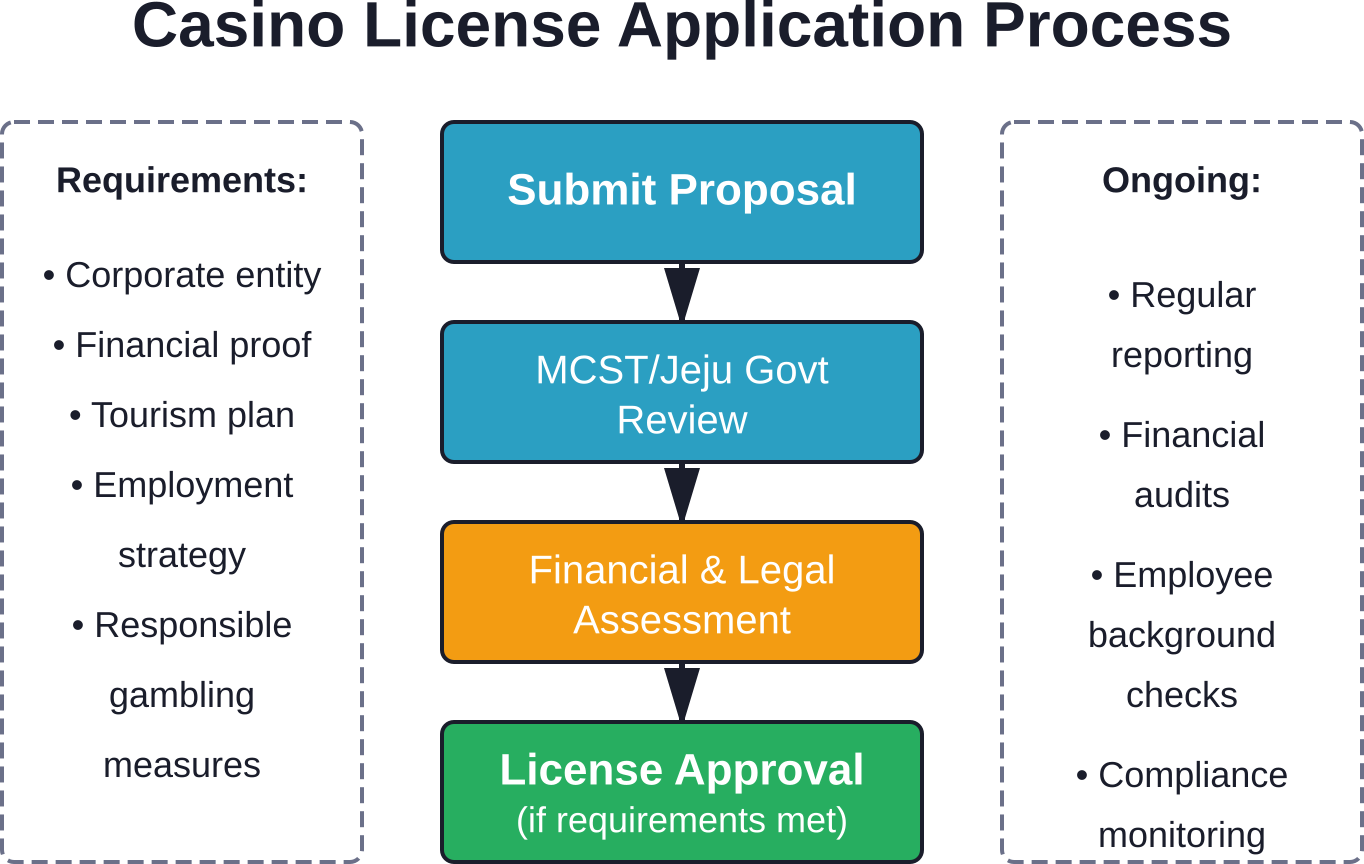
Applicants submit proposals to either the Ministry of Culture, Sports and Tourism or Jeju Special Self-Governing Province, depending on location. Applications must demonstrate:
- Financial capability to operate a casino and associated tourism facilities
- Plans for employment and economic development
- Responsible gambling measures and oversight systems
- Compliance with all legal requirements
The review process is lengthy and selective. The government doesn’t issue casino licenses freely; each approval represents a deliberate policy decision about tourism development.
Operational Requirements
Licensed casinos must comply with ongoing requirements including regular reporting, financial audits, employee background checks, and compliance with responsible gambling policies.
The National Gambling Control Commission oversees gambling operations across South Korea, monitoring compliance and investigating violations.
Build Smarter Gaming Systems with Sologe
South Korea has a complex gaming environment, so business research often goes beyond a simple legal answer. Sologe is a B2B iGaming marketplace that helps companies explore suppliers and service categories across different areas of the gaming industry.
Sologe can help businesses:
- Compare gaming platform options
- Review payment solution categories
- Explore mobile application tools
- Assess analytics software
- Check certification-related options
Contact Sologe to explore platform options, payment solutions, certification categories, and other B2B gaming technologies.
Tax Treatment of Casino Revenue
Casino taxation in South Korea varies based on the type of operation and customer base.
Foreigner-Only Casino Taxation
Casinos serving foreign tourists face different tax structures than Kangwon Land. The government taxes gross gaming revenue at rates that vary by casino location and specific agreements.
Generally speaking, casino operators pay significant taxes that fund tourism promotion, regional development, and other government programs.
Kangwon Land Taxation
Kangwon Land operates under unique tax arrangements reflecting its status as the only casino serving Korean citizens. A significant portion of its revenue goes to local government and regional development funds, fulfilling the original purpose of economically revitalizing the former mining region.
The casino generates substantial tax revenue. This financial benefit to government coffers provides one argument for maintaining legal gambling options, even as policymakers worry about social costs.
Can Koreans Gamble Abroad Legally?
Here’s a surprising aspect of South Korean gambling law: even gambling in foreign countries can be prosecutable under Korean law.
South Korea asserts extraterritorial jurisdiction over its citizens’ gambling activities. In theory, a Korean citizen gambling at a casino in Las Vegas, Macau, or Singapore could face prosecution upon returning to South Korea.
The Reality of Enforcement
In practice, enforcement focuses primarily on habitual or large-scale gambling abroad rather than casual tourism gambling.
Authorities are more likely to investigate and prosecute Koreans who make repeated trips to foreign casinos and gamble substantial amounts, particularly if there are concerns about money laundering or other financial crimes.
A tourist visiting a Las Vegas casino during a vacation is unlikely to face prosecution. But someone making frequent trips to Macau specifically for gambling? That creates legal risk.
Why This Law Exists
The extraterritorial reach aims to prevent wealthy Koreans from simply traveling abroad for regular gambling. Without this provision, overseas gambling would provide an easy workaround to domestic restrictions.
Whether this extensive reach of criminal law is appropriate remains debated. Critics argue the government overreaches by criminalizing activity that’s legal where it occurs.
Recent Developments and Future Outlook
South Korea’s gambling landscape continues to evolve, though major policy changes remain unlikely in the near term.
Impact of COVID-19
The pandemic severely impacted South Korea’s casino industry, particularly foreigner-only casinos dependent on Chinese tourism. Travel restrictions eliminated most international visitors, forcing casinos to operate at minimal capacity or temporarily close.
As international travel recovers, the industry is rebuilding. But the heavy dependence on Chinese tourists remains a vulnerability, particularly given geopolitical uncertainties and China’s ongoing regulatory scrutiny of overseas gambling by its citizens.
Calls for Reform
Some voices advocate for liberalizing gambling laws. Arguments include:
- Generating additional tax revenue
- Reducing illegal gambling by providing legal alternatives
- Personal freedom arguments against paternalistic restrictions
- Economic development through expanded tourism
But these arguments face strong opposition from those concerned about gambling addiction, social costs, and cultural values. The political will for significant liberalization appears limited.
Technology and Enforcement Challenges
Online gambling presents ongoing enforcement challenges. Despite aggressive website blocking and penalties, illegal online gambling continues through VPNs, cryptocurrency transactions, and other workarounds.
The government faces a technology race: as authorities develop new detection and blocking methods, illegal operators develop new evasion techniques.
Practical Implications for Tourists and Expats
Understanding these laws matters for both tourists and foreign residents in South Korea.
For International Tourists
Foreign tourists can legally visit any of the 17 foreigner-only casinos. Just bring your passport—it’s required for entry.
These casinos offer standard games including blackjack, roulette, baccarat, poker, and slot machines. Most major establishments cater to international clientele with English-speaking staff and various currency exchange options.
For Foreign Residents
Foreign nationals legally residing in South Korea maintain access to foreigner-only casinos. Residence status doesn’t change eligibility—citizenship is what matters.
A foreign passport holder can visit casinos regardless of how long they’ve lived in South Korea or whether they hold a work visa or permanent residence.
For Korean Citizens and Dual Citizens
Korean citizens cannot enter foreigner-only casinos. This prohibition extends to dual citizens holding both Korean and foreign passports.
The single legal casino option is Kangwon Land. Korean citizens planning to visit should be aware of entry limitations, admission fees, and advance reservation requirements that manage capacity.
Frequently Asked Questions
Can Korean citizens enter foreigner-only casinos if they have a foreign passport too?
No. South Korean citizens, including dual nationals, are prohibited from entering foreigner-only casinos. The restriction is based on citizenship rather than the passport presented, so holding a foreign passport does not exempt a Korean citizen from the prohibition.
Is it legal for Koreans to use online gambling sites based in other countries?
No. South Korean law prohibits Korean citizens from participating in online gambling, regardless of where the gambling website is based. Violations may result in criminal penalties, including fines and imprisonment.
How does South Korea enforce gambling laws against online gambling?
South Korean authorities block access to illegal gambling websites, monitor financial transactions, investigate suspicious money transfers, and prosecute individuals who participate in unlawful online gambling. Financial institutions also help prevent gambling-related payments.
Can foreigners living in South Korea legally gamble online?
The legal position for foreign residents is not clearly defined. Because South Korean law applies within the country, foreign residents should exercise caution. Foreign visitors who wish to gamble legally generally use licensed foreigner-only land-based casinos rather than online gambling platforms.
What happens to Koreans caught gambling at illegal casinos or gambling operations?
Korean citizens who participate in illegal gambling may face criminal penalties, including fines, imprisonment, and a criminal record. Organizing or operating illegal gambling businesses carries substantially more severe penalties than participating as a player.
Are there any legal ways for Korean citizens to bet on sports?
Yes. Sports Toto is the only legal sports betting system available to Korean citizens. It is government-operated and subject to restrictions on betting options, wagering limits, and the sports that may be offered.
Can Korean citizens legally visit Kangwon Land as often as they want?
Korean citizens may legally visit Kangwon Land, the country’s only casino open to local residents. However, the casino applies various admission rules, including entry fees, reservation requirements, and other measures intended to manage visitor numbers and support responsible gambling.
Conclusion: Navigating South Korea’s Complex Gambling Landscape
South Korea maintains one of Asia’s strictest gambling regulatory frameworks. The system is paradoxical: 17 casinos for foreigners but only one for citizens, thriving tourism gambling alongside harsh penalties for illegal domestic gambling, cultural opposition to gambling paired with government revenue dependence on it.
For Korean citizens, legal options remain limited to Kangwon Land, state lotteries, government-controlled racing, and Sports Toto. Everything else is prohibited, including all online gambling.
For foreign tourists and residents, access is straightforward: bring a passport to any foreigner-only casino.
The laws aren’t likely to change dramatically soon. Cultural attitudes, addiction concerns, and political considerations keep restrictions firmly in place despite economic arguments for liberalization.
Understanding this landscape is essential whether you’re a tourist planning to visit, a foreign resident living in South Korea, or simply curious about international gambling regulation.
The system works for now—generating tourism revenue while limiting domestic exposure. But tensions remain between economic benefits and social costs, between personal freedom and public health concerns, between opening to the world and protecting citizens.
That’s South Korea’s gambling reality in 2026. Legal, but with many strings attached.
Related Articles

September 3, 2026Is the Casino Legal in Denmark? 2026 Guide

September 3, 2026Is the Casino Legal in Angola? What the 2026...