 Nothing found for the request
Is the Casino Legal in Ghana? 2026 Licensing & Laws
Sologe July 10, 2026
Share:


The Legal Foundation: Ghana's Gaming Act
Ghana enacted the Gaming Act (Act 721) in 2006 to formalize and liberalize the gambling market. This landmark legislation established the legal framework that governs all gaming activities in the country today.
The Act created the Gaming Commission of Ghana, the regulatory authority responsible for licensing and oversight. The Commission handles everything from issuing licenses to conducting inspections and enforcing compliance.
According to the Gaming Commission of Ghana, the regulator is responsible for issuing licenses to all gaming operators and permits to companies and individuals that wish to run promotions with elements of game of chance. The Commission conducts continuous inspections to ensure full compliance with gaming law and regulations, including suitability of gaming premises, safety and security requirements, gaming employees’ licenses, compliance with gaming devices, and minimum bankroll requirements.
The National Lottery Authority operates alongside the Gaming Commission. Established under Act 722 (2006) with supportive Legislative Instrument LI 1948 (Lotto Regulations 2008), the National Lottery Authority regulates, supervises, conducts, manages, and provides assistance on issues related to national lotto in Ghana.
These two bodies create a dual regulatory system that separates traditional lottery operations from broader gaming activities like casinos, sports betting, and online gambling platforms.
Types of Legal Gambling in Ghana
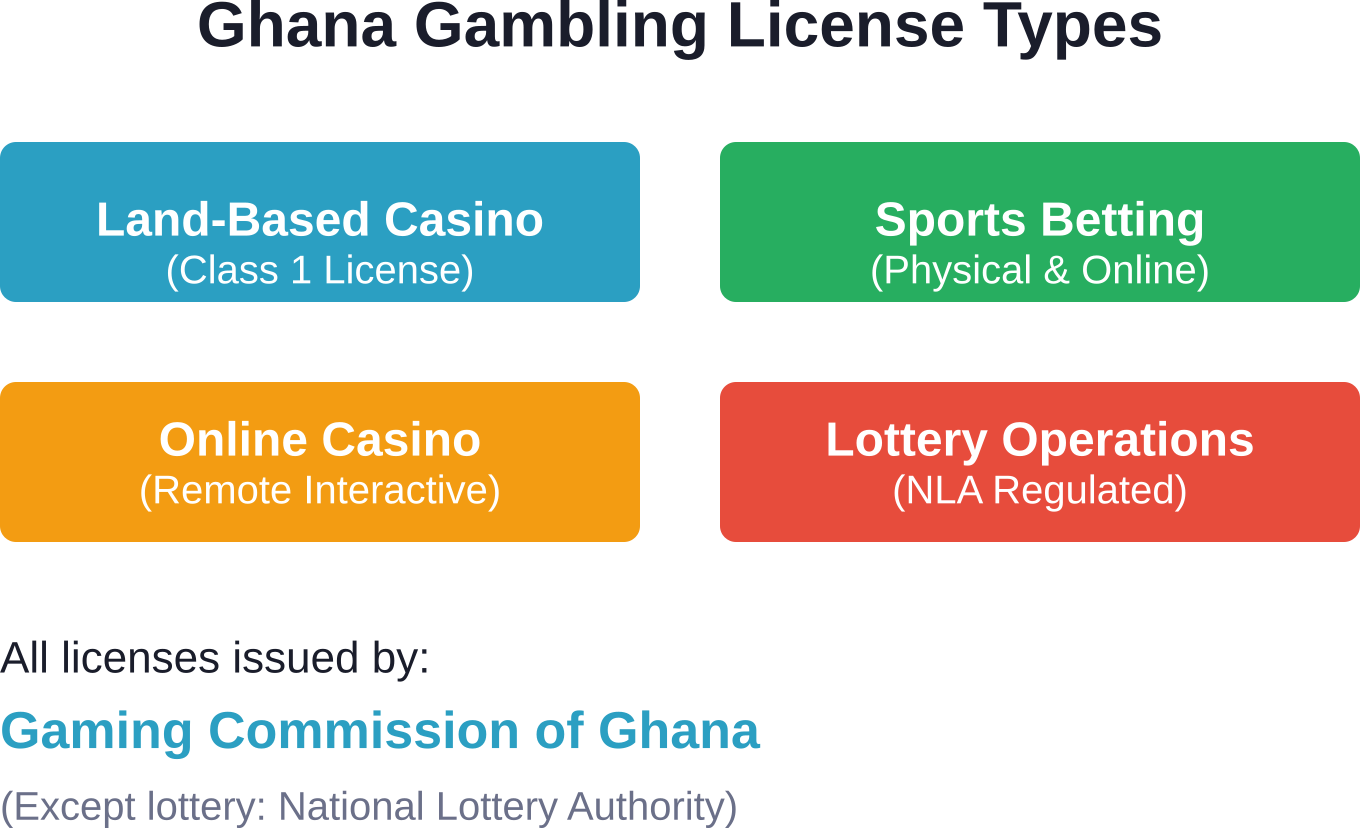
Ghana’s regulatory framework recognizes several distinct categories of gambling operations. Each requires specific licensing and compliance measures.
Land-Based Casinos
Physical casinos operating table games and slot machines fall under Class 1 licenses. These establishments must meet stringent premises suitability standards, demonstrate substantial financial capacity, and implement robust internal controls.
The Gaming Commission maintains a public list of licensed operators. As of 2026, dozens of casino operations hold valid licenses across Ghana, primarily concentrated in Accra and other major cities.
Sports Betting Operations
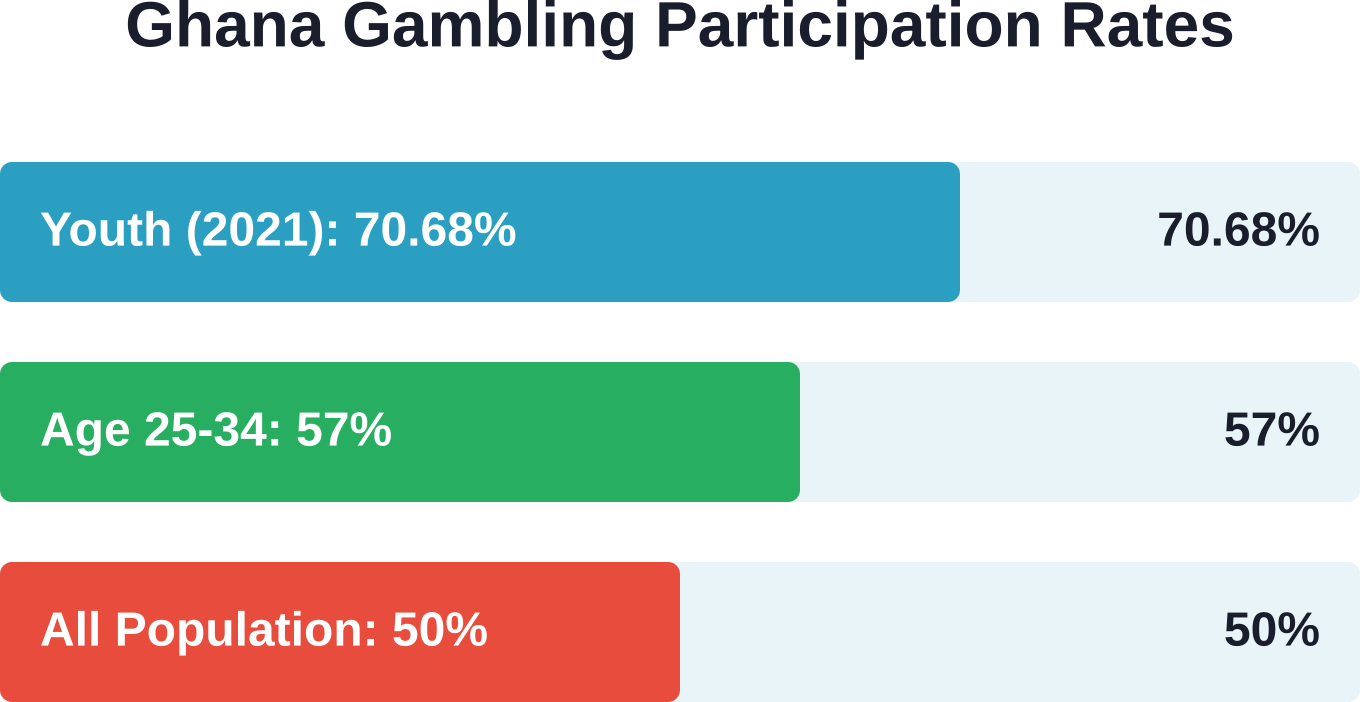
Sports betting has exploded in popularity throughout Ghana. Research by TGM Global found 50% of Ghana’s population engaged in some form of betting.
Both physical betting shops and online sports betting platforms require licenses from the Gaming Commission. Major international brands like 1XBET and 22BET operate legally in Ghana with proper licensing for sports betting services.
Online Gambling Platforms
Remote interactive gaming—the official term for online gambling—covers online casinos, virtual sports, and digital betting platforms. These operators need separate online casino licenses or remote interactive games licenses.
Ghana’s online gambling sector grew 24% in 2025, according to industry analysis. This growth trajectory has attracted significant international investment, with operators like Kaizen Gaming launching its Betano brand in Ghana on 5 February 2026.
Lottery and Promotional Games
The National Lottery Authority handles lottery operations and promotional games with chance elements. Private Lotto Operators (PLOs) can obtain licenses to run lotto services under NLA supervision.
The NLA has implemented identification sticker systems for all Lotto Writers and Agents under registered PLOs to combat illegal lottery operations and protect compliant operators.
Find iGaming Business Solutions with Sologe
Ghana has an active gaming sector, and businesses researching the market may need more than legal information. Sologe is a B2B iGaming marketplace that helps companies compare suppliers across key areas of the gaming ecosystem.
Sologe can help businesses:
- Review casino platform options
- Compare game aggregator solutions
- Find payment solutions
- Explore sports betting software
- Check certification categories
Contact Sologe to review available options and identify solutions that fit your business requirements.
Licensing Requirements and Process
Obtaining a gambling license in Ghana involves rigorous scrutiny. The Gaming Commission doesn’t hand out licenses casually—applicants must demonstrate they meet strict criteria.
Core Requirements for Operators
Prospective operators must first establish a legal entity registered in Ghana. Foreign companies typically incorporate locally or establish subsidiaries before applying.
Financial capacity represents a critical evaluation factor. Operators must prove they maintain sufficient capital to cover operations, pay out winnings, and meet minimum bankroll requirements set by the Commission.
Background checks apply to all beneficial owners, directors, and key personnel. The Commission investigates criminal records, financial history, and industry experience. Anyone with convictions related to fraud, money laundering, or previous gaming violations faces rejection.
For land-based operations, premises must meet suitability standards. This includes appropriate zoning, adequate security measures, responsible gaming infrastructure, and compliance with safety regulations.
Technical and Operational Standards
Gaming devices and software require certification. The Commission tests random number generators, payout percentages, and security protocols before approving equipment for use.
Online operators face additional technical requirements around server locations, data protection, player verification systems, and responsible gambling tools like deposit limits and self-exclusion mechanisms.
Internal control procedures must be documented and submitted. These cover anti-money laundering protocols, dispute resolution processes, player fund segregation, and audit trails for all transactions.
Application Timeline
The licensing process typically takes several months. Initial application review can take 4-8 weeks, followed by detailed due diligence that extends another 8-12 weeks for complex applications.
Gaming Commission inspections add time. Inspectors visit premises, review systems, interview key personnel, and verify compliance with all stated requirements before recommending license approval.
Most licenses are issued for annual periods, requiring renewal each year. The Commission lists current licensed operators publicly, with expiry dates visible—for example, many 2026 licenses show expiry dates of December 31, 2026.
Tax Structure and Financial Obligations
Ghana’s gaming taxation has evolved significantly, particularly with reforms introduced in April 2023 under the Income Tax (Amendment) Act 2023 (Act 1094).
The industry has become an essential source of revenue for the government. In pursuit of necessary revenue, the 2023 Act introduced substantial changes to gambling taxation.
Operator Taxation
The government implemented a gaming revenue tax on gross gaming revenue (GGR) of 20% in April 2023. This applies to all licensed gaming operators and represents a significant revenue stream for the state.
Operators must calculate GGR as total stakes or wagers minus winnings paid to players. The 20% tax applies to this net figure, not total turnover.
Standard corporate income tax also applies to gaming businesses. Combined with the GGR tax, the total tax burden on operators has increased substantially since 2023.
Winnings Tax (Now Abolished)
The April 2023 reforms initially introduced a 10% tax on winnings from the gaming industry. This withholding tax applied to player winnings from betting, lottery, and gaming activities.
However, this winnings tax proved controversial and was subsequently abolished. Ghana abolished the 10% withholding tax on winnings that was introduced in April 2023, so players do not pay tax on gambling winnings as of April 2025.
Licensing Fees
Beyond taxation, operators pay annual licensing fees to the Gaming Commission. Fee structures vary by license type, with land-based casino licenses commanding higher fees than online-only operations.
Application fees are non-refundable, paid upfront during the licensing process. Successful applicants then pay the full annual license fee before the license is issued.
Tax/Fee Type | Rate | Applied To | Status (2026)
|
|---|---|---|---|
Gaming Revenue Tax (GGR) | 20% | Operator gross gaming revenue | Active since April 2023 |
Winnings Tax | 10% | Player winnings | Abolished after April 2023 |
Corporate Income Tax | Standard rate | Operator profits | Active |
Annual License Fee | Varies by type | Each licensed operator | Active |
Market Size and Growth Trajectory
Ghana’s gambling market has experienced remarkable expansion. The country now ranks fourth in Africa for gambling activity, trailing only Kenya, Nigeria, and South Africa.
In a 2021 survey, Statista established that 70.68% of Ghanaian youths engaged in gambling. This extraordinarily high participation rate reflects how normalized betting has become, particularly among younger demographics.
Ghana’s population of approximately 34 million provides a substantial market base. When half the population engages in some form of betting, the commercial opportunity becomes clear.
Demographic Breakdown
Age distribution reveals betting is most popular among young adults. The 18-24 age group shows 56% engagement in betting activities, while the 25-34 age group demonstrates even higher participation at 57%.
These demographics explain why mobile-first betting platforms have thrived. Younger Ghanaians adopt digital services readily.
Revenue Projections
Ghana’s gambling market is projected to reach about $915 million revenue in 2025, according to public health research. This substantial figure underscores the industry’s economic significance.
The online segment drives much of this growth. Ghana’s online gambling sector grew 24% in 2025, outpacing traditional land-based operations and reflecting global digitalization trends.
International operators recognize this potential. Major gaming companies have entered or expanded in Ghana, with Kaizen Gaming’s February 2026 Betano launch exemplifying continued foreign investment in the market.
Compliance and Enforcement
Licensing alone doesn’t guarantee ongoing legal status. Operators must maintain continuous compliance with regulatory standards or risk sanctions.
Ongoing Monitoring
The Gaming Commission conducts regular inspections of licensed premises and operations. These inspections verify compliance with safety standards, proper operation of gaming devices, adequate bankroll maintenance, and adherence to responsible gaming requirements.
Remote monitoring applies to online operators. The Commission can request access to systems, review transaction logs, audit payout percentages, and verify player protection measures at any time.
Employee licensing adds another layer. Gaming employees require individual licenses in certain positions, ensuring personnel meet integrity standards and possess necessary training.
Anti-Money Laundering Requirements
Gaming operators fall under Ghana’s anti-money laundering framework. They must implement know-your-customer (KYC) procedures, report suspicious transactions, and maintain records for regulatory inspection.
Industry observers note that gaming-specific AML rules require further development. As online gambling grows, stronger cryptocurrency controls and enhanced transaction monitoring may become necessary.
Responsible Gambling Obligations
Licensed operators must provide responsible gambling tools. These include self-exclusion programs, deposit limits, reality checks, and access to problem gambling support resources.
Advertising restrictions prevent targeting of minors and require responsible gambling messaging. The Gaming Commission monitors promotional materials for compliance with advertising standards.
Age verification remains mandatory. No one under 18 can legally gamble in Ghana, and operators must implement robust age-checking mechanisms both online and at physical locations.
Penalties for Non-Compliance
Violations can result in fines, license suspension, or permanent license revocation. Serious breaches—like operating without a license, facilitating underage gambling, or money laundering—can trigger criminal prosecution.
The National Lottery Authority has stepped up enforcement against illegal lotto operations. The identification sticker system helps authorities distinguish legal operators from unlicensed entities, making prosecution of illegal operations more straightforward.
Regulatory Challenges and Future Development
Despite Ghana’s functional regulatory framework, challenges remain. The rapid evolution of gambling, particularly online, creates gaps that regulations struggle to address.
Online Gambling Oversight
Current regulations were designed primarily for land-based operations. While they’ve been extended to cover online gambling, industry experts argue that greater oversight is needed specifically for online gambling in Ghana’s regulations.
Issues like cryptocurrency betting, live streaming gambling content, social casino games, and emerging technologies require more specific regulatory guidance than currently exists.
Cross-border enforcement presents difficulties. When unlicensed offshore operators accept Ghanaian players, the Gaming Commission’s enforcement powers are limited without international cooperation agreements.
Crypto Opportunities and Risks
Cryptocurrency adoption is growing in Ghana, creating both opportunities and regulatory challenges for the gambling sector. Some operators have begun accepting crypto payments, but the regulatory framework hasn’t fully addressed this payment method.
Legal experts examining Ghana’s growth trajectory believe crypto opportunities could drive further expansion. However, gaming-specific AML rules for cryptocurrency transactions remain underdeveloped.
The Commission will likely need to establish clear standards for crypto gambling—covering everything from wallet verification to blockchain transaction monitoring—as this payment method becomes more prevalent.
Problem Gambling Prevention
Research has documented gambling-related harm in Ghana. The normalization of gambling, especially sports betting, has been associated with increasing trends in gambling-related harm, including financial stress, poor mental health and wellbeing, poor academic performance, and challenges with personal and social life, including family breakdown and crime.
Public health researchers have called for stronger gambling regulation in Ghana. Current responsible gambling requirements could be enhanced with mandatory affordability checks, stricter advertising limits, and better-funded problem gambling support services.
The balance between protecting vulnerable individuals and allowing a legitimate industry to operate remains an ongoing policy challenge.
How to Verify Legal Status
Players and operators alike need to verify licensing status. Here’s how to confirm whether a gambling operation is legal.
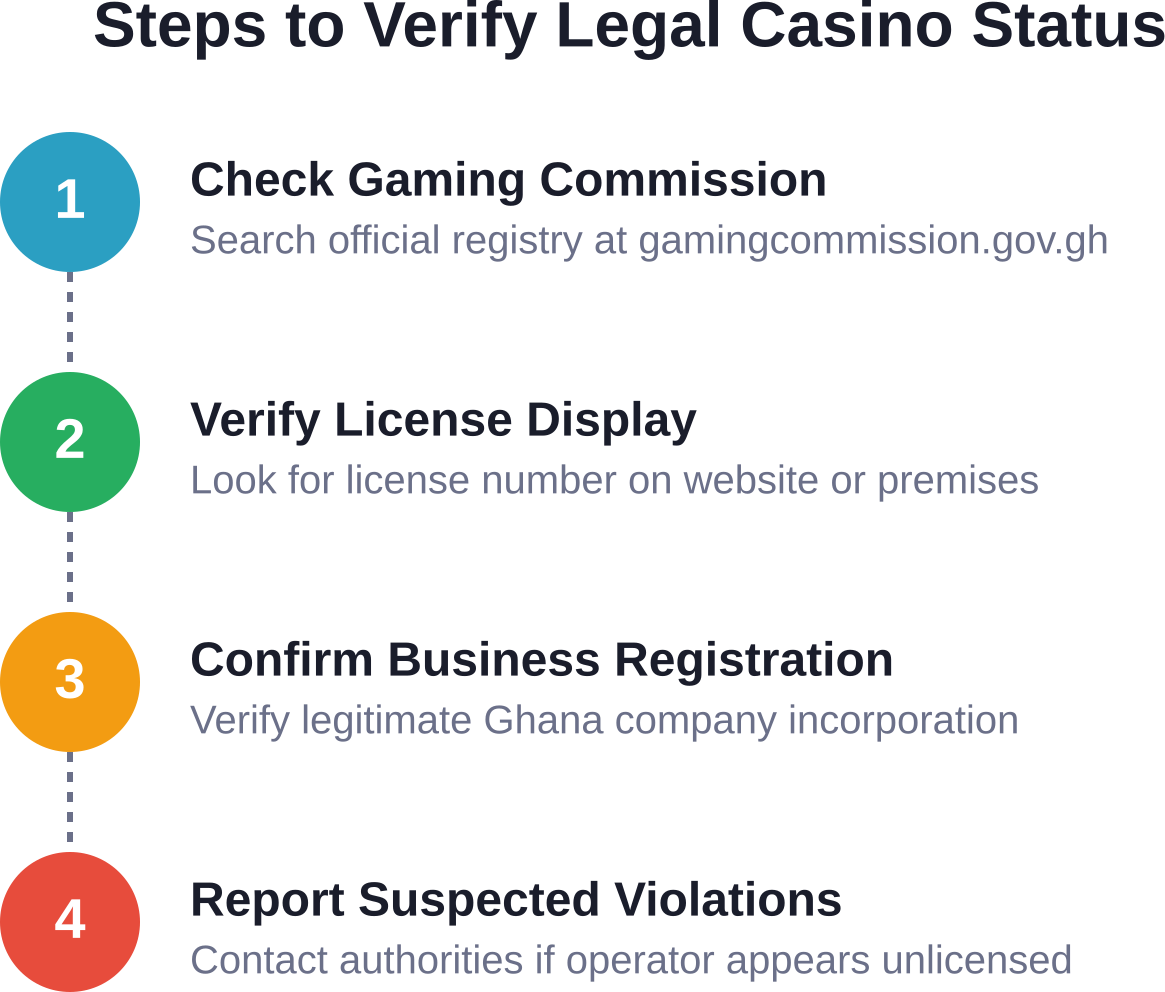
Check the Gaming Commission Registry
The Gaming Commission of Ghana maintains a public registry of licensed operators on its official website. This list shows the operator’s trade name, operation type (sports betting, online casino, etc.), license issue date, and expiry date.
For example, the registry shows entries like “1XBET – Sports Betting – 1/1/2026 – 31/12/2026 – Accra” and “1XBET – Online Casino – 1/1/2026 – 31/12/2026 – Accra,” confirming both sports betting and online casino licenses for that operator.
Always verify an operator appears in this official registry before depositing money or placing bets.
Look for License Display
Legitimate operators prominently display their license information. Physical casinos must post their license certificates where customers can see them.
Online platforms typically show their Gaming Commission license number in the website footer, along with links to the Commission’s website and responsible gambling resources.
If an operator refuses to provide license information or can’t produce verifiable credentials, that’s a red flag.
Verify Physical Presence
Licensed operators must have legitimate business registration in Ghana. Check whether the company has a registered office address, proper incorporation documents, and tax compliance.
For online operations claiming to be licensed in Ghana, verify they actually operate from Ghana or have substantive local presence—not just a mailbox address.
Report Suspected Illegal Operations
The Gaming Commission accepts reports of suspected unlicensed gambling. The National Lottery Authority similarly investigates illegal lotto operations.
Community reporting helps regulators identify and shut down illegal operators that undermine the licensed, regulated market.
Comparison with Regional Markets
Ghana’s regulatory approach differs from neighboring West African countries and competes with other major African gambling markets.
Kenya’s Mature Market
Kenya ranks among Africa’s top three gambling markets. The country’s regulatory framework is more developed, with specific online gambling regulations that Ghana is still working to match.
Kenya implemented stricter advertising restrictions and problem gambling interventions earlier than Ghana. These measures provide a potential model for Ghana’s regulatory evolution.
Nigeria’s Scale
Nigeria’s massive population makes it Africa’s largest gambling market by revenue. However, regulatory complexity across Nigeria’s states creates challenges that Ghana’s unified national framework avoids.
Both markets attract similar international operators, with brands like 1XBET and 22BET operating across multiple African countries under different national licenses.
South Africa’s Restrictions
South Africa maintains stricter online gambling restrictions than Ghana, technically prohibiting most forms of remote interactive gambling for domestic operators, though enforcement challenges exist.
Ghana’s more permissive online gambling framework positions it competitively for operators seeking a forward-looking regulatory environment that embraces digital platforms.
Country | Market Rank (Africa) | Online Gambling | Recent Growth
|
|---|---|---|---|
Nigeria | 1st | Legal, complex state variations | Steady expansion |
Kenya | 2nd | Legal, well-regulated | Mature market |
South Africa | 3rd | Restricted | Limited online growth |
Ghana | 4th | Legal, growing rapidly | 24% growth in 2025 |
Practical Implications for Players
Understanding the legal framework matters for anyone participating in gambling activities in Ghana.
Player Protections
Legal, licensed operators must follow player protection standards. This includes fair game outcomes through certified random number generators, transparent terms and conditions, secure handling of player funds, and accessible dispute resolution mechanisms.
Unlicensed operators offer none of these protections. Players using illegal platforms have no recourse if the operator refuses to pay winnings, manipulates games, or disappears with deposits.
Responsible Gambling Tools
Licensed platforms must provide self-exclusion options, deposit and loss limits, reality check reminders, and links to problem gambling support services.
Take advantage of these tools. With 70.68% of Ghanaian youths gambling and documented gambling-related harm increasing, responsible gambling practices matter.
Tax Implications
Good news for players: Ghana abolished the 10% tax on winnings that was briefly introduced in April 2023. As of April 2025, gambling winnings are not taxed.
This means whatever a player wins, they keep in full—at least from a tax perspective. The 20% GGR tax applies only to operators, not individual players.
Entering the Ghana Market: Operator Perspective
For businesses considering Ghana’s gambling market, several factors make it attractive—but success requires proper legal positioning.
Market Opportunity
The combination of high participation rates, rapid online growth (24% in 2025), strong mobile adoption, and a population of 34 million creates compelling commercial opportunities.
International operators like Kaizen Gaming clearly see long-term growth potential, as evidenced by continued market entry despite an already competitive landscape.
Regulatory Pathway
Operators should engage local legal counsel experienced in gaming law. Firms specializing in Ghana gambling licensing can navigate the Gaming Commission’s requirements, assist with company incorporation, prepare license applications, and ensure ongoing compliance.
The licensing process demands patience and thoroughness. Rushing through applications or cutting corners on compliance requirements leads to rejection or delayed approval.
Local Partnerships
Many international operators partner with local entities for market entry. Local partners provide crucial knowledge of consumer preferences, payment systems (particularly mobile money), regulatory nuances, and business culture.
The National Lottery Authority has emphasized ongoing partnership efforts with international gaming jurisdictions, particularly Malta, to elevate Ghana’s lottery industry through knowledge transfer and regulatory cooperation.
Compliance Investment
Budget adequately for compliance infrastructure. This includes licensing fees, legal counsel, compliance personnel, technical systems for monitoring and reporting, responsible gambling tools, and AML/KYC procedures.
Operators who view compliance as a cost center rather than investment often struggle with regulatory relationships and risk enforcement action.
Frequently Asked Questions
Is online gambling legal in Ghana?
Yes. Online gambling is legal in Ghana when offered by operators licensed by the Gaming Commission of Ghana. Separate licenses are available for online casino gaming and online sports betting, and players can verify an operator’s status through the Commission’s public register.
Do I need to pay tax on my gambling winnings in Ghana?
No. As of April 2025, players do not pay tax on gambling winnings in Ghana. The country’s 20% gaming tax applies to licensed operators based on their gross gaming revenue rather than to individual players.
How can I verify if a casino is licensed in Ghana?
You can verify a casino’s license by checking the public register maintained by the Gaming Commission of Ghana. Licensed operators also display their license details on their websites or at their physical premises. If an operator cannot provide valid licensing information, it should be avoided.
What types of gambling licenses exist in Ghana?
Ghana issues licenses for land-based casinos, sports betting operators, online casino platforms, and lottery operations. Each license category has its own financial, technical, operational, and regulatory requirements that operators must satisfy before receiving approval.
What happens if I use an unlicensed gambling site?
Unlicensed gambling websites operate outside the oversight of the Gaming Commission of Ghana. Players using these platforms may have no protection if disputes arise, winnings are withheld, or funds are lost. Licensed operators are required to meet standards for fair gaming, responsible gambling, and player fund protection.
How long does it take to get a gambling license in Ghana?
The licensing process generally takes several months. Most applications require around six to nine months to complete, depending on the complexity of the business, regulatory reviews, inspections, and technical compliance assessments.
What age do you need to be to gamble legally in Ghana?
The legal gambling age in Ghana is 18. Licensed operators must verify the age of customers before allowing participation in casinos, sports betting, lottery games, or online gambling services.
Conclusion
So, is the casino legal in Ghana? Absolutely—when properly licensed and regulated.
Ghana has established a functional regulatory framework under the Gaming Act 2006, with the Gaming Commission and National Lottery Authority providing oversight. Land-based casinos, sports betting, online gambling, and lottery operations all operate legally when operators hold appropriate licenses and maintain compliance.
The market has grown impressively, with 70.68% of Ghanaian youths gambling and the online sector expanding 24% in 2025. This growth attracts continued international investment while generating substantial government revenue through the 20% GGR tax.
But legal status requires verification. Players should always confirm an operator appears in the Gaming Commission’s official registry before depositing funds. Operators must navigate rigorous licensing requirements and maintain ongoing compliance to operate legally.
Challenges remain. Online gambling regulations need strengthening, cryptocurrency integration requires clearer standards, and gambling-related harm prevention deserves enhanced focus. The regulatory framework continues evolving to address these gaps.
For players, the message is clear: stick with licensed operators, use responsible gambling tools, and verify legal status before participating. For operators, Ghana offers real opportunity—but only through proper licensing and genuine commitment to regulatory compliance.
The casino is legal in Ghana. Make sure you’re using one that actually follows the law.
Ready to verify your preferred gambling platform’s legal status? Visit the Gaming Commission of Ghana’s official website today to check their licensed operators registry and ensure you’re playing on a legitimate, regulated platform.
Related Articles

September 3, 2026Is the Casino Legal in Denmark? 2026 Guide

September 3, 2026Is the Casino Legal in Angola? What the 2026...