 Nothing found for the request
Is the Casino Legal in South Sudan? 2026 Laws & Facts
Sologe July 10, 2026
Share:


The Legal Status of Gambling in South Sudan
Gambling is legal in South Sudan. Full stop.
This puts the nation in the majority across Sub-Saharan Africa. According to medical research published by the National Center for Biotechnology Information, 41 out of 49 Sub-Saharan African countries regulate gambling—that’s 83.6% of nations in the region. Only seven African countries maintain outright prohibitions: Burundi, Eritrea, Guinea Bissau, Mali, Mauritania, Somalia, and Sudan.
South Sudan’s legal stance reflects its distinct political and cultural identity. When the country gained independence in 2011, it didn’t adopt the strict Islamic legal codes that govern its northern neighbor. Instead, the government permitted gambling activities, though it hasn’t prioritized building a robust regulatory system.
No Dedicated Regulatory Authority
Here’s where things get complicated. South Sudan doesn’t have a specific gambling commission or dedicated regulatory body overseeing casino operations.
Most countries with legal gambling establish agencies to license operators, enforce standards, protect consumers, and collect taxes. Think of bodies like the UK Gambling Commission or Malta Gaming Authority.
South Sudan? None of that exists yet.
This absence doesn’t make gambling illegal—it just means there’s minimal oversight. Operators work in a loosely regulated environment, and players have limited recourse if disputes arise.
How South Sudan Differs From Sudan
The confusion between Sudan and South Sudan is understandable but critical to sort out.
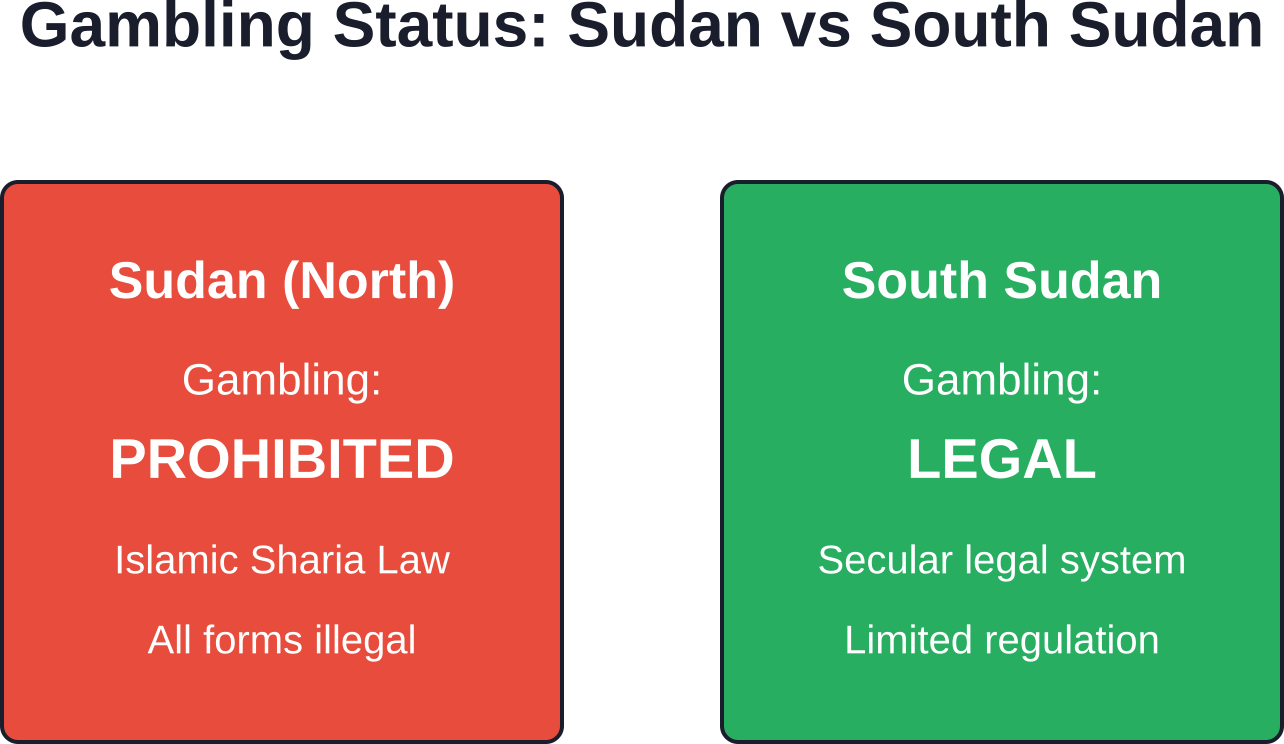
Sudan (the country to the north) operates under Islamic Sharia law, which categorically prohibits gambling in all forms. Casinos, betting shops, and online gambling platforms are illegal there, and enforcement can be strict.
South Sudan follows a different legal tradition. The population is predominantly Christian and practices traditional African religions. Islamic law doesn’t govern civil society, which is why gambling faces no religious prohibition.
So when someone asks whether casinos are legal “in Sudan,” the answer depends entirely on which Sudan they mean. For the Republic of South Sudan, the answer is yes.
Gambling Taxes and Operator Requirements
While South Sudan lacks a dedicated gambling regulator, the government does impose taxes on gaming operations.
The South Sudan Financial Act 2024/2025 introduced specific taxation measures targeting gambling and lottery activities. These tax rates apply to all operators conducting business in the country.
Current Tax Rates for Gambling Operators
Operators face two primary tax obligations:
Tax Type | Rate | Applied To |
|---|---|---|
Gross Gaming Tax | 24% | Gross Gaming Revenue (GGR) |
Excise Tax | 10% | Total Turnover/Stakes |
The 24% Gross Gaming Tax applies to an operator’s revenue after payouts but before operating expenses. That’s a substantial rate compared to many jurisdictions—for context, some European countries charge between 15-20% on GGR.
The 10% Excise Tax on total stakes adds another layer of taxation. This applies to the total amount wagered, not just what the operator keeps.
Combined, these taxes create a significant fiscal burden for gambling businesses. Operators need to structure their operations carefully to remain profitable while meeting these obligations.
Licensing and Compliance
Here’s where the lack of a regulatory authority becomes apparent. There’s no standardized licensing process that operators must navigate.
In most regulated markets, casinos and betting companies apply for licenses, undergo background checks, prove financial stability, and demonstrate responsible gaming measures. They renew licenses periodically and face audits to ensure compliance.
South Sudan doesn’t have this infrastructure in place. Operators may need to register as businesses and pay taxes, but there’s no comprehensive licensing regime governing gambling-specific operations.
This creates uncertainty. Companies operating in South Sudan can’t point to a license as proof they’re following the rules—because the detailed rules simply don’t exist yet.
Land-Based Casinos in South Sudan
Physical casino infrastructure in South Sudan remains extremely limited.
The country faces significant economic challenges. Years of civil conflict, underdeveloped infrastructure, and political instability haven’t created conditions favorable for major casino resort development.
But that doesn’t mean land-based gambling is entirely absent.
Current Casino Landscape
Information about specific casino venues in South Sudan is scarce. International casino directories list minimal or no entries for the country, suggesting that if casinos do operate, they’re small-scale and informal.
This contrasts sharply with other African nations. Countries like South Africa, Kenya, and Nigeria have well-established casino industries with multiple venues, international operators, and substantial tourism traffic.
South Sudan’s casino market—such as it is—likely consists of modest gaming rooms attached to hotels or social clubs, catering primarily to expatriates and wealthy locals.
Challenges Facing Land-Based Development
Several factors prevent casino expansion in South Sudan:
- Political instability: The Revitalized Transitional Government of National Unity has made slow progress on reforms, creating uncertainty for investors.
- Infrastructure gaps: Limited power supply, poor road networks, and minimal international flight connections make operating entertainment venues difficult.
- Economic constraints: The local market can’t support large-scale casino operations, and tourism infrastructure is underdeveloped.
- Regulatory ambiguity: Without clear rules, international casino operators hesitate to invest.
According to the U.S. State Department’s 2023 Investment Climate Statement, no significant improvements in trade and investment conditions occurred in South Sudan, and the government has issued stronger warnings about business risks in the country.
That environment doesn’t attract the kind of capital needed to build modern casino resorts.
Online Gambling and Casino Sites
The internet has changed gambling worldwide, and South Sudan is no exception—though with unique characteristics.
Online casinos don’t face the same infrastructure barriers as physical venues. A player with an internet connection can access offshore gambling sites from anywhere, and enforcement against individual bettors is practically nonexistent.
Offshore Operators Serving South Sudan
South Sudanese players can access international online casinos, though the selection may be limited compared to other markets.
Many global gambling sites accept players from South Sudan, offering:
- Slot machines and casino games
- Sports betting on international leagues
- Live dealer casino games
- Mobile gambling apps
These operators typically hold licenses from jurisdictions like Curacao, Malta, or Gibraltar. They’re not licensed specifically for South Sudan—they’re international platforms that accept South Sudanese customers.
Payment Methods and Practical Challenges
Real talk: getting money in and out of online casinos is the biggest hurdle for South Sudanese players.
The country’s banking infrastructure is underdeveloped. Credit card penetration is low, international wire transfers can be expensive and slow, and many global payment processors don’t fully support South Sudanese financial institutions.
Players often rely on:
- Cryptocurrency (Bitcoin, Litecoin, Ethereum)
- E-wallets that operate in the region
- Mobile money services
- Prepaid vouchers
Cryptocurrency has become particularly popular in countries with banking limitations. It allows players to deposit and withdraw without relying on traditional financial infrastructure.
Regulatory Status of Online Gambling
South Sudan hasn’t enacted specific legislation addressing online gambling.
There’s no law explicitly permitting it, but there’s also no law prohibiting it. This creates a gray market where offshore operators serve customers without South Sudanese government oversight.
The government collects no taxes on these online transactions, and players have no local regulatory protections if disputes arise.
This situation is common in developing markets. Many countries haven’t updated their gambling laws to address internet gaming, leaving players and operators in legal limbo.
Explore Gaming Business Networks with Sologe
Researching South Sudan’s gaming landscape often starts with legal questions, but businesses may also want to understand how the broader iGaming ecosystem is structured. Sologe is a B2B iGaming marketplace that helps companies explore supplier categories and business solutions used across the gaming industry.
Sologe can help businesses:
- Explore gaming software options
- Compare online gaming platforms
- Review company registration categories
- Assess certification-related options
- Find analytics and marketing tools
👉Contact Sologe to learn more about software, platforms, certification options, and other B2B iGaming solutions.
Comparing South Sudan to Other African Gambling Markets
Looking at South Sudan’s gambling landscape makes more sense when compared to regional peers.
The Broader African Context
Africa’s gambling industry has experienced substantial growth over recent years. Mobile technology and internet penetration have accelerated the shift toward online betting, particularly sports betting on football.
According to research on gambling in Sub-Saharan Africa, the majority of countries in the region permit and regulate gambling activities. Out of 49 Sub-Saharan African countries, 41 have legal gambling frameworks—83.6% of the region.
Only 14.3% maintain prohibitions, typically due to Islamic law (as in Sudan, Somalia, and Mauritania) or specific cultural policies.
Developed vs. Emerging Markets
African gambling markets exist on a spectrum:
Developed markets like South Africa, Kenya, and Nigeria feature:
- Multiple land-based casinos with international operators
- Robust regulatory frameworks and dedicated gambling commissions
- Licensed online operators with local servers
- Consumer protection mechanisms and responsible gambling initiatives
- Significant tax revenue from gambling activities
Emerging markets like South Sudan, South Sudan’s neighbors, and other post-conflict nations show:
- Minimal land-based infrastructure
- Limited or absent regulatory frameworks
- Reliance on offshore online operators
- Gray-market conditions with unclear legal status
- Low tax collection from gambling activities
South Sudan firmly occupies the emerging category. The country permits gambling in principle but hasn’t developed the institutional capacity to regulate it effectively.
Regional Regulatory Trends
Across Africa, governments are recognizing the need to regulate online gambling.
According to analysis by LexisNexis Risk Solutions on the rise of online gaming in Africa, the booming market faces inevitable regulation to combat financial crime and ensure responsible gaming.
Countries are motivated by multiple factors:
- Revenue generation: Taxing gambling provides significant income for government budgets
- Consumer protection: Unregulated markets expose players to fraud and unfair practices
- Crime prevention: Regulation helps combat money laundering and match-fixing
- Social responsibility: Frameworks can mandate problem gambling interventions
South Sudan may eventually follow this trend, particularly if online gambling continues growing among its population. But for now, the government hasn’t prioritized regulatory development.
Country Type | Regulatory Status | Operator Environment | Example Countries
|
|---|---|---|---|
Prohibited | Complete ban on gambling | No legal operators | Sudan, Somalia, Mauritania |
Developed | Comprehensive regulation | Licensed local and international operators | South Africa, Kenya, Nigeria |
Emerging | Legal but minimal oversight | Offshore operators dominate | South Sudan, several neighbors |
What Players Should Know
If you’re in South Sudan and considering gambling—whether at a local venue or online—here’s what matters.
Legal Risks for Players
Individual players face essentially zero legal risk for gambling in South Sudan.
There are no laws criminalizing betting or casino gaming. The government doesn’t prosecute people for placing wagers, whether at a physical location or online.
This differs from countries with prohibitions, where players can theoretically face fines or other penalties (though enforcement varies widely even in those jurisdictions).
Consumer Protections Are Limited
But wait. Just because gambling is legal doesn’t mean players have strong protections.
Without a regulatory authority, there’s no official body to:
- Investigate complaints against operators
- Ensure games are fair and random
- Verify that casinos can pay out winnings
- Enforce responsible gambling standards
- Maintain player fund segregation requirements
If a dispute arises with an offshore online casino, South Sudanese players have limited recourse. They can’t contact a local regulator, and international jurisdictions may not prioritize complaints from South Sudanese citizens.
Choosing Safe Gambling Options
Players should prioritize established operators with solid reputations.
Look for sites that:
- Hold licenses from recognized jurisdictions (Malta, UK, Curacao, Gibraltar)
- Have been operating for several years with documented track records
- Offer transparent terms and conditions
- Provide secure payment methods with encryption
- Have positive reviews from independent gambling communities
Cryptocurrency casinos offer advantages in South Sudan’s banking environment, but the same due diligence applies. Verify the operator’s reputation before depositing.
Responsible Gambling Considerations
Without regulatory requirements, operators serving South Sudan may not offer robust responsible gambling tools.
Players need to self-impose limits:
- Set strict budgets before playing
- Never chase losses
- Recognize warning signs of problem gambling
- Seek help if gambling becomes difficult to control
International organizations like Gamblers Anonymous offer resources, though local South Sudanese support services may be limited.
Future Outlook for Gambling Regulation
Will South Sudan develop a comprehensive gambling regulatory framework? Possibly, but not soon.
Priorities and Challenges
The government faces far more pressing issues than gambling regulation.
South Sudan continues working through political transition, implementing the 2018 peace agreement, and addressing fundamental governance challenges. Economic development, infrastructure, healthcare, and education demand attention and resources.
Gambling regulation simply isn’t high on the priority list.
That said, if online gambling continues growing—particularly sports betting on mobile platforms—the government may eventually recognize the revenue potential from proper regulation and taxation.
Potential Regulatory Models
If South Sudan does pursue regulation, it might follow models used by neighboring countries:
- Licensing-based approach: Establish a gambling authority that issues licenses to operators meeting specific standards. Kenya and Uganda use variations of this model.
- Tax-focused approach: Concentrate on collecting revenue from operators without extensive regulatory oversight. This lighter-touch model requires less institutional capacity.
- Hybrid approach: Combine elements of licensing and taxation with gradual development of consumer protection measures.
The current taxation measures in the 2024/2025 Financial Act suggest South Sudan is taking initial steps—collecting revenue before building comprehensive regulation.
International Pressure and Standards
International organizations are increasingly focused on gambling regulation in Africa.
The United Nations Office on Drugs and Crime has warned about match-fixing and urged stronger cooperation with the gambling industry. Their reports examine how illegal betting networks and organized crime drive match manipulation, urging governments to implement safeguards.
As these international standards evolve, South Sudan may face pressure to align with regional best practices—particularly if it seeks international development assistance or trade agreements.
Practical Gambling Options in South Sudan
So what can someone in South Sudan actually do if they want to gamble?
Land-Based Options
Options are extremely limited.
Any physical gambling venues likely operate informally and cater to narrow clientele. Visitors shouldn’t expect Las Vegas-style casinos or even regional equivalents like Sun City in South Africa.
Those seeking land-based casino experiences would need to travel to neighboring countries with established industries.
Online Casino Gaming
This is the most practical option for South Sudanese players.
International online casinos accept South Sudanese customers and offer:
- Hundreds or thousands of slot games
- Table games (blackjack, roulette, baccarat)
- Live dealer games with real-time video streaming
- Progressive jackpot slots
- Video poker variants
Mobile compatibility is crucial given that smartphone penetration exceeds desktop computer access in South Sudan. Most modern online casinos offer mobile-optimized sites or dedicated apps.
Sports Betting
Sports betting has proven enormously popular across Africa, and South Sudan is no exception.
International sportsbooks accept wagers on:
- International football (Premier League, La Liga, Champions League)
- Basketball (NBA)
- Regional African football leagues
- Cricket, tennis, and other sports
Live betting (placing wagers during matches) has become particularly popular, though it requires stable internet connections that can be challenging in South Sudan.
Lottery and Other Forms
Information about lottery operations in South Sudan is limited. If they exist, they likely operate on a small scale.
Some international lottery betting sites allow players to wager on outcomes of major global lotteries like Powerball or EuroMillions, though this isn’t the same as buying official lottery tickets.
Key Takeaways for Operators
Gambling companies considering South Sudan face a unique calculation.
Opportunities
The market is essentially unregulated, creating potential first-mover advantages. There’s minimal competition for land-based operations, and online operators can serve customers with relatively little interference.
Mobile penetration is growing, and young demographics suggest future market expansion.
Risks and Barriers
But the risks are substantial:
- Political instability: The transitional government hasn’t fully stabilized, and conflicts can flare
- Economic challenges: Limited purchasing power constrains market size
- Infrastructure deficits: Unreliable power, poor internet connectivity, and payment processing difficulties
- Regulatory uncertainty: Rules could change without warning as the government develops capacity
- Reputational concerns: Operating in high-risk jurisdictions can create compliance issues with international financial systems
According to the U.S. State Department, corruption and lack of transparency increase risks for companies conducting business in South Sudan.
Most international gambling operators choose to serve South Sudan from offshore jurisdictions rather than establishing local operations. This approach minimizes physical infrastructure investment while still capturing online market share.
Compliance Considerations
Operators must still comply with tax obligations under the Financial Act 2024/2025.
The 24% Gross Gaming Tax and 10% Excise Tax apply to operators conducting business in South Sudan, though enforcement mechanisms remain unclear.
Companies should also consider anti-money laundering obligations. International standards from the Financial Action Task Force apply regardless of local regulatory capacity, and operators can face consequences in other jurisdictions if they facilitate financial crime.
Common Misconceptions About Gambling in South Sudan
Several myths circulate about South Sudan’s gambling laws. Let’s clear them up.
Myth: Gambling Is Illegal Because It’s Islamic
False. While neighboring Sudan prohibits gambling under Islamic law, South Sudan is a predominantly Christian nation with a secular legal system.
The confusion stems from the similar names and shared history, but the two countries have entirely different legal frameworks regarding gambling.
Myth: There Are No Gambling Taxes
Also false. The 2024/2025 Financial Act explicitly establishes tax rates for gambling operators.
While enforcement may be inconsistent and there’s no dedicated regulatory body collecting fees, tax obligations legally exist.
Myth: Online Gambling Is Regulated
Not accurate. Online gambling exists in a gray area—it’s not explicitly prohibited, but it’s also not formally regulated.
Offshore operators serve South Sudanese customers without local licenses because no licensing system exists.
Myth: Players Are Protected by Law
Unfortunately, no. While gambling is legal, there are minimal consumer protections.
Players can’t file complaints with a regulatory authority because none exists. Disputes with operators must be resolved through the operator’s own jurisdiction or through private negotiation.
Frequently Asked Questions
Is it legal to gamble in South Sudan?
Yes. Gambling is legal in South Sudan. Both land-based and online gambling activities are generally permitted, although the country has a limited regulatory framework and no dedicated national gambling authority.
Are there casinos in South Sudan?
South Sudan has very limited casino infrastructure. While casino gambling is legal, economic conditions and infrastructure challenges have restricted the development of large-scale casino resorts, with only a small number of gambling venues operating.
What taxes do gambling operators pay in South Sudan?
Under the Financial Act 2024/2025, gambling operators are subject to a 24% Gross Gaming Tax on Gross Gaming Revenue and a 10% Excise Tax on total turnover or stakes. These taxes apply to gambling and lottery activities conducted within South Sudan.
Can I legally use online casinos in South Sudan?
Online gambling is not specifically prohibited under South Sudanese law and operates in a legal gray area. Although players generally do not face legal penalties for using international gambling websites, online gambling is not formally regulated, leaving consumers with limited legal protections.
How does South Sudan differ from Sudan regarding gambling?
South Sudan and Sudan have very different gambling laws. South Sudan permits gambling under its secular legal system, while Sudan prohibits gambling under laws based on Islamic Sharia principles.
What payment methods work for online gambling in South Sudan?
Due to limited banking infrastructure, players commonly rely on cryptocurrencies, e-wallets, mobile money services, and prepaid payment methods. Traditional bank cards and bank transfers may not always be available for international gambling transactions.
Will South Sudan regulate gambling in the future?
It is possible, but no official plans or timeline have been announced. Any future gambling reforms are likely to depend on broader economic development, regulatory priorities, and the continued growth of the country’s gambling market.
Conclusion
Casino gambling is legal in South Sudan, placing the nation among the 83.6% of Sub-Saharan African countries that permit gaming activities.
The legal framework, however, remains underdeveloped. There’s no dedicated gambling regulatory authority, no comprehensive licensing system, and minimal consumer protections. What does exist are tax obligations—a 24% Gross Gaming Tax on revenue and a 10% Excise Tax on stakes under the 2024/2025 Financial Act.
For players, this creates a straightforward situation: gambling is legal, but caveat emptor applies. Choose established operators carefully, prioritize platforms with international licenses and proven track records, and exercise personal responsibility since regulatory protections don’t exist.
For operators, South Sudan represents an emerging market with both opportunity and substantial risk. Political instability, infrastructure challenges, and regulatory uncertainty require careful evaluation before committing resources.
The contrast with neighboring Sudan is stark and worth remembering. While Sudan prohibits all gambling under Islamic law, South Sudan’s secular legal system permits casinos, betting, and gaming. The similar names cause confusion, but the legal realities couldn’t be more different.
Looking ahead, South Sudan may eventually develop more robust gambling regulation—particularly as mobile gaming grows and governments across Africa recognize the revenue potential. But for now, the country offers a legal yet loosely regulated gambling environment that requires both operators and players to proceed with eyes wide open.
Whether you’re considering gambling in South Sudan or simply curious about the legal landscape, the bottom line is clear: it’s legal, it’s lightly regulated, and it carries both opportunities and risks that demand careful consideration.
Related Articles

September 3, 2026Is the Casino Legal in Denmark? 2026 Guide

September 3, 2026Is the Casino Legal in Angola? What the 2026...