 Nothing found for the request
Is the Casino Legal in Poland? 2026 Guide
Sologe July 11, 2026
Share:


The Legal Framework: Poland's Gambling Act
The Gambling Act of 19 November 2009 completely reshaped Poland’s gambling industry. According to official government sources, this legislation established clear rules for organizing gambling activities and set the taxation framework for operators.
The Ministry of Finance oversees all gambling operations in Poland. They issue licenses, monitor compliance, and maintain registries of both legal operators and blacklisted illegal websites.
But here’s the thing: Poland operates a mixed model. The state holds a monopoly over certain games while allowing private entities to operate others under strict licensing conditions.
State Monopoly vs. Private Operations
The government maintains exclusive control over number lottery games, lotteries with cash prizes, telebingo, and electronic gaming machines outside casinos. Private companies can’t touch these segments.
Private entities may organize other gambling activities — including casinos, betting, and poker — but only after obtaining proper permits from the Ministry of Finance.
This dual structure exists to balance consumer protection, government revenue, and business growth. Whether it’s achieved that balance remains debatable among industry participants.
Are Land-Based Casinos Legal?
Yes, land-based casinos operate legally in Poland when properly licensed. The catch? Getting that license is neither cheap nor easy.
Only joint-stock companies or limited liability companies established in Poland can apply for casino licenses. Shareholders must be legal persons or individuals from European Union member states or European Free Trade Association countries.
The financial barrier is substantial. As of 2023, the base amount for gambling calculations stands at 6,565.44 PLN, and casino licenses cost 32,000% of this base amount, representing a substantial investment.
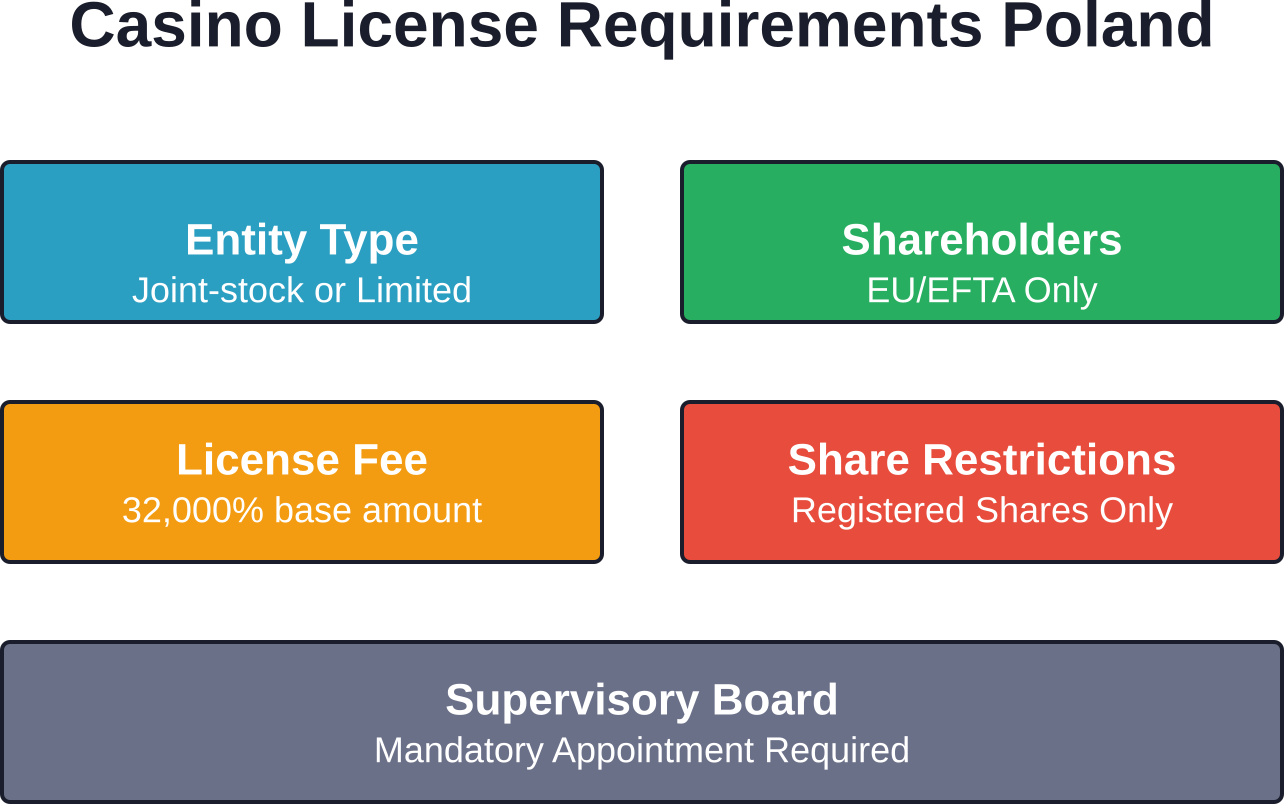
Additional restrictions apply. If the casino operates as a joint-stock company, shares can only be registered, not bearer shares. The company must appoint a supervisory board.
No legitimate objections can exist against the company, shareholders holding more than 10% of shares, or members of representative bodies. This background check ensures only reputable operators enter the market.
What About Online Casinos?
Here’s where things get restrictive. Online gambling in Poland operates under tight constraints that many operators find prohibitive.
Online casino licenses exist, but the regulatory environment makes them expensive to obtain and maintain. Operators must pay significant fees for the initial permit and annual license retention.
The Ministry of Finance maintains a Register of Illegal Gambling Websites. When a domain appears on this list, telecommunications undertakings must block access within 48 hours. If the domain is removed from the register, access must be restored within 48 hours.
Popular payment methods face restrictions too. BLIK, a popular Polish payment method, often can’t be used for online gambling transactions. This payment barrier significantly impacts user experience and operator revenue.
Many international online casinos choose not to pursue Polish licenses due to these stringent requirements. They either operate without licenses — risking blacklisting and prosecution — or avoid the Polish market entirely.
The Enforcement Reality
Poland doesn’t just regulate on paper. Authorities actively enforce gambling laws, maintaining databases and coordinating with telecommunications providers to block illegal operators.
Community discussions reveal that players who use unlicensed foreign sites operate in a legal gray zone. While the law targets operators rather than individual players, accessing blocked sites carries potential risks.
Explore Gaming Providers with Sologe
Poland’s gaming market combines regulation, technology, and operational requirements, so businesses often need more than legal information when conducting research. Sologe helps companies review iGaming categories in one B2B marketplace, from software and payments to licensing, certification, and equipment.
Through Sologe, businesses can:
- Compare online casino platform options
- Review payment and licensing categories
- Explore analytics and marketing software
- Check certification-related solutions
- Research casino equipment categories
👉Contact Sologe to compare software, payments, licensing, certification, equipment, and other B2B iGaming solutions.
Gambling Tax Rates in Poland
Tax obligations vary dramatically based on the type of gambling activity. The Gambling Act stipulates specific rates for each category.
Gambling Type | Tax Rate
|
|---|---|
Raffle lottery and raffle bingo | 10% |
Cash lottery | 15% |
Lottery | 20% |
Cash bingo game, telebingo | 25% |
Betting on sports competitions (except animal competitions) | 12% |
Any other betting | 12% |
Betting operators face base license fees of 2,000% of the base amount, plus additional fees for each betting point and website. Promotional lottery licenses require 10% of the prize pool, with a minimum of 50% of the base amount.
These tax rates apply whether the gambling occurs online or at physical locations. The government uses gambling tax revenue as a significant income stream, creating an incentive to maintain strict control over the industry.
Is Poker Legal in Poland?
The poker question generates considerable confusion. Community discussions reveal contradictory experiences, with some players reporting legal live poker venues while others claim the game faces restrictions.
The reality? It depends on the format and location.
Poker played in licensed casinos is legal. These establishments hold the proper permits to offer card games, including poker tournaments and cash games.
Live poker rooms outside casinos exist in a murkier space. Some operate under promotional lottery licenses or other legal structures, while others skirt regulations.
Online poker faces the same restrictions as online casinos. Operators need Polish licenses to legally offer poker to Polish residents. Most international poker sites either obtain these licenses — rare due to cost — or block Polish players.
The Illegal Gambling Market
Despite strict regulations, Poland’s illegal online casino market thrived in recent years. The unlicensed market has generated substantial turnover, with reports indicating nearly PLN 26 billion in turnover and over PLN 1 billion in revenue for illegal operators.
These numbers highlight a fundamental tension in Polish gambling policy. The regulations aim to control the market and protect consumers, but they also create conditions that push activity underground.
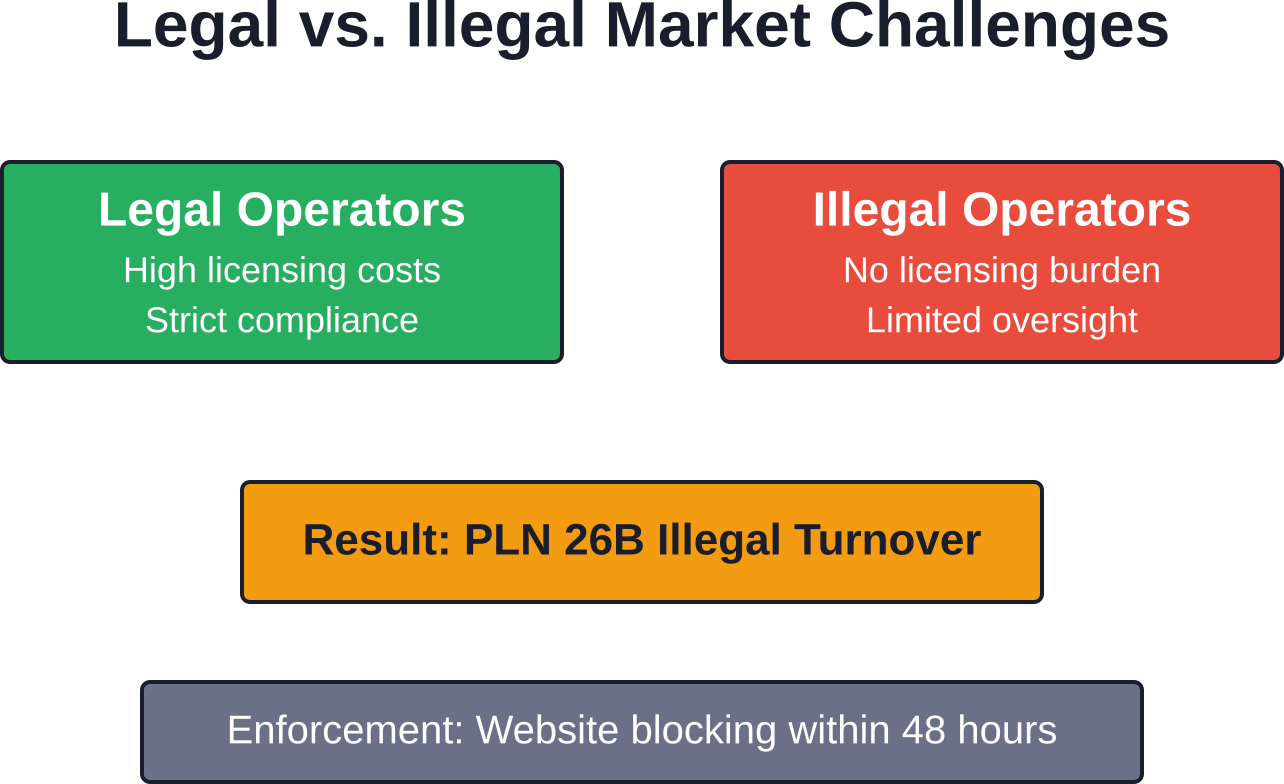
The Ministry of Finance battles this through website blocking and registry maintenance. But enforcement proves challenging when international operators host services outside Polish jurisdiction.
Players gravitate toward illegal sites for several reasons: better bonuses, more payment options, wider game selection, and lower fees. The legal market struggles to compete while bearing significantly higher operating costs.
Penalties for Illegal Gambling
Poland’s Treasury Code outlines specific offenses and penalties related to illegal gambling. These provisions target both operators and, in some cases, participants.
Organizing gambling without a proper license constitutes a serious offense. Operators face substantial fines and potential criminal prosecution.
Selling tickets for games of chance without authorization violates the law. Advertising illegal gambling also carries penalties, creating risk for affiliate marketers and media outlets.
Attending gaming establishments that operate illegally can theoretically result in penalties, though enforcement typically focuses on operators rather than players.
Real talk: the government prioritizes shutting down illegal operators over prosecuting individual players. But that doesn’t mean player activity is risk-free, particularly as enforcement mechanisms evolve.
How Poland Compares to EU Neighbors
Poland’s approach to gambling regulation differs notably from many European Union neighbors. No sector-specific EU legislation governs gambling services across member states.
Each EU country maintains autonomy in organizing gambling services, provided they comply with fundamental freedoms under the Treaty on the Functioning of the European Union. The freedom to provide services or establish businesses across borders remains particularly relevant.
Most EU countries allow at least some games of chance. But implementation varies wildly. Some nations embrace liberal licensing regimes that attract operators. Others, like Poland, impose restrictive frameworks that limit market access.
Academic research on Polish gambling regulation describes a “search for equilibrium” following the 2009 reforms. The government continues adjusting rules to balance consumer protection, business viability, and state revenue.
That equilibrium remains elusive. Industry participants argue the current framework tilts too heavily toward restriction, inadvertently strengthening the illegal market.
The 2009 Gambling Affair and Its Aftermath
Understanding current Polish gambling law requires knowing its origin story. The so-called “gambling affair” of 2009 sparked the comprehensive reform that produced the Gambling Act.
Political controversy surrounded gambling operations before 2009. The affair prompted legislators to overhaul the entire regulatory structure, creating clearer rules but also more restrictions.
Some market segments became delegalized. Others fell under state monopoly. A select few saw liberalization, but with strict licensing requirements that limited practical access.
The reform significantly altered Poland’s gambling landscape. International operators who previously offered services found themselves locked out unless they secured expensive licenses. Domestic operators faced new compliance burdens.
Academic analyses of this period identify it as a starting point for ongoing regulatory adjustments. The Ministry of Finance and parliament continue tweaking rules, attempting to create a sustainable environment that serves multiple objectives.
Current Market Status in 2026
Where does Poland’s gambling market stand today? The legal framework remains largely unchanged from the 2009 foundations, with incremental modifications over the years.
Licensed land-based casinos operate in major cities, serving tourists and locals who want guaranteed legal gambling experiences. These venues offer traditional casino games under regulatory oversight.
The online market remains constrained. A handful of operators hold Polish licenses, but international giants largely avoid the market or operate without authorization from offshore locations.
Betting represents a more active segment, with licensed operators offering sports betting through physical locations and authorized websites.
The state monopoly continues generating revenue through lottery products and other reserved games. Private operators remain barred from these lucrative segments.
Key Compliance Requirements
Operators who pursue legal status in Poland must navigate complex compliance obligations beyond initial licensing.
Anti-money laundering rules apply to gambling businesses. The Act on Counteracting Money Laundering and Terrorist Financing imposes reporting requirements and customer due diligence obligations.
Operators must maintain detailed records of transactions, implement know-your-customer procedures, and report suspicious activities to authorities.
Advertising restrictions limit how gambling services can be promoted. Marketing materials must include responsible gambling warnings and avoid targeting minors.
Technical standards govern gaming equipment and software. Systems must meet certification requirements that ensure fairness and prevent manipulation.
Regular audits and inspections verify ongoing compliance. The Ministry of Finance monitors licensed operators to ensure they maintain standards and pay appropriate taxes.
What This Means for Players
So you’re a player wondering what you can legally do. Here’s the practical breakdown.
You can visit licensed land-based casinos without legal concern. These establishments operate with full government approval. Your winnings are legitimate, and your participation is protected under Polish law.
For online gambling, stick to operators holding Polish licenses if you want certainty. The selection is limited and the user experience may not match international competitors, but you won’t face legal questions.
Using unlicensed international sites puts you in a gray area. Poland primarily targets operators rather than players, but the sites themselves risk blocking. Access can disappear within 48 hours when domains hit the blacklist.
Payment processing through unlicensed sites can prove difficult. Banks and payment providers increasingly refuse transactions to gambling sites without Polish licenses.
For poker specifically, legal options exist primarily at licensed casinos. Some live poker rooms operate in legal gray zones — research carefully before playing in these venues.
Future Outlook for Polish Gambling Law
Will Poland’s gambling regulations change significantly? The government shows no signs of major liberalization.
Industry advocates continue pushing for reforms that would make licensing more accessible and reduce barriers to legal operation. Their argument: the current system enriches illegal operators while depriving the state of tax revenue.
Consumer protection remains a stated government priority. Authorities argue strict controls prevent problem gambling and protect vulnerable populations.
The tension between these objectives — market access versus protection — will continue shaping policy debates. Incremental adjustments seem more likely than wholesale reform.
European Union developments could influence Polish policy. As other member states experiment with different regulatory models, Poland may adapt its approach based on observed outcomes.
For now, expect the current framework to persist. Operators face high barriers to entry. Players navigate limited legal options. The illegal market thrives in the gaps.
FAQ
Can I legally play at online casinos in Poland?
Yes, but only at online casinos licensed by the Polish Ministry of Finance. Unlicensed international gambling websites are not authorized to operate in Poland and may be blocked by the government, although enforcement generally targets operators rather than individual players.
How much does a casino license cost in Poland?
A casino license costs 32,000% of the statutory base amount used for gambling calculations. Using the 2023 base amount of PLN 6,565.44, this represents a substantial licensing investment for casino operators.
Is poker legal in Poland?
Yes. Poker is legal in licensed casinos that have permission to offer card games. Online poker is subject to the same licensing requirements as online casinos, and operators must hold a Polish license to legally provide services within the country.
What gambling activities does the Polish state monopolize?
The Polish state has exclusive rights to operate number lotteries, cash prize lotteries, telebingo, and electronic gaming machines located outside casinos. These gambling activities cannot be offered by private operators.
What happens if I use an unlicensed gambling website?
Poland maintains an official Register of Illegal Gambling Websites. Internet service providers must block listed websites, and access may be restricted within 48 hours. Although enforcement mainly targets operators, players may lose access to their accounts and any funds held on blocked platforms.
Who can apply for a gambling license in Poland?
Only joint-stock companies and limited liability companies established in Poland may apply for gambling licenses. Shareholders must generally come from the European Union or European Free Trade Association, and ownership is subject to regulatory suitability requirements.
Are there different tax rates for different types of gambling?
Yes. Gambling tax rates vary depending on the activity. Sports betting is generally taxed at 12%, while lottery products are taxed at different rates depending on the game. The applicable tax is determined by the type of gambling rather than whether it is offered online or in person.
Conclusion
Casinos are legal in Poland, but within a tightly controlled regulatory framework that makes market access challenging. The Gambling Act of 2009 established rules that favor state monopolies in some segments while allowing licensed private operators in others.
Land-based casinos operate successfully under proper licensing. Online gambling faces more significant constraints that limit both operator participation and player options. The result? A substantial illegal market that thrives alongside the regulated sector.
For players, the safest approach involves using licensed establishments and websites. For operators, Polish licensing requires substantial capital investment and rigorous compliance.
Poland’s gambling regulations reflect an ongoing attempt to balance competing interests. Whether the current equilibrium serves those interests effectively remains a matter of debate among industry participants, regulators, and academic observers.
Check with the Ministry of Finance or qualified legal counsel for the most current licensing requirements and regulatory updates before operating or investing in Polish gambling ventures.
Related Articles
September 3, 2026Is the Casino Legal in Denmark? 2026 Guide

September 3, 2026Is the Casino Legal in Angola? What the 2026...