 Nothing found for the request
Is the Casino Legal in Haiti? 2026 Law & Regulation Guide
Sologe July 11, 2026
Share:


Legal Status of Casinos in Haiti
Land-based casinos are perfectly legal in Haiti, though they operate under specific conditions. The regulatory framework distinguishes between full-scale casinos and smaller gaming establishments, each with different requirements.
The Lottery of the Haitian State (LEH – Loterie de l’État Haïtien) serves as the primary regulatory authority overseeing gambling activities in the country.
Gambling has historical roots in Haitian culture. The national lottery enjoys massive popularity, with ticket stands visible on nearly every street corner in Port-au-Prince and other cities. Cockfighting, while controversial internationally, remains a legal and popular pastime deeply embedded in local tradition.
What Types of Gambling Are Legal?
Haiti’s legal gambling framework covers several categories:
- Land-based casinos: Permitted in qualifying hotels and resorts
- Gaming houses: Smaller establishments with restricted table game offerings
- National lottery: Operated and regulated by LEH
- Cockfighting: Legal and culturally significant betting activity
- Sports betting: Limited presence, not extensively regulated
The distinction between full casinos and gaming houses matters significantly. Gaming houses face tighter restrictions and can’t offer the same breadth of options as hotel-based casinos.
Discover Proven Gambling Solutions with Sologe
Businesses studying Haiti’s gaming landscape may need to understand not only regulations but also the supplier categories used in regulated markets around the world. Sologe connects companies with iGaming categories through a centralized marketplace covering software, platforms, payments, certification, and other business resources.
Sologe makes it easier to:
- Explore gaming software and equipment
- Compare online gaming platforms
- Review payment solution options
- Check company registration categories
- Assess certification-related services
👉Contact Sologe to explore software, platforms, payments, certification, registration, and other B2B iGaming solutions.
Licensing Requirements for Haitian Casinos
Operating a casino in Haiti isn’t simply a matter of opening doors. LEH (Loterie de l’État Haïtien) imposes specific requirements that separate legitimate operations from illegal gambling.
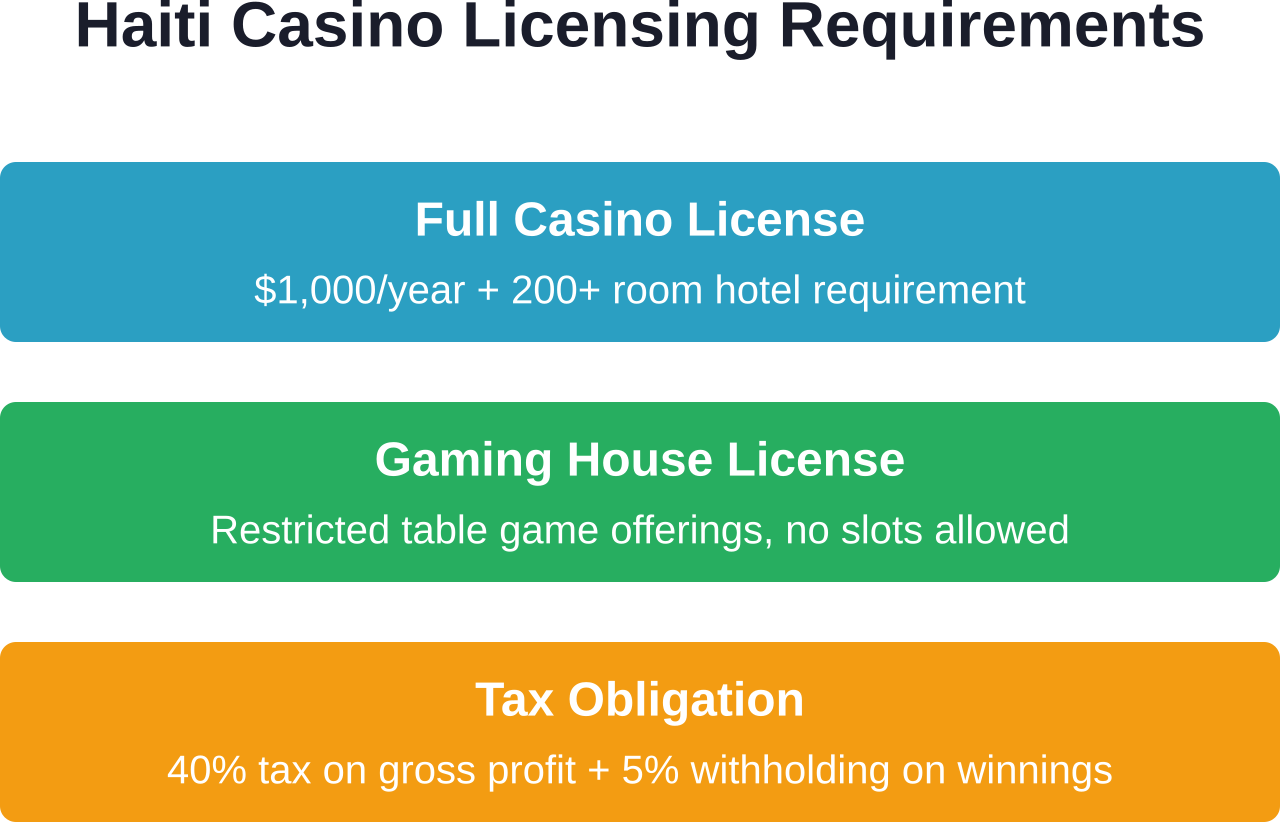
According to authoritative sources, land-based casinos must pay an annual license fee of $1,000. That’s remarkably affordable compared to many jurisdictions, but the entry barriers extend beyond just the fee.
Hotel Size Requirements
Here’s where it gets interesting. Full casino licenses require the establishment to be part of a hotel with at least 200 rooms. This requirement effectively limits casinos to major hospitality venues in Port-au-Prince and potentially other tourist areas.
The rationale? Haiti positions casino gaming as part of a broader tourism and hospitality offering rather than standalone gambling venues. This approach mirrors regulatory strategies in several Caribbean nations.
Gaming House Restrictions
Smaller operators can pursue gaming house licenses, but face significant limitations. Gaming houses are prohibited from operating slot machines.
That’s a substantial restriction. Table games require dealers, space, and higher operational costs compared to slots. The limitation effectively keeps gaming houses as boutique operations rather than mass-market gambling venues.
Tax Structure
Casinos in Haiti are subject to a 40% tax on gross profits, plus an annual fee of $1,000 and a 5% withholding tax on player winnings. That’s considerably higher than the licensing fee alone and represents the government’s primary revenue stream from legal gambling.
Gross profit taxation (rather than gross gaming revenue) means casinos can deduct direct costs before calculating their tax obligation. But 40% still represents a significant bite, particularly given Haiti’s economic conditions and the operational challenges casinos face in the country.
Where Are Casinos Located in Haiti?
Haiti has very limited casino infrastructure. The Global Casino Guide notes that Haiti ‘has just one casino in the capital city of Port-au-Prince,’ which is Casino El Rancho, located in Pétion-Ville (a commune within the Port-au-Prince metropolitan area).
This establishment combines casino gaming with fine dining and entertainment, targeting both wealthy locals and international visitors.
The concentration in Port-au-Prince reflects both the hotel infrastructure requirements and the economic reality that most Haitians lack disposable income for casino gambling. The industry caters primarily to the country’s small upper class and foreign visitors.
Online Gambling Status in Haiti
This is where Haitian gambling law enters gray territory. Online gambling exists in a legal vacuum—there are no specific regulations prohibiting it, but there’s also no framework explicitly authorizing or licensing online casino operations.
In practice, Haitian players can and do access international online casino sites. Many offshore operators accept Haitian customers without restriction. But these sites operate outside Haitian jurisdiction and regulatory oversight.
Why Online Gambling Remains Unregulated
Several factors explain the regulatory gap:
- Limited internet infrastructure: Internet penetration remains relatively low in Haiti
- Economic priorities: The government faces more pressing concerns than online gambling regulation
- Enforcement challenges: Monitoring and controlling offshore operators requires resources Haiti doesn’t have
- Small market size: The number of Haitians with both internet access and disposable income for online gambling is quite limited
The result? Haiti functions as what industry observers call a “white-level gambling jurisdiction” for online gaming—neither explicitly legal nor actively prosecuted.
Player Protection Concerns
The lack of online gambling regulation creates legitimate player protection issues. Haitian players using offshore sites have no recourse if they encounter problems with withdrawals, unfair games, or other disputes.
LEH provides no oversight of these international operators. Players essentially gamble at their own risk when using online casinos, with no government authority to turn to if issues arise.
The Role of LEH in Haitian Gambling
Understanding Haiti’s casino legality requires understanding LEH (Loterie de l’État Haïtien). This government entity functions as the country’s gambling regulator, though its authority and enforcement capabilities have significant limitations.
LEH’s primary focus has historically been the national lottery, which generates substantial revenue and enjoys widespread participation across all economic classes. Casino regulation appears to be a secondary function, with less robust oversight compared to the lottery operations.
Regulatory Gaps and Challenges
Haiti faces substantial governance challenges that extend to gambling regulation. LEH’s regulatory documentation isn’t extensively published or easily accessible. Applicants must comply with additional requirements beyond the basic licensing rules, but these aren’t detailed in public documentation.
This opacity creates uncertainty for potential operators and makes it difficult for observers to fully understand the regulatory landscape. It also raises questions about consistency and fairness in licensing decisions.
According to the U.S. State Department’s International Narcotics Control Strategy Report, Haiti struggles with corruption, embezzlement of government funds, and weak institutional capacity. These broader governance challenges inevitably affect gambling regulation as well.
Economic Context: Gambling in Haiti’s Poorest Nation
Haiti’s status as the Western Hemisphere’s poorest country profoundly shapes its gambling industry. The vast majority of Haitians lack the disposable income to participate in casino gaming.
Yet the lottery thrives. That apparent contradiction reflects the different economic profiles of these gambling forms. Lottery tickets cost minimal amounts, making them accessible even to low-income Haitians. Casino gaming requires substantially more capital and targets a completely different demographic.
The concentration of casinos in upscale hotels reinforces this divide. These aren’t community gambling venues—they’re entertainment destinations for Haiti’s elite and international visitors.
Gambling Type | Target Market | Accessibility | Regulatory Status
|
|---|---|---|---|
National Lottery | All income levels | Extremely high | Fully regulated by LEH |
Land-Based Casinos | Upper class, tourists | Very limited | Licensed by LEH |
Gaming Houses | Middle to upper class | Limited | Licensed by LEH |
Online Casinos | Internet-enabled population | Low | Unregulated |
Cockfighting | Varies, culturally widespread | Moderate | Legal, minimal oversight |
What Games Can You Play at Haitian Casinos?
Legal casinos in Haiti offer traditional table games found in casinos worldwide. Popular options include poker (particularly Texas Hold’em), blackjack, roulette, and baccarat.
Slot machines are available at full-license casinos in qualifying hotels. Remember that gaming houses—those smaller establishments with restricted licenses—cannot offer slots at all.
The gaming selection at Haitian casinos is relatively modest compared to major gambling destinations. Don’t expect the vast gaming floors of Las Vegas or Macau. Haiti’s casinos operate on a smaller scale, reflecting both the regulatory restrictions and the limited market size.
Payment Methods and Banking Considerations
Casinos in Haiti primarily operate on a cash basis. The country’s banking infrastructure is less developed than in many neighboring Caribbean nations, and credit card penetration remains limited among the population.
According to the U.S. State Department’s 2016 International Narcotics Control Strategy Report, foreign currencies comprised 59.77 percent of Haiti’s bank deposits in August 2015. The U.S. dollar circulates alongside the Haitian gourde, and many businesses—including casinos—accept both currencies.
For international visitors, bringing cash is advisable. ATM availability exists in Port-au-Prince but can be unreliable. Credit card acceptance varies by establishment.
Online Casino Payment Options
Haitian players using international online casino sites face additional payment challenges. Many traditional banking options restrict transactions with offshore gambling operators.
Common payment methods for Haitian online gamblers include:
- Cryptocurrency (Bitcoin, Ethereum, etc.)
- E-wallets (Neteller, Skrill where available)
- Prepaid cards
- Direct bank transfers (limited availability)
Each method has trade-offs in terms of fees, processing times, and accessibility from Haiti. Cryptocurrency has gained traction precisely because it bypasses traditional banking restrictions.
Cultural Attitudes Toward Gambling
Gambling occupies an interesting cultural space in Haiti. The lottery enjoys near-universal participation and social acceptance across all demographic groups. It’s woven into daily life in a way that casino gaming simply isn’t.
Cockfighting represents another culturally embedded form of gambling. While controversial from international animal welfare perspectives, it has deep historical roots in Haitian tradition and continues openly despite some criticism.
Casino gambling, by contrast, carries associations with wealth and luxury that separate it from these more populist gambling forms. It’s viewed as entertainment for the elite rather than a community activity.
Religious attitudes also play a role. Haiti has strong Christian influences (both Catholic and Protestant), and some denominations view gambling as problematic. But these objections don’t translate into legal prohibitions—the country maintains its secular approach to gambling regulation.
Comparing Haiti to Other Caribbean Gambling Jurisdictions
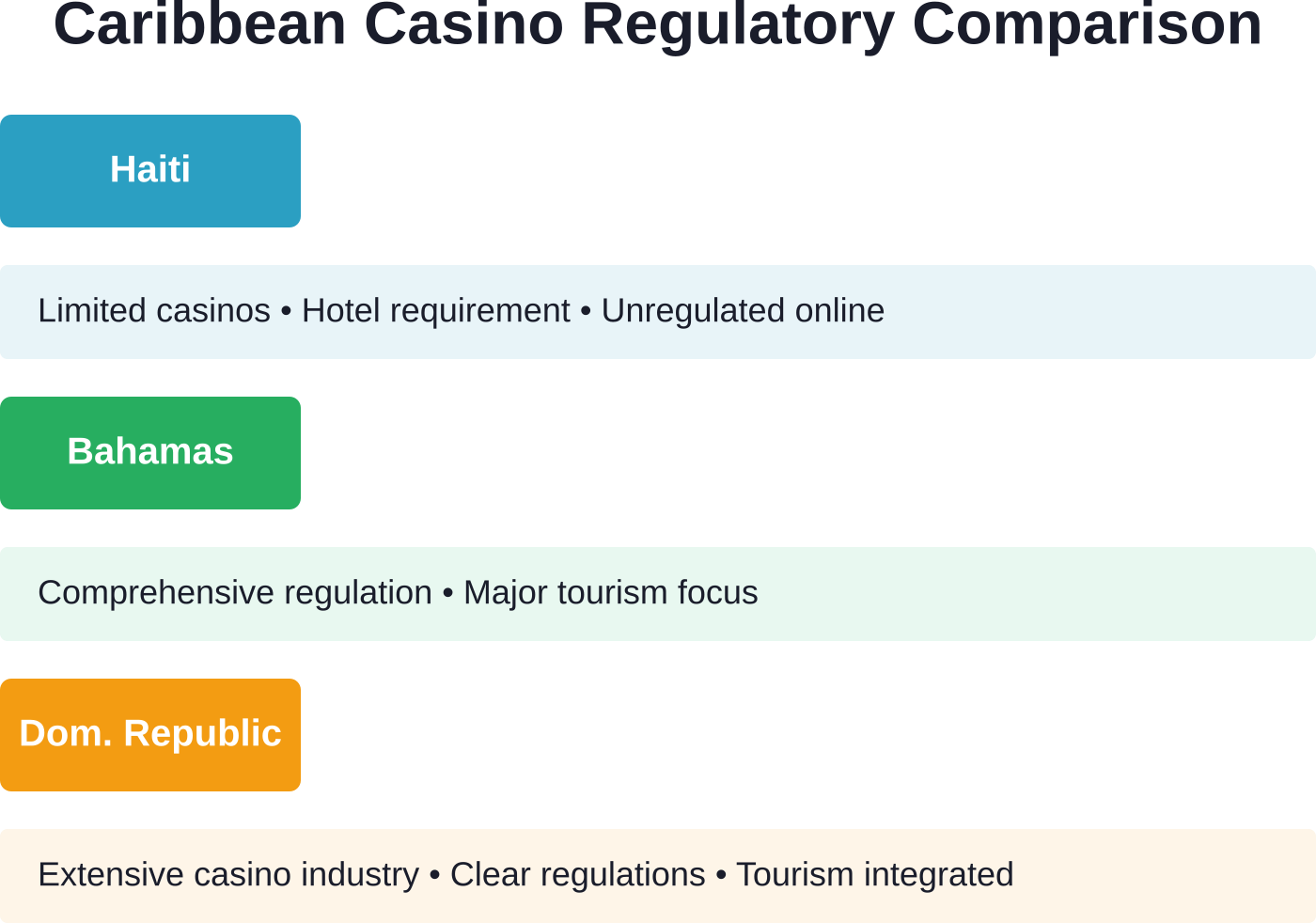
Haiti’s approach to casino regulation differs substantially from many Caribbean neighbors. The Bahamas and other Caribbean jurisdictions have developed more comprehensive regulatory frameworks for gambling.
Puerto Rico and the Dominican Republic (Haiti’s neighbor on Hispaniola) both have more developed casino industries with clearer regulatory oversight. The Dominican Republic particularly has invested in casino tourism as part of its broader hospitality sector.
Haiti’s limited casino infrastructure reflects both its economic challenges and different development priorities. The country hasn’t pursued gambling tourism with the same intensity as some neighbors, focusing regulatory attention primarily on the popular national lottery.
Future Outlook for Haiti’s Casino Industry
Predicting Haiti’s gambling future requires acknowledging the country’s broader challenges. Political instability, gang violence, and economic struggles overshadow any discussion of casino development.
As of 2026, Haiti continues to face severe security issues that impact tourism and business development generally. These conditions don’t favor casino expansion or attract the international operators that have transformed gambling industries elsewhere.
Online gambling regulation remains unlikely in the near term. The government lacks both the technical infrastructure and institutional capacity to effectively license and monitor online operators. The current gray-area status will probably persist.
That said, the national lottery continues to thrive. If Haiti’s security situation improves and economic development accelerates, there’s potential for modest casino industry growth—particularly if tied to broader tourism development initiatives.
Frequently Asked Questions
Can tourists legally gamble in Haiti?
Yes. Foreign visitors may legally gamble at licensed casinos in Haiti. Casinos in the Port-au-Prince area are open to tourists as well as eligible local patrons, with no separate restrictions based on nationality.
What’s the legal gambling age in Haiti?
Haiti generally follows minimum gambling age requirements that are consistent with many Caribbean jurisdictions. However, enforcement policies may vary between individual casinos and gaming establishments.
Are online casinos legal for Haitian players?
Online gambling operates in a legal gray area in Haiti. The country has no comprehensive licensing system for online casinos, and while offshore gambling websites are accessible, they are not regulated by Haitian authorities.
How many casinos operate in Haiti?
Haiti has a very small casino industry. The country’s best-known licensed casino is Casino El Rancho, located in Pétion-Ville within the Port-au-Prince metropolitan area.
Does Haiti tax casino winnings?
Licensed casinos are subject to a 40% tax on gross profits, an annual licensing fee, and a 5% withholding tax on player winnings. Foreign visitors should also consider any tax obligations that may apply in their home countries.
Can I use credit cards at Haitian casinos?
Payment options vary by casino. Cash remains the most widely accepted method, with both U.S. dollars and Haitian gourdes commonly used. Visitors should check with the casino in advance if they plan to use credit or debit cards.
What happens if I have a dispute with a Haiti casino?
Disputes involving licensed casinos may be reported to the Loterie de l’État Haïtien (LEH), which oversees gambling activities. Online gambling disputes involving offshore operators generally fall outside Haiti’s regulatory framework, leaving players with limited legal protection.
Conclusion
So, is the casino legal in Haiti? Absolutely—within a specific regulatory framework that distinguishes between hotel-based casinos, smaller gaming houses, and the wildly popular national lottery.
The Lottery of the Haitian State manages licensing and oversight, requiring casinos to meet hotel size requirements, pay annual fees, and remit taxes on gaming revenue. Online gambling remains unregulated, creating opportunities for players to access international sites but without any player protection or government oversight.
Haiti’s casino industry remains modest, reflecting the country’s economic challenges and limited infrastructure. Port-au-Prince hosts the few existing casinos, which cater primarily to the wealthy elite and international visitors rather than functioning as mass-market entertainment.
For those considering visiting or investing, understanding this legal landscape is essential. Casinos operate legally and openly, but within a regulatory environment that’s less robust and transparent than many jurisdictions. The industry exists, it’s legitimate, but it’s also constrained by Haiti’s broader developmental challenges.
If considering gambling in Haiti—whether at a land-based casino or through international online sites—know the rules, understand the limitations, and recognize that player protections aren’t as comprehensive as in more developed gambling markets.
Related Articles
September 3, 2026Is the Casino Legal in Denmark? 2026 Guide

September 3, 2026Is the Casino Legal in Angola? What the 2026...