 Nothing found for the request
Is the Casino Legal in Britain? 2026 UK Gambling Laws Explained
Sologe July 11, 2026
Share:


Understanding the UK Gambling Regulatory Framework
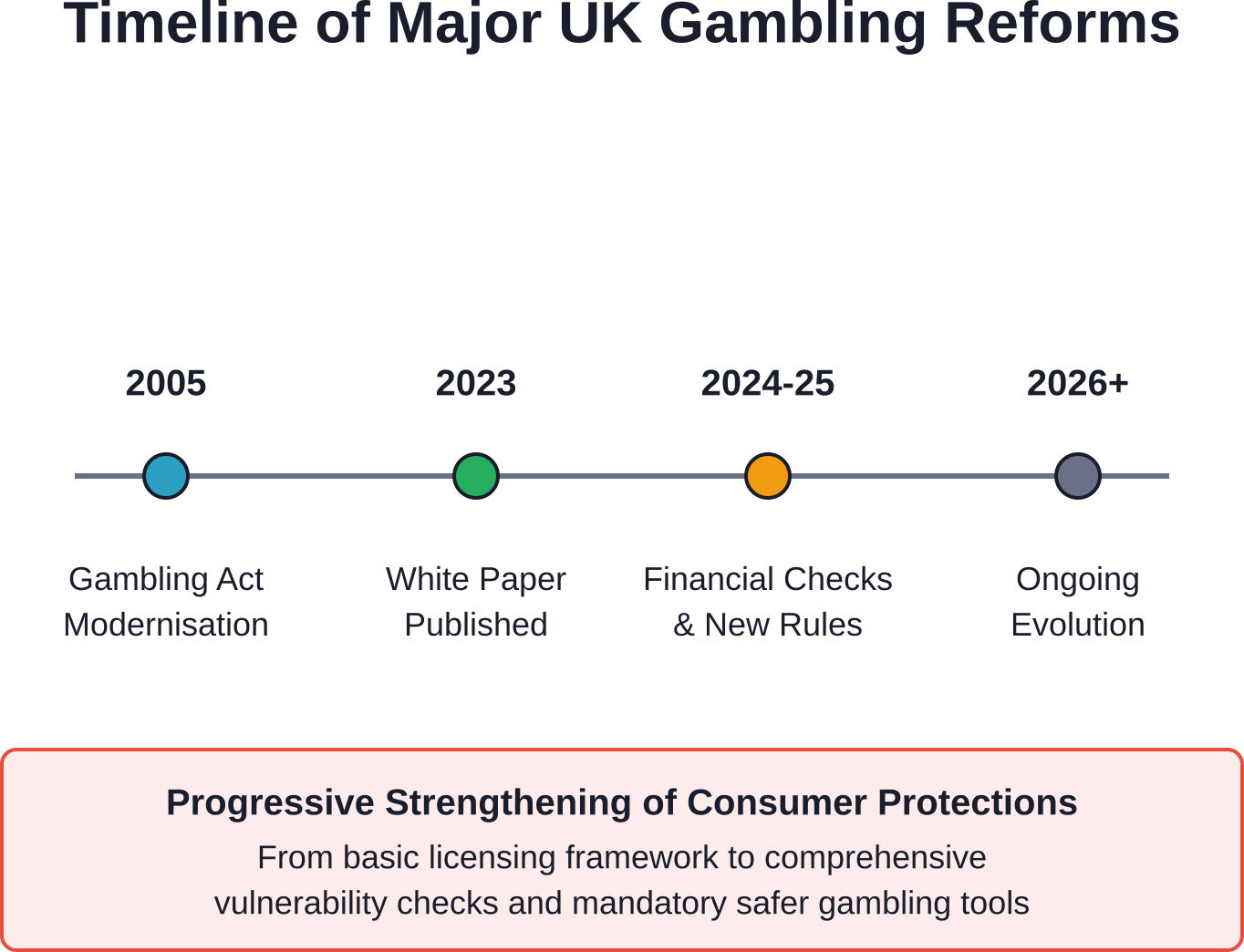
Gambling in Britain operates under a well-established legal structure that balances commercial freedom with consumer protection. The foundation sits on the Gambling Act 2005, which significantly updated older laws and introduced modern protections.
The Gambling Commission serves as the primary regulatory body. This organisation licenses, regulates, advises and provides guidance to individuals and businesses that offer gambling in Great Britain, including the National Lottery.
Now, the term “Great Britain” matters here. The regulatory framework covers England, Scotland and Wales. Northern Ireland has its own separate gambling legislation, which is why you’ll see official documents reference Great Britain specifically rather than the United Kingdom as a whole.
What the Gambling Act 2005 Actually Covers
This legislation replaced the Gaming Act 1968 and brought gambling regulation into the modern era. It established three core licensing objectives:
- Preventing gambling from being a source of crime or disorder
- Ensuring gambling is conducted fairly and openly
- Protecting children and vulnerable people from being harmed or exploited
The Act covers all forms of gambling—casinos, betting, bingo, arcades, lotteries, and gaming machines. It introduced a licensing structure where both operators and premises must obtain appropriate licences to offer gambling legally.
Under this framework, casinos operating without proper licensing face serious consequences, including prosecution and substantial fines.
How the Gambling Commission Maintains Standards
The Gambling Commission maintains a public register where anyone can verify whether a gambling business holds a valid licence. This register includes thousands of licensed operators across different gambling categories.
According to the Gambling Commission’s full business register, operators are categorised by activity type including arcades, betting, bingo, casinos, game and betting hosts, gambling software, lotteries, and machines. Each category has specific licensing requirements and compliance obligations.
The Commission doesn’t just issue licences and walk away. Ongoing supervision ensures operators continue meeting regulatory standards. This includes reviewing compliance with licence conditions and codes of practice, investigating complaints, and taking enforcement action when operators fail to meet their obligations.
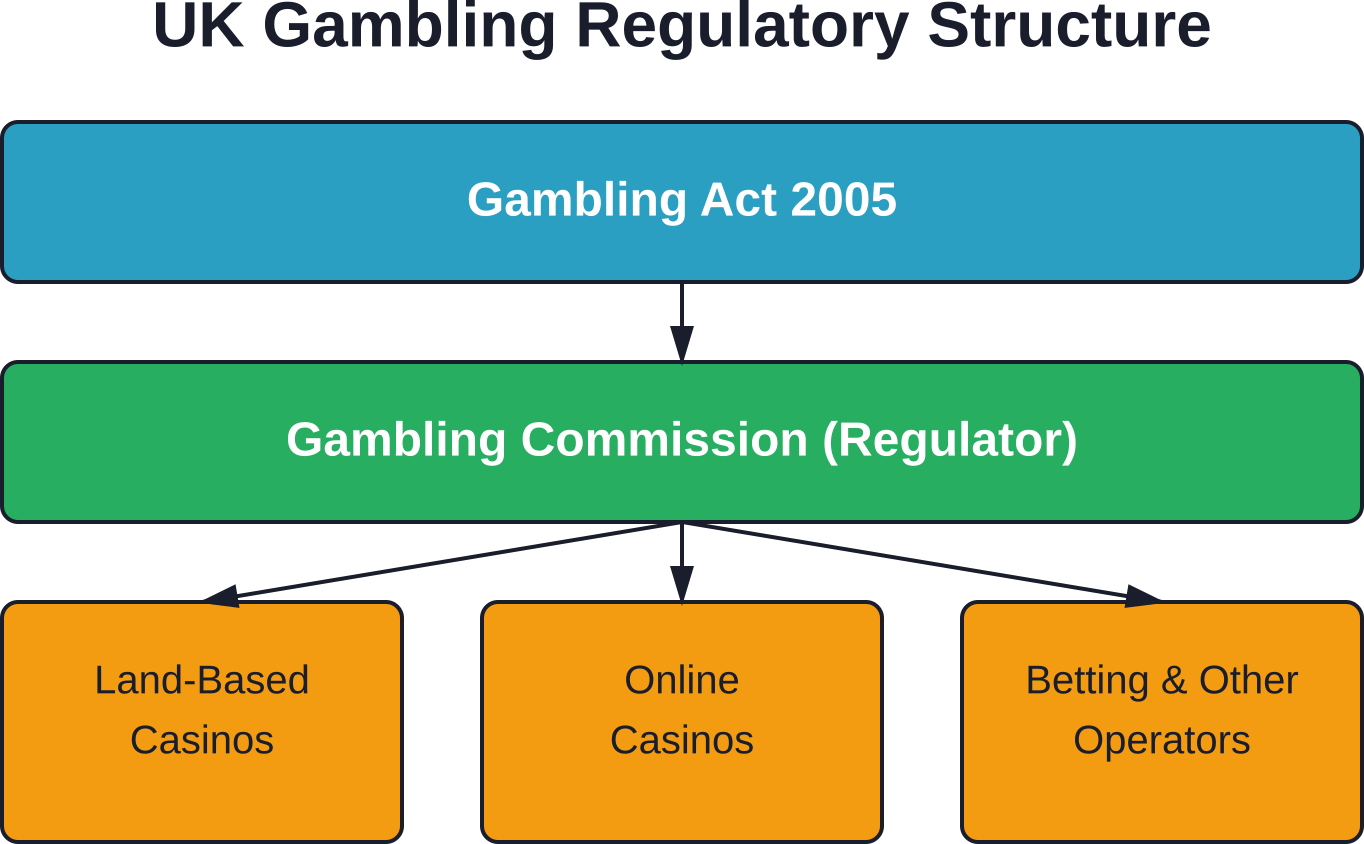
Land-Based Casino Regulations in Britain
Physical casinos in Britain operate under strict controls that date back decades, though the specific rules have modernised considerably since 2005.
These venues must obtain both an operating licence from the Gambling Commission and a premises licence from the local licensing authority. The dual-licensing system ensures casinos meet both national regulatory standards and local community concerns.
Types of Casino Licences Available
Britain recognises different categories of casino licences based on the Gaming Act 1968 and the Gambling Act 2005. The distinction matters because it affects what facilities a casino can offer and where it can operate.
Under the 1968 Act, existing casinos operated under grandfathered provisions. The 2005 Act introduced new categories including small casinos, large casinos, and regional casinos (though no regional casino licences were ultimately issued).
The Department for Culture, Media and Sport published a white paper in April 2023 that outlined plans to modernise casino regulation. Following governmental review, changes have been implemented to update the rules for casinos whilst maintaining strong protections.
Age Restrictions and Entry Requirements
No one under 18 can legally enter a casino in Britain. Period.
This isn’t a casual guideline—it’s a strict legal requirement backed by significant penalties. Casinos must verify the age of anyone who appears under 25 through acceptable identification such as passports, driving licences, or nationally recognised proof-of-age cards.
Staff receive training on age verification procedures, and the Gambling Commission actively monitors compliance through test purchasing and inspections.
Location and Operational Restrictions
Local licensing authorities have considerable input into whether a casino can open in their jurisdiction. They assess applications against the three licensing objectives and can refuse licences or impose additional conditions based on local concerns.
Once licensed, casinos face operational restrictions around advertising their premises, ensuring fair gaming, and preventing crime and disorder. Staff must be trained to identify problem gambling behaviours and provide information about support services.
The premises themselves must meet physical security standards, maintain comprehensive records of gaming activity, and implement systems to prevent money laundering.
Online Casino Legality and Regulation
Here’s where things get particularly relevant for most people reading this. Online casinos have exploded in popularity, and the regulatory approach has had to keep pace.
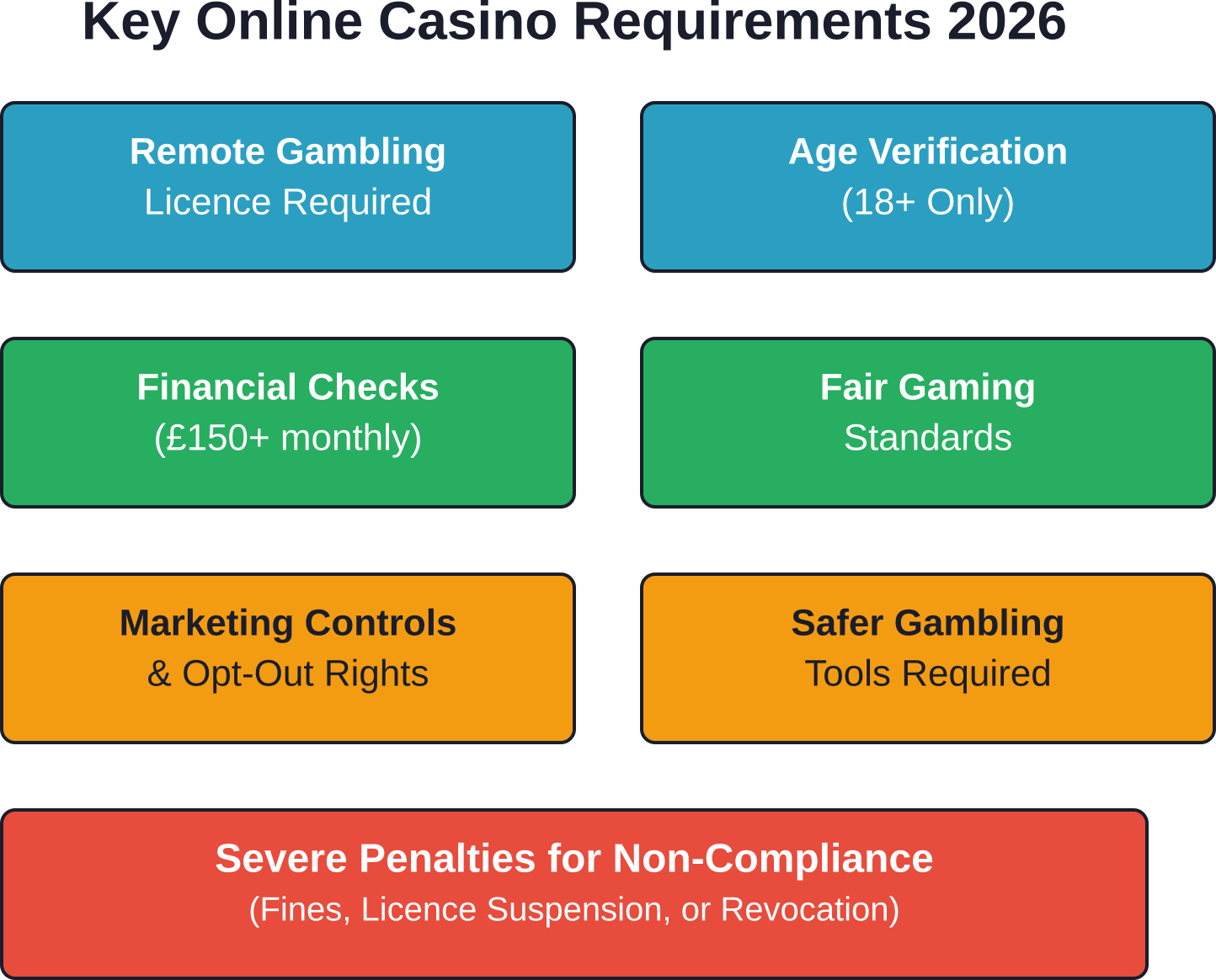
Yes, online casinos are completely legal in Britain—provided they hold a remote gambling licence from the Gambling Commission.
The term “remote” covers all gambling conducted via the internet, telephone, television, radio, or any other electronic communication method. If an operator wants to accept customers in Great Britain, they must be licensed regardless of where the company is physically located.
Licensing Requirements for Online Operators
Online casino operators face rigorous licensing requirements. They must demonstrate financial stability, implement robust player protection systems, maintain secure technical infrastructure, and prove key personnel are fit and proper to hold a licence.
According to the Gambling Commission, operators must undertake financial vulnerability checks where customers meet certain thresholds. Since 28 February 2025, financial vulnerability checks are required when monthly net deposits reach certain thresholds.
These enhanced checks aim to prevent situations where operators allowed clearly vulnerable customers to lose catastrophic amounts. The government’s white paper highlighted cases including one customer who lost £70,000 over a 10-hour period and another who was allowed to deposit £245,000 over three months despite earning only £30,000 annually as an NHS nurse.
Checking Whether an Online Casino Is Licensed
The Gambling Commission maintains a searchable public register where anyone can verify whether an online casino holds a valid licence.
Simply visit the Gambling Commission website and search by business name, trading name, or domain name. Licensed operators display their licence number prominently on their websites—usually in the footer.
Playing at unlicensed online casinos carries real risks. These operators don’t follow British consumer protection standards, disputes have no regulatory recourse, and there’s no guarantee games are fair or that withdrawals will be honoured.
Recent Regulatory Changes for Online Gambling
The regulatory landscape for online gambling has shifted significantly. On 1 May 2024, the Gambling Commission announced widespread changes aimed at increasing safety and customer choice.
These changes, consistent with the government’s white paper “High stakes: gambling reform for the digital age,” include reducing the intensity of online games, improving consumer choice over receiving gambling marketing, and tightening processes to support age verification.
Enhanced financial checks now catch situations where customer circumstances may not align with their spending patterns. Operators must identify when stated affordability may not match actual spending behaviour.
Find Better Gaming Business Solutions with Sologe
Britain has one of the world’s most mature gaming markets, and businesses researching the sector often need a clear view of the suppliers and categories supporting operators across different segments. Sologe brings together iGaming categories in one marketplace, helping companies compare available solutions without researching each area separately.
Sologe can help businesses:
- Compare casino and gaming platform options
- Review sports betting software
- Explore game aggregator solutions
- Assess traffic and affiliate channels
- Research licensing-related categories
👉Contact Sologe to compare platform options, sports betting software, traffic categories, licensing-related solutions, and other B2B iGaming products.
Consumer Protections Under British Gambling Laws
The regulatory framework isn’t just bureaucracy for bureaucracy’s sake. It exists primarily to protect consumers from harm.
British gambling laws include some of the strongest consumer protections anywhere in the world. These safeguards cover everything from game fairness to advertising standards to support for problem gambling.
Financial Vulnerability Checks
One of the most significant recent changes involves mandatory financial vulnerability checks for online gambling.
As of February 2025, operators must conduct light-touch financial vulnerability assessments when a customer’s monthly net deposits reach £150. This relatively low threshold catches problematic patterns early.
The checks verify whether customers can afford their gambling spend without experiencing harm. Operators access credit reference data and other information to assess affordability, though the process aims to be frictionless for the vast majority of customers gambling within their means.
According to the Gambling Commission, these enhanced checks address failures where operators allowed customers to spend amounts wildly inconsistent with their known income. In one case highlighted by the government, a customer was permitted to spend £245,000 over three months—an obvious sign of problem gambling that went unchallenged.
Safer Gambling Tools and Self-Exclusion
All licensed operators must provide safer gambling tools allowing customers to control their gambling activity. These include:
- Deposit limits (daily, weekly, monthly)
- Loss limits
- Time-out periods
- Reality checks that interrupt play
- Self-exclusion options
Self-exclusion schemes let customers ban themselves from gambling for set periods. For online gambling, the national scheme GAMSTOP allows individuals to exclude from all licensed online operators simultaneously.
Land-based casinos participate in multi-operator self-exclusion schemes, and venues must maintain their own exclusion lists where customers can request removal from that specific premises.
Advertising and Marketing Restrictions
Gambling advertising in Britain faces strict controls. The Advertising Standards Authority enforces rules preventing ads from targeting children, exploiting vulnerable people, or suggesting gambling can solve financial problems.
Recent reforms have strengthened marketing protections. Operators must now respect customer preferences around receiving marketing communications, with clearer opt-out mechanisms and restrictions on promotional intensity.
Gambling ads cannot appear during children’s programming or around content likely to appeal primarily to under-18s. Celebrities and sports personalities under 25 cannot feature in gambling advertising.
Support Services for Problem Gambling
The Gambling Commission ensures that information about support services is readily available. Licensed operators must display information about where customers can get help if gambling becomes problematic.
Key support services include:
- National Gambling Helpline (England and Scotland): 0808 8020 133, available 24/7
- NHS Wales Gambling Helpline: 0808 2819 265, available 24/7
- BeGambleAware, GamCare, and other specialist charities
A statutory gambling operator levy ensures operators contribute funding for treatment services and research, including through the NHS. Previously, operator contributions were voluntary and inconsistent—the levy makes funding mandatory and proportional.
Enforcement and Penalties for Illegal Gambling
So what happens when casinos or gambling operators break the rules?
The Gambling Commission has substantial enforcement powers, and it uses them. Penalties for regulatory failures range from financial sanctions to licence suspension or complete revocation.
Notable Enforcement Actions
The Gambling Commission maintains a public record of enforcement actions taken against operators. Recent cases demonstrate the regulator’s willingness to impose significant penalties:
Recent enforcement actions by the Gambling Commission include Paddy Power Betfair making a £2 million payment in lieu of a financial penalty (17 December 2025) and Done Brothers (Cash Betting) Limited receiving an £825,000 fine (7 November 2025) for regulatory failures.
These aren’t isolated incidents. Operators consistently failing to meet social responsibility obligations, allowing money laundering, or providing unfair games face serious consequences.
In the most serious cases, the Commission revokes licences entirely, effectively shutting down operators in the British market.
Criminal Penalties for Unlicensed Gambling
Operating a casino without a licence isn’t just a regulatory matter—it’s a criminal offence under the Gambling Act 2005.
Individuals and businesses providing gambling facilities without proper licensing can face prosecution, substantial fines, and imprisonment. The penalties reflect the seriousness of operating outside the regulatory framework designed to protect consumers.
Customers also face risks when using unlicensed casinos. Beyond the lack of consumer protections, winnings from illegal gambling may not be legally enforceable, and there’s no regulatory recourse if disputes arise.
Violation Type | Regulatory Response | Potential Penalties |
|---|---|---|
Operating Without Licence | Criminal Prosecution | Unlimited fines, imprisonment, asset seizure |
Social Responsibility Failures | Regulatory Action | Fines up to £millions, licence conditions, suspension |
Money Laundering Controls | Enforcement Action | Major fines, licence review, revocation |
Unfair Gaming Practices | Investigation & Sanctions | Fines, compensation orders, licence loss |
Marketing Rule Breaches | ASA/Commission Action | Ad bans, fines, enhanced compliance requirements |
The Government’s Gambling Reform White Paper
In April 2023, the government published a comprehensive white paper titled “High stakes: gambling reform for the digital age.” This document set out the most significant planned changes to British gambling regulation in nearly two decades.
The reforms recognise that most people gamble without issue, but too many cases of addiction, catastrophic financial loss, and tragic outcomes including suicide demonstrate the need for stronger protections.
Key Reforms Already Implemented
Many proposals from the white paper have now been implemented through amendments to the Licence Conditions and Codes of Practice (LCCP) and secondary legislation.
The consultation response was published on 4 February 2025, detailing changes to the LCCP and related regulatory instruments.
Implemented reforms include:
- Financial vulnerability checks at the £150 monthly deposit threshold
- Reduced intensity of online slot games to limit rapid losses
- Enhanced customer choice around gambling marketing
- Strengthened age verification processes
- Statutory operator levy to fund treatment and research
The financial checks pilot specifically addresses high-risk spending patterns. Enhanced checks are introduced only if they can be implemented in a frictionless manner through data-sharing, cutting down on cases where operators ignored obvious affordability red flags.
What’s Still Coming
Some reforms remain in development or consultation. The regulatory landscape continues evolving as the Commission and government respond to emerging challenges in the gambling sector.
The new government reviewed previous proposals, particularly around modernising casino rules, and decided to implement changes largely as outlined in earlier consultations. These changes acknowledge how gambling habits and technology have shifted since the original 2005 framework.
Ongoing areas of focus include refining affordability checks, addressing emerging forms of gambling-like activities in video games, and ensuring regulations remain effective as technology evolves.
How to Verify a Casino’s Legal Status
Anyone can quickly verify whether a casino—online or land-based—operates legally in Britain.
Check the Gambling Commission Register
The Gambling Commission maintains a comprehensive public register of all licensed gambling businesses. Visit the Gambling Commission website and use the search function to look up any operator.
The register allows filtering by activity type (casinos, betting, bingo, etc.) and licence category (remote or non-remote). Each entry shows the operator’s account number, licence status, and what activities they’re authorised to provide.
For online casinos, search by the website domain name. Licensed operators must clearly display their licence number on their website—typically in the footer alongside responsible gambling information.
Red Flags for Unlicensed Operations
Certain warning signs suggest a casino might be operating without proper licensing:
- No visible Gambling Commission licence number or logo
- Domain not listed in the Commission’s register
- Operator based outside Britain with no GB licence
- Refusal or difficulty processing withdrawals
- Aggressive marketing without responsible gambling information
- Poor or non-existent customer verification processes
Legitimate licensed casinos actively promote their regulatory status. If finding licensing information requires detective work, that’s a significant red flag.
What to Do If You Encounter Illegal Gambling
The Gambling Commission accepts reports about suspected illegal gambling operations. Information can be submitted through their website or by contacting them directly.
Local authorities also have enforcement powers over premises-based gambling in their jurisdictions. Suspected illegal gambling premises should be reported to both the Gambling Commission and the relevant local licensing authority.
For consumers who’ve experienced problems with potentially unlicensed operators, documenting everything—screenshots, emails, transaction records—provides essential evidence for any complaint or legal action.
Comparing Britain’s Approach to Other Jurisdictions
Britain’s gambling regulatory framework is widely regarded as one of the most comprehensive globally. But it’s worth understanding how this approach compares to other major jurisdictions.
Why British Licensing Matters
Many offshore gambling jurisdictions offer licences with far lower standards than Britain’s. Malta, Gibraltar, and Isle of Man maintain relatively robust frameworks, but numerous other jurisdictions operate essentially as licensing mills with minimal oversight.
The British approach prioritises consumer protection alongside commercial activity. The three licensing objectives—preventing crime, ensuring fairness, and protecting vulnerable people—guide all regulatory decisions.
This contrasts sharply with jurisdictions where licensing mainly serves revenue generation with token consumer protections.
Regulatory Cooperation and Enforcement Challenges
Online gambling creates enforcement challenges when operators target British customers from overseas jurisdictions. The Gambling Act 2005 addressed this by requiring anyone offering gambling to British customers to hold a British licence regardless of where they’re physically located.
This “point of consumption” model has been adopted by other jurisdictions recognising that physical location matters less than where customers are based.
The Gambling Commission cooperates with international regulators through information-sharing agreements and coordinated enforcement actions. However, pursuing operators in non-cooperative jurisdictions remains challenging.
The Future of Casino Regulation in Britain
Where is casino regulation heading? Several trends seem likely to shape the regulatory landscape over coming years.
Technology and Regulatory Innovation
Technology simultaneously creates new risks and new solutions. The Gambling Commission increasingly focuses on how operators use technology for both marketing and player protection.
Data analytics enable better identification of problem gambling patterns, but also more sophisticated targeting of vulnerable customers. Regulatory evolution will likely focus on ensuring technology serves protection rather than exploitation.
Innovations like blockchain-based gambling, cryptocurrency casinos, and increasingly immersive virtual gambling environments all present regulatory challenges that current frameworks may need to adapt to address.
Balancing Commercial Interests and Protection
The gambling sector contributes significantly to the British economy through employment, tax revenue, and associated industries. Any regulatory approach must balance these economic benefits against the genuine harms experienced by problem gamblers and their families.
This tension underlies many regulatory debates. Industry representatives often argue that excessive regulation drives customers to unlicensed offshore operators, whilst consumer protection advocates point to continued evidence of regulatory failures allowing preventable harm.
Finding the right balance remains an ongoing challenge that will shape future regulatory developments.
Potential Areas for Future Reform
Despite recent comprehensive reforms, several areas may see further regulatory attention:
- Enhanced affordability checks beyond current thresholds
- Restrictions on gambling advertising volume and placement
- Mandatory direct debit blocks for gambling transactions
- Gambling-like features in video games and social media
- Maximum stake and prize limits for certain games
The regulatory framework will continue evolving as evidence emerges about what interventions effectively reduce harm without excessive impacts on recreational gamblers.
Practical Implications for Casino Users
What does all this regulation actually mean for someone who just wants to play blackjack or spin some slots?
Your Rights as a Casino Customer
Licensed casinos must treat customers fairly and transparently. This includes:
- Clear terms and conditions in plain English
- Transparent game rules and odds
- Prompt payment of legitimate winnings
- Protection of customer funds in segregated accounts
- Fair handling of complaints
- Access to safer gambling tools
If a dispute arises with a licensed operator, customers can escalate through the operator’s complaints process, then to alternative dispute resolution services, and ultimately to the Gambling Commission.
These protections simply don’t exist with unlicensed operators. Disputes with offshore unlicensed casinos often leave customers with no recourse whatsoever.
Responsible Gambling Tools
Every licensed casino—online and land-based—must provide tools supporting responsible gambling. Take advantage of them.
Setting deposit limits before starting gambling provides guardrails preventing overspending in the heat of the moment. Reality checks that interrupt play after set time periods counter the “time flies when you’re having fun” effect that gambling environments deliberately cultivate.
Self-exclusion remains the strongest tool for anyone recognising their gambling has become problematic. GAMSTOP for online gambling and venue-based exclusion schemes for land-based casinos allow effective breaks from gambling.
When to Seek Help
Problem gambling can develop gradually or suddenly. Warning signs include:
- Gambling with money needed for bills or essentials
- Chasing losses with bigger bets
- Lying to family about gambling activity
- Borrowing money specifically to gamble
- Feeling anxious or irritable when not gambling
- Gambling interfering with work or relationships
Help is available and confidential. The National Gambling Helpline for England and Scotland (0808 8020 133) operates 24/7, as does the NHS Wales Gambling Helpline (0808 2819 265).
Organisations like BeGambleAware, GamCare, and Gamblers Anonymous provide free support, counselling, and peer support groups. Licensed operators must display this information prominently.
Frequently Asked Questions
Can I legally gamble at online casinos in Britain?
Yes. Online casinos are legal in Great Britain when they hold a remote gambling licence issued by the Gambling Commission. Players should always verify that an operator is licensed before creating an account to ensure they receive the protections provided under British gambling law.
What happens if I use an unlicensed casino?
Using an unlicensed casino carries significant risks. These operators are not regulated by the Gambling Commission, meaning players may have limited consumer protection, no guaranteed dispute resolution, weaker security standards, and no assurance that games are fair or winnings will be paid.
How old do I need to be to enter a casino in Britain?
You must be at least 18 years old to gamble at any land-based or online casino in Great Britain. Licensed operators are required to verify customers’ ages before allowing gambling activities.
Are there limits on how much I can deposit or bet?
There are no universal legal limits on deposits or bets. However, licensed operators must carry out financial vulnerability checks in certain circumstances and provide tools that allow customers to set their own deposit, spending, and loss limits.
What should I do if I have a complaint about a licensed casino?
You should first use the casino’s internal complaints procedure. If the issue is not resolved, you can refer the dispute to the operator’s approved Alternative Dispute Resolution (ADR) provider. Concerns about possible licence breaches may also be reported to the Gambling Commission.
Can gambling winnings be taxed in Britain?
No. Gambling winnings are generally not subject to tax for individuals in Great Britain. Instead, licensed gambling operators pay taxes on their gambling revenue.
How does self-exclusion work for online casinos?
Licensed online gambling operators must offer self-exclusion tools. In Great Britain, players can also register with GAMSTOP, the national self-exclusion scheme, which blocks access to participating licensed online gambling websites for a chosen period.
Conclusion: Casinos Are Legal—When Properly Licensed
So, is the casino legal in Britain? Absolutely yes—provided it operates under proper licensing from the Gambling Commission.
Britain’s gambling regulatory framework is comprehensive, balancing commercial freedom with robust consumer protections. The Gambling Act 2005 established the foundation, and ongoing reforms continue strengthening safeguards particularly around financial vulnerability and problem gambling.
Both land-based and online casinos can operate lawfully when they meet licensing requirements, implement player protections, and follow regulatory standards. The Gambling Commission actively enforces these requirements, imposing significant penalties on operators who fail to protect customers.
For casino users, the implications are clear. Stick with licensed operators—verify their status through the Gambling Commission register. Take advantage of safer gambling tools. Recognise that whilst most people gamble without problems, support is available if gambling becomes harmful.
The regulatory landscape continues evolving. Recent reforms addressing financial vulnerability, game intensity, and marketing protections demonstrate that the framework adapts to emerging challenges. Further changes seem likely as technology evolves and evidence accumulates about effective harm reduction.
Want to verify whether a casino is licensed? Visit the Gambling Commission website and search their public register. It takes seconds and ensures the protections described throughout this article actually apply.
If gambling is causing problems, don’t wait. Call the National Gambling Helpline on 0808 8020 133 (England and Scotland) or 0808 2819 265 (Wales)—both available 24/7 with free, confidential support.
Related Articles

September 3, 2026Is the Casino Legal in Denmark? 2026 Guide

September 3, 2026Is the Casino Legal in Angola? What the 2026...