 Nothing found for the request
Is the Casino Legal in the Philippines? The 2026 Rules Explained
Sologe September 3, 2026
Share:


Quick Summary
Yes, casino gambling is legal in the Philippines. Land-based casinos operate under strict regulation from the Philippine Amusement and Gaming Corporation (PAGCOR), while offshore online gambling operators (POGOs) were permanently banned as of January 2025. Filipinos can legally gamble in licensed physical casinos and certain regulated online platforms, but plenty of gray areas remain.
Manila’s skyline lights up every night with neon signs advertising Solaire, Okada, and City of Dreams. That alone tells most visitors something about casino gambling here. But the legal picture is messier than a quick glance at Entertainment City suggests, especially once online gambling enters the conversation.
The short answer to “is the casino legal in Philippines?” is yes. Casinos are legal, regulated, and a genuine pillar of the country’s tourism economy. The longer answer involves a government agency that both regulates and runs casinos, a recent crackdown on offshore online operators, and rules that differ sharply depending on whether someone is playing at a physical table or tapping a phone screen.
Who Actually Regulates Gambling in the Philippines?
Almost every conversation about Philippine gambling law eventually leads back to one name: PAGCOR. The Philippine Amusement and Gaming Corporation was created under Presidential Decree 1869 and later reorganized through Republic Act 9487. For decades it played a strange dual role — regulator and operator at the same time, licensing private casinos while also running its own gaming halls.
That’s changing. PAGCOR has been steadily privatizing its own casino operations to focus purely on regulation, a shift that mirrors how gaming authorities work in places like Nevada or Macau. Beyond PAGCOR, a few special zones have their own gaming authorities, notably the Cagayan Economic Zone Authority (CEZA) and the Aurora Pacific Economic Zone, which license certain offshore-facing operators under separate rules.
Land-Based Casinos: Fully Legal, Heavily Regulated
Physical casinos are the least controversial part of this whole topic. Entertainment City in Manila Bay is the country’s answer to the Las Vegas Strip, home to Solaire Resort, City of Dreams Manila, and Okada Manila. Add Newport World Resorts near the airport, and a growing number of provincial casinos in Cebu, Clark, and elsewhere, and it’s clear the industry has real scale.
These venues operate under PAGCOR-issued licenses, follow anti-money-laundering rules enforced through the Anti-Money Laundering Council, and are subject to inspection and compliance checks. Filipino citizens can legally play, though PAGCOR-owned casinos historically imposed entry restrictions on certain government employees and required proof of income for locals — a rule aimed at curbing problem gambling rather than banning it outright. The standard minimum age to enter a casino floor is 21, higher than the general adult age of 18, which lines up with how most Southeast Asian gaming jurisdictions treat casino access.
Casino/Resort | Location | Notable For |
|---|---|---|
Solaire Resort | Manila (Entertainment City) | First integrated resort in the district |
City of Dreams Manila | Manila (Entertainment City) | Large gaming floor, international brands |
Okada Manila | Manila (Entertainment City) | Fountain shows, luxury positioning |
Newport World Resorts | Pasay, near NAIA | Airport-adjacent convenience |
Waterfront Cebu City Hotel | Cebu | Regional casino outside Manila |

Put Your Gaming Product in Front of Philippine Buyers
Sologe is built around iGaming products and services, from gaming software and platforms to payments, sports betting, traffic, and equipment. Listing on Sologe gives your product a dedicated industry setting instead of leaving it buried in a general business directory.
Ready to Add Your Product?
Sologe lets vendors:
- showcase gaming products in a relevant category
- present their offer alongside other iGaming solutions
- make it simpler for interested buyers to see what they provide
👉 Get in touch with Sologe if you want to list your product.
The Online Gambling Puzzle: Where It Gets Complicated
Here’s the thing though — online gambling in the Philippines splits into two very different categories, and mixing them up is where most confusion starts.
Domestic Online Gambling for Filipino Players
PAGCOR licenses certain online gaming platforms aimed at the local market, generally requiring age verification, geo-restrictions, and payment controls. These sites operate legally, but the sector is far smaller and more tightly supervised than the offshore industry ever was.
POGOs: The Offshore Model That Got Banned
For years, Philippine Offshore Gaming Operators — POGOs — ran online casinos and sportsbooks licensed in the Philippines but marketed almost exclusively to players in China and other overseas markets, since online gambling is illegal there. It became a massive industry, drawing billions in investment and thousands of foreign workers to office towers around Metro Manila.
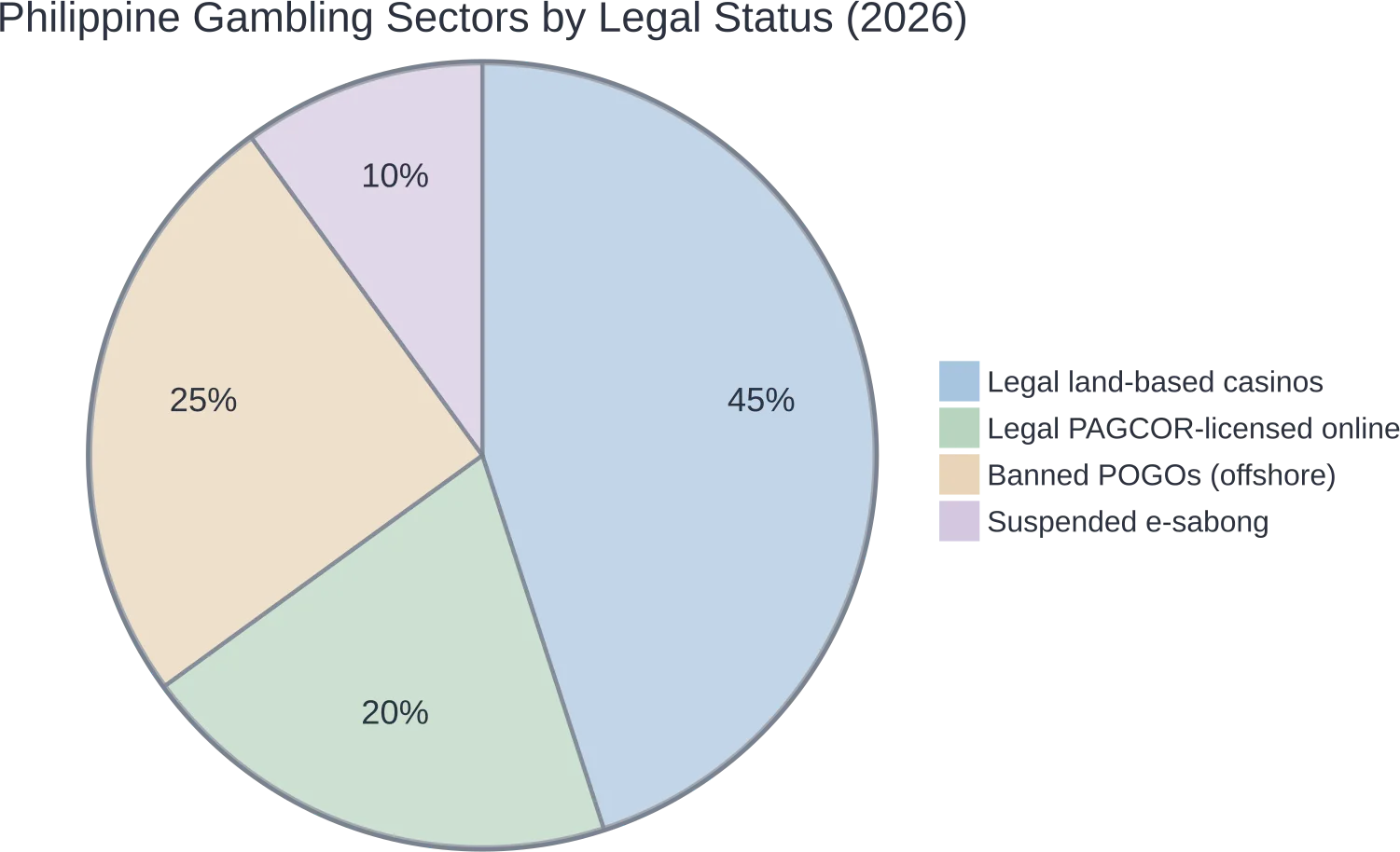
Then it collapsed under its own weight. Reports of human trafficking, forced labor scam compounds, money laundering, and organized crime ties piled up until President Ferdinand Marcos Jr. ordered a shutdown of all POGOs through an executive order, with operations required to cease by December 31, 2024. Congress followed up by passing the Anti-POGO Act, which Marcos signed into law, making the ban permanent rather than just an executive directive. By 2026, the Department of Justice has stated the industry has been effectively eradicated, with no officially licensed POGOs left operating.
What About E-Sabong?
Online cockfighting betting, known as e-sabong, is a separate story but follows a similar arc. It was suspended by presidential order after disappearances of dozens of e-sabong personnel raised alarm, and lawmakers have since pushed bills to ban it outright rather than let it quietly resume.
Can Filipinos Play at Offshore Casino Sites Hosted Abroad?
This is the question that trips up a lot of readers. A Filipino player logging onto a casino site licensed in, say, Curaçao or Malta isn’t necessarily doing anything a Philippine court has ruled on directly — enforcement in that specific direction has been limited compared to the crackdown on POGOs, which targeted operators based in the Philippines serving other countries, not the reverse. That said, using an unlicensed or unregulated foreign site carries real practical risk: no local consumer protection, no guaranteed payout enforcement, and murky legal standing if a dispute arises. PAGCOR and financial regulators have also worked with banks to flag suspicious gambling-related transactions, which can complicate deposits and withdrawals on offshore platforms.
The safer, unambiguous path for anyone in the Philippines who wants to gamble online stays within PAGCOR-licensed platforms or sticks to physical casino floors.
Legal Casino vs. Illegal Gambling: A Quick Comparison
Activity | Legal Status | Regulator |
|---|---|---|
Land-based casino gaming | Legal | PAGCOR |
PAGCOR-licensed online gaming (domestic) | Legal, restricted | PAGCOR |
POGOs (offshore operators based in PH) | Illegal since Jan 2025 | Formerly PAGCOR, now banned by law |
E-sabong | Suspended / moving toward ban | PAGCOR / Executive Order |
Unlicensed street gambling (jueteng, illegal numbers games) | Illegal | Law enforcement |
Why the Government Keeps Tightening the Rules
It isn’t hard to see why lawmakers have grown wary. The POGO boom generated real revenue and jobs, but the human cost — trafficking, scam compounds disguised as call centers, and links to organized crime — eventually outweighed the economic upside in the eyes of the Marcos administration. Land-based casinos, by contrast, sit inside a much more transparent and long-established regulatory system, which is largely why they’ve avoided the same level of political backlash.
Problem gambling is a separate, ongoing concern. Advocacy groups have flagged the accessibility of mobile gambling apps as a driver of addiction among lower-income Filipinos, a worry that shows up repeatedly in local reporting. Expect further restrictions, stricter age verification, and possibly new taxes on digital gambling platforms as the government tries to balance tourism revenue against social cost.
Frequently Asked Questions
Is it legal for a Filipino citizen to gamble at a casino in Manila?
Yes. Filipino citizens can legally enter and play at PAGCOR-licensed casinos, subject to the standard minimum age requirement, typically 21 at casino floors.
Are online casinos legal in the Philippines?
Domestic online gambling through PAGCOR-licensed platforms is legal. Offshore operators (POGOs) that once served foreign markets from Philippine soil were permanently banned as of January 2025.
What happened to POGOs?
President Marcos ordered all Philippine Offshore Gaming Operators to shut down by the end of 2024, and Congress later passed the Anti-POGO Act to make that ban permanent under law.
Is e-sabong still active in the Philippines?
Online cockfighting betting remains suspended following a presidential order, and legislators have pushed for a full legislative ban rather than letting it resume.
What is the minimum age to enter a casino in the Philippines?
Most casinos require guests to be at least 21 years old, higher than the general legal adult age of 18 in the country.
Which agency regulates casinos in the Philippines?
PAGCOR is the primary regulator, though certain special economic zones like CEZA and APECO license some offshore-facing gaming operators under separate frameworks.
Can tourists gamble at Philippine casinos?
Yes, tourists are welcome at PAGCOR-licensed casinos such as Solaire, Okada, and City of Dreams Manila, and generally face fewer entry restrictions than some local patrons once did under older PAGCOR-run venues.
The Bottom Line
So, is the casino legal in the Philippines? Absolutely — as long as it’s operating under a PAGCOR license or a recognized special economic zone authority. Land-based casinos remain a legitimate, regulated, and thriving part of the country’s tourism sector. Online gambling is legal too, but only through properly licensed domestic platforms; the offshore POGO industry that once dominated headlines is gone, banned by both executive order and permanent legislation.
Anyone planning to gamble in the Philippines, whether at a Manila casino floor or through a licensed app, should double-check current PAGCOR licensing lists and official government advisories before playing, since enforcement details and platform approvals continue to shift year to year.
Related Articles

September 3, 2026Is the Casino Legal in Denmark? 2026 Guide

September 3, 2026Is the Casino Legal in Angola? What the 2026...