 Nothing found for the request
Is the Casino Legal in Switzerland? The 2026 Rulebook Explained
Sologe September 3, 2026
Share:


Quick Summary
Yes, casinos are fully legal in Switzerland. Land-based casinos and their affiliated online platforms operate under the Federal Act on Money Gaming (Geldspielgesetz), in force since January 1, 2019, and are licensed by the Federal Gaming Board (ESBK). Only Swiss-licensed operators may legally offer casino games, while unlicensed foreign gambling sites are blocked at the network level.
Switzerland has never hidden its love for gambling. Casino Baden opened its doors more than a century ago, and today roughly two dozen brick-and-mortar casinos dot the country from Geneva to St. Gallen. But the legal picture got a serious overhaul a few years back, and plenty of players still aren’t sure what’s actually allowed. So here’s the direct answer: casinos are legal, tightly regulated, and — thanks to some unusually generous tax rules — genuinely player-friendly.
This guide walks through exactly how Swiss casino law works in 2026, who regulates what, which online platforms are permitted, and what happens to winnings at tax time.
Who Regulates Gambling in Switzerland?
Regulation is split between two bodies, and mixing them up is one of the most common mistakes people make when researching this topic.
- ESBK (Eidgenössische Spielbankenkommission / Federal Gaming Board): oversees casinos — both physical venues and their licensed online platforms. It issues casino concessions, monitors compliance, and maintains the blocklist of illegal foreign gambling sites.
- GESPA (Swiss Gambling Supervisory Authority): oversees large-scale lotteries and sports betting, which remain a monopoly run by two intercantonal operators, Swisslos and Loterie Romande, alongside sports-betting brands like Sporttip and JouezSport.
Cantons still play a role too, since Switzerland’s federal structure means casino concessions are geographically distributed and cantons have a say in local licensing and tax revenue sharing. That’s why competitor guides often mention “federal and cantonal authorities” in the same breath — both layers matter.
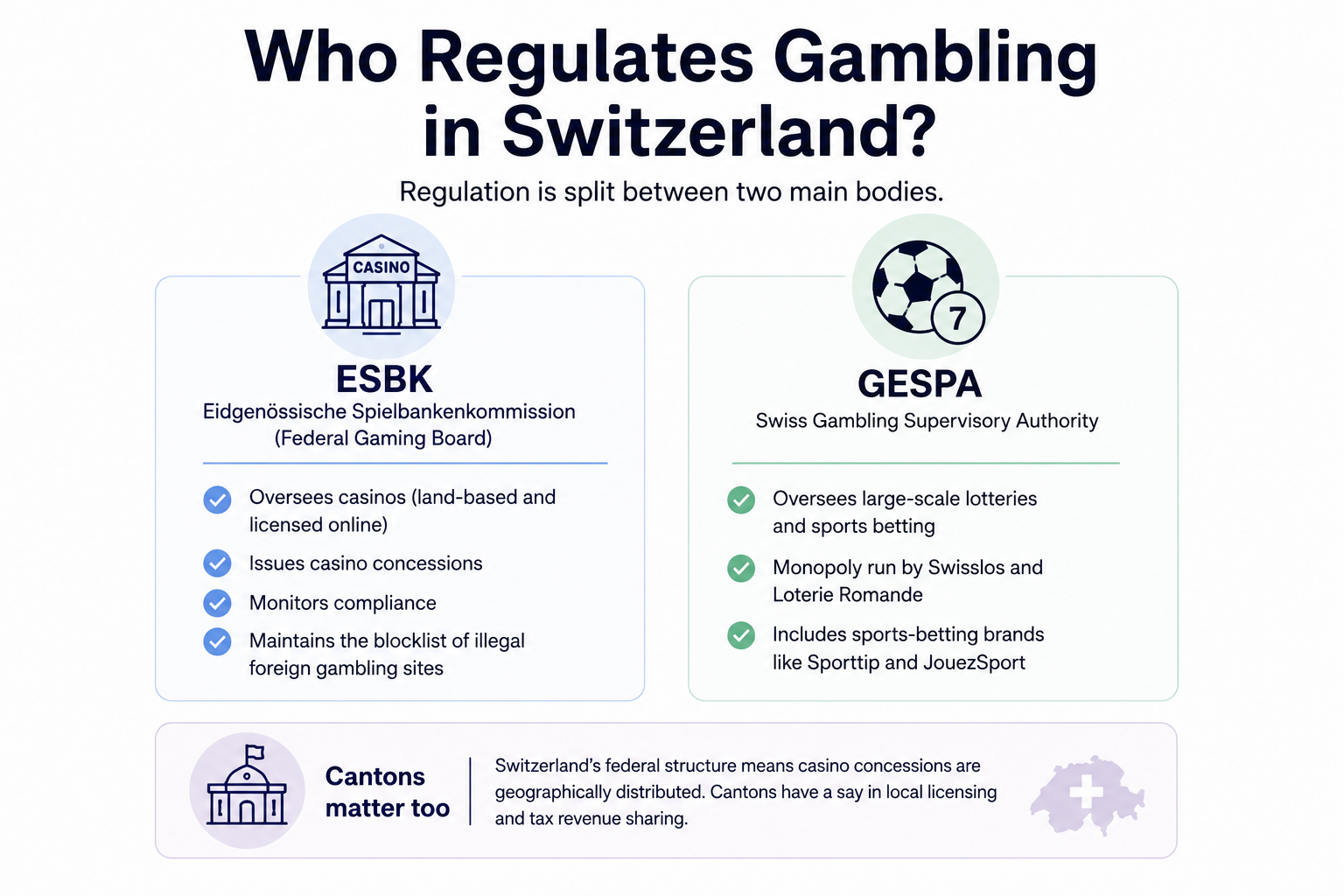
Who Regulates Gambling in Switzerland?
Regulation is split between two bodies, and mixing them up is one of the most common mistakes people make when researching this topic.
- ESBK (Eidgenössische Spielbankenkommission / Federal Gaming Board): oversees casinos — both physical venues and their licensed online platforms. It issues casino concessions, monitors compliance, and maintains the blocklist of illegal foreign gambling sites.
- GESPA (Swiss Gambling Supervisory Authority): oversees large-scale lotteries and sports betting, which remain a monopoly run by two intercantonal operators, Swisslos and Loterie Romande, alongside sports-betting brands like Sporttip and JouezSport.
Cantons still play a role too, since Switzerland’s federal structure means casino concessions are geographically distributed and cantons have a say in local licensing and tax revenue sharing. That’s why competitor guides often mention “federal and cantonal authorities” in the same breath — both layers matter.
Are Online Casinos Legal?
Yes, with a catch. Since January 1, 2019, Swiss-licensed land-based casinos have been allowed to offer online casino games — slots, roulette, blackjack, poker variants — to players physically located in Switzerland. As of 2026, roughly ten operators hold an online casino licence extension, each running a branded domestic platform (often with a .ch domain).
Here’s the thing though — offshore casinos, even well-known international brands, are not licensed in Switzerland. If they target Swiss players without a domestic concession, the ESBK can order internet service providers to block the domain. Switzerland’s Federal Supreme Court has upheld this DNS-blocking approach, so it’s not just theoretical enforcement; it’s an active, court-backed tool.
Activity | Legal status in Switzerland | Regulator |
|---|---|---|
Land-based casinos | Legal, licensed venues only | ESBK |
Online casino (Swiss-licensed) | Legal, piggyback model | ESBK |
Offshore online casinos | Illegal to target Swiss market; sites blocked | ESBK (enforcement) |
Lotteries | Legal, monopoly operators only | GESPA |
Sports betting | Legal via Sporttip / JouezSport | GESPA |
Private poker games (non-commercial) | Generally tolerated, unregulated | None |

List Your iGaming Product for the Swiss Market
Sologe gives gaming vendors a place to present products such as casino software, platforms, payment solutions, sports betting tools, services, traffic solutions, and equipment. If Switzerland is one of the markets you are targeting, it offers a more focused setting than a general business directory.
Want to Add Your Product?
With Sologe, you can:
- place your offer in a relevant iGaming category
- make your product easier for industry buyers to discover
- present your solution alongside other gaming-related products
👉 Get in touch with Sologe to list your product.
Spotting a Legal Casino Site
Players trying to tell licensed platforms apart from grey-market lookalikes can check a few practical signals:
- A Swiss domain (usually ending in .ch) tied to a known land-based casino brand.
- An imprint or “about” page naming the licensed Swiss casino operator.
- Visible reference to ESBK licensing or a licence number.
- Geo-restriction — legal Swiss platforms only accept players physically located in Switzerland at the time of play.
Offshore sites might look flashier, offer bigger bonuses, or accept players with fewer restrictions. That’s exactly the point — they’re operating outside Swiss consumer protection rules, so there’s no regulator to turn to if a dispute or non-payment happens.
What About Sports Betting?
Sports betting sits in its own lane. Under the Money Gaming Act, large-scale sports betting is reserved for the two intercantonal lottery-and-betting operators: Swisslos (German- and Italian-speaking regions) and Loterie Romande (French-speaking regions), operating their betting products under brands such as Sporttip and JouezSport. Unlike casinos, there’s no “piggyback” path here for private operators — it’s a closed monopoly by design, meant to keep proceeds channelled toward public and charitable causes, which is a long-standing feature of Swiss lottery law.
Taxation of Casino Winnings
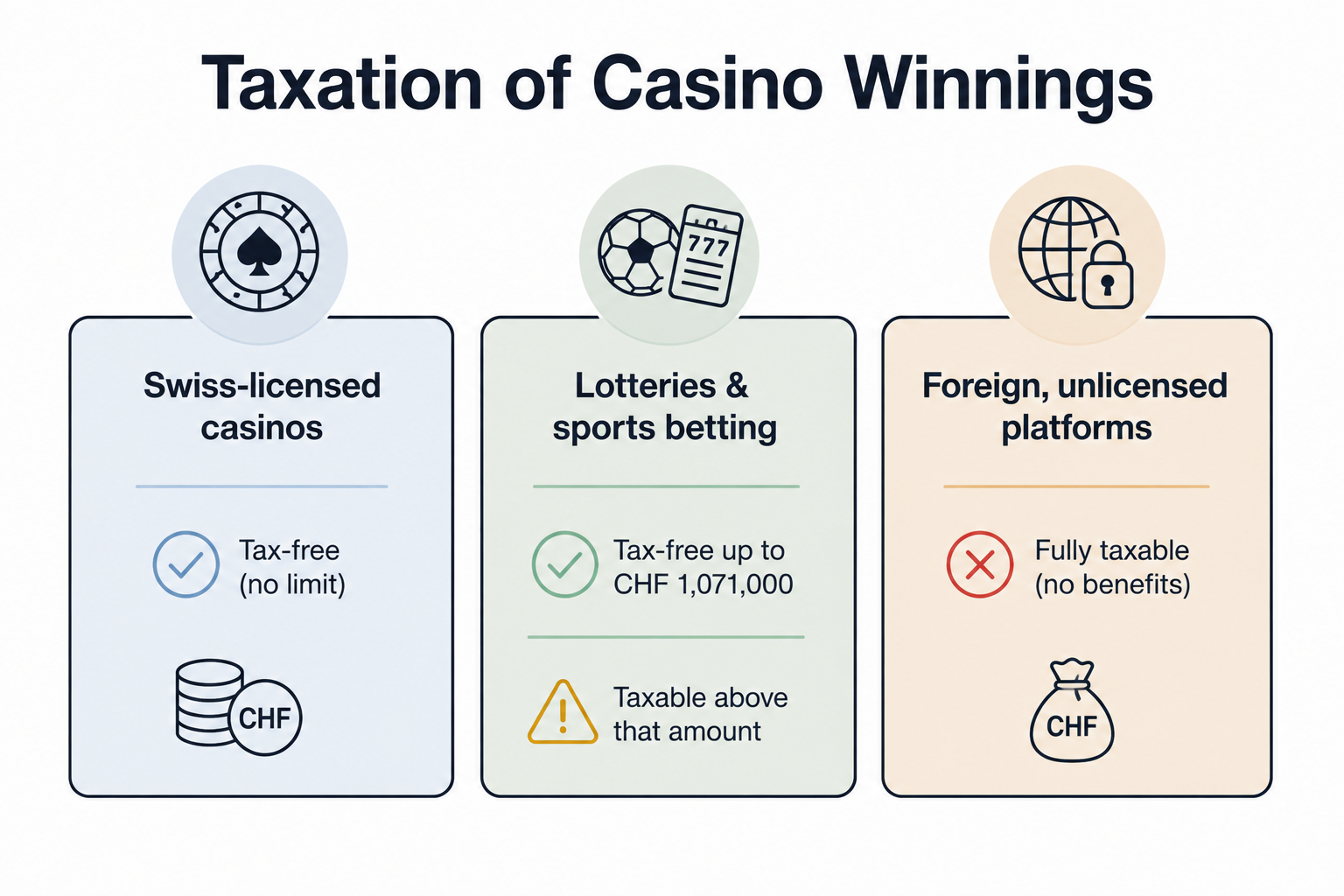
This is where Switzerland stands out compared to most of Europe. Winnings from a Swiss-licensed casino — land-based or online — are entirely tax-free, with no upper limit. Win 500 francs on a slot machine or hit a seven-figure jackpot at Casino Zürich, and none of it counts as taxable income under the Direct Federal Tax Act.
Lotteries and sports betting work differently. Winnings there are tax-free only up to a threshold that gets periodically adjusted for inflation — set at CHF 1,071,000 as of January 1, 2026, according to Swiss tax authorities. Anything above that line becomes taxable income, and a 2025 consultation process even proposed taxing very large wins at the winner’s place of residence at the time of the win, specifically to close a loophole where winners relocated cantons afterward to reduce their tax bill.
Winnings from foreign, unlicensed gambling platforms don’t get any of these breaks — they’re fully taxable regardless of amount, on top of carrying no consumer protection. That combination makes playing offshore a lose-lose proposition from both a legal and financial standpoint.
Land-Based Casinos: What to Expect
Switzerland’s casino floor culture leans upscale and low-key rather than flashy. Most venues combine table games — roulette, blackjack, poker — with slot halls, and many attach a restaurant, bar, or even a small entertainment venue. Minimum table stakes vary by casino and by table, but modest blackjack minimums (in the ten-franc range at some venues) keep the doors open to casual visitors, not just high rollers.
Entry typically requires a valid photo ID, and casinos are legally obligated to run responsible-gambling checks — including self-exclusion registers shared across the industry, so a player barred at one casino is barred at all of them.
A Quick Timeline
Year | Milestone |
|---|---|
Pre-2019 | Casinos and lotteries regulated under separate, older statutes |
Jan 1, 2019 | Federal Act on Money Gaming enters into force; online casinos permitted under piggyback model |
2019–2021 | First online casino licence extensions granted; ESBK blocklist launched |
2021 | Comlot and ESBK-linked lottery oversight consolidates into GESPA |
2025–2026 | Consultation on taxing very large lottery wins at residence “at time of win”; tax-free threshold updated to CHF 1,071,000 |
Frequently Asked Questions
Is gambling legal in Switzerland?
Yes. Gambling is legal and regulated at the federal and cantonal level under the Federal Act on Money Gaming, which covers casinos, lotteries, and sports betting.
Can Swiss residents play at foreign online casinos?
Not legally, if the platform lacks a Swiss licence. Unlicensed foreign sites are added to an official block list, and internet providers are required to restrict access. Winnings from such sites also lose the usual tax-free treatment and carry no legal protection.
Do casino winnings get taxed in Switzerland?
Winnings from Swiss-licensed casinos – online or land-based – are completely tax-free, with no cap. Lottery and sports betting winnings are tax-free only up to CHF 1,071,000 as of 2026; amounts above that are taxable.
What’s the minimum age to enter a Swiss casino?
18 is the standard minimum age at Swiss casinos, enforced through mandatory ID checks at entry.
How many licensed casinos operate in Switzerland?
Around twenty land-based casinos hold concessions across Switzerland, with roughly half of them also holding an online casino licence extension as of 2026. Check the ESBK’s official register for the current, exact count.
Is online sports betting legal?
Yes, but only through the two authorised intercantonal providers, Sporttip and JouezSport, run respectively by Swisslos and Loterie Romande. No private operator holds a sports betting licence in Switzerland.
What happens if a casino operates without a Swiss licence?
It’s illegal to target the Swiss market without a concession. The ESBK can order network-level blocking of the domain, a measure the Federal Supreme Court has confirmed as lawful enforcement.
The Bottom Line
Casinos aren’t just legal in Switzerland — they’re one of the more clearly regulated corners of the country’s economy, with a licensing system that’s been stress-tested through both parliamentary debate and a public vote. Land-based venues, their linked online platforms, tax-free winnings, strict age checks, and an active foreign-site blocklist all fit together into a system designed to channel gambling revenue through accountable, licensed operators.
Anyone planning to play, whether at a table in Baden or on a licensed app at home, should stick to operators listed on the ESBK’s official register and double-check current licence status before depositing a franc. The rules are stable, but details like the tax-free threshold shift periodically — worth a quick check on the official source before assuming last year’s numbers still apply.
Related Articles
September 3, 2026Is the Casino Legal in Denmark? 2026 Guide

September 3, 2026Is the Casino Legal in Angola? What the 2026...