 Nothing found for the request
Is Casino Gambling Legal in Nigeria? What the Law Actually Says in 2026
Sologe September 3, 2026
Share:


Quick Summary
Casino gambling is legal in Nigeria for adults aged 18 and above, but it’s regulated at both federal and state levels rather than through a single national law. Land-based casinos need licenses from state gaming boards (Lagos and Abuja host most of them), while online casinos operate in a legal gray zone since no single statute expressly licenses them. Games of pure chance like dice and unlicensed card games remain restricted under the Criminal Code, so the legality of any specific casino depends heavily on where it’s based and whether it holds a valid license.
Ask ten Nigerians whether casino gambling is legal and you’ll probably get ten different answers. Some point to the glittering casino floors in Victoria Island. Others swear the whole thing is illegal because they read it in a Criminal Code section from decades ago. Neither answer is quite complete.
The truth sits somewhere in between, and it’s more layered than a single yes-or-no. Nigeria doesn’t have one tidy gambling statute that covers everything from lottery tickets to blackjack tables. Instead, the legal picture is stitched together from colonial-era criminal codes, a 2005 federal lottery act, state-level gaming boards, and — more recently — a landmark court ruling that reshuffled who actually gets to call the shots.
The Short Answer: Yes, But With Conditions
Casino gambling is legal in Nigeria. That’s the headline. Licensed land-based casinos operate openly in major cities, sports betting shops line entire streets in Lagos and Abuja, and the national lottery sells tickets without anyone batting an eye.
But “legal” comes with strings attached. Operators need licenses. Certain games — particularly those based purely on chance rather than skill, like unlicensed dice games — remain restricted under old criminal statutes. And online casinos, which is where most of the confusion lives, aren’t governed by any law written specifically for them. So the honest answer isn’t a clean “yes” or “no.” It’s “yes, if the operator is properly licensed and the game itself isn’t one of the specifically prohibited forms.”
How Nigeria’s Gambling Laws Are Structured
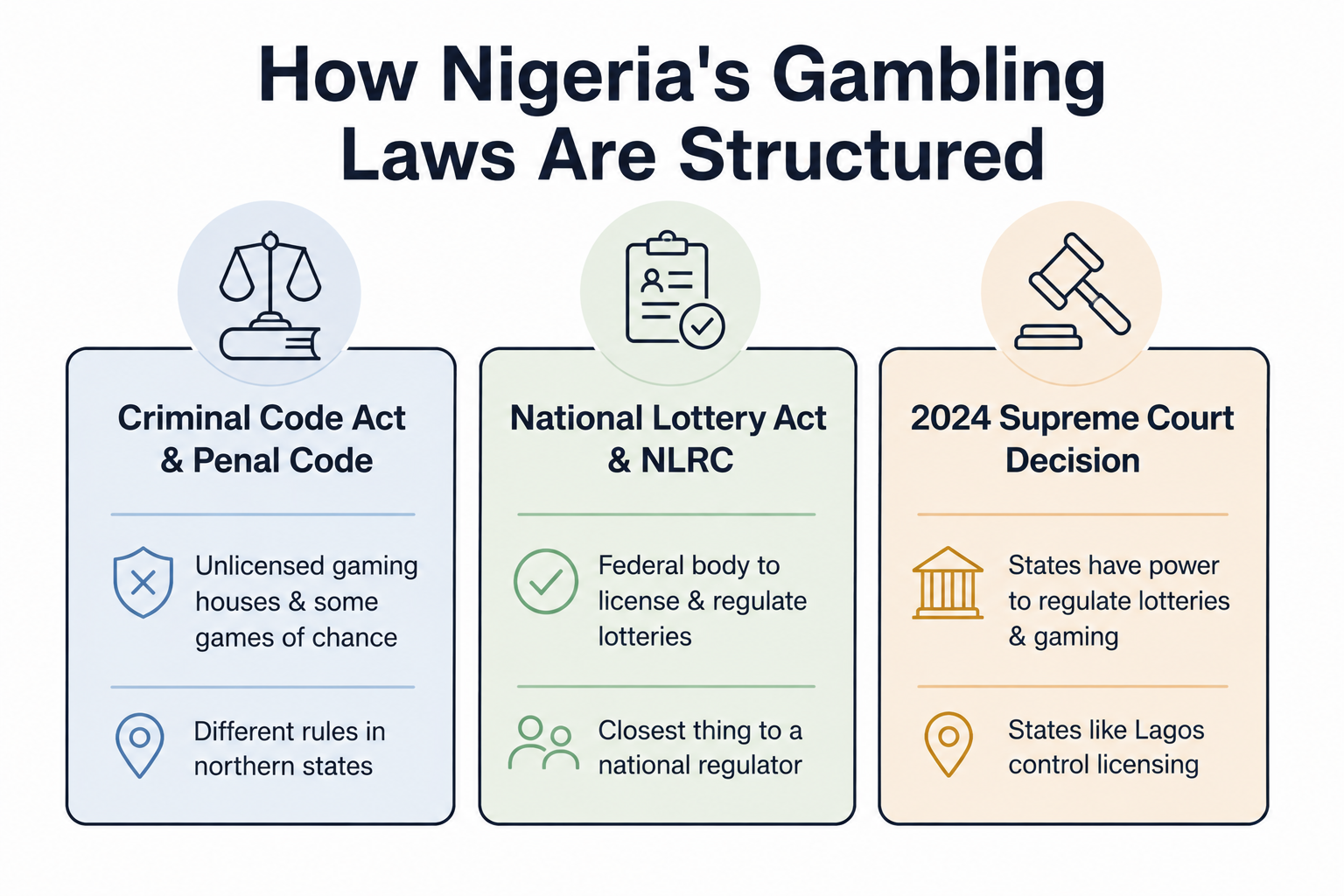
Understanding Nigerian gambling law means understanding that Nigeria runs a federal system, and gambling regulation doesn’t sit neatly under one authority. Three layers matter here.
The Criminal Code Act and the Penal Code
Nigeria’s southern states operate under the Criminal Code Act, a statute with roots stretching back over a century. Chapter 22 of that code deals with gaming houses and betting, and it’s the section most often cited when people claim gambling is “illegal” in Nigeria. What it actually does is outlaw unlicensed gaming houses and certain games of pure chance — not gambling as a whole.
Northern states, meanwhile, apply the Penal Code, which takes a somewhat different (and in places stricter) approach to gaming and betting activities, partly reflecting the influence of Sharia-based principles in several states.
The National Lottery Act and the NLRC
In 2005, the federal government passed the National Lottery Act, creating the National Lottery Regulatory Commission (NLRC) to license and oversee lottery operations nationwide. For years this was treated as the closest thing Nigeria had to a general gambling regulator, and it issued licenses covering various forms of lottery-adjacent gaming.
The 2024 Supreme Court Shake-Up
Here’s where things get interesting. A closely watched Supreme Court decision, widely reported in 2024, reaffirmed that the power to regulate lotteries and gaming activities within a state’s borders belongs to that state’s government — not the federal legislature. This effectively echoed an earlier constitutional dispute between Lagos State and the federal government over who controls lottery and gaming licensing.
The practical effect is that states like Lagos, which already run their own Lotteries Board, retain firm control over licensing casinos and gaming houses operating within their territory, while the NLRC’s federal reach is understood to be narrower than it once claimed.
Online Casinos and Sports Betting
This is where most of the questions land, and understandably so. Nigeria doesn’t have a single, dedicated online gambling statute the way places like the UK or Malta do. That absence creates a gray zone rather than an outright ban.
Are Online Casinos Actually Illegal?
Not exactly — but they’re not clearly legal in the way land-based casinos are, either. The Criminal Code’s provisions were written long before the internet existed, so applying them directly to offshore online casino platforms is legally murky. Some legal commentators argue that unlicensed online wagering entities technically fall foul of the same “unlicensed gaming house” logic used against physical operations. Others note that since most online casinos serving Nigerian players are licensed abroad (Malta, Curaçao, and similar jurisdictions), Nigerian criminal law simply doesn’t reach them in practice.
What’s clearer is sports betting. Numerous Nigerian-licensed sportsbooks operate openly, advertise heavily, and pay taxes under NLRC or state licenses. Online lottery products follow a similar pattern. Casino-style online games — slots, roulette, blackjack — sit in murkier territory precisely because no license category was built specifically for them.
Checking Whether a Platform Is Trustworthy
Given the regulatory gap, due diligence falls heavily on the player. A few checks go a long way:
- Look for a visible license number from a recognized jurisdiction, even if it’s not Nigerian.
- Check whether the platform supports Nigerian payment methods transparently, without hidden fees.
- Search for user reviews mentioning withdrawal problems — a common red flag with unlicensed operators.
- Confirm the site enforces an 18+ age verification step before allowing deposits.

Put Your Gaming Offer in Front of Nigerian Buyers
Sologe is an iGaming marketplace built around products and services for the gaming industry. Vendors can list everything from software and platforms to payments, sports betting solutions, equipment, traffic, and related services. If Nigeria is one of the markets you want to reach, Sologe gives you a simple way to get your offer in front of people already looking for gaming products and services.
Ready to Get Listed?
Sologe lets vendors:
- add products to a dedicated gaming marketplace
- choose the category that best fits their offer
- give buyers a clearer view of what they provide
👉 Get in touch with Sologe to add your product to the marketplace.
Land-Based Casinos in Nigeria
Physical casinos are the most straightforward part of this story. They exist, they’re licensed, and they’re concentrated in Nigeria’s two biggest urban centers — Lagos and Abuja — where wealthier clientele and international hotel chains create demand for table games, slot machines, and poker rooms.
To open one legally, an operator has to secure a license from the relevant state gaming or lotteries board, meet capital and premises requirements, and submit to ongoing regulatory oversight. Age restrictions apply strictly: patrons must be 18 or older, and most venues check identification at the door.
Gambling Activity | Legal Status in Nigeria | Regulator |
|---|---|---|
Land-based casinos | Legal with license | State gaming/lotteries boards |
National lottery | Legal | NLRC / state lottery boards |
Sports betting | Legal with license | NLRC and state boards |
Online casinos | Not expressly regulated; operates in a gray area | No dedicated federal law |
Unlicensed dice/card games of pure chance | Restricted / illegal | Criminal Code / Penal Code |
How to Get a Casino or Gambling License in Nigeria
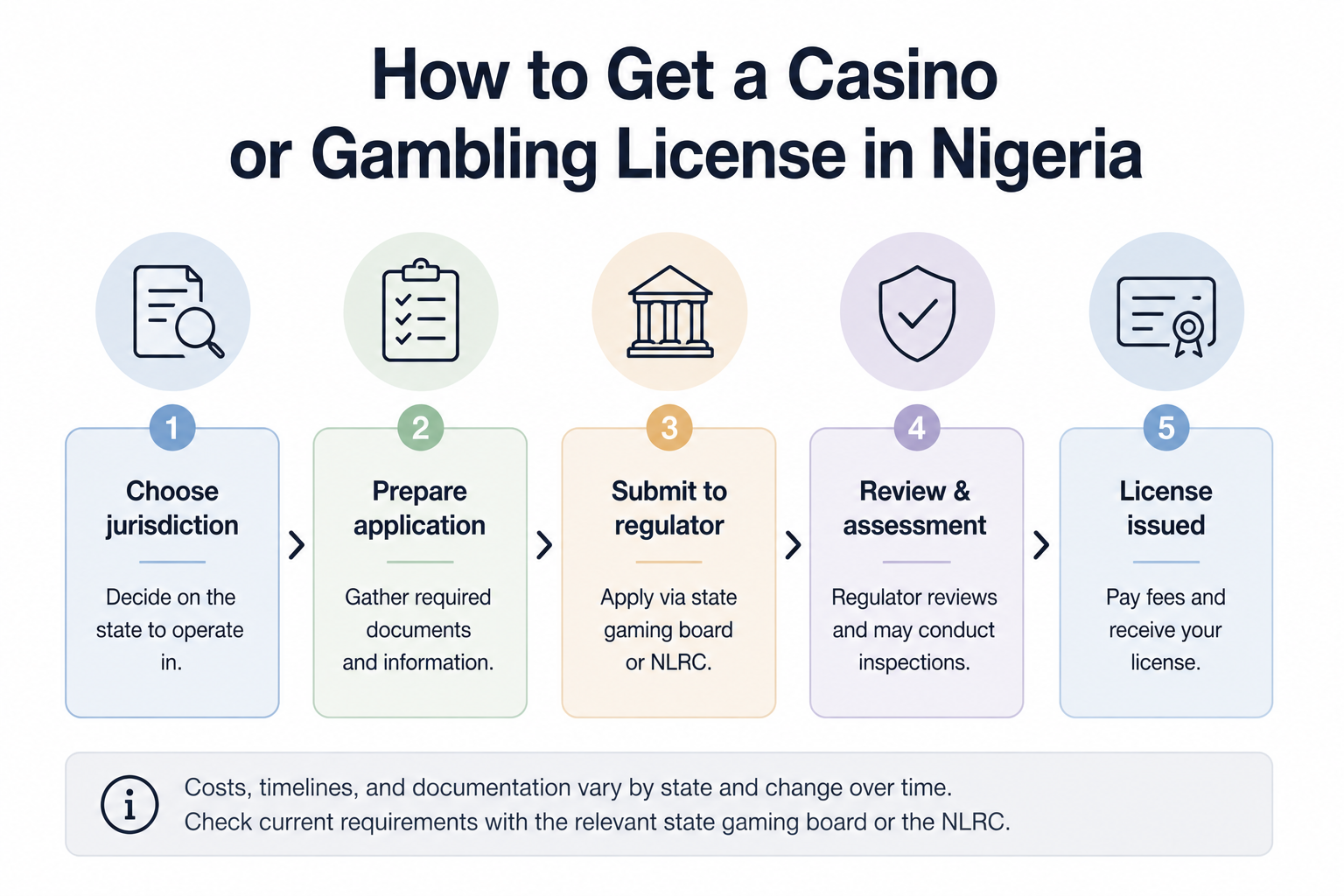
Operators looking to run a legitimate casino business in Nigeria typically need to work through both federal and state layers. The exact steps vary by state, but the general path looks fairly consistent.
Costs, timelines, and specific documentation requirements shift from state to state and change periodically, so anyone seriously pursuing a license should check the current fee schedule directly with the relevant state gaming board or the NLRC rather than relying on older published figures.
Penalties for Illegal Gambling Operations
Running an unlicensed gaming house, or offering restricted games of pure chance, still carries real legal risk under the Criminal Code and Penal Code. Consequences can include fines, seizure of gaming equipment, and in some cases criminal prosecution of operators. Players themselves are rarely prosecuted for simply placing a bet, but operators face the brunt of enforcement action.
Land-Based vs Online: A Side-by-Side Look
Factor | Land-Based Casinos | Online Casinos |
|---|---|---|
Legal clarity | High — licensed and inspected | Low — no dedicated statute |
Regulator | State gaming/lotteries boards | Typically foreign (Malta, Curaçao) |
Availability | Limited to major cities | Accessible nationwide via internet |
Tax obligations | Enforced through state licensing | Rarely enforced on offshore operators |
Player protection | Regulated dispute resolution | Depends on operator’s home jurisdiction |
FAQ: Casino Gambling in Nigeria
Is casino gambling legal for Nigerian citizens?
Yes. Adults aged 18 and above can legally gamble at licensed land-based casinos, buy lottery tickets, and place bets with licensed sportsbooks. Online casino gambling sits in a gray area rather than being explicitly banned.
Do I need to be a certain age to gamble in Nigeria?
Yes, the minimum legal gambling age across Nigeria is 18. Licensed venues and platforms are required to verify age before allowing wagers.
Which cities have licensed land-based casinos?
Lagos and Abuja host most of Nigeria’s licensed physical casinos, largely tied to major hotels and entertainment complexes catering to both locals and international visitors.
Are foreign online casinos illegal to use from Nigeria?
There’s no explicit federal law banning Nigerians from using offshore-licensed online casinos. Enforcement against individual players is essentially nonexistent, though the platforms themselves operate outside direct Nigerian regulation.
Who regulates gambling in Nigeria – the federal government or the states?
Both, with states holding more authority than many assume. A widely reported 2024 Supreme Court decision reaffirmed that states control lottery and gaming regulation within their borders, while the National Lottery Regulatory Commission retains a narrower federal role.
Is sports betting treated differently from casino gambling?
In practice, yes. Sports betting has clearer licensing pathways through the NLRC and state boards, and Nigerian-licensed sportsbooks operate very openly. Online casino-style games lack an equivalent dedicated license category.
What happens if someone runs an unlicensed casino in Nigeria?
Operating without a license exposes the operator to fines, equipment seizure, and potential prosecution under the Criminal Code or Penal Code, depending on the state. Players are rarely the target of enforcement action.
The Bottom Line
So, is the casino legal in Nigeria? Land-based, licensed casinos: absolutely yes. Sports betting and the national lottery: yes, with proper licensing. Online casinos: legally ambiguous rather than outright banned, which means the responsibility to gamble safely and choose a reputable, licensed platform falls squarely on the player.
Anyone planning to gamble — online or in person — should stick to licensed operators, confirm age and identity verification is in place, and treat gambling strictly as entertainment rather than an income strategy. For anyone considering opening a gambling business, checking directly with the relevant state gaming board or the NLRC for current licensing rules is the only reliable way to stay on the right side of a legal landscape that’s still evolving.
Related Articles

September 3, 2026Is the Casino Legal in Denmark? 2026 Guide

September 3, 2026Is the Casino Legal in Angola? What the 2026...