 Nothing found for the request
Is the Casino Legal in Paraguay? What the 2026 Law Really Says
Sologe September 3, 2026
Share:


Quick Summary
Yes, casino gambling is legal in Paraguay and always has been under Law 1016/1997. What changed is the structure: Law No. 7438/2025, signed by President Santiago Peña and backed by Decree 3846/2025, dismantled the country’s decades-old gambling monopoly and put the regulator CONAJZAR under the tax authority DNIT. Land-based casinos remain fully licensed, sports betting runs on an exclusive concession through 2028, and online casino gambling is now a recognized licensable category, even though the tender process is still rolling out through 2026.
Paraguay isn’t a country most people associate with casino floors and neon signs. But gambling has quietly been part of its legal economy for close to three decades. So when travelers, bettors, or operators ask whether a casino in Paraguay is actually legal, the honest answer isn’t a flat yes or no — it’s “legal, but the rulebook just got rewritten.”
That rewrite matters. Since late 2024, Paraguay has been unwinding a gambling monopoly that had shaped the industry since the 1990s, replacing it with a competitive licensing system. Here’s what’s actually legal, what’s changed, and what still sits in a gray zone.
Short Answer: Casino Gambling Is Legal in Paraguay
Land-based casinos, slot halls, lottery games, and sports betting are all legal activities in Paraguay, provided the operator holds a government concession or license. This isn’t a new development — Paraguay has permitted regulated gambling since Law 1016/1997 established the original legal framework. What’s new is who gets to operate and how those permissions are granted.
Online gambling sits in trickier territory. It’s neither explicitly banned nor fully licensed yet for most operators, though the 2025 reform opened the door for online casino products to become a licensed category going forward.
A Quick History: How Paraguay Regulated Gambling
For most of the last three decades, Paraguay ran its gambling sector through a small number of long-term concessions. One private operator effectively held exclusive rights across large swaths of the industry — casinos, slot machines, and eventually sports betting — through contracts that critics argued limited competition and left tax revenue on the table.
The regulator overseeing all of this was CONAJZAR, the Comisión Nacional de Juegos de Azar (National Gambling Commission). It issued permits, monitored operators, and enforced the rules, but it had limited independence and, according to industry observers, limited resources to actually police an expanding market — especially online.
By the early 2020s, pressure had built for reform. Lawmakers argued the monopoly structure was choking off investment and letting illegal operators, particularly unlicensed online sites, fill the gap unchecked.
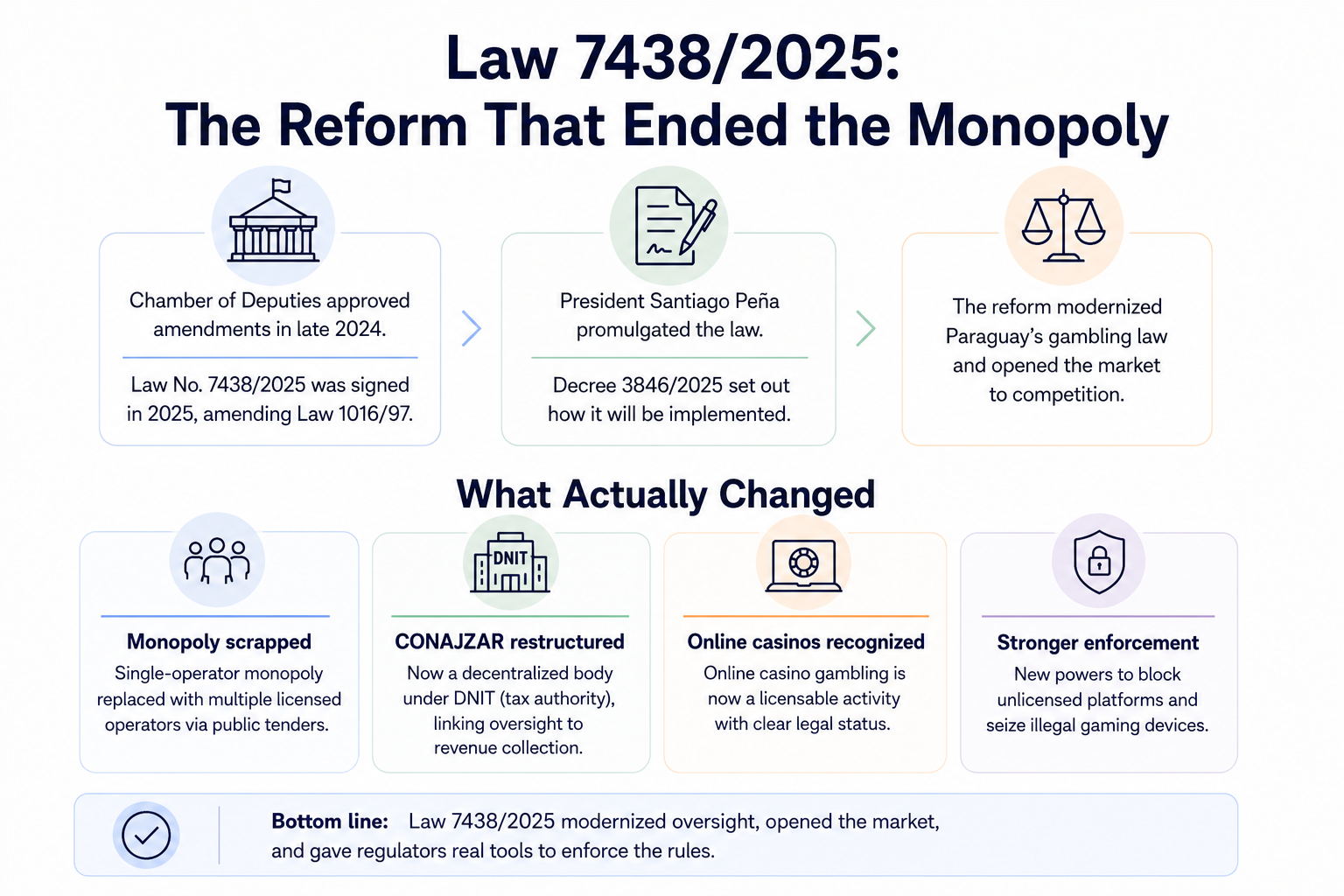
Law 7438/2025: The Reform That Ended the Monopoly
Change arrived in stages. The Chamber of Deputies approved amendments toward the end of 2024, and the reform was formally signed into law in 2025 as Law No. 7438/2025, amending the original Law 1016/97. President Santiago Peña promulgated it, and Decree 3846/2025 laid out how it would actually be implemented.
What Actually Changed
- The single-operator monopoly model was scrapped in favor of multiple licensed operators competing through public tenders.
- CONAJZAR was restructured as a decentralized body operating under the Dirección Nacional de Ingresos Tributarios (DNIT), Paraguay’s tax authority — tying gambling oversight more directly to revenue collection.
- Online casino gambling was formally recognized as a licensable activity for the first time, rather than existing outside any clear legal category.
- Enforcement powers expanded significantly, including authority to block unlicensed gambling platforms and seize illegal gaming devices.
Why CONAJZAR Moving Under DNIT Matters
Folding the gambling regulator into the tax authority wasn’t just a bureaucratic reshuffle. It links licensing directly to tax compliance, giving inspectors more direct leverage over operators and, in theory, making it harder for a licensed business to under-report revenue. Paraguay also reportedly added hundreds of new inspectors to support enforcement against illegal operations — a sign regulators expect the informal market to resist the shift.
Land-Based Casinos in Paraguay Today
Physical casinos remain the most straightforward part of the picture: they’re legal, licensed, and have operated openly for years, mostly concentrated in Asunción and along border regions near Argentina and Brazil where cross-border tourism drives demand.
Aspect | Status Under Current Law |
|---|---|
Legal basis | Law 1016/1997, amended by Law 7438/2025 |
Regulator | CONAJZAR, decentralized under DNIT |
Licensing model | Public tender, open to multiple operators (post-2025) |
Minimum age | 18 |
Common locations | Asunción and border cities near Argentina/Brazil |
Nothing about walking into a licensed casino in Paraguay changed overnight because of the reform. What changed is who’s allowed to build the next one, and how many competitors can bid for that right.
What About Online Casinos and Sports Betting Sites?
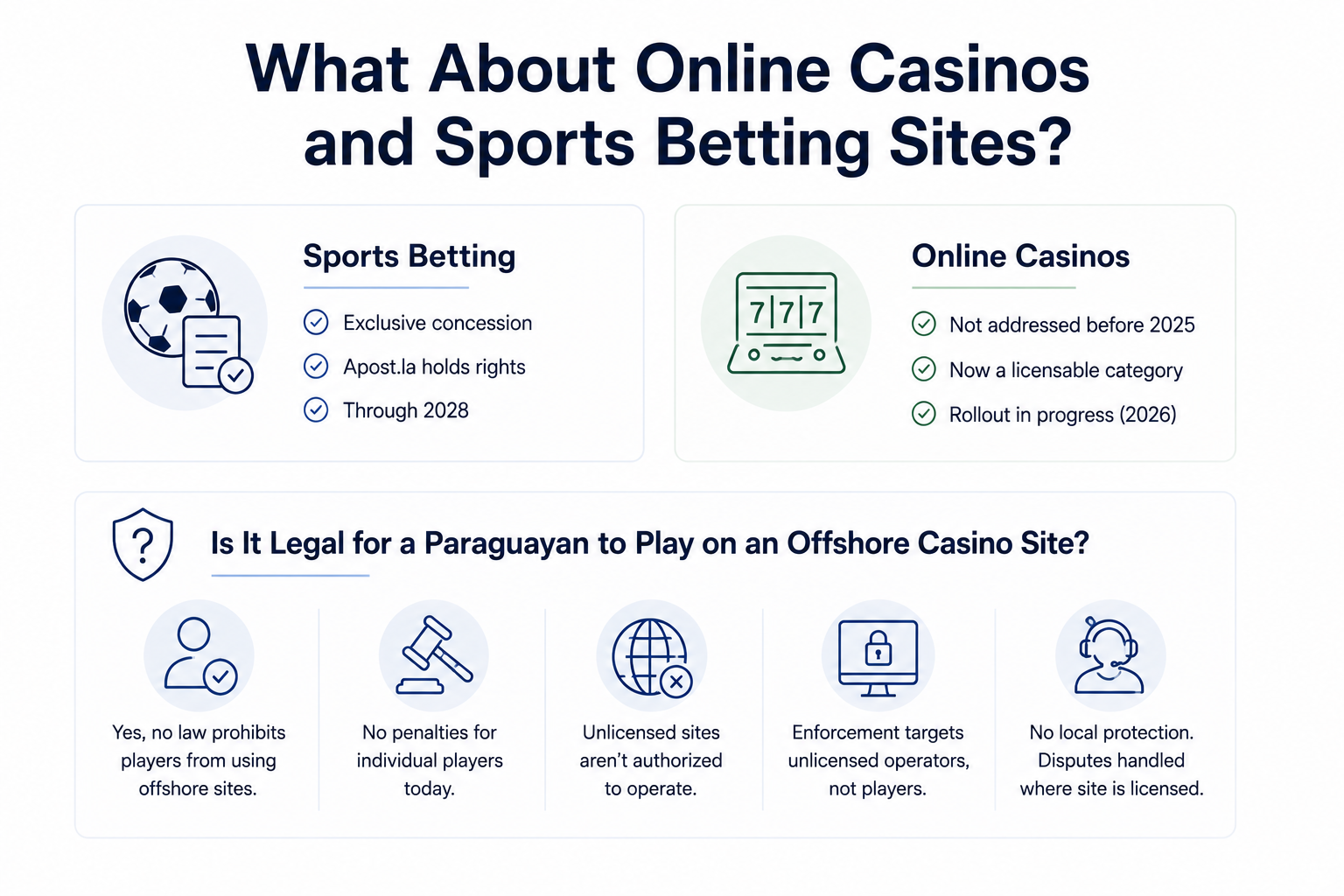
This is where things get less tidy. Sports betting has run for years under an exclusive concession — the operator Apost.la has held that arrangement, reportedly through 2028, meaning it remains the sole licensed sportsbook brand even as other verticals open up to competition.
Online casino gambling, by contrast, had never been clearly addressed in Paraguayan law before 2025. It wasn’t explicitly illegal, but it also wasn’t licensed — a genuine legal gray zone that pushed Paraguayan players toward offshore, internationally licensed sites. Law 7438/2025 changes the legal status on paper, naming online casino as a licensable category. But recognizing a category and actually running a competitive tender for it are two different things, and as of 2026 that rollout is still in progress, with lottery concessions being among the first awarded under the new system.
So Is It Legal for a Paraguayan to Play on an Offshore Casino Site?
Practically speaking, yes — there’s no law explicitly prohibiting a player in Paraguay from opening an account with an internationally licensed offshore casino. There’s also no domestic mechanism currently penalizing individual players for doing so. The ambiguity sits on the operator side, not the player side: sites without a Paraguayan license aren’t authorized to operate there, but enforcement has historically focused on blocking access or targeting unlicensed local operations rather than prosecuting individual bettors.
That said, playing on an unlicensed offshore site removes any local consumer protection. Disputes over payouts or account issues have to be resolved wherever that operator is actually licensed, which can mean anywhere from Malta to Curaçao.

List Your iGaming Product for the Paraguayan Market
Sologe is a marketplace for gaming software, platforms, payment solutions, sports betting products, services, traffic, and equipment. If Paraguay is one of the markets on your radar, Sologe gives you a focused place to present your product to people already browsing within the iGaming industry.
Want to Get Your Product Listed?
With Sologe, you can:
- add your product to a dedicated gaming marketplace
- place it in the category that fits your offer
- make it easier for industry buyers to discover what you provide
👉 Get in touch with Sologe to list your product.
Taxes, Licensing, and Enforcement
Gambling operators in Paraguay are subject to the standard corporate income tax (IRE) under Law 6380/2019, generally cited at 10% for corporate entities, on top of whatever fees or revenue shares apply to their specific concession or license. Exact licensing costs and tender terms vary by category and are set individually — anyone evaluating a specific license should check CONAJZAR’s official bidding documentation rather than rely on secondhand figures, since terms are still being finalized category by category through 2026.
Category | Before Law 7438/2025 | After Law 7438/2025 |
|---|---|---|
Casino operations | Single long-term concession model | Open to multiple licensed operators via tender |
Sports betting | Exclusive concession (Apost.la) | Exclusive concession continues to 2028 |
Online casino | Legal gray area, unregulated | Recognized licensable category, rollout in progress |
Regulator structure | CONAJZAR, standalone | CONAJZAR, decentralized under DNIT |
Enforcement tools | Limited inspection capacity | Expanded inspectors, platform-blocking powers |
What This Means for Bettors and Operators Right Now
For everyday players, not much changes day to day — casinos still operate, sports betting still runs through the same exclusive brand, and offshore sites remain accessible without direct legal risk to the individual. For operators eyeing the market, the calculus is different: the monopoly’s end means real competition is coming, but the tender timelines and specific licensing terms for each category are still being worked out.
Operators considering entry should track CONAJZAR’s bidding announcements directly rather than assuming timelines from news coverage, since tender schedules are subject to change as the agency works through each category.
FAQ: Casino Gambling in Paraguay
Is gambling legal in Paraguay?
Yes. Land-based casinos, slot halls, lottery, and sports betting are all legal, provided the operator holds a government-issued license or concession under Law 1016/1997 as amended by Law 7438/2025.
What is Law 7438/2025?
It’s the reform signed by President Santiago Peña that ended Paraguay’s long-standing gambling monopoly, restructured CONAJZAR under the tax authority DNIT, and formally recognized online casino gambling as a licensable category.
Is online casino gambling legal in Paraguay?
It’s in transition. Before 2025 it existed in a legal gray area – not explicitly banned, but not licensed either. The new law creates a path to licensing, though the tender process for online casino operators is still being rolled out.
Can Paraguayans legally use offshore casino sites?
There’s no law directly penalizing individual players for using internationally licensed offshore sites. The legal uncertainty applies to unlicensed operators, not to the players using them, though offshore play offers no local consumer protection.
What is CONAJZAR?
CONAJZAR, the Comisión Nacional de Juegos de Azar, is Paraguay’s national gambling regulator. Under the 2025 reform it became a decentralized body operating under DNIT, the national tax authority.
What is the minimum gambling age in Paraguay?
18 years old, consistent with the standing legal framework under Law 1016/1997 and its amendments.
Is sports betting legal in Paraguay?
Yes, but it currently runs through an exclusive concession held by a single licensed operator, reportedly through 2028, rather than the multi-operator model now applying to other gambling categories.
The Bottom Line
Casino gambling in Paraguay isn’t some legal loophole or gray-market curiosity — it’s been sanctioned, taxed, and regulated for decades. What’s genuinely new is the competitive structure arriving through Law 7438/2025: a system built for multiple licensed operators instead of one entrenched concessionaire, with CONAJZAR now folded into the country’s tax machinery to keep closer tabs on the industry.
Online play is the part still catching up to the law on paper. Anyone planning to bet real money in Paraguay, whether at a physical casino or through a betting app, should confirm current licensing status directly with CONAJZAR or DNIT before assuming an operator is authorized — the tender rollouts are ongoing, and the specifics will keep shifting through 2026 and beyond.
Related Articles

September 3, 2026Is the Casino Legal in Denmark? 2026 Guide

September 3, 2026Is the Casino Legal in Angola? What the 2026...