 Nothing found for the request
Is the Casino Legal in Sweden? 2026 Rules Explained
Sologe September 3, 2026
Share:


Quick Summary
As of January 1, 2026, land-based full-scale casinos are illegal in Sweden — even the state-owned Casino Cosmopol venues had to stop offering table games and slots under that model. Online casino gambling, however, remains fully legal and regulated under the Swedish Gambling Act (2018:1138), provided it’s offered through an operator licensed by the Swedish Gambling Authority (Spelinspektionen). So the short answer is: casinos aren’t banned in Sweden, but the land-based version of them effectively is.
Ask a Swede whether casinos are legal and you’ll probably get a confused look, followed by “well, it depends what you mean.” That’s a fair reaction. Sweden’s gambling rules changed dramatically heading into 2026, and the answer to this question genuinely shifted for the first time in decades.
Here’s the thing though — Sweden isn’t banning gambling. It’s banning one specific format of it. Online casinos, sports betting, poker, lotteries, and horse racing betting are all still legal and widely used across the country. What disappeared is the traditional, walk-in, full-scale casino experience that used to exist in four Swedish cities.
This piece breaks down exactly what’s legal, what isn’t, why the change happened, and what it means for anyone in Sweden who still wants to play casino games.
The Short Answer: Yes, But Not Land-Based
Casino gambling is legal in Sweden. It just isn’t legal in the traditional bricks-and-mortar sense anymore. Since January 1, 2026, Swedish law prohibits full-scale land-based casino operations entirely — a rule that applies even to the government’s own former monopoly operator.
Online casinos are a different story. They remain legal, provided they hold a license from Spelinspektionen, the Swedish Gambling Authority. That’s the regulator responsible for issuing licenses, monitoring compliance, and cracking down on unlicensed operators targeting the Swedish market.
So the real distinction isn’t “legal vs. illegal casino gambling.” It’s “licensed online gambling vs. a now-defunct physical casino model.”
How Sweden’s Gambling Laws Got Here
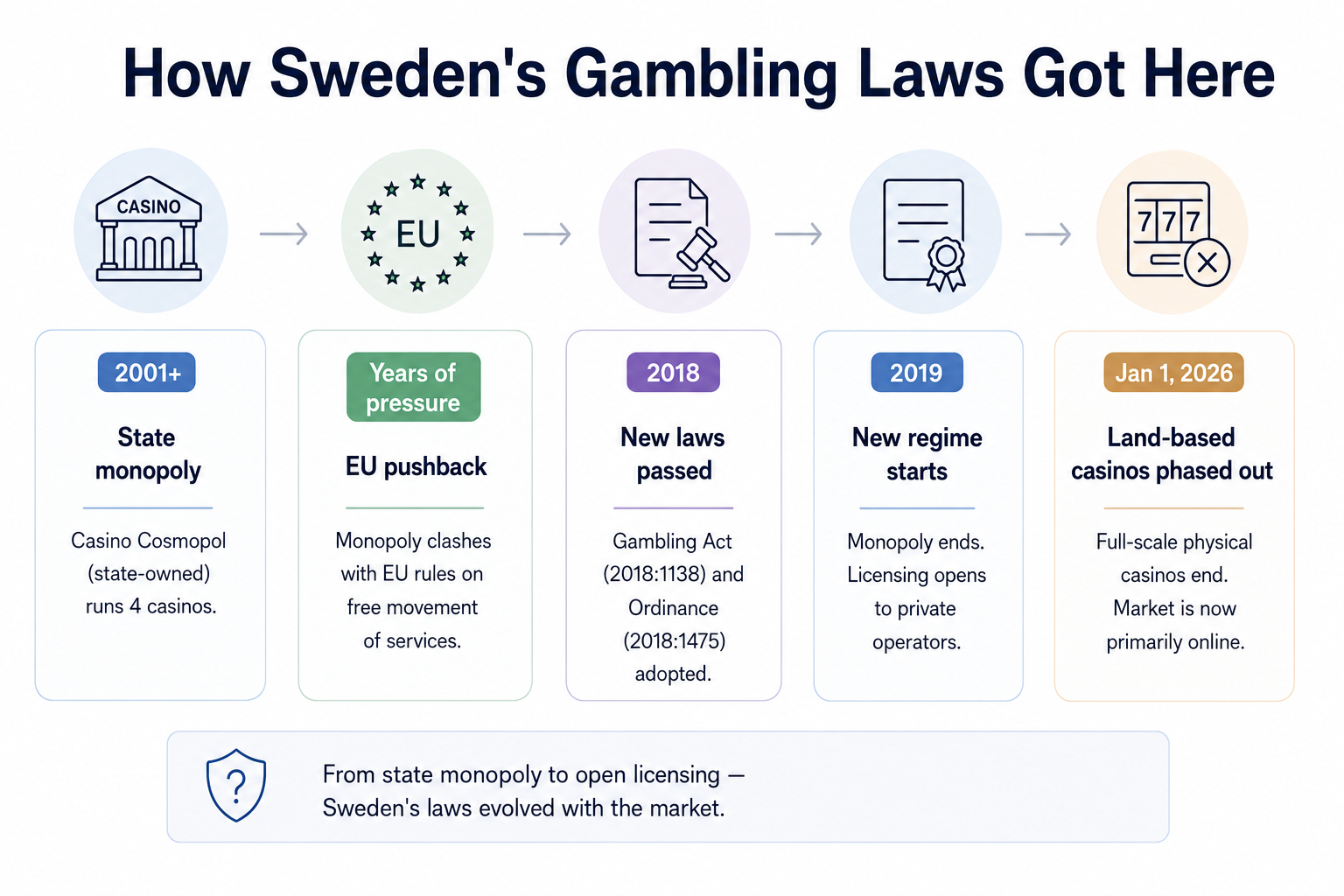
For a long time, Sweden ran a state monopoly on gambling. Casino Cosmopol, owned by the state gambling company, operated four physical casinos — in Sundsvall, Malmö, Gothenburg, and Stockholm — starting from 2001.
Pressure from the European Union eventually forced a rethink. Sweden’s monopoly model didn’t sit well with EU rules on free movement of services, and Brussels raised infringement concerns for years. Rather than fight that battle indefinitely, Sweden overhauled its entire approach.
In 2018, the Swedish Parliament passed the Gambling Act (2018:1138) alongside the Gambling Ordinance (2018:1475). Together they dismantled the old monopoly and replaced it with a licensing system open to private operators, not just the state. That new regime took effect in 2019, and it’s still the backbone of Swedish gambling regulation today.
Fast forward to the mid-2020s, and lawmakers decided the land-based casino model — even under license — no longer fit where the market was heading. Most gambling activity had already moved online. Regulators argued that maintaining full-scale physical casinos created oversight challenges without much upside, so Parliament moved to phase them out entirely, effective January 1, 2026.
What’s Actually Banned vs. What’s Still Legal
This is where a lot of confusion creeps in, so it helps to separate things clearly.
Activity | Legal Status in 2026 | Regulator / Notes |
|---|---|---|
Full-scale land-based casinos (table games, slots venues) | Prohibited | Banned nationwide from Jan 1, 2026, including for the former state operator |
Online casino games (slots, table games, live dealer) | Legal | Requires a Spelinspektionen license |
Sports betting | Legal | Licensed operators only |
Horse racing betting | Legal | Licensed operators only |
Lotteries | Legal | Licensed operators, including charitable lotteries |
Charitable/non-profit bingo | Legal | Subject to non-profit licensing rules |
Limited casino-style games at hospitality venues (e.g. slot machines under värdeautomater rules) | Conditionally legal | Separate, narrower licensing track under updated 2025/2026 rules — not full casinos |
Unlicensed offshore online casinos | Illegal | Spelinspektionen actively pursues bans and blocks against these |
Notice the pattern: nearly everything that used to require a walk-in venue is now either fully banned or restricted to a narrower licensing category that doesn’t resemble a traditional casino floor.

Put Your Gaming Product in Front of Swedish Buyers
Sologe gives iGaming vendors a place to showcase products and services in a marketplace focused on the gaming industry. Listings can include gaming software, platforms, payment solutions, sports betting, equipment, traffic services, and more. If Sweden is a market you want to reach, Sologe gives you a simple way to put your offer in front of people already looking for gaming-related products and services.
Ready to Add Your Offer?
Sologe lets you:
- choose a relevant category for your product
- show buyers what type of gaming solution you provide
- keep your offer in an industry-specific marketplace
👉 Get in touch with Sologe if you want to add your product.
Why Did Sweden Ban Land-Based Casinos?
Several factors pushed lawmakers toward this decision, and none of them are particularly surprising once you look at the broader gambling market.
- Declining foot traffic. Casino Cosmopol venues had seen shrinking visitor numbers for years as online alternatives became more convenient.
- Regulatory cost vs. benefit. Supervising physical casinos consumes resources that regulators felt were disproportionate to the size of that segment of the market.
- Channelization goals. Sweden’s gambling policy generally aims to steer players toward licensed, trackable channels. Officials concluded that land-based casinos weren’t essential to that goal anymore, since online licensing covers the demand.
- Expanded authority powers. The same legislative package that ended land-based casinos also broadened Spelinspektionen’s enforcement powers against illegal operators, suggesting the government wanted to tighten the whole system, not just close casino doors.
Sweden becoming the first EU country to eliminate all legal full-scale land-based casinos is a notable milestone. It signals a broader European conversation about whether physical casino venues still justify the regulatory overhead they require.
What This Means for Players and Visitors
Anyone hoping to walk into a casino during a Stockholm or Gothenburg trip in 2026 is out of luck — that experience no longer exists in Sweden. Tourists used to visiting Casino Cosmopol locations will need to look elsewhere, possibly across the border in Denmark or other EU countries that still license physical venues.
For everyday players based in Sweden, though, not much changes practically speaking. Most gambling in the country had already shifted online well before this law took effect. Choosing a licensed operator is still the key thing to get right.
A few practical pointers for staying on the legal side of things:
- Check that an online casino holds an active Spelinspektionen license before depositing money.
- Be wary of offshore sites marketing aggressively to Swedish players without local licensing — these operate outside consumer protection rules and enforcement can be inconsistent.
- Keep an eye on self-exclusion tools like Spelpaus, Sweden’s national self-exclusion register, which applies across all licensed gambling operators.
- Understand that gambling advertising rules in Sweden are stricter than in many countries, so licensed operators can’t market as aggressively as unlicensed ones might.
The Role of Spelinspektionen
Spelinspektionen — the Swedish Gambling Authority — sits at the center of all of this. It’s the state administrative body responsible for regulating gambling and lotteries across the country, and its job got noticeably bigger with the 2026 reforms.
Its core responsibilities include:
- Issuing and renewing licenses for online and land-based gambling operators that still qualify under current rules
- Monitoring licensed operators for compliance with responsible gambling requirements
- Investigating and reporting suspected illegal gambling activity
- Issuing bans against unlicensed operators targeting Swedish consumers
- Enforcing advertising restrictions on gambling promotions
Any operator — online or otherwise — that wants to legally serve Swedish customers has to meet the suitability criteria laid out in the Gambling Act (2018:1138) and get through Spelinspektionen’s licensing process. Operators that skip this step and target Swedish players anyway are operating illegally, regardless of how legitimate they might look.
Land-Based Casinos: Then vs. Now
Aspect | Before Jan 1, 2026 | After Jan 1, 2026 |
|---|---|---|
Operator model | State-owned monopoly (Casino Cosmopol) plus limited licensing | No full-scale land-based casino licenses issued at all |
Locations | Sundsvall, Malmö, Gothenburg, Stockholm | None operating as full casinos |
Games available in venues | Table games (blackjack, roulette, poker), slot machines | Only narrow, separately licensed formats like värdeautomater in hospitality settings |
Legal basis | Gambling Act (2018:1138), transitional provisions | Gambling Act amendments effective Jan 1, 2026 |
It’s a fairly stark before-and-after. What used to be a niche but legitimate part of Swedish entertainment is now, legally speaking, gone.
Is Online Gambling Actually Safe and Legal in Sweden?
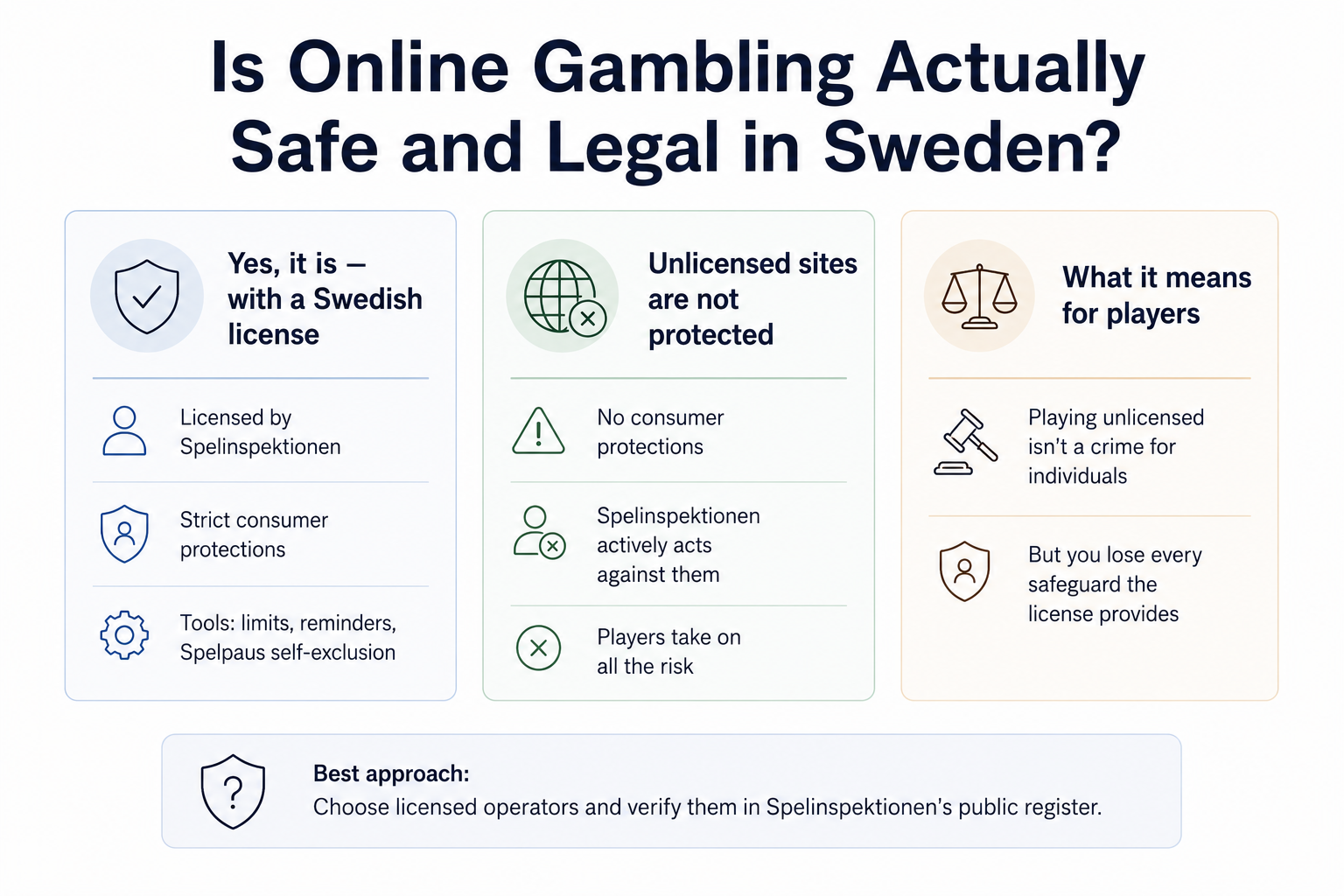
Yes — and this is worth repeating because so much confusion around this topic conflates “casino” with “land-based casino.” Online casino platforms that hold a Spelinspektionen license operate under strict consumer protection standards, including mandatory responsible gambling tools, deposit limits options, and participation in the Spelpaus self-exclusion system.
Unlicensed sites are a different matter entirely. They might still accept Swedish players, but they fall outside consumer protections, and Spelinspektionen actively works to identify and act against them. Playing on an unlicensed platform isn’t necessarily going to land an individual player in legal trouble, but it does strip away every safeguard the licensing system is designed to provide.
The safest approach is straightforward: stick to operators that display a valid Swedish license, and check Spelinspektionen’s public register if there’s any doubt.
FAQ
Is it illegal to gamble in Sweden?
No. Gambling itself is legal in Sweden across multiple formats, including online casinos, sports betting, lotteries, horse racing, and charitable bingo. What changed is that full-scale land-based casinos became illegal to operate starting January 1, 2026.
Can Swedes still play at a physical casino?
Not within Sweden. Full-scale land-based casinos, including the former Casino Cosmopol venues, are no longer permitted. Anyone wanting a traditional in-person casino experience would need to travel to a country that still licenses them.
Are online casinos legal in Sweden in 2026?
Yes, as long as the operator holds a valid license from Spelinspektionen. Unlicensed international sites accepting Swedish players operate outside the regulated system and don’t carry the same consumer protections.
What happened to Casino Cosmopol?
Casino Cosmopol was Sweden’s state-owned land-based casino brand, with venues in Sundsvall, Malmö, Gothenburg, and Stockholm. The new legislation ending full-scale land-based casinos applies even to this former state operator, effectively ending that model.
What is the Swedish Gambling Authority?
Spelinspektionen is Sweden’s state administrative body responsible for regulating gambling and lotteries. It issues licenses, monitors compliance, and enforces action against unlicensed or illegal gambling operators.
Why did Sweden ban land-based casinos?
Regulators pointed to declining visitor numbers, the resource cost of overseeing physical venues relative to their market size, and a broader push to channel gambling activity toward licensed, trackable formats – most of which had already moved online anyway.
Is sports betting still legal in Sweden?
Yes. Sports betting remains fully legal in Sweden provided it’s offered by an operator licensed under the Gambling Act (2018:1138).
The Bottom Line
So, is the casino legal in Sweden? Legally licensed online casinos are still very much part of the picture. The traditional, walk-in casino floor, though, is a thing of the past as of January 1, 2026 — a genuinely historic shift that makes Sweden the first EU country to eliminate that format entirely.
For anyone gambling in Sweden today, the practical advice hasn’t really changed: play with licensed operators, use tools like Spelpaus if needed, and treat any site without a Spelinspektionen license as a red flag rather than a shortcut. Check Spelinspektionen’s official register directly for the most current list of licensed operators before signing up anywhere.
Related Articles

September 3, 2026Is the Casino Legal in Denmark? 2026 Guide

September 3, 2026Is the Casino Legal in Angola? What the 2026...