 Nothing found for the request

Is the Casino Legal in Thailand? 2026 Law Explained
Sologe September 3, 2026
Share:


Quick Summary
As of September 2026, casinos remain illegal in Thailand under the Gambling Act of 1935, with only state-controlled horse racing, the government lottery, and limited sports betting permitted. A long-debated Entertainment Complex Bill would legalize casino resorts, but it stalled after cabinet approval and has not been passed into law, so no licensed casino currently operates on Thai soil.
Ask around Bangkok and someone will inevitably mention an underground poker den or a friend-of-a-friend who bets on football through a Line app. That’s not surprising in a country where gambling sits in a strange gray zone — technically banned almost everywhere, yet clearly happening anyway. So when travelers or investors ask whether a casino is legal in Thailand, the honest answer requires a bit of unpacking.
The short answer? No, not yet. Casinos are still illegal under Thai law. But the country has spent the last couple of years inching toward a major policy shift, and understanding where things stand now means separating old law from pending legislation.
The Legal Baseline: Thailand’s Gambling Act of 1935
Thailand’s gambling framework traces back to the Gambling Act B.E. 2478, passed in 1935. That law prohibits nearly all forms of betting, wagering, or games of chance involving money or goods, with only a narrow set of carve-outs written into the statute or added later by royal decree.
Two activities have long stood as the exceptions: horse racing at licensed tracks and the government-run Thai lottery. Both are state-controlled, heavily regulated, and generate meaningful tax revenue, which is part of why they’ve survived nearly a century of otherwise strict prohibition. A small number of sports betting pools, tied to specific events, also get occasional government sign-off, but this remains limited and tightly monitored rather than a general legalization of sports wagering.
Everything else — slot machines, table games, private card games for money, underground lottery numbers, and online betting sites — falls outside the law. Enforcement varies by location and political climate, but the legal exposure is real, and it applies to both operators and, in many cases, players.
So Why Do Casinos Seem to Exist in Thailand Anyway?
Visitors sometimes report seeing casino-style venues, particularly near border towns with Myanmar, Cambodia, and Laos. These aren’t Thai-licensed establishments — they’re typically located just across the border, in jurisdictions like Poipet or Myawaddy, where casino gambling is legal and Thai patrons cross over specifically to play.
Underground gambling dens do exist within Thailand itself, often tied to organized crime networks, and periodic police raids make local news. These operations are illegal, unregulated, and offer no consumer protection whatsoever. Anyone assuming that a physical gambling venue inside Thailand is government-sanctioned would be mistaken; if it’s not horse racing or the lottery, it almost certainly isn’t legal.
The Entertainment Complex Bill: Where Casino Legalization Actually Stands
Here’s where it gets interesting. Thailand’s government has floated the idea of legal, integrated casino resorts for years, largely as a tool to boost tourism revenue and compete with regional hubs like Singapore and Macau. The vehicle for this is the so-called Entertainment Complex Bill.
The draft law would permit large-scale entertainment complexes — hotels, convention space, retail, and entertainment venues — with a casino component making up a small percentage of the total floor area. Thai citizens would face age restrictions and, under earlier drafts, financial eligibility checks before being allowed to gamble, while foreign visitors would generally have freer access.
The draft bill received cabinet approval in early 2025, but after public and political opposition, the Thai Cabinet officially withdrew the Entertainment Complex Act from parliamentary consideration in July 2025. Subsequent deliberations were delayed, though discussions around reviving the framework continued into 2026.
Because Thai parliamentary rules generally require pending bills to be reintroduced within a set window after a new government forms, the bill’s fate is tied directly to political stability. Anyone tracking this closely should check current Thai government or Ministry of Finance announcements rather than relying on older news, since the timeline has already shifted multiple times.
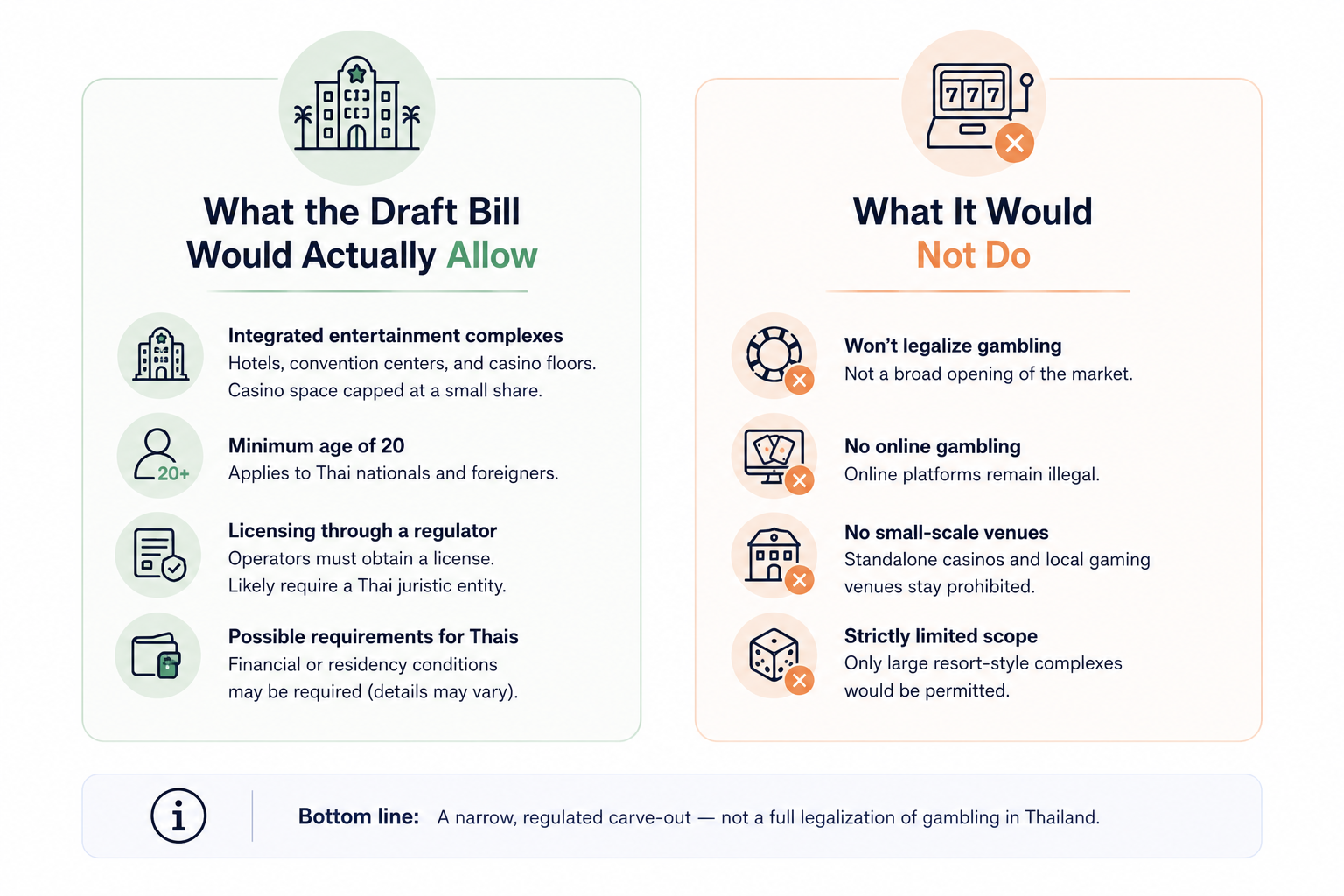
What the Draft Bill Would Actually Allow
- Integrated entertainment complexes combining hotels, convention centers, and casino floors, with the casino portion capped at a small share of total space.
- A minimum age of 20 for entry, applying to both Thai nationals and foreigners.
- Licensing through a regulatory body overseeing operators, likely requiring registration as a Thai juristic entity.
- Possible financial or residency requirements for Thai citizens wishing to gamble, though these details have shifted across drafts.
What It Would Not Do
The bill wouldn’t legalize gambling broadly across Thailand. Standalone casinos, online gambling platforms, and small-scale gaming venues outside the approved entertainment complex framework would remain illegal. This is a targeted carve-out for large resort-style developments, not a general opening of the gambling market.
Comparing Thailand’s Current Rules to Regional Neighbors
Thailand’s caution looks different when placed next to its neighbors, several of which built entire tourism strategies around legal gambling.
Country | Casino Legal Status | Notes |
|---|---|---|
Thailand | Illegal (pending reform) | Only lottery, horse racing, limited sports betting allowed under current law |
Singapore | Legal | Two licensed integrated resorts, entry restrictions for locals |
Cambodia | Legal | Numerous casinos, many catering to cross-border Thai visitors |
Philippines | Legal | Regulated by a state gaming authority, large resort casino sector |
Vietnam | Legal for foreigners only | Citizens generally barred except in pilot programs |
That table tells its own story. Thailand is something of an outlier in Southeast Asia’s gambling landscape, and the pressure to capture tourism dollars currently flowing to Cambodia and Singapore is a big part of why the Entertainment Complex Bill keeps resurfacing despite political setbacks.

Bring Your iGaming Product to the Right Buyers
Sologe gives gaming vendors a place to showcase products across software, platforms, payments, sports betting, equipment, traffic, and other iGaming categories. It gives your offer a place where people are already browsing gaming products and services.
Ready to Add Your Offer?
Sologe lets you:
- list your product in a relevant gaming category
- show buyers clearly what your solution offers
- keep your product visible in an industry-specific marketplace
👉Get in touch with Sologe to start your listing.
What This Means for Tourists Right Now
Anyone visiting Thailand today should assume there are no legal, licensed casinos operating inside the country. Betting on horse races at approved tracks and buying official lottery tickets are the only fully legal wagering options for now.
Online gambling sites marketed toward Thai users, including many offshore sportsbooks and casino platforms, operate in a legal gray area at best. Thai authorities have, at various points, blocked access to specific sites and pursued cases against operators and, occasionally, players. Using such platforms carries real legal risk, even if enforcement isn’t consistent.
For anyone genuinely wanting a casino experience nearby, the legal route remains crossing into a neighboring country where gambling is licensed and regulated, rather than seeking out unlicensed venues within Thailand.
Penalties for Illegal Gambling in Thailand
Thai law does not treat illegal gambling as a minor infraction. Penalties can include fines and potential jail time for operators of unlicensed gambling venues, and players caught in raids have faced fines as well, though enforcement against individual tourists tends to be inconsistent and situational.
Foreign nationals face an added complication: a gambling-related arrest can trigger visa and immigration consequences well beyond the immediate fine. That risk alone makes it worth steering clear of underground gambling operations, no matter how normalized they might seem locally.
Why Legalization Keeps Stalling
A few recurring forces explain the bill’s rocky path. Buddhist civil society groups and some public health advocates have voiced concern about problem gambling and social harm, arguing that legal casinos would normalize an activity Thai culture has long treated with suspicion. Political coalitions have also been fragile, and any bill this significant tends to get shelved when governments face more urgent priorities or risk losing coalition partners over it.
There’s also a practical debate about who actually benefits. Some officials favor a model where foreign tourists provide most of the casino revenue while Thai citizens face strict access limits, precisely to blunt criticism about domestic social harm. Whether that compromise holds if the bill eventually passes remains an open question.
FAQ: Casinos and Gambling Law in Thailand
Is it illegal to gamble in Thailand as a tourist?
Yes, in most cases. Only the government lottery, licensed horse racing, and certain limited sports betting are legal. Casino games, whether online or in unlicensed venues, are not legal for tourists or locals.
Are there any real casinos operating inside Thailand right now?
No licensed casinos currently operate in Thailand. Any casino-style venue found domestically is unregulated and illegal; legitimate casinos exist only just across the border in countries like Cambodia.
Has Thailand legalized casinos yet in 2026?
Not as of September 2026. The Entertainment Complex Bill, which would permit casino resorts, received cabinet approval but has stalled in the legislative process amid political and coalition instability.
Can Thai citizens gamble at a casino if the bill eventually passes?
Under earlier drafts, yes, but with restrictions including a minimum age of 20 and potentially financial eligibility checks. Details could still change before any final law passes, so it’s worth checking official government sources for the latest version.
What happens if someone is caught gambling illegally in Thailand?
Penalties can include fines and, for operators particularly, jail time. Foreign nationals also risk visa or immigration complications on top of any direct legal penalty.
Why hasn’t Thailand legalized casinos already, given the tourism potential?
Opposition from religious and civil society groups, concerns about problem gambling, and repeated political instability have all slowed the bill’s progress, despite clear economic incentives tied to competing with regional gambling hubs.
Is online gambling legal in Thailand?
No. Online casino and sports betting platforms fall outside the legal exceptions carved out for the lottery and horse racing, and Thai authorities have blocked access to some sites and pursued enforcement in certain cases.
The Bottom Line
Casinos are not legal in Thailand today, full stop. The country’s gambling framework, rooted in a 1935 law, still limits legal wagering to the state lottery, horse racing, and a handful of sanctioned sports betting pools. The Entertainment Complex Bill could change that picture, but it’s been stuck in political limbo for well over a year, and nobody can say with certainty when — or if — it clears Parliament.
Anyone planning a trip or considering an investment tied to Thailand’s gambling market should treat this as a moving target. Check official government and Ministry of Finance sources before making decisions, and steer clear of unlicensed venues or gray-market betting sites regardless of how common they seem on the ground. The legal landscape here can shift quickly once political conditions align — it’s just not there yet.
Related Articles

September 29, 2026Is the Casino Legal in Japan? The Real Answer...

September 29, 2026Is the Casino Legal in Gambia? What the Law...