 Nothing found for the request
Is the Casino Legal in China? The Real Rules for 2026
Sologe September 29, 2026
Share:


Quick Summary
Casino gambling is illegal across mainland China, banned since the Communist Party took power in 1949, but Macau, a special administrative region, has operated legal casinos since 1847 and remains the only place under Chinese sovereignty where gambling is fully legal. Hong Kong permits narrow exceptions like horse racing and the Mark Six lottery, while online gambling is banned everywhere in the country, including Macau.
Short answer: it depends entirely on which “China” is being asked about. Walk into a casino in Shanghai or Beijing and you’re breaking the law, full stop. Walk into one in Macau, an hour’s ferry ride from Hong Kong, and you’re standing in what’s become the biggest gambling hub on the planet. Same country, wildly different rules.
That contradiction confuses a lot of travelers, and honestly, it trips up plenty of longtime residents too. The People’s Republic of China operates under a “one country, two systems” arrangement, which means Macau and Hong Kong keep legal frameworks that look nothing like the mainland’s. Here’s how the actual legal landscape breaks down, region by region, and why it’s stayed this way for decades.
Casinos in Mainland China: A Flat Ban
Gambling has been illegal across mainland China since 1949, when the Communist Party took power and outlawed the casinos, lottery halls, and betting parlors that had operated fairly openly beforehand. The ban isn’t a gray area or a loosely enforced formality — it’s written into national law, and it covers pretty much every form of wagering for money, from card games in private rooms to sports betting rings.
Enforcement varies by region and by how visible the activity is. Mahjong played for small stakes among friends rarely draws police attention, but organized gambling operations, whether run out of a warehouse or hosted online, get treated as serious criminal offenses. Penalties can include fines, confiscation of winnings, and jail time for operators.
State-run lotteries are the one carve-out. China Welfare Lottery and China Sports Lottery are both legal, government-operated, and marketed as ways to fund public programs rather than as gambling in the traditional sense. That distinction matters a lot in how Beijing frames the policy: state lotteries generate revenue for social causes, while casino-style gambling is framed as exploitative and socially corrosive.
Macau: China’s Only Legal Casino Territory
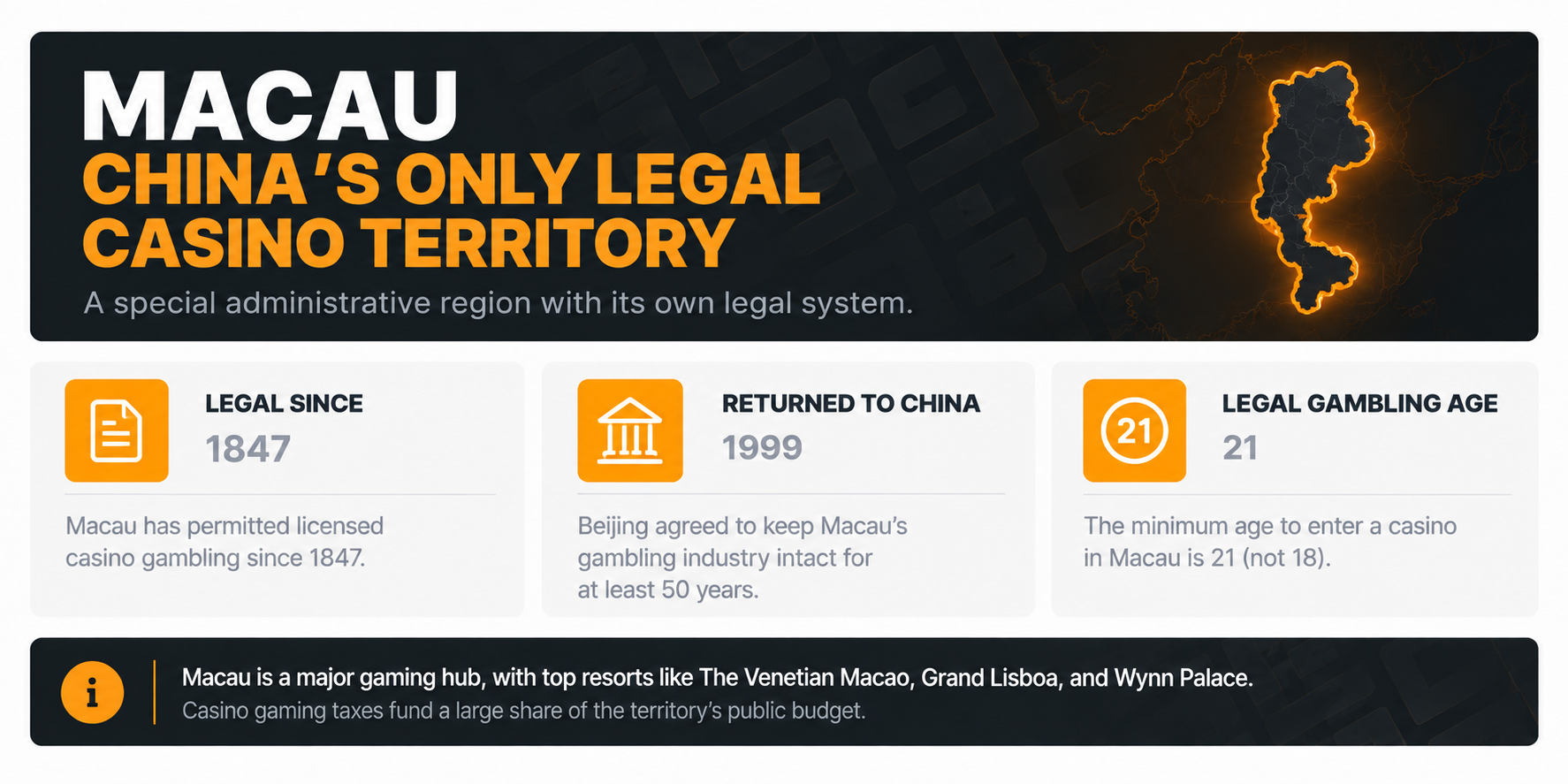
Macau is the exception that swallows the rule. As a special administrative region of China, it’s allowed to keep its own legal system under the same arrangement that governs Hong Kong, and that system has permitted licensed casino gambling since 1847, long before the Communist Party ever came to power. When Portugal handed sovereignty back to China in 1999, Beijing agreed to leave Macau’s gambling industry intact for at least fifty years.
The result is a city that now dwarfs Las Vegas in gaming revenue most years. The Venetian Macao, Grand Lisboa, and Wynn Palace anchor a strip that draws visitors from across mainland China, Hong Kong, and increasingly Southeast Asia. Casino gaming taxes fund a huge share of Macau’s public budget, which is part of why the territory has been so reluctant to loosen its monopoly-style licensing system even as competition from Singapore and the Philippines has grown.
One rule catches a lot of visitors off guard: the legal gambling age inside a Macau casino is 21, not 18. Macau raised the minimum age from 18 in recent years specifically to curb underage and problem gambling among residents, and the rule applies to everyone stepping onto a casino floor — locals, mainland tourists, and foreign visitors alike.
Getting There From the Mainland
Mainland Chinese citizens can legally visit Macau’s casinos, but Beijing keeps tight control over how much money makes the trip with them. Currency export rules cap how much cash residents can carry out of the mainland, and banks monitor large transfers tied to gambling activity closely. It’s a deliberate friction point — Macau’s casinos are legal, but the mainland government doesn’t make it effortless for its own citizens to fund a gambling habit there.
Hong Kong: Legal, But Very Limited
Hong Kong sits somewhere in between. There are no casinos here at all — none are licensed, and opening one would violate the territory’s Gambling Ordinance. But a handful of gambling activities are legal and tightly regulated, all of them run through a single operator, the Hong Kong Jockey Club.
- Horse racing betting at tracks including Happy Valley and Sha Tin
- The Mark Six lottery, drawn several times a week
- Licensed football betting on major overseas leagues and tournaments
Everything outside that short list — private poker games for money, underground betting shops, casino-style gaming — is illegal, and Hong Kong police do run periodic crackdowns on illegal gambling dens, particularly around major sporting events like the World Cup.
Comparing the Three Systems
Region | Casinos Legal? | Legal Gambling Options | Minimum Age |
|---|---|---|---|
Mainland China | No | State lotteries only | 18 (lottery) |
Macau | Yes | Casinos, slot parlors, some sports betting | 21 (casino floor) |
Hong Kong | No | Horse racing, football betting, Mark Six lottery | 18 |

Get Your iGaming Offer Seen with Sologe
At Sologe, we provide a focused marketplace where iGaming vendors can present software, platforms, payment solutions, sports betting products, equipment, services, and other industry solutions. We help make your offer easier to discover for people already comparing suppliers and products across the iGaming industry.
Want More Relevant Buyers to Find Your Business?
With Sologe, you can:
- add your product or service to an iGaming-specific marketplace
- place your offer in the most relevant category
- make your company easier to discover during vendor research
- give potential partners a simple way to learn more about what you offer
👉 Get in touch with us to list your offer on Sologe.
Why Does Beijing Allow Macau But Ban the Mainland?
This is the question that trips up most people, and the answer is really about legal continuity rather than ideology. When Beijing negotiated the return of Macau and Hong Kong, it promised both territories they could keep their existing economic systems largely unchanged for fifty years under the “one country, two systems” model. Ripping out Macau’s casino industry would have broken that promise and devastated the territory’s economy overnight, since gaming revenue funds a huge portion of public spending there.
There’s also a practical containment argument. Keeping legal gambling walled off inside Macau gives Beijing a controlled outlet — mainland citizens who want to gamble can travel there, spend money, and go home, all while the activity stays outside mainland jurisdiction and doesn’t normalize casinos as an everyday feature of Chinese cities. Extending that model to Shanghai or Guangzhou would be a very different political calculation, and there’s no indication it’s coming anytime soon.
Online Gambling: Banned Everywhere, Including Macau
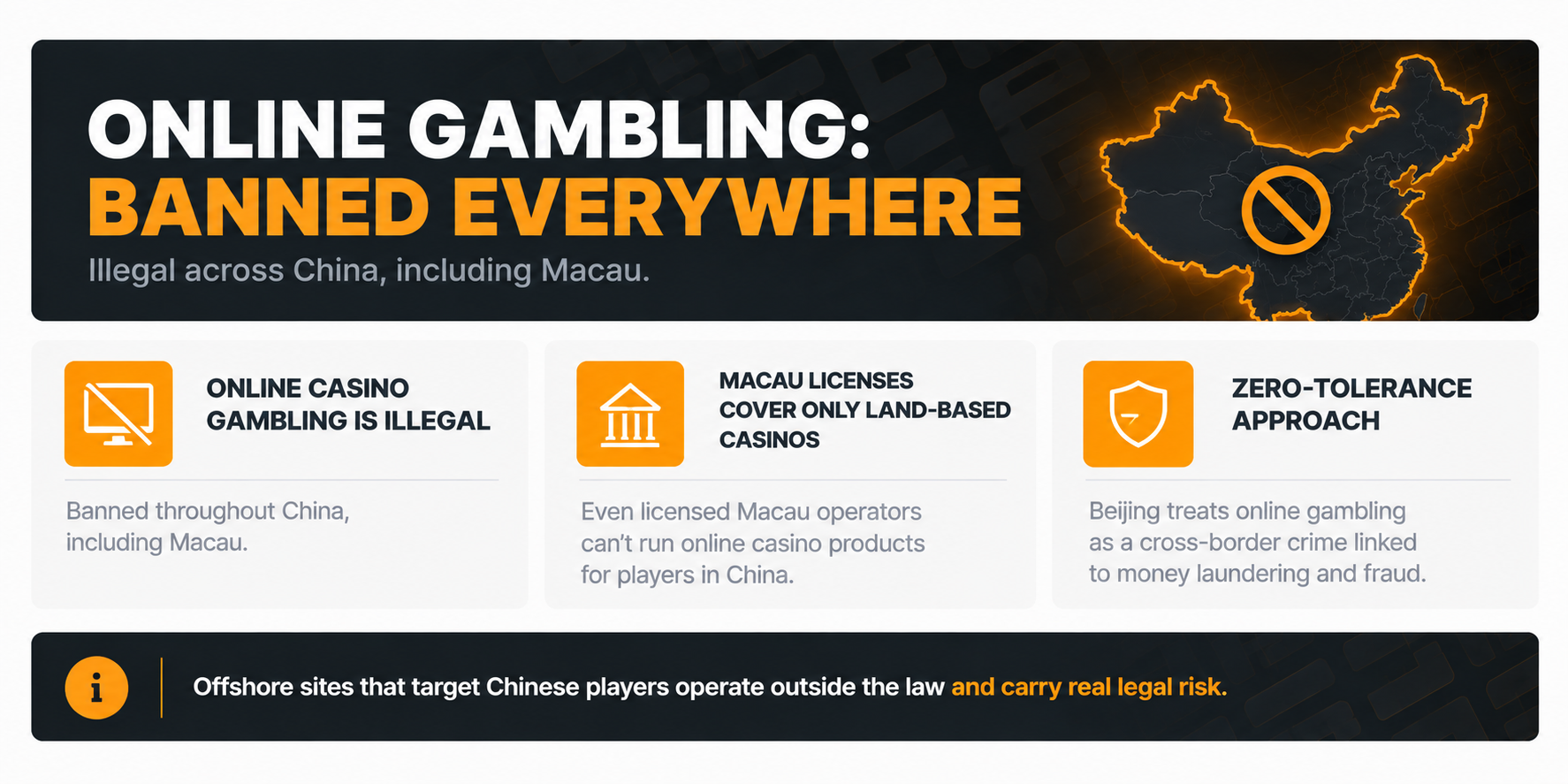
Here’s a detail that surprises a lot of people: online casino gambling is illegal throughout the entire country, and that includes Macau. Macau’s gaming law permits brick-and-mortar casinos, not internet-based betting platforms, so even licensed Macau operators can’t legally run online casino products aimed at players inside China.
Beijing has taken what amounts to a zero-tolerance stance toward online gambling generally, treating it as a cross-border crime issue tied to money laundering and organized fraud rather than a simple regulatory gap. Offshore sites that target Chinese players get blocked at the network level where possible, and authorities have pursued payment processors and marketing affiliates linked to illegal online betting operations. Anyone in mainland China considering an offshore gambling site should assume it’s operating outside the law and carries real legal risk, not just a technical inconvenience.
What Happens If You’re Caught Gambling Illegally?
Penalties in mainland China scale with the scope of the activity. In practice, consequences may include:
- Warnings or administrative fines for relatively minor gambling activity, depending on the circumstances.
- Larger fines and asset seizure when authorities determine that someone helped organize or profit from illegal gambling.
- Criminal prosecution and prison sentences for people who run gambling rings, facilitate large-scale betting, or operate illegal gambling businesses online or offline.
- Deportation for foreign nationals in addition to any applicable criminal or administrative penalties.
- Cross-border enforcement pressure where gambling operations based overseas specifically target mainland Chinese customers or involve mainland citizens in organizing the activity.
It’s worth remembering that Chinese law can also reach beyond the country’s borders in certain circumstances. That’s one reason cross-border online gambling operators targeting Chinese players have faced increasing scrutiny even when their platforms are technically based overseas.
Frequently Asked Questions
Is it legal for tourists to gamble in mainland China?
No. The ban applies to everyone physically present in mainland China, tourists included. There’s no carve-out for foreign visitors – casinos simply don’t exist there legally, and participating in underground gambling as a tourist carries the same legal risk as it does for residents.
Can mainland Chinese citizens legally visit Macau’s casinos?
Yes. Mainland residents can travel to Macau and gamble legally once they’re there, subject to travel permit rules and currency export limits that restrict how much cash they can carry across the border. Macau’s gambling laws don’t distinguish between mainland visitors and anyone else on the casino floor.
What’s the minimum age to gamble in a Macau casino?
Twenty-one. Macau raised its casino entry age from 18 to 21 as part of an effort to reduce problem gambling, and the rule applies uniformly to residents, mainland visitors, and international tourists.
Does Hong Kong have any casinos?
No, Hong Kong has never licensed casinos. Legal gambling there is limited to horse racing, football betting, and the Mark Six lottery, all operated exclusively through the Hong Kong Jockey Club under strict government regulation.
Is online gambling legal anywhere in China, including Macau?
No. Online casino gambling is illegal across all of China, and that restriction extends to Macau despite its legal land-based casinos. Macau’s licenses cover physical casino operations only, not internet betting platforms.
Why does China allow gambling in Macau but not on the mainland?
Macau’s casino industry predates Communist rule by nearly a century and was protected under the terms of its 1999 handover from Portugal to China. Beijing agreed to preserve Macau’s existing legal and economic systems, casinos included, rather than force mainland law onto the territory.
Are private card games for money illegal in China?
Technically yes, though enforcement in practice varies widely. Small-stakes games among friends rarely attract police attention, but organized or large-scale private gambling can still lead to fines or, in more serious cases, criminal charges.
The Bottom Line
So, is the casino legal in China? In the mainland, no — it’s been off-limits since 1949 and there’s little sign that’s changing. In Macau, casinos aren’t just legal, they’re the backbone of the entire territory’s economy. Hong Kong lands somewhere in the middle, permitting a narrow slice of regulated betting while keeping casinos out entirely.
Anyone planning a trip that involves gambling in the region should treat Macau as the destination, double-check the current entry age and currency rules before traveling, and steer well clear of online gambling platforms regardless of which part of China they’re in. The laws aren’t likely to blur together anytime soon — and betting on that happening would be, fittingly, a losing wager.
Related Articles

September 29, 2026Is Sports Betting Legal in Kazakhstan? The...

September 29, 2026Is Sports Betting Legal in Mexico? The...