 Nothing found for the request
Is Sports Betting Legal in Kazakhstan? The 2026 Answer
Sologe September 29, 2026
Share:


Quick Summary
Yes, sports betting is legal in Kazakhstan for players aged 21 and over, but only through operators licensed by the Ministry of Tourism and Sports and connected to the state’s Unified Betting Account Center. Online casino games, poker, and slots remain banned outside licensed land-based venues, and licensed bookmakers withhold 10% tax on net betting winnings (payout minus stake). Unlicensed offshore bookmakers are illegal, even though many Kazakhstani players still use them.
Short answer first: betting on sports is legal in Kazakhstan. Online casinos are not. That split is the single most confusing part of Kazakhstani gambling law, and it’s the reason so many searches land on conflicting information.
The Republic of Kazakhstan has run a licensed gambling market since 2007, but the rules around what’s allowed online versus offline have shifted several times since then — most recently with amendments signed in mid-2024 that tightened enforcement even further. This guide breaks down exactly what’s permitted, who regulates it, what it costs bettors, and how the market is likely to evolve.
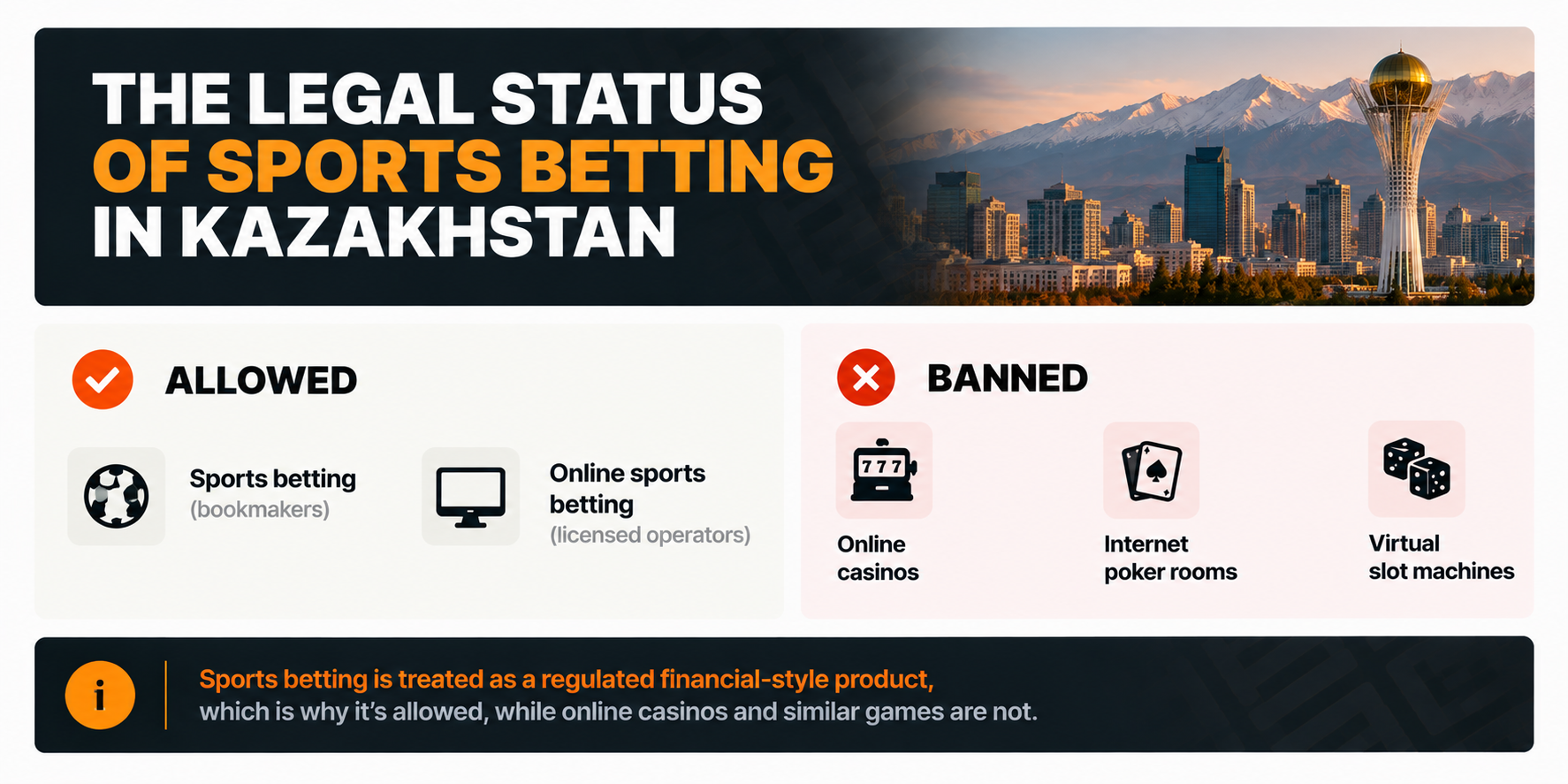
The Legal Status of Sports Betting in Kazakhstan
Kazakhstan’s gambling framework traces back to a law signed on January 12, 2007, which laid the legal foundations for organizing and conducting gambling business in the country. That statute authorized four categories of activity: casinos, slot-machine halls, bookmakers (totalizators included), and — critically — it left the door open for licensed sports betting operators to eventually go digital.
Here’s the thing though — the same law explicitly bans online casinos, internet poker rooms, and virtual slot machines. Sports betting got carved out as an exception because it was treated more like a regulated financial-style product than a casino game. So while a Kazakhstani resident can’t legally spin a slot online, they can place a bet on a football match through a licensed bookmaker’s website or app.
That distinction is why competitor guides sometimes contradict each other: some focus on the “gambling is legal” headline, others focus on the “online casino is banned” detail. Both are true at the same time.
Who Regulates Betting in Kazakhstan?
Oversight sits with the Ministry of Tourism and Sports of the Republic of Kazakhstan, which keeps the official register of licensed operators and tracks unlicensed or foreign bookmakers operating without authorization. The ministry publishes which companies hold valid licenses, and it works with banks and payment institutions to cut off financial transactions tied to offshore, unlicensed sites.
Since 2023–2024, the country has been rolling out a more centralized enforcement structure. Every licensed bookmaker must route bets through the Unified Betting Account Center (sometimes referenced as a unified accounting system), a mandatory clearing hub that verifies wagers and helps tax authorities track turnover in real time. Amendments signed by President Kassym-Jomart Tokayev in July 2024 gave the ministry stronger tools to flag foreign bookmakers and force banks to block payments to them — a move aimed squarely at the gray market that still dominates a lot of everyday betting activity in the country.
Licensed Operators vs. Offshore Bookmakers
On paper, any bookmaker taking bets from Kazakhstani residents without a local license is operating illegally. In practice, plenty of international betting brands remain popular with Kazakhstani bettors despite lacking that license — a gray zone that regulators are actively trying to close rather than one that’s been resolved.
Enforcement has escalated. Reports over the past couple of years describe thousands of unlicensed gambling websites identified and restricted, alongside criminal penalties — including possible prison time — for operators who keep running unlicensed books after being flagged. That’s a meaningfully harder line than the country took a decade ago.
Feature | Licensed Kazakhstani Operator | Offshore/Unlicensed Bookmaker |
|---|---|---|
Legal status | Fully legal, ministry-approved | Illegal under Kazakhstani law |
Tax handling | Withholds 10% tax on net winnings automatically | No tax withholding, player liable |
Payment access | Domestic bank transfers, e-wallets | Increasingly blocked by banks |
Dispute protection | Regulated complaint process | Little to no recourse |
Product scope | Sports betting only, no online casino | Often bundles casino + betting |

Get Your Sports Betting Offer Seen with Sologe
AtSologe, we provide a marketplace where sports betting and iGaming vendors can present platforms, software, payment solutions, services, and other industry products. If Kazakhstan is a market you are researching, we can help you make your offer more visible to buyers already searching for relevant suppliers.
Want More Relevant Buyers to Find Your Business?
With Sologe, you can:
- add your product or service to an industry-specific marketplace
- choose the category that fits your offer best
- make your business easier to discover during vendor research
- give potential partners a straightforward way to learn more about what you provide
👉Get in touch with us to list your offer on Sologe.
Taxes on Betting Winnings
Kazakhstan taxes net gambling winnings at 10% (payout minus stake) for residents, and licensed operators are required to withhold that amount before crediting a player’s account — similar to how income tax works on wages. Bettors using licensed platforms don’t need to separately file or calculate this; the operator handles it automatically. Operators themselves also carry corporate-level tax obligations, including corporate income tax, VAT, and fixed monthly levies tied to each betting counter or gaming table they run, though exact rates and thresholds are best confirmed on the Ministry of Tourism and Sports’ official guidance since these figures get adjusted periodically.
Bettors who use unlicensed offshore sites don’t get that automatic withholding — which sounds convenient until it isn’t. Winnings from unlicensed platforms still create a tax obligation under Kazakhstani law, and there’s no built-in dispute mechanism if a payout gets delayed or denied.
Age Limits and Player Protections
Minimum Gambling Age
The legal age for gambling and sports betting in Kazakhstan is 21, higher than the 18-year threshold common in much of Europe. Licensed operators are required to verify a player’s identity and age before allowing them to fund an account or place a bet.
Identity and Age Verification
These checks are designed to prevent underage gambling and make it harder to create accounts using false or borrowed personal information. For licensed platforms, verification is now a standard part of account registration and payment processing.
Stronger Player-Protection Rules
Kazakhstan has also been expanding its player-protection infrastructure as part of the 2023–2024 reform wave. Measures include broader self-exclusion mechanisms, tighter advertising restrictions, and stricter rules around promotional bonuses.
That kind of framework barely existed in a meaningful form a decade ago. Its expansion suggests that problem gambling is now being treated as a genuine policy issue rather than simply a side effect of a regulated gambling market.
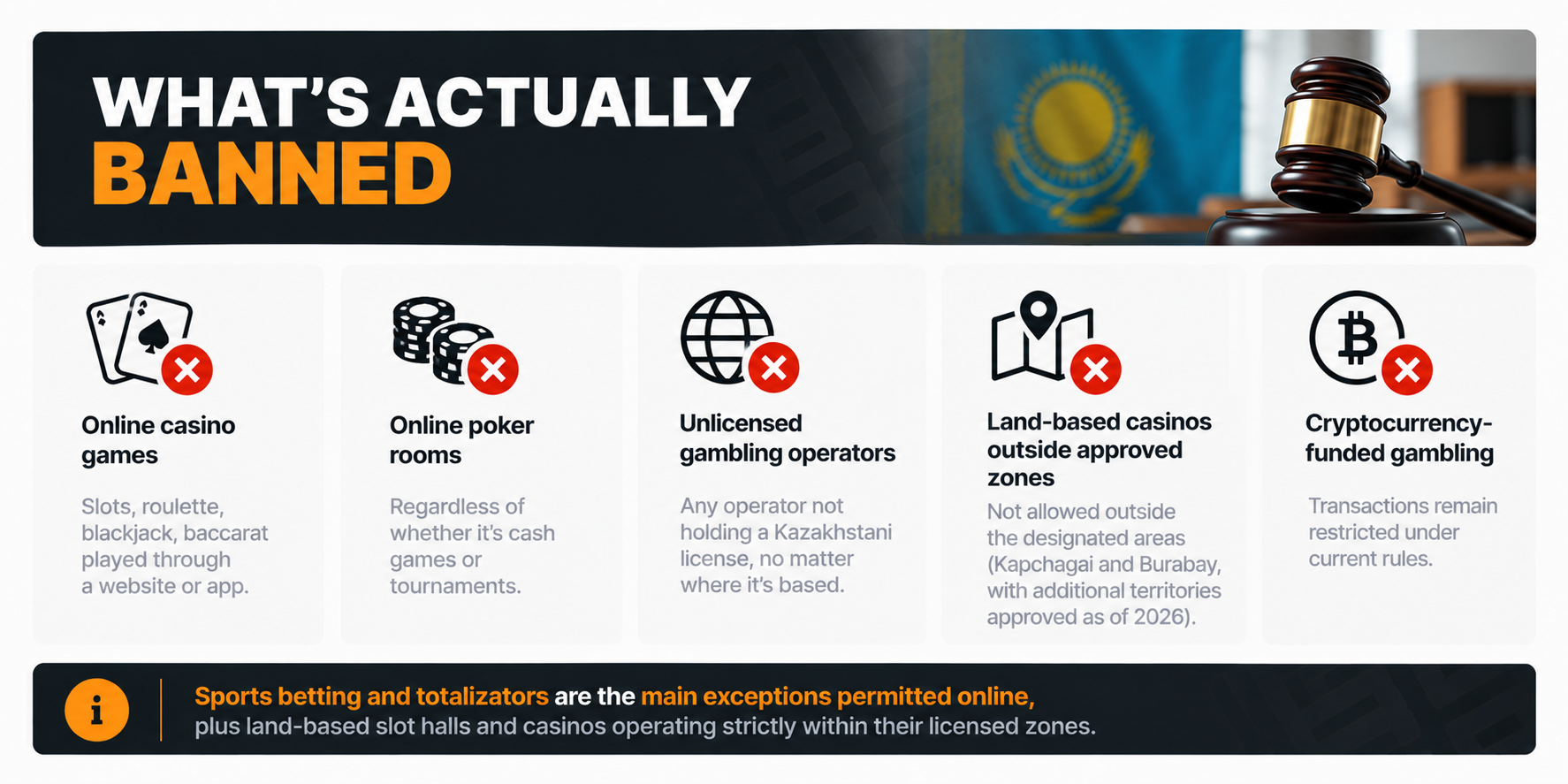
What’s Actually Banned
- Online casino games — slots, roulette, blackjack, baccarat played through a website or app
- Online poker rooms, whether cash games or tournaments
- Any gambling operator not holding a Kazakhstani license, regardless of where it’s based
- Land-based casinos outside the two officially designated gaming zones (Kapchagai and Burabay), a restriction dating back to the mid-2000s push to concentrate casinos away from major cities; as of September 2026, additional territories were approved, some of them limited to foreign visitors.
- Cryptocurrency-funded gambling transactions, which remain restricted under current rules
Sports betting and totalizators are the main exceptions permitted online, plus land-based slot halls and casinos operating strictly within their licensed zones.
How the Market Has Changed Since 2007
It’s easy to treat gambling law as static, but Kazakhstan’s has been anything but. The original 2007 statute set the baseline — casinos in two zones, licensed bookmakers, no online casino. For years afterward, enforcement was relatively loose, and a handful of operators built large followings, including one operator whose long-running dominance in the local betting market eventually drew heavy tax scrutiny and legal action from authorities.
The 2023–2024 reform cycle changed the tone. A specialized regulator structure, the Unified Betting Account Center, mandatory bank-level blocking of unlicensed operators, and criminal penalties for repeat offenders all point toward a government trying to formalize a market that had been operating half in the shadows for years. By the end of 2024, the country reportedly held around two dozen active licenses for gambling-related activities — a small, tightly controlled field compared to open markets elsewhere..
Choosing a Licensed Betting Site
Before signing up anywhere, it’s worth checking a few things. Does the operator appear on the Ministry of Tourism and Sports’ published register? Is the site processing payments through domestic banking channels rather than routing around them? Does it clearly display responsible-gambling tools like deposit limits and self-exclusion options?
None of that guarantees a great betting experience, but skipping it increases the odds of running into a frozen account, a blocked bank transfer, or worse — a platform that vanishes with a balance still on it. Always confirm current licensing status directly through official government channels rather than relying on a betting site’s own claims, since license rosters do change.
FAQ: Sports Betting in Kazakhstan
Is it legal to bet on sports online in Kazakhstan?
Yes. Online sports betting is legal when placed through an operator licensed by the Ministry of Tourism and Sports. Betting through unlicensed foreign sites is not legal, even if enforcement against individual bettors is inconsistent.
Is online casino gambling legal in Kazakhstan?
No. Online casino games, including slots, roulette, and table games, are explicitly banned under the 2007 gambling law and its subsequent amendments. Only land-based casinos in designated zones can legally offer these games.
What’s the minimum age to bet in Kazakhstan?
21 years old. This applies to both online sports betting and land-based gambling activities, and licensed operators must verify age before allowing deposits or wagers.
How much tax do bettors pay on winnings?
Winnings are taxed at 10% of the net gain (payout minus stake), and licensed operators withhold this amount automatically before paying out. Bettors using licensed platforms typically don’t need to file anything extra for this specific tax.
Can Kazakhstani players use foreign betting sites?
Legally, no – unlicensed foreign bookmakers are not authorized to accept bets from Kazakhstani residents, and banks are increasingly required to block payments to them. Plenty of players still do it, but the legal and financial risk sits entirely with the bettor.
Who enforces gambling law in Kazakhstan?
The Ministry of Tourism and Sports oversees licensing and enforcement, working alongside banks and payment providers to restrict unlicensed operators and, since 2024, with expanded criminal penalties for repeat violations.
Is cryptocurrency accepted for betting deposits?
Generally, no. Crypto-based gambling transactions remain restricted under current Kazakhstani regulation, so licensed operators stick to domestic banking and standard e-wallet options.
The Bottom Line
Sports betting in Kazakhstan sits in a clearer legal position than most former Soviet-bloc markets: it’s permitted, taxed, and actively regulated, not just tolerated. Online casino gambling is the part that stays firmly off-limits, and that’s unlikely to change soon given the direction of recent reforms.
Anyone placing bets from within Kazakhstan should stick to operators that show up on the official licensed register, expect a 10% withholding on winnings, and treat any site promising unrestricted online casino access with real suspicion. The regulatory trend over the past two years points toward tighter enforcement, not looser rules — so betting through the right channel matters more now than it did five years ago. Check the Ministry of Tourism and Sports’ current published list before depositing anywhere.
Related Articles

September 29, 2026Is Sports Betting Legal in Mexico? The...

September 29, 2026Is Sports Betting Legal in Chile? The 2026 Answer