 Nothing found for the request

Casino Gaming Market 2026: Size, Growth & Trends
Sologe March 27, 2026
Share:


Market Size and Growth Projections
The global casino gaming market is expanding across multiple fronts. While North America leads with the largest market share captured in 2023, other regions are accelerating their growth trajectories.
Online gambling specifically shows even more aggressive expansion. The global online gambling market was valued at $78.66 billion in 2024 and is projected to reach $153.57 billion by 2030, growing at an 11.9% CAGR from 2025 to 2030.
That’s nearly doubling in six years.
For the broader casino gaming market, analysts project market opportunities of $26.92 billion expanding to $45.9 billion during the 2024-2029 forecast period, with a 3.3% CAGR driving that acceleration.
Market Segment | Base Year Value | Forecast Year | Projected Value | CAGR |
|---|---|---|---|---|
North America Casino Gambling | $96.85B (2025) | 2031 | $142.03B | 6.59% |
Online Gambling (Global) | $78.66B (2024) | 2030 | $153.57B | 11.9% |
Casino Gaming Market | $26.92B (2024) | 2029 | $45.9B | 3.3% |
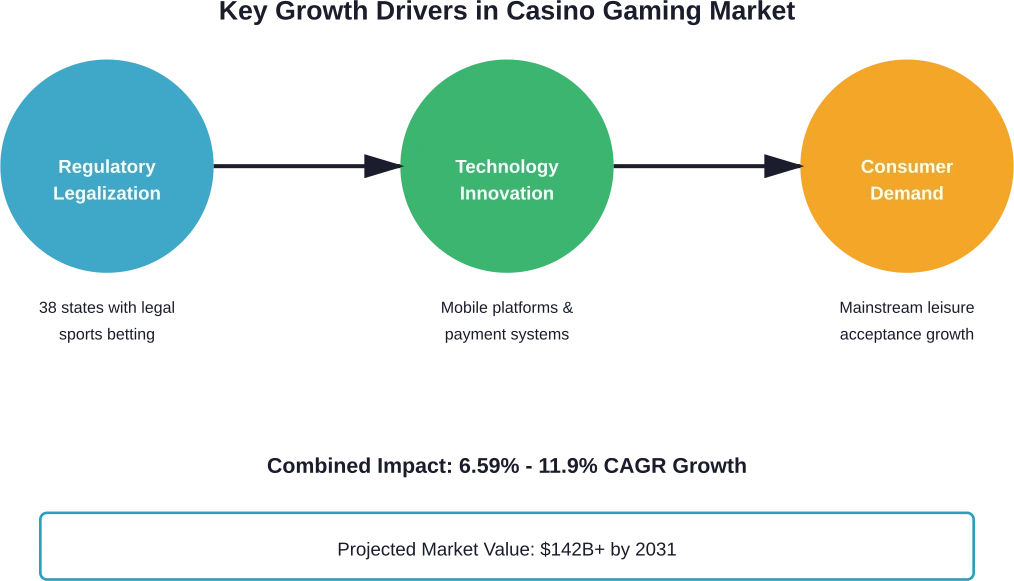
What’s driving this expansion? Several factors converge to push the market forward: regulatory changes enabling legal sports betting in 38 U.S. states and the District of Columbia, technological advances making mobile wagering accessible, and shifting consumer preferences toward integrated entertainment experiences.
Leisure-travel metrics now exceed 2019 benchmarks in Las Vegas and Atlantic City, underscoring a durable consumer appetite for integrated entertainment experiences that combine gaming, dining, shows, and hospitality.
Reach Companies Looking for Casino Industry Partners

The casino gaming market includes a wide range of suppliers, platforms, and service providers competing for attention. Sologe gives those companies a dedicated place to be discovered. It works as an iGaming marketplace where buyers can search for products, services, and partners, while vendors use the platform to present what they offer and start business conversations.
Want to Be Found by Gaming Operators and Buyers?
Use Sologe to:
- present your offering inside a dedicated iGaming marketplace
- connect with buyers searching for vendors and partners
- keep your company visible beyond short-term campaigns or events
👉 Get in touch with Sologe to discuss becoming a vendor on the platform.
Market Segmentation by Product Type
Not all casino games contribute equally to market revenue. The segmentation reveals clear leaders and emerging categories worth watching.
Slot Machines Dominate Revenue
Slot machines accounted for the largest market revenue share in 2023 and continue to lead the pack. In North America specifically, slot machines secured 43.68% of the casino gambling market share in 2025.
Why do slots dominate so thoroughly?
They require minimal staff oversight, offer varied themes and jackpot structures, and provide consistent revenue streams for operators. The lower barrier to entry for players compared to table games also expands the addressable customer base.
Sports Betting Shows Rapid Growth
Sports betting represents one of the fastest-growing segments. In the online gambling market, sports betting dominated with a revenue share exceeding 50% in 2024.
The legalization wave that started with the 2018 Supreme Court decision continues to reshape the landscape. According to NIDA, sports betting is now legal in 38 U.S. states and the District of Columbia, and in 26 states, bettors can place wagers directly from their mobile devices.
That accessibility changed everything.
Mobile sports betting removed geographic friction and enabled real-time wagering during live events. The convenience factor can’t be overstated—placing a bet no longer requires visiting a physical location or sitting at a desktop computer.
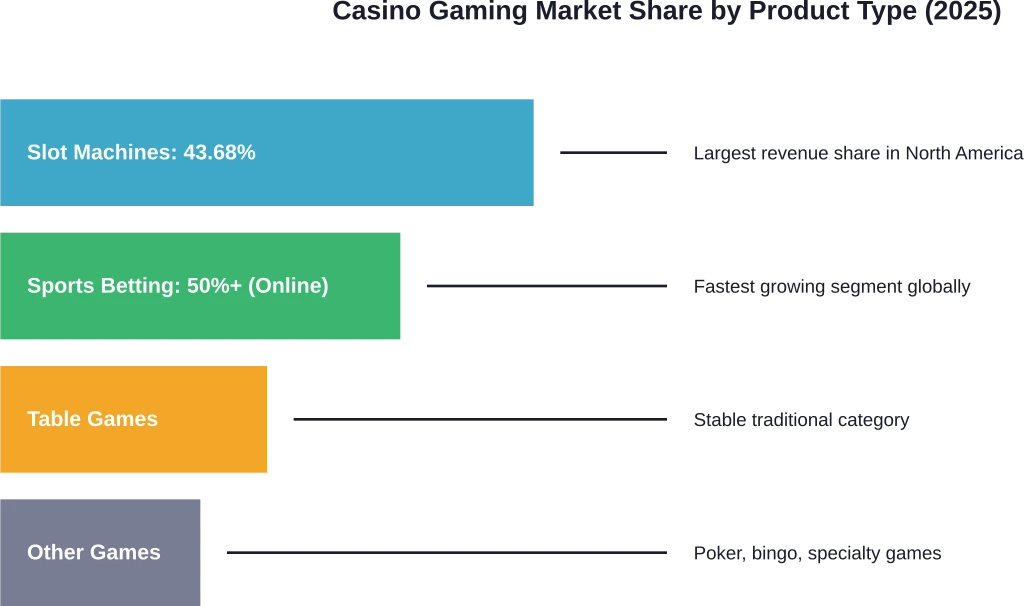
Table Games and Other Categories
Traditional table games—blackjack, roulette, baccarat, craps—maintain steady performance despite not matching slot machine volume. These games appeal to experienced gamblers seeking social interaction and skill-based play.
Poker rooms and bingo halls represent smaller segments but serve dedicated player communities. Online poker specifically has carved out a niche with tournament structures and cash game availability that physical venues struggle to match.
Regional Market Analysis
Geographic distribution of casino gaming revenue reveals distinct patterns and growth opportunities across regions.
North America Leads the Market
North America held the largest market share in 2023 and continues that leadership position. The region benefits from mature regulatory frameworks, established casino destinations, and widespread consumer acceptance of gambling entertainment.
Nevada remains the cornerstone, with the Nevada Gaming Control Board tracking detailed revenue data across the state’s nonrestricted gaming activity. Their monthly revenue reports reflect 1-month, 3-month, and 12-month data, providing transparent industry benchmarks.
The concentrated casino ecosystems in Las Vegas and Atlantic City drive significant tourism and convention traffic beyond pure gaming revenue. These integrated resort models generate revenue from hospitality, food and beverage, entertainment, and retail alongside gaming floors.
Asia-Pacific Shows Strong Growth Potential
The Asia-Pacific region, including markets in China, India, Japan, and South Korea, represents substantial growth potential. While regulatory environments vary significantly across countries, the large population base and rising middle class create favorable long-term conditions.
Macau historically served as the Asian casino hub, though regulatory shifts have impacted that market’s trajectory. Other jurisdictions are developing their own gaming frameworks to capture demand.
European Market Maintains Steady Performance
Europe, including France, Germany, Italy, Spain, and the UK, maintains established casino markets with both traditional venues and robust online gambling infrastructure. The region’s well-developed regulatory systems enable legal online gambling across multiple formats.
The UK in particular has a mature online gambling market with strict licensing requirements and consumer protection measures. That regulatory clarity has enabled sustainable market growth while addressing problem gambling concerns.
Online vs. Traditional Casino Gaming
The split between physical casino venues and online platforms represents one of the market’s most significant dynamics.
Desktop vs. Mobile Platforms
Within online gambling, device preferences shape product development and marketing strategies. Desktop devices dominated the online gambling market with significant share in 2024, but mobile growth is accelerating rapidly.
Mobile sports betting exemplifies this shift. The ability to place wagers on the same device used for communication, entertainment, and daily tasks removes friction from the betting process.
Sound familiar? That’s the same pattern seen across countless digital markets—mobile accessibility drives adoption and frequency of use.
But here’s the concern that comes with that accessibility: research published by NIDA indicates that mobile gambling accessibility presents challenges for gambling disorder prevention, particularly among younger adults who grew up with smartphone technology.
Platform Type | Advantages | Growth Trend |
|---|---|---|
Traditional Casino | Social experience, integrated entertainment, hospitality amenities | Steady, tourism-driven |
Desktop Online | Larger screens, detailed interfaces, comfortable extended sessions | Stable market share |
Mobile Online | Accessibility, convenience, real-time betting, location flexibility | Rapid acceleration |
The Integrated Entertainment Model
Traditional casinos aren’t just competing on gaming anymore. The integrated resort model combines casino floors with luxury hotels, celebrity chef restaurants, headliner entertainment, nightlife venues, shopping, and convention facilities.
That diversification serves strategic purposes: it attracts non-gaming customers, extends visitor stays, and creates multiple revenue streams that buffer against gaming revenue volatility.
MGM Resorts International, Caesars Entertainment Inc., Las Vegas Sands Corp., Wynn Resorts Ltd., and Penn Entertainment Inc. operate as major companies in the North American casino gambling market, each pursuing variations of this integrated model.
Market Drivers and Growth Factors
Several key forces propel the casino gaming market’s expansion trajectory.
Regulatory Legalization
The wave of sports betting legalization across U.S. states represents the single most impactful regulatory shift in recent years. Each state that legalizes sports betting opens a new revenue opportunity for operators and tax revenue for state governments.
That creates aligned incentives driving continued expansion.
Technological Innovation
Technology enables new gaming formats, improved player experiences, and operational efficiencies. Mobile app development, secure payment processing, live dealer streaming, and data analytics all contribute to market growth.
For online platforms specifically, technology reduces operational overhead compared to physical venues. There’s no need for massive casino floor buildouts, hotel towers, or restaurant infrastructure.
Consumer Behavior Shifts
Gambling has shifted from niche entertainment to mainstream leisure activity for many demographics. The stigma historically associated with gambling has diminished as legal, regulated options have proliferated.
Marketing plays a role here too. Research published in PMC journals examined the association between gambling marketing and unplanned gambling spend among sports bettors and emerging adults.
That’s a double-edged dynamic—effective for operators but raising concerns about consumer protection.
Challenges and Risk Factors
No market analysis would be complete without examining headwinds and potential obstacles.
Problem Gambling Concerns
The accessibility that drives market growth also increases risks for vulnerable populations. According to NIDA research published in November 2025, gambling disorder in the age of mobile sports betting presents significant public health challenges.
The research notes that despite available treatment tools for problem gambling, they currently only reach a fraction of those who need help. Physicians have a unique role in recognizing and responding to this transformed landscape through routine delivery of evidence-based care or referral to specialists.
A 2024 study published in the Journal of Gambling Studies examined perceived impact of gambling advertising among patients with gambling disorder, including a sample of 210 gamblers. Advertising disproportionately affects those experiencing more severe gambling harm.
Regulatory Uncertainty
While regulatory expansion has driven growth, the patchwork of state-by-state regulations creates operational complexity. Operators must navigate different licensing requirements, tax structures, and compliance frameworks across jurisdictions.
That fragmentation increases costs and limits scalability compared to federally regulated markets.
Economic Sensitivity
Casino gaming revenue shows sensitivity to economic conditions. During recessions, discretionary entertainment spending typically contracts. While the integrated resort model provides some diversification, gaming revenue remains the core business for most operators.
Future Outlook and Emerging Trends
Looking ahead, several trends will likely shape the market’s evolution through the forecast period and beyond.
Continued Digital Integration
The boundary between online and traditional casino gaming will continue blurring. Operators are developing omnichannel strategies that let customers move seamlessly between physical venues and digital platforms.
Loyalty programs, payment systems, and customer data increasingly integrate across channels.
Responsible Gambling Tools
As regulatory scrutiny on problem gambling increases, operators are implementing more sophisticated responsible gambling tools. Deposit limits, self-exclusion programs, reality checks, and AI-driven behavior monitoring aim to identify and intervene with at-risk players.
These aren’t just compliance exercises—they’re becoming competitive differentiators as consumers and regulators demand accountability.
New Market Entries
States and countries that haven’t yet legalized various forms of gambling represent greenfield opportunities. Each new jurisdiction that legalizes sports betting, online casinos, or other gaming formats expands the total addressable market.
The pattern established over recent years suggests continued expansion is likely, though the pace may vary based on political and social factors in each jurisdiction.
Frequently Asked Questions
What is the current size of the casino gaming market?
The North America casino gambling market reached $96.85 billion in 2025, while the global online gambling market was valued at $78.66 billion in 2024. The broader casino gaming market shows opportunities expanding from $26.92 billion in 2024 toward $45.9 billion by 2029.
Which segment dominates casino gaming revenue?
Slot machines account for the largest share, capturing 43.68% of the North America casino gambling market in 2025. For online gambling specifically, sports betting dominates with over 50% revenue share in 2024.
How fast is the casino gaming market growing?
Growth rates vary by segment and region. North America casino gambling is growing at a 6.59% CAGR toward $142.03 billion by 2031. Online gambling shows even faster expansion at 11.9% CAGR, projected to reach $153.57 billion by 2030.
Which companies are the major players in casino gaming?
Major operators in the North American market include MGM Resorts International, Caesars Entertainment Inc., Las Vegas Sands Corp., Wynn Resorts Ltd., and Penn Entertainment Inc. These companies operate integrated resort properties combining gaming, hospitality, and entertainment.
What drives casino gaming market growth?
Three primary drivers fuel expansion: regulatory legalization of sports betting across states, technological innovation enabling mobile platforms, and shifting consumer attitudes toward gambling as mainstream entertainment. Sports betting is now legal in 38 U.S. states and the District of Columbia.
What are the risks in the casino gaming market?
Key challenges include problem gambling concerns as accessibility increases, regulatory uncertainty from state-by-state frameworks, and economic sensitivity affecting discretionary entertainment spending. Research highlights concerns that mobile gambling accessibility presents challenges for younger adults prone to gambling disorder.
How does mobile gaming compare to traditional casinos?
Mobile platforms show faster growth rates due to accessibility and convenience, but traditional casinos maintain advantages in social experience and integrated entertainment offerings. Desktop online gambling held significant share in 2024, though mobile is accelerating. Physical casinos exceed 2019 leisure-travel benchmarks in key markets like Las Vegas and Atlantic City.
Conclusion
The casino gaming market stands at a pivotal moment. Revenue growth projections across segments paint a picture of substantial expansion—from $96.85 billion to $142.03 billion in North America alone by 2031, and even more aggressive growth in online gambling reaching $153.57 billion globally by 2030.
Slot machines continue dominating revenue, but sports betting’s explosive growth reshapes competitive dynamics. The regulatory landscape enabling legal sports betting in 38 states has fundamentally altered market structure.
Technology, regulation, and consumer behavior align to drive market expansion. But that growth comes with responsibility—addressing problem gambling concerns, implementing effective player protection tools, and navigating complex regulatory frameworks.
For investors, operators, and policymakers tracking this market, the data suggests sustained growth opportunities balanced against emerging risks that demand thoughtful management.
Want to understand how specific market segments or regions fit your strategic priorities? Dive deeper into the detailed revenue reports and regulatory frameworks shaping this dynamic industry.
Related Articles

September 29, 2026Is the Casino Legal in Japan? The Real Answer...

September 29, 2026Is the Casino Legal in Gambia? What the Law...