 Nothing found for the request
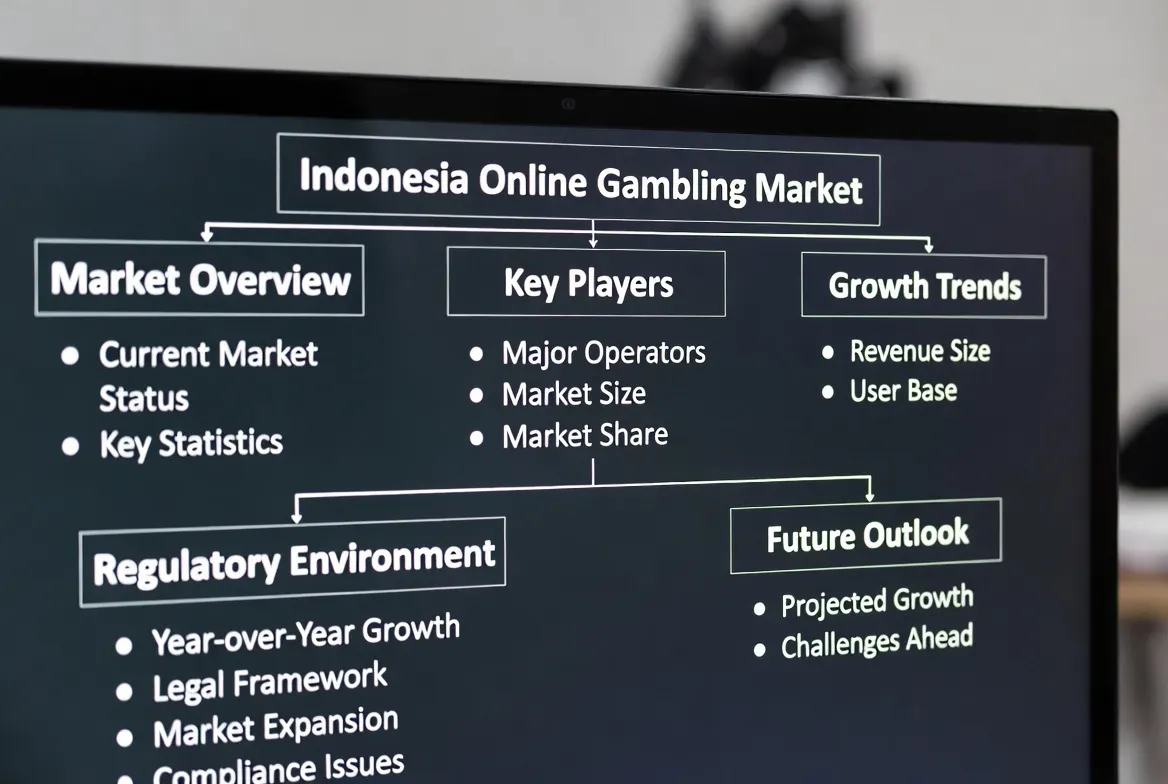
Indonesia Online Gambling Market: 2026 Data & Insights
Sologe March 30, 2026
Share:


The 2025 Decline: What the Numbers Reveal
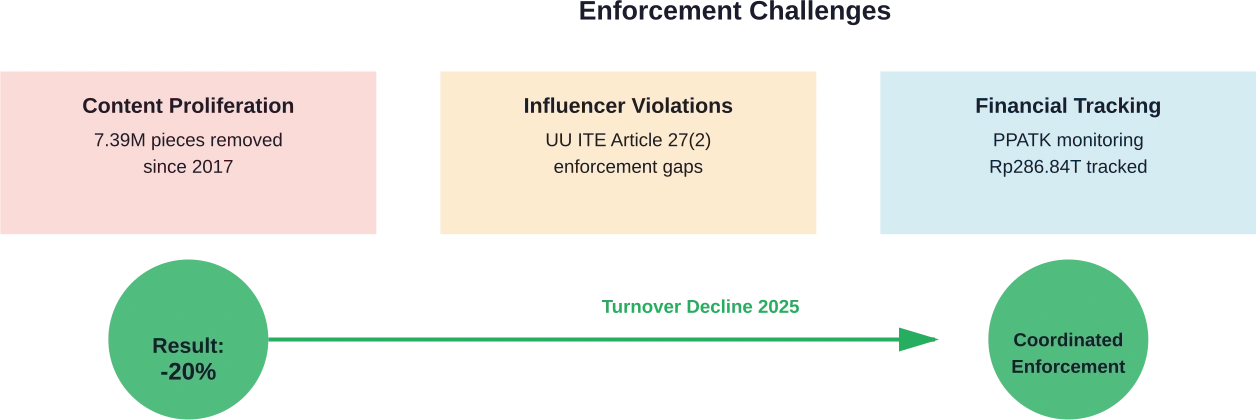
PPATK’s study revealed that online gambling money circulation throughout 2025 reached Rp286.84 trillion. While that figure might sound massive, it represents a 20% drop compared to 2024’s turnover.
This decline marks a significant shift. For years, illegal online gambling funds in Indonesia had been growing steadily, with operators finding creative ways to circumvent enforcement. The 2025 data suggests those tactics are becoming less effective.
The reduction reflects stronger enforcement mechanisms and closer cooperation between government agencies and private sector platforms. Social media companies and payment processors have stepped up their monitoring, making it harder for gambling operations to function seamlessly.

Government Enforcement Intensifies
The Ministry of Communication and Digital reported removing approximately 7.39 million pieces of online gambling content from various social media platforms between 2017 and November 11, 2025. That’s a staggering volume of prohibited material.
“Online gambling poses a serious threat to the social and economic lives of people of all ages, including students,” said Muchtarul Huda, a ministry official, highlighting the government’s rationale for aggressive content removal.
But content removal is just one piece of the puzzle. Financial tracking has become increasingly sophisticated, with PPATK monitoring suspicious transactions more effectively than ever before.
The Regulatory Framework Challenge
Here’s where things get complicated. Indonesia bans gambling for religious and moral reasons, operating under a prohibitionist framework. But according to academic analysis from UI’s ScholarHub, this approach creates unintended economic consequences.
A law and economic analysis published in 2024 suggests that while the moral case for banning online gambling exists, the economic repercussions—including black markets and lost tax revenue—deserve serious consideration. The research argues that regulated online gambling could protect consumers, generate substantial tax revenues, and minimize negative externalities.
UGM sociologist observations from April 2025 warn that online gambling creates a “digital trap” in Indonesia, with ties to politics and weak regulatory oversight despite the prohibition.
Enforcement Action | Volume/Impact | Timeframe |
|---|---|---|
Content Removed | 7.39 million pieces | 2017-Nov 2025 |
Turnover Reduction | 20% decline | 2025 vs 2024 |
Total Money Circulation | Rp 286.84 trillion | 2025 |
Players Under Rp100k Income | 78% of gamblers | 2023 data |
Who's Actually Gambling?
The demographic data is particularly striking. Nearly 70% of online gamblers in Indonesia earn under $300. These aren’t high-rollers seeking entertainment—they’re predominantly low-income individuals chasing financial escape routes.
This demographic reality underscores why the government views online gambling as a social threat rather than merely a regulatory challenge. When the majority of participants can least afford losses, the societal harm multiplies.
The Influencer Problem
Research published in the Journal of Indonesian Communication highlights another enforcement challenge: influencers promoting online gambling through social media.
Article 27 verse (2) of Indonesia’s 2016 Electronic Information and Transactions Law (UU ITE) specifically addresses online gambling promotion. Yet influencers continue violating these regulations, often claiming ignorance about whether promoted sites constitute illegal gambling.
The research identifies a critical gap: unclear definitions separating online gambling from legitimate online games. Some gaming platforms incorporate gambling-like mechanics, creating grey areas that influencers exploit as legal cover.
Regional Context and Money Laundering Concerns
UNODC analysis estimates more than 340 licensed and unlicensed land-based casinos were operating in Southeast Asia as of early 2022, with most shifting online to offer live-dealer streaming and proxy betting services.
The formal online gambling industry across Southeast Asia generates billions in revenue, but Indonesia’s prohibition means none of that economic activity occurs legally within its borders. Instead, Indonesian players access offshore platforms, creating enforcement headaches and money laundering risks.
UNODC estimates financial losses between US $18 billion and $37 billion from scams targeting victims in East and Southeast Asia in 2023 alone, with organized crime groups using fake job advertisements to traffic thousands of workers into illegal scam compounds.
Economic Fundamentals Amid Gambling Concerns
The broader economic context matters. According to OJK’s April 2025 press release, Indonesia’s financial services sector remains resilient despite rising uncertainty risks. Market volatility remains high, coupled with growing economic policy uncertainty and escalating geopolitical risks.
The OECD revised global economic growth projections downward, with global GDP projected at 3.1% in 2025 and 3% in 2026 due to rising trade barriers. These macroeconomic headwinds create environments where vulnerable populations become more susceptible to gambling’s false promises.
Looking Ahead to 2026
The 2025 decline represents real progress, but challenges remain substantial. The government must continue refining its approach, particularly around definitional clarity between legitimate gaming and illegal gambling.
Stronger public-private sector cooperation will be essential. Payment processors, social media platforms, and telecommunications companies all play crucial roles in disrupting gambling operations.
From a policy perspective, the debate between prohibition and regulation continues. Academic research suggests Indonesia might benefit from reconsidering its absolute prohibition in favor of a regulated framework that balances moral concerns with economic realities.
But that would require significant political will in a predominantly Muslim nation where gambling prohibition enjoys broad social support.
Enter Indonesia With the Right Setup, Not Guesswork

Markets like Indonesia are shaped by limitations as much as opportunity. That means growth depends less on speed and more on how well the setup is built from the start – platforms, content providers, and technical partners all have to fit together. Sologe focuses on that part of the process, helping casino developers and operators connect with companies that handle these core pieces.
Instead of piecing things together through scattered contacts, teams use Sologe to get a clearer view of who they are working with and how everything fits into one system. It helps turn market insight into decisions that actually hold up in practice.
Contact Sologe and start a direct conversation to move into markets like Indonesia, avoiding costly missteps.
Frequently Asked Questions
Is online gambling legal in Indonesia?
No, all forms of gambling are strictly illegal in Indonesia for religious and moral reasons. The country operates under a prohibitionist framework that bans both land-based and online gambling activities.
How much money circulated through online gambling in Indonesia in 2025?
According to PPATK data, approximately Rp286.84 trillion circulated through illegal online gambling operations in Indonesia during 2025, representing a 20% decline from the previous year.
Who typically gambles online in Indonesia?
PPATK research cited in 2023 found that most online gamblers in Indonesia earn under $300 in monthly income, indicating that participants are predominantly from lower-income demographics rather than affluent recreational gamblers.
How many gambling content pieces has Indonesia removed?
The Ministry of Communication and Digital removed approximately 7.39 million pieces of online gambling content from social media platforms between 2017 and November 2025.
What penalties exist for promoting online gambling in Indonesia?
Article 27 verse (2) of Indonesia’s 2016 Electronic Information and Transactions Law (UU ITE) addresses online gambling promotion, though enforcement faces challenges due to unclear definitions separating illegal gambling from legitimate online gaming.
Why did online gambling turnover decline in 2025?
The 20% decline resulted from intensified government enforcement, improved cooperation between public and private sectors, more effective financial tracking by PPATK, and aggressive content removal from social media platforms.
Could Indonesia legalize and regulate online gambling?
While academic research suggests regulated gambling could generate tax revenue and better protect consumers, significant legalization appears politically unlikely given Indonesia’s religious and cultural opposition to gambling in this predominantly Muslim nation.
Conclusion: Progress with Persistent Challenges
Indonesia’s online gambling market faced significant headwinds in 2025. Note: One source cited by the Ministry of Communication and Digital reported online gambling transaction values dropping from 51 trillion rupiah in 2024 to 24 trillion rupiah in 2025, while PPATK reported total circulation of Rp286.84 trillion in 2025. This decline demonstrates that coordinated enforcement can produce measurable results even against a sophisticated underground industry.
The removal of 7.39 million pieces of gambling content since 2017 shows sustained commitment. Financial tracking improvements by PPATK have made it harder for operators to move money undetected.
Yet the fundamental tension remains: prohibition creates black markets that generate zero tax revenue while still causing social harm. As Indonesia moves through 2026, policymakers face difficult questions about whether the current approach truly serves the nation’s interests or whether alternative regulatory frameworks deserve consideration.
For now, the enforcement strategy continues—and the 2025 data suggests it’s working better than ever before.
Related Articles

September 29, 2026Is the Casino Legal in Japan? The Real Answer...

September 29, 2026Is the Casino Legal in Gambia? What the Law...