 Nothing found for the request

Social Casino Market 2026: Size, Growth & Trends
Sologe March 30, 2026
Share:


Market Size and Growth Projections
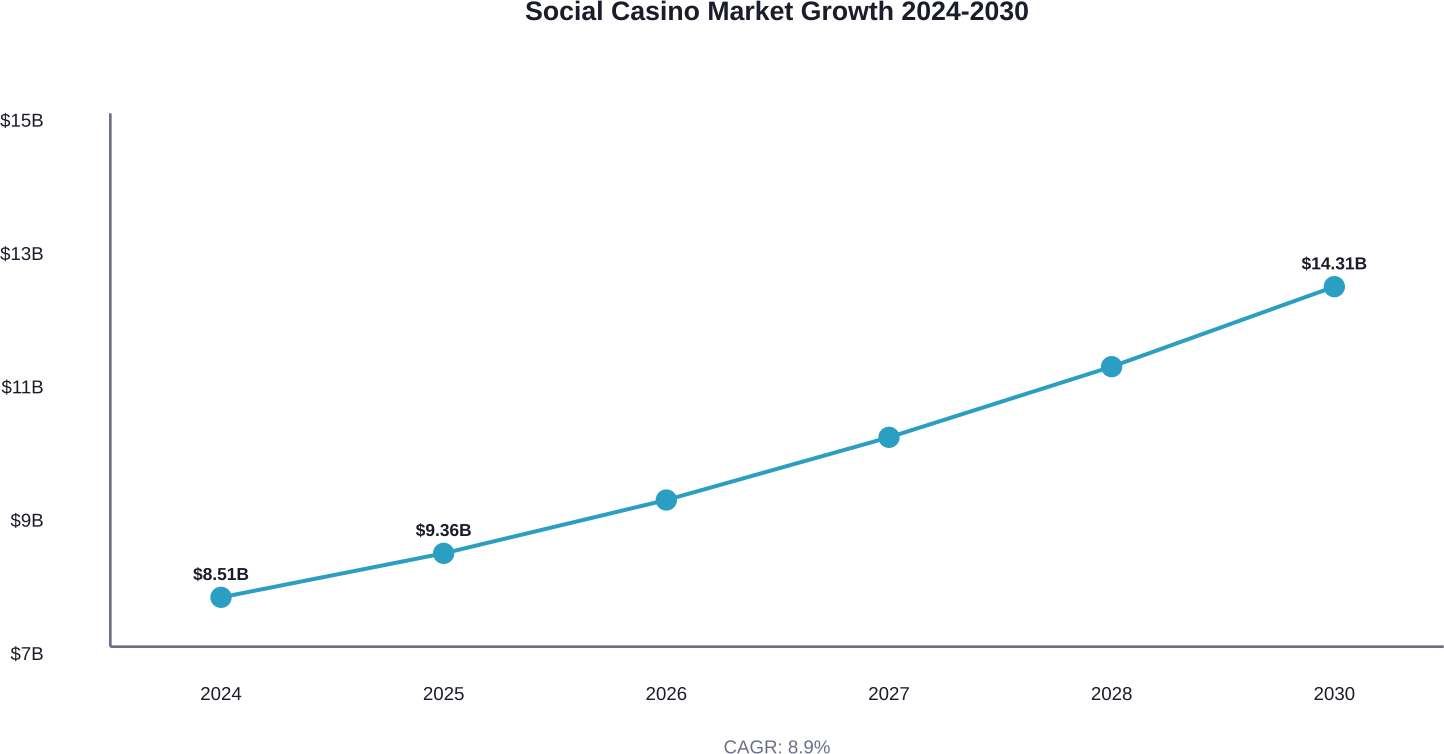
The global social casino market was valued at $8.51 billion in 2025, according to Grand View Research. That figure jumped to $9.36 billion in 2026 and shows no signs of slowing down.
Projections indicate the market will reach $14.31 billion by 2030, representing a compound annual growth rate (CAGR) of 8.9% from 2025 to 2030. Other research from Mordor Intelligence places the 2026 market size at $9.06 billion, growing to $13.49 billion by 2031 at a CAGR of 8.32%.
These slight variations in forecasts reflect different methodologies and scope definitions, but the trajectory remains clear—the social casino market is expanding rapidly.
For context, the broader online gambling and betting industry is referenced in Statista sources, though specific 2024 figures are behind paywalls in the provided source material. The global casino and online gambling sector figures are available through Statista, though exact 2024 values are behind paywalls in the provided source material.
Social casinos occupy a distinct niche within this landscape—offering entertainment without the regulatory complexities of real-money gambling.
What Defines Social Casino Gaming
Social casinos blur the line between gaming and gambling, but there’s a critical distinction. Players use virtual currencies—gold coins, tokens, or credits—instead of actual money. These platforms emphasize entertainment and social interaction over monetary stakes.
The games themselves mirror traditional casino offerings. Slots dominate the category, but poker, blackjack, roulette, and bingo also attract substantial player bases. What separates social casinos from real-money gambling is the absence of cash payouts.
Some platforms incorporate sweepstakes mechanics, where players can redeem virtual winnings for prizes or gift cards. But traditional social casinos operate purely on a free-to-play model with optional in-app purchases for additional virtual currency.
Sweepstakes vs. Traditional Social Casinos
The distinction matters for both players and regulators. Traditional social casinos offer no path to real-money redemption. Players buy virtual currency solely for extended gameplay.
Sweepstakes casinos introduce a dual-currency system. One currency functions like traditional social casino tokens. The second—often called “sweeps coins”—can be accumulated through gameplay and redeemed for cash or prizes.
This model operates under sweepstakes laws rather than gambling regulations, creating a legal workaround in jurisdictions where online gambling faces restrictions. According to analysis sources, sweepstakes casinos have proliferated across markets where real-money online casinos remain prohibited.
Feature | Traditional Social Casino | Sweepstakes Casino |
|---|---|---|
Primary Currency | Virtual coins/tokens | Dual currency system |
Real Money Payouts | No | Yes (via sweeps coins) |
Purchase Required | Optional (free play available) | Optional (free play available) |
Regulatory Framework | Gaming/entertainment laws | Sweepstakes laws |
Prize Redemption | None | Cash, gift cards, prizes |
Market Segmentation and Segment Performance
Breaking down the social casino market reveals which game types, platforms, and regions drive the most revenue. These insights matter for understanding where the industry is headed.
Game Type Breakdown
Slots captured the largest market share at over 56% in 2024, according to Grand View Research. The appeal is straightforward—slots require minimal skill, offer fast-paced action, and translate easily to mobile screens.
Poker and card games represent the second-largest category. These games attract players seeking more strategic gameplay and social interaction. Multiplayer poker rooms enable competition and communication between players, adding depth beyond simple slot mechanics.
Bingo rounds out the major categories, appealing to demographics that traditional casinos sometimes overlook. The format works particularly well for community-oriented gameplay where multiple players participate simultaneously.
Mordor Intelligence data indicates slots held 55.62% of market share in 2025, with bingo forecast to post the fastest growth rate of 9.5% CAGR through 2031. That said, slots will likely maintain dominance due to their broad appeal and straightforward monetization.
Platform Distribution
Mobile platforms generate the majority of social casino revenue. The shift mirrors broader gaming trends—smartphones provide constant access, and touchscreen interfaces suit casino-style gameplay.
Desktop platforms maintain relevance, particularly for poker and other games where screen size enhances the experience. But mobile’s convenience and ubiquity make it the primary battleground for user acquisition and retention.
The platform split also influences game design. Successful social casino developers optimize for mobile-first experiences, then adapt those games for desktop rather than the reverse.
Regional Market Dynamics
Geography plays a significant role in social casino adoption and revenue generation. Cultural attitudes toward gambling, smartphone penetration, and disposable income all influence regional performance.
North America Leads, But Asia Pacific Accelerates
North America represents the largest regional market for social casinos. The United States in particular drives substantial revenue, supported by high smartphone adoption and established social gaming culture.
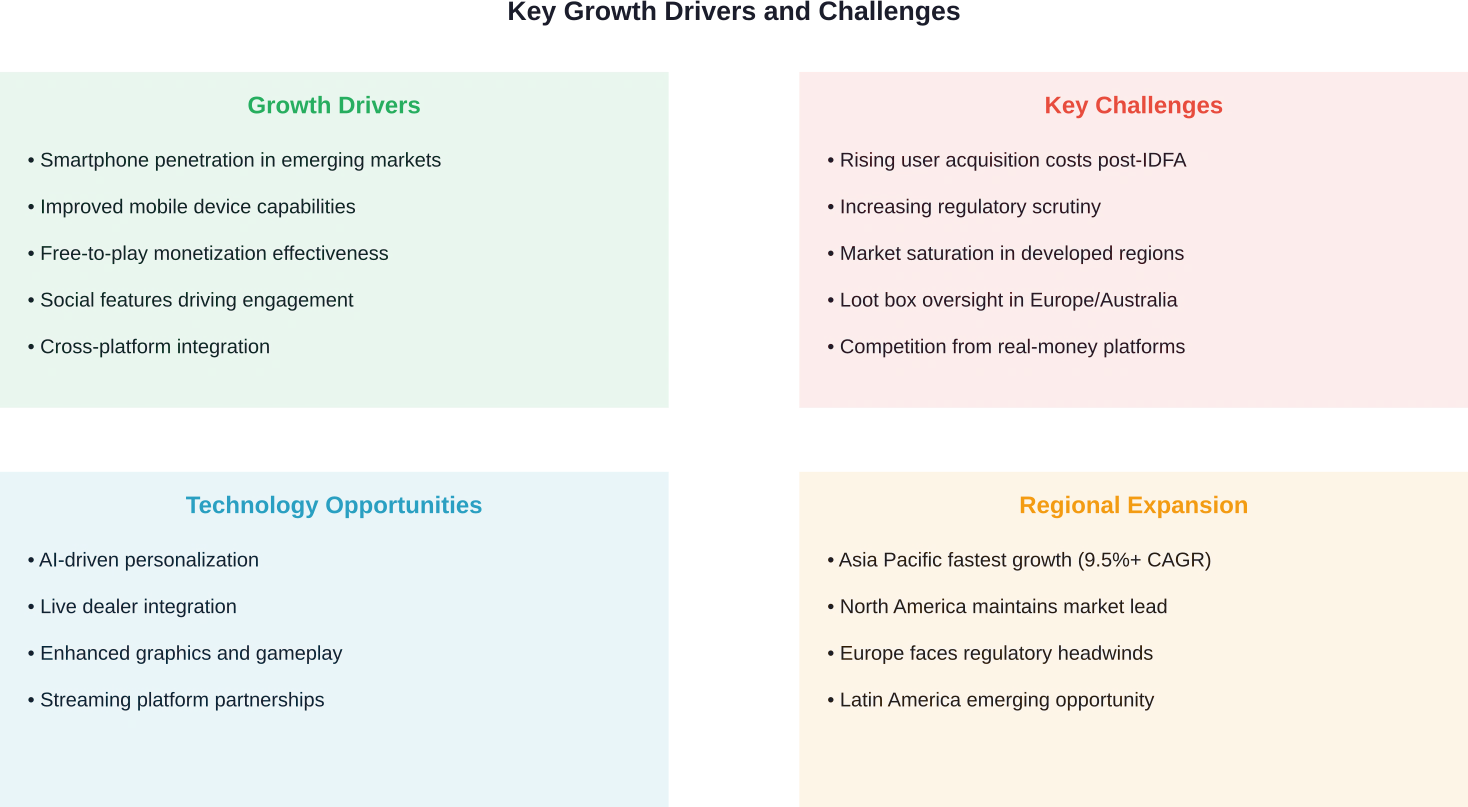
Europe follows as the second-largest market, though regulatory scrutiny around loot boxes and gambling-adjacent mechanics has created headwinds. Several European countries have introduced stricter oversight, particularly around games that blur lines between social and real-money gambling.
Asia Pacific shows the fastest growth trajectory. Mordor Intelligence identifies it as the fastest-growing market, driven by smartphone proliferation in countries like India, Indonesia, and the Philippines. However, regulatory fragmentation across the region creates market access challenges.
Cultural factors matter too. In markets where traditional gambling carries social stigma, social casinos offer entertainment without the negative associations. This dynamic helps explain strong adoption in certain Asian markets despite gambling restrictions.
Regulatory Considerations by Region
The Unlawful Internet Gambling Enforcement Act in the United States prohibits real-money gambling transactions but doesn’t restrict social casino play. This regulatory clarity has enabled the industry to flourish in the U.S. market.
European regulators have taken a more cautious approach. Concerns about loot boxes, particularly their potential impact on minors, have led to investigations and proposed restrictions. Some jurisdictions now require social casino operators to implement age verification and spending limits.
In practice, these regulatory differences shape how companies approach different markets. Successful operators maintain flexibility to adapt monetization and game mechanics based on local requirements.
Key Players and Market Concentration
The social casino market shows medium concentration, according to Mordor Intelligence. A handful of major players generate substantial revenue, but the market remains open to new entrants with innovative offerings.
Industry Leaders
Playtika Holding Corp. ranks among the top social casino operators globally. The company’s portfolio includes multiple branded titles spanning slots, poker, and bingo categories.
Aristocrat Leisure Ltd., through its subsidiaries SciPlay and Big Fish, maintains significant market presence. The company leverages established casino game IP to create social versions of popular land-based titles.
Zynga Inc., acquired by Take-Two Interactive, brought social gaming expertise to the casino category. Zynga Poker became one of the category’s earliest success stories and continues generating revenue years after launch.
Caesars Entertainment Inc. and Light and Wonder Inc. (formerly Scientific Games) round out the major players. Both companies bridge traditional casino operations and social gaming, bringing brand recognition and game development expertise.
But here’s the thing—market leadership doesn’t guarantee long-term dominance. User acquisition costs have climbed following Apple’s IDFA changes, squeezing margins across the industry. Smaller developers with efficient monetization can compete effectively despite limited brand recognition.
Recent Market Movements
Consolidation activity picked up in recent years as companies seek scale advantages. Larger portfolios enable cross-promotion between titles and more efficient user acquisition spending.
That said, the market remains fragmented enough that breakout hits can still emerge from smaller studios. Innovation in game mechanics, social features, or monetization approaches can level the playing field quickly.
Growth Drivers and Market Trends
Several factors contribute to the social casino market’s expansion. Understanding these dynamics helps explain where growth will come from over the next decade.
Smartphone Penetration
Mobile device adoption remains the fundamental driver. As smartphones reach new markets and demographics, potential social casino audiences expand correspondingly.
Improved device capabilities also matter. Modern smartphones handle sophisticated graphics and gameplay mechanics that earlier devices couldn’t support. This enables more engaging experiences that retain players longer.
Monetization Innovation
Free-to-play models with in-app purchases have proven highly effective for social casinos. The approach removes barriers to entry while capturing revenue from engaged players willing to pay for extended play or exclusive features.
Successful operators continually refine monetization mechanics. Limited-time offers, VIP programs, and battle pass systems borrowed from other gaming genres have found applications in social casinos.
The data shows which approaches work. According to Statista, social casino revenues have grown consistently since 2014, validating the free-to-play monetization model’s effectiveness.
Social Features and Community Building
Multiplayer mechanics and social interaction differentiate social casinos from traditional slot machine experiences. Leaderboards, tournaments, and club systems create community engagement that drives retention.
These features also facilitate organic user acquisition through social sharing and referrals. When players invite friends to join their club or compete in tournaments, they become unpaid marketing channels for the platform.
Cross-Platform Integration
Modern social casinos increasingly span mobile, desktop, and even social media platforms. Cloud save functionality lets players switch seamlessly between devices, increasing engagement opportunities throughout the day.
Facebook integration helped launch the category initially, though its importance has diminished as mobile-first approaches dominate. Still, social media connectivity remains relevant for user acquisition and retention.
Challenges Facing the Industry
Despite strong growth projections, social casino operators face headwinds that could impact future performance.
User Acquisition Costs
Apple’s App Tracking Transparency framework, which introduced IDFA restrictions, fundamentally changed mobile user acquisition economics. Targeted advertising became less precise and more expensive overnight.
According to Mordor Intelligence, higher user acquisition costs following IDFA changes are pressing margins and accelerating consolidation. Operators with larger budgets and diversified acquisition channels weathered the transition better than smaller competitors.
Regulatory Scrutiny
Governments worldwide are examining social casino mechanics more closely. Questions about whether these platforms constitute gambling, their potential to encourage real-money gambling, and their accessibility to minors have prompted investigations.
Loot box oversight in Europe and Australia has created compliance costs and, in some cases, forced changes to monetization approaches. Operators must balance maximizing revenue with managing regulatory risk.
The Federal Trade Commission has increased focus on gaming industry practices, particularly around children and deceptive monetization. According to FTC records from June 25, 2025, the agency sent refunds totaling more than $126 million to Fortnite players who were charged for unwanted in-game purchases—a warning shot for the broader gaming industry.
Market Saturation Concerns
As the social casino category matures, finding new players becomes more challenging. Markets with high smartphone penetration show signs of saturation, forcing operators to focus on engagement and monetization optimization rather than pure user growth.
Real talk: the easy growth phase may be ending in developed markets. Future expansion will likely depend on emerging market penetration and increasing revenue per user rather than explosive player base growth.
Technology Trends Shaping the Future
Emerging technologies promise to reshape social casino experiences over the coming years.
Artificial Intelligence and Personalization
AI-driven personalization enables operators to tailor game recommendations, promotional offers, and difficulty curves to individual players. This increases engagement and conversion rates by delivering more relevant experiences.
Machine learning models can identify players at risk of churning and trigger retention interventions automatically. They can also optimize pricing and promotion timing based on individual spending patterns.
Live Dealer and Streaming Integration
Some social casino platforms experiment with live dealer formats, streaming real dealers managing virtual card games or roulette wheels. This bridges the gap between social casino convenience and land-based casino atmosphere.
Integration with streaming platforms like Twitch creates marketing opportunities. Popular streamers playing social casino games expose the category to new audiences while providing entertainment value beyond the games themselves.
Blockchain and NFT Experiments
Certain operators have explored blockchain integration and NFT collectibles within social casino frameworks. These experiments remain early-stage, with unclear value propositions for most players.
The technology could theoretically enable provably fair games and true ownership of virtual items. But implementation challenges and regulatory uncertainty have slowed adoption.
Build a Stronger Product for the Social Casino Market

As the social casino market grows, the pressure shifts from quick launches to building products that can actually hold attention over time. It’s not just about adding more content, but about how games are structured, how the platform performs, and how easily the product can evolve as user expectations change. Sologe works with operators and development teams on that layer – supporting custom game development, portfolio structure, and systems designed to stay stable as scale increases.
If you’re planning a social casino product or trying to improve an existing one, this is usually where the real challenges start to show. Fixing them early is far easier than reworking everything later. If you need to strengthen your product or rethink how it’s built, get in touch and speak directly with the Sologe team.
Comparison with Real-Money Online Gambling
Understanding how social casinos differ from real-money gambling platforms provides important context for market analysis.
Aspect | Social Casinos | Real-Money Online Gambling |
|---|---|---|
Market Size (2024) | ~$9 billion | ~$80 billion |
Currency | Virtual tokens | Real money |
Payouts | None (or prizes via sweepstakes) | Cash withdrawals |
Regulatory Complexity | Moderate | High |
Age Restrictions | Varies (often 18+) | Strict 18+ or 21+ |
Primary Revenue Model | In-app purchases | House edge on bets |
The markets sometimes overlap—social casino players may eventually transition to real-money gambling. But they also serve distinct audiences. Some players specifically prefer social casinos because they avoid gambling’s financial risks.
The Brick-and-Mortar Context
While social casinos grow, traditional brick-and-mortar gaming shows different trends. According to data from LIGHT at Stockton University, annual brick-and-mortar gaming revenue in Atlantic City has remained essentially flat since 2022, while internet gaming continues growing exponentially.
Internet gaming eclipsed brick-and-mortar gaming for the first time in 2025 in that market. This shift indicates broader trends affecting casino entertainment—convenience and accessibility increasingly trump the physical casino experience for many players.
Social casinos benefit from this trend. They offer instant access without travel requirements, making them natural alternatives for casual players who might otherwise visit land-based casinos occasionally.
Future Outlook Through 2030
The social casino market’s trajectory through 2030 appears positive, though growth rates may moderate as markets mature.
Emerging markets represent the primary expansion opportunity. As smartphone adoption increases in developing economies, social casino operators will follow. Cultural localization will be critical—games and monetization approaches that work in North America won’t necessarily translate directly to Asian or Latin American markets.
Technology improvements will enable more sophisticated experiences. Better graphics, more complex game mechanics, and enhanced social features will help retain existing players and attract new ones.
Regulatory evolution remains the wild card. Stricter oversight could constrain monetization or increase compliance costs. Conversely, regulatory clarity might unlock new markets currently uncertain about social casino legality.
Industry consolidation will likely continue. Smaller operators face mounting pressure from user acquisition costs and compliance requirements. Acquisitions by larger gaming companies or private equity firms will concentrate market share among fewer players.
The relationship between social casinos and real-money gambling will evolve. Some jurisdictions may create clearer pathways for social casino operators to offer real-money versions where legal. Others may erect stronger barriers to prevent social casinos from serving as on-ramps to gambling.
Frequently Asked Questions
What exactly is a social casino?
A social casino offers casino-style games using virtual currency, focusing on entertainment rather than real-money gambling.
How big is the social casino market in 2026?
The market is worth around $9–9.36 billion and continues steady global growth.
Are social casinos legal?
Yes, they are legal in most regions since no real money is wagered or won.
What’s the difference between a social casino and a sweepstakes casino?
Social casinos use virtual currency only, while sweepstakes casinos allow certain winnings to be redeemed for real prizes.
Which games are most popular in social casinos?
Slots lead the market, followed by poker and other card-based games.
Why are social casinos growing so fast?
Mobile access, social features, and risk-free gameplay are key growth drivers.
What challenges do social casino operators face?
Operators face regulatory pressure, high marketing costs, and increasing competition.
Conclusion
The social casino market stands at an interesting crossroads. Solid growth projections point toward a $14+ billion industry by 2030, driven by mobile adoption, emerging market expansion, and proven monetization strategies.
But challenges loom large. User acquisition costs squeeze margins. Regulators ask harder questions about the line between entertainment and gambling. Market leaders consolidate their positions, making breakout success harder for newcomers.
For investors, operators, and observers, the key question isn’t whether the social casino market will grow—data strongly suggests it will. Rather, the question is which companies will capture that growth most effectively, and how regulatory evolution will shape the industry’s structure.
What remains clear is that social casinos have permanently altered the gaming landscape. They’ve created a massive market for casino-style entertainment divorced from gambling’s financial stakes. As technology improves and new markets open, that fundamental value proposition will continue attracting players worldwide.
Stay informed about social casino market trends and regulatory developments to understand where this dynamic industry heads next.
Related Articles

September 29, 2026Is the Casino Legal in Japan? The Real Answer...

September 29, 2026Is the Casino Legal in Gambia? What the Law...