 Nothing found for the request

APAC Casino Market 2026: Growth, Trends & Analysis
Sologe March 30, 2026
Share:


Market Size and Growth Projections
The numbers tell a compelling story about where the APAC casino market is headed.
According to Mordor Intelligence, the Asia-Pacific casino gambling market reached USD 59.14 billion in 2025 and is expected to grow at a CAGR of 7.24% to reach USD 117.07 billion by 2030. That’s essentially doubling the market size in five years.
Market Research Future reports slightly different projections for the broader APAC casino market, estimating it at USD 108.34 billion in 2024 and forecasting growth to USD 250 billion by 2035, representing a CAGR of 7.9% over that longer timeframe.
These projections reflect several parallel trends playing out simultaneously across the region.
Online vs. Land-Based Growth Trajectories
The online segment is outpacing traditional venues significantly. Grand View Research data shows the Asia Pacific online casino market reaching US$ 8,313.8 million by 2030, with a robust 13.5% CAGR from 2025 to 2030.
The broader online gambling market in the region demonstrates similar momentum. According to Grand View Research, the Asia Pacific online gambling market is expected to reach US$ 39,079.8 million by 2030, growing at 12.8% CAGR from 2025 to 2030.
Mobile platforms are the primary catalyst. Desktop casino gaming currently represents the largest segment, but mobile is the fastest-growing format as smartphone penetration deepens across emerging markets.
Market Segment | 2024/2025 Size | 2030 Projection | CAGR |
|---|---|---|---|
Total APAC Casino Market | USD 59.14 billion | USD 117.07 billion | 7.24% |
Online Casino (APAC) | USD 3,897.9 million | US$ 8,313.8 million | 13.5% |
Online Gambling (APAC) | — | US$ 39,079.8 million | 12.8% |
Social Casino (APAC) | — | US$ 4,149.7 million | 13.3% |
What’s driving this digital shift? Convenience plays a major role, but so does regulatory arbitrage—online platforms can operate from jurisdictions with favorable licensing while serving players across borders.
Reach Gaming Buyers Across the APAC Market

In a large regional market, suppliers and service providers still need a clear place to be discovered. Sologe is a dedicated iGaming marketplace where operators and gaming businesses search for suppliers, software, platforms, and service partners. Vendors use it to present products, services, and company profiles in one place and stay visible year-round.
Want to Be Found by More Gaming Buyers?
Use Sologe to:
- show your offering to companies actively searching for vendors
- present your company and products in one place
- maintain visibility inside a dedicated iGaming marketplace
👉 Get in touch with Sologe to discuss listing your company as a vendor.
Key Growth Drivers Reshaping the Market
Several interconnected factors are propelling the APAC casino market forward. Understanding these drivers helps explain both current momentum and future trajectory.
Rising Disposable Incomes Across the Region
Economic development remains the foundation of gambling market expansion. As middle-class populations grow across Southeast Asia, India, and other emerging markets, more consumers have discretionary income for entertainment spending.
This isn’t just about people having more money. It’s about shifting cultural attitudes toward leisure spending and entertainment as societies urbanize and modernize.
Tourism Recovery and Integrated Resorts
The post-pandemic tourism rebound has reinvigorated destination casinos, particularly integrated resorts that combine gambling with hotels, dining, entertainment, and shopping.
Macau and Singapore continue to dominate this segment, but new integrated resort developments in Japan, Vietnam, and the Philippines are diversifying the regional landscape.
Integrated resort casinos represent a significant facility format within the broader market segmentation, alongside stand-alone land-based casinos, riverboat casinos, cruise-ship casinos, and racinos.
Technology Adoption and Mobile Gaming
Technology investments are raising table yields and strengthening operations across both physical and digital venues. AI-driven pit management, customer analytics, and compliance reporting are becoming standard tools for major operators.
Mobile gambling platforms account for an increasingly large share of online activity, with app-based experiences offering convenience that desktop platforms can’t match.
Regulatory Evolution in Key Markets
Regulatory frameworks vary dramatically across APAC, creating both opportunities and challenges.
Australia maintains stringent regulations. The Philippines has embraced a more liberal approach, fostering offshore gambling hubs. Countries like India are gradually opening up, while others maintain strict prohibitions that drive demand toward international online platforms.
This regulatory patchwork means market dynamics differ substantially from country to country. What works in one jurisdiction may be completely impossible in another.
Regional Market Dynamics and Leaders
The APAC casino market isn’t monolithic. Different countries and subregions exhibit distinct characteristics, regulatory environments, and growth trajectories.
Macau: The Undisputed Revenue Leader
Macau remains the world’s largest gambling market by revenue, dwarfing Las Vegas and other global competitors. Despite pandemic-related disruptions and evolving regulatory oversight from Beijing, Macau’s integrated resorts continue generating massive revenues.
Major operators including Galaxy Entertainment Group, Las Vegas Sands Corp (through Sands China), MGM China Holdings, and Melco Resorts & Entertainment dominate the landscape.
But Macau faces headwinds. Chinese government scrutiny of capital outflows and efforts to diversify Macau’s economy beyond gambling create uncertainty about long-term growth rates.
Singapore: Premium Integrated Resorts
Singapore’s two integrated resorts—Marina Bay Sands (operated by Las Vegas Sands Corp) and Resorts World Sentosa (owned by Genting Berhad)—represent a different model focused on premium tourism and non-gaming amenities.
The city-state’s strict regulatory framework and limited license structure create oligopolistic conditions with high barriers to entry. This protects existing operators but limits market expansion.
The Philippines: Liberal Licensing and Growth
The Philippines has embraced casino development aggressively, particularly in the Manila area. The country’s relatively liberal licensing approach has attracted both traditional operators and online gambling platforms.
Philippine Offshore Gaming Operators (POGOs) became a significant economic sector before regulatory crackdowns reduced their numbers. The land-based integrated resort market continues growing.
Japan: Massive Potential, Slow Rollout
Japan legalized integrated resorts in 2018, creating enormous anticipation. The market’s potential is staggering given Japan’s population, wealth, and tourism appeal.
But the rollout has been slower than expected. Osaka has received an integrated resort license and is moving forward with development (scheduled opening in 2030); Nagasaki’s bid was rejected in the first round, and no license has been granted there Once operational, Japanese integrated resorts could reshape regional competitive dynamics.
Emerging Markets: India, Vietnam, and Beyond
India represents perhaps the largest untapped opportunity. With a population exceeding 1.4 billion and rapidly growing middle class, even limited liberalization could unleash enormous market potential.
Current regulations vary by state, with Goa and Sikkim offering some legal gambling options. Online gambling exists in regulatory gray areas, with offshore platforms serving Indian players despite legal ambiguity.
Vietnam has several casino developments, including properties allowing local citizens to gamble under specific conditions—a significant shift in a region where many countries prohibit locals from gambling domestically.
Market Segmentation and Gaming Preferences
Understanding what types of casino gaming resonate across APAC helps explain market dynamics and growth patterns.
Game Type Preferences
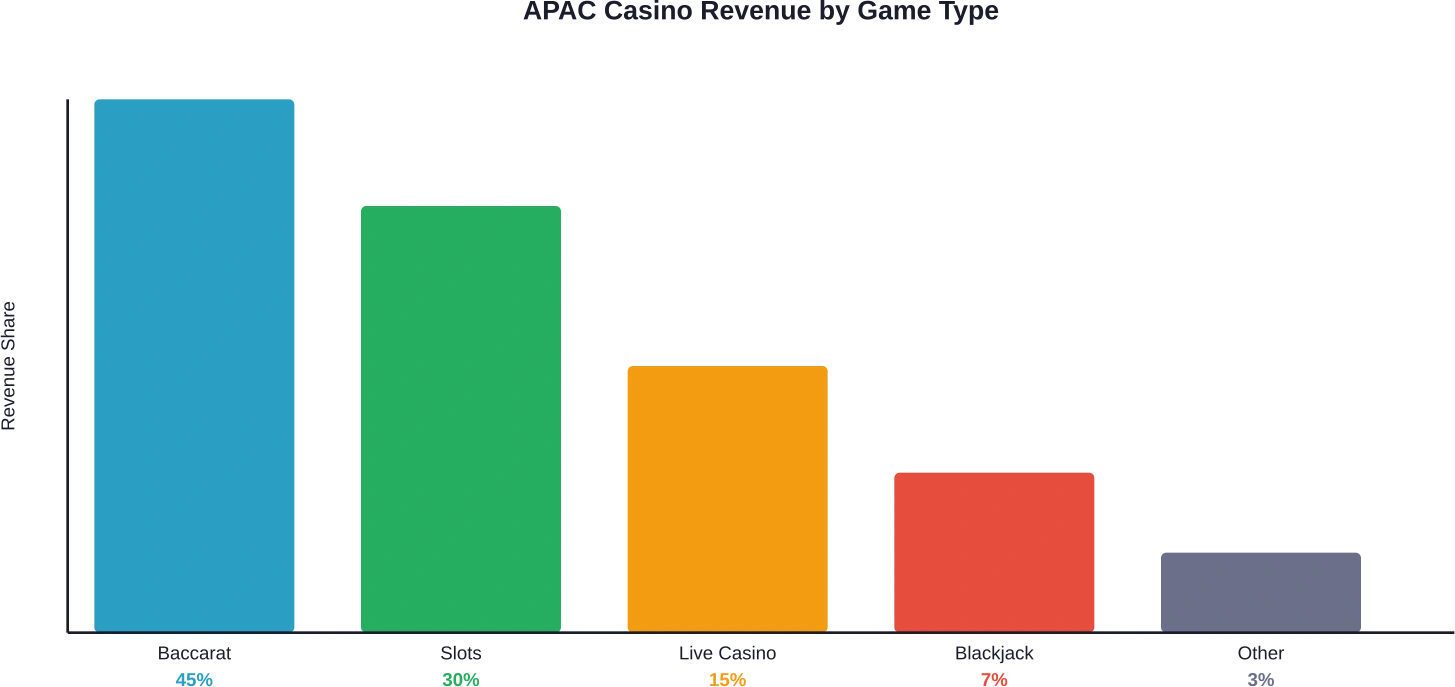
Baccarat dominates Asian casino floors in ways that surprise Western observers. The game accounts for the majority of table game revenue in Macau and Singapore, reflecting strong cultural preferences.
Other significant segments include slots, live casino games, blackjack, and poker. The market is segmented by type into these categories, with each showing different growth trajectories.
Social casino games represent a growing adjacent market. According to Grand View Research, the Asia Pacific social casino market is expected to reach US$ 4,149.7 million by 2030, growing at a 13.3% CAGR from 2025 to 2030. Slots was the largest segment within social casinos in 2024.
Online vs. Land-Based Preferences
Physical casinos still generate the bulk of revenue, but online platforms are closing the gap rapidly. The online segment benefits from accessibility, convenience, and the ability to serve markets where land-based casinos face regulatory restrictions.
Live dealer games bridge these formats, offering the experience of table games with real dealers streamed via video, combining online convenience with the social elements of physical casinos.
Player Segmentation
The market serves diverse player types: gambling enthusiasts who drive significant revenue despite representing a smaller percentage of players, dabblers who gamble occasionally, lottery loyalists, and unengaged audiences who rarely or never gamble.
VIP and high-roller segments remain crucial revenue drivers, particularly in Macau and Singapore. These players generate disproportionate revenue but require specialized services, credit arrangements, and relationship management.
Major Players and Competitive Landscape
The APAC casino market features a mix of international gambling giants and regional operators, each pursuing distinct strategies.
Dominant International Operators
Las Vegas Sands Corp operates Marina Bay Sands in Singapore and holds a majority stake in Sands China Ltd., which operates its Macau properties. The company pioneered the integrated resort model in Asia.
MGM China Holdings operates MGM Macau and MGM Cotai, bringing Las Vegas-style entertainment to Asian markets with adaptations for local preferences.
Melco Resorts & Entertainment focuses exclusively on Asia, operating properties in Macau, the Philippines, and Cyprus. This regional specialization differentiates it from competitors with global portfolios.
Regional Champions
Galaxy Entertainment Group ranks among Macau’s largest operators with multiple properties including Galaxy Macau, a massive integrated resort offering extensive gaming and non-gaming amenities.
Genting Berhad, based in Malaysia, operates casinos across Southeast Asia including Resorts World Sentosa in Singapore and Resorts World Genting in Malaysia. The company has expanded globally while maintaining strong Asian roots.
Competitive Dynamics
Competition centers on several dimensions: securing favorable regulatory positions and licenses, developing integrated resorts that appeal to both gaming and non-gaming visitors, building VIP customer relationships, and investing in technology for operations and customer experience.
Market concentration varies by country. Macau and Singapore have oligopolistic structures with limited licenses. The Philippines and emerging markets show more competitive fragmentation.
Challenges and Risk Factors
Despite strong growth projections, the APAC casino market faces significant headwinds that could constrain expansion or create volatility.
Regulatory Uncertainty
Government policies toward gambling remain unpredictable across the region. China’s crackdown on capital outflows directly impacted Macau VIP gaming. Regulatory shifts in any major market can cascade throughout the regional industry.
Online gambling faces particular regulatory complexity. Many countries prohibit or restrict online gambling while lacking effective enforcement mechanisms, creating ambiguous operating environments.
Social and Political Opposition
Gambling addiction concerns drive opposition in many countries. Social costs associated with problem gambling create political pressure for restrictions, particularly as markets liberalize and gambling becomes more accessible.
Some countries face cultural or religious opposition to gambling expansion, limiting growth potential in specific markets regardless of economic factors.
Economic Volatility
Casino gambling is highly cyclical and sensitive to economic conditions. Recessions or slowdowns can dramatically reduce revenues, particularly from VIP segments where players may face liquidity constraints.
Currency fluctuations add another layer of volatility for international operators managing multi-country portfolios.
Competition from Alternative Entertainment
Gambling competes with other entertainment options for discretionary spending. E-sports, streaming entertainment, mobile gaming (non-gambling), and other digital entertainment formats increasingly vie for the same consumer time and money.
Emerging Trends Shaping the Future
Several trends are reshaping how casino gaming operates and what forms future growth will take.
Mobile-First Gaming Experiences
Mobile platforms now represent the primary interface for many online gambling customers. Operators are designing experiences specifically for smartphone use rather than adapting desktop interfaces.
This shift extends beyond online-only operators. Traditional casino companies are developing mobile apps for customer engagement, loyalty programs, and even on-property gaming management.
Cryptocurrency and Blockchain Integration
Some online platforms have begun accepting cryptocurrency payments, offering anonymity and faster transactions. Blockchain technology promises transparent, verifiable fairness for online casino games.
Regulatory acceptance remains limited, but technological experimentation continues in jurisdictions with favorable frameworks.
E-Sports Betting Convergence
E-sports betting has fueled demand growth in online gambling platforms. The convergence of gaming culture and gambling creates new customer acquisition pathways, particularly for younger demographics.
Traditional sports betting and casino gaming operators are adding e-sports offerings to capture this growing segment.
AI and Personalization
Artificial intelligence enables sophisticated customer analytics, personalized marketing, and dynamic pricing. Casinos are using AI for pit management, fraud detection, and optimizing operations.
Personalization extends to game recommendations, bonus structures, and VIP services tailored to individual player preferences and behaviors.
Non-Gaming Revenue Diversification
Integrated resorts continue emphasizing non-gaming revenue streams—hotels, dining, retail, entertainment, and MICE (meetings, incentives, conventions, exhibitions) facilities.
This diversification reduces regulatory risk, appeals to broader customer segments, and provides revenue stability when gaming revenues fluctuate.
Investment and Development Pipeline
Substantial capital continues flowing into APAC casino development despite various headwinds.
Japan’s integrated resort projects represent multi-billion dollar investments that will reshape the regional landscape once operational. Osaka’s development, in particular, has attracted significant international attention.
Vietnam continues attracting casino investment, with several projects in development or recently opened. The country’s evolving regulatory framework and tourism appeal make it an attractive destination for operators.
Online platform investments are accelerating. Technology infrastructure, payment processing, game development, and marketing represent major capital allocation areas for digital operators.
Existing properties in established markets like Macau and Singapore continue investing in renovations, expansions, and technology upgrades to maintain competitiveness.
Market | Key Characteristics | Growth Outlook | Major Challenges |
|---|---|---|---|
Macau | World’s largest gambling market, VIP-focused, integrated resorts | Moderate (mature market) | Chinese regulatory pressure, VIP segment volatility |
Singapore | Premium integrated resorts, limited licenses, high barriers | Stable (controlled growth) | Oligopolistic constraints, limited expansion |
Philippines | Liberal licensing, POGO sector, developing integrated resorts | Strong (emerging market) | Regulatory unpredictability, political factors |
Japan | Newly legalized, enormous potential, slow rollout | Very strong (long-term) | Development delays, local opposition |
Online | Mobile-first, regulatory arbitrage, rapid technology evolution | Very strong (highest CAGR) | Regulatory uncertainty, payment processing |
Frequently Asked Questions
What is the projected size of the APAC casino market by 2030?
The APAC casino market is expected to reach approximately USD 117.07 billion by 2030, with strong growth in both land-based and online segments.
Which countries dominate the APAC casino market?
Macau and Singapore dominate the region, generating the majority of casino revenue.
What are the main drivers of APAC casino market growth?
Growth is fueled by rising incomes, tourism, mobile adoption, and expanding integrated resort developments.
How does online casino growth compare to land-based casinos in APAC?
Online casinos are growing faster than traditional venues, driven by mobile gaming and digital accessibility.
What role does baccarat play in APAC casinos?
Baccarat is the dominant table game in the region, particularly in markets like Macau and Singapore.
Which companies are the major players in the APAC casino market?
Major players include Galaxy Entertainment, Las Vegas Sands, MGM China, Genting, and Melco Resorts.
What are the biggest challenges facing APAC casino operators?
Key challenges include regulatory uncertainty, economic fluctuations, and competition from alternative entertainment.
The Road Ahead for APAC Casino Markets
The Asia-Pacific casino market stands at a fascinating inflection point. Strong fundamentals—economic growth, tourism expansion, technology adoption—suggest continued momentum through 2030 and beyond.
But the path forward isn’t simply linear growth extrapolated from current trends.
Regulatory evolution will determine which markets unlock their potential and which face constraints. Japan’s rollout, India’s potential liberalization, and China’s ongoing approach to Macau all represent variables that could significantly alter projections.
The online-offline balance will continue shifting. Mobile platforms offer convenience and accessibility that physical venues can’t match, particularly in markets with limited land-based options. Yet integrated resorts provide premium experiences and non-gaming amenities that create distinct value propositions.
Technology will keep reshaping operations, customer experiences, and competitive dynamics. AI, blockchain, personalization, and yet-unimagined innovations will differentiate winners from laggards.
For operators, investors, and industry observers, the APAC casino market offers both enormous opportunities and significant risks. Success requires understanding local market nuances, navigating complex regulatory environments, and adapting to rapid technological change.
The doubling of market size projected by 2030 represents not gradual expansion but fundamental transformation of how millions across Asia-Pacific engage with casino gaming. That transformation is well underway, creating one of the world’s most dynamic gambling markets and reshaping the global casino industry’s center of gravity.
Related Articles

September 29, 2026Is the Casino Legal in Japan? The Real Answer...

September 29, 2026Is the Casino Legal in Gambia? What the Law...