 Nothing found for the request

Casino Gaming Equipment Market Trends 2026 & Forecast
Sologe March 30, 2026
Share:


Market Size and Growth Trajectory
Understanding market size requires acknowledging the different scopes and timeframes researchers employ. Here’s the thing though—despite numerical variations, the directional trend remains unmistakably positive.
Research Firm | 2024-2025 Valuation | Forecast Year | Projected Size | CAGR |
|---|---|---|---|---|
Market Research Future | $7.5 billion (2024) | 2035 | $11.98 billion | 4.35% |
IMARC Group | $12.3 billion (2025) | 2034 | $15.4 billion | 2.52% |
Maximize Market Research | $14.43 billion (2024) | 2032 | $22.32 billion | 5.6% |
Reports Insights Consulting | $15.2 billion (2026) | 2033 | $32.2 billion | 9.8% |
Technavio | Base year 2024 | 2025-2029 | N/A | 5.2% |
The range of growth rates—from a conservative 2.52% to an aggressive 9.8%—reflects different assumptions about regulatory expansion, technological adoption rates, and economic recovery patterns across global markets.
Slot machines represent the cornerstone of casino revenue, accounting for approximately 70% of the average US casino income according to Technavio’s research. This dominance explains why slot machine innovation drives much of the equipment market’s evolution.
But wait. The equipment category extends far beyond slots. Gaming chips, casino tables, video poker machines, and emerging digital gaming interfaces all contribute to the overall market composition.
Key Market Drivers Shaping Industry Growth
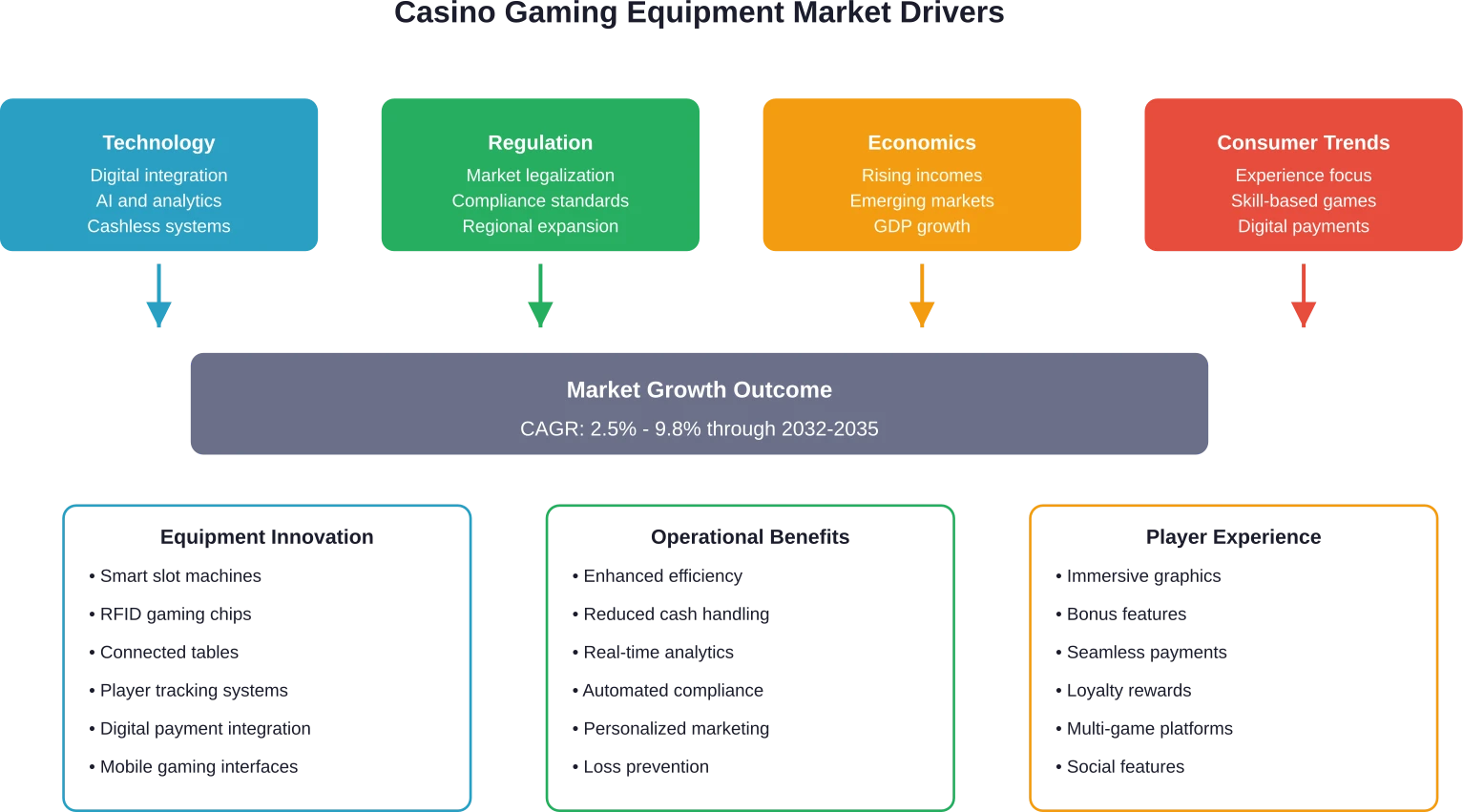
Multiple forces converge to propel the casino gaming equipment market forward. Understanding these drivers provides context for why different analysts project varying growth trajectories.
Technological Advancement and Digital Integration
Modern casino equipment bears little resemblance to the mechanical slot machines of decades past. Today’s gaming devices incorporate sophisticated software, connectivity features, and data analytics capabilities that transform the player experience.
Evolution AB’s acquisition of Galaxy Gaming for $85 million exemplifies how major operators invest in technology to strengthen market positioning. This strategic move aimed to reinforce Evolution’s US market presence and expand their product portfolio.
According to data from the Nevada Gaming Control Board’s Technology Division, gaming technology approval statistics from 2023-2024 demonstrate increasing submission volumes for connected gaming devices, mobile gaming platforms, and cashless payment systems.
These technological advancements help casino operators enhance operational efficiency, streamline payment systems, and offer personalized gaming experiences. Player tracking systems now integrate with casino CRM platforms, enabling targeted marketing and loyalty programs that drive repeat visits.
Regulatory Expansion and Legalization Trends
The global regulatory landscape continues shifting toward legalization and regulation of gambling activities. This trend opens new markets and creates demand for compliant gaming equipment.
Flutter Entertainment plc announces that it has completed the acquisition of a 51% stake in MaxBet on 9 January 2024 for €141m (£121m). Each market entry requires equipment procurement, installation, and ongoing technology updates.
Regulatory frameworks vary significantly by jurisdiction, creating complexity for equipment manufacturers who must design products meeting diverse compliance requirements. The Nevada Gaming Control Board publishes comprehensive gaming statutes and regulations that often serve as benchmarks for other jurisdictions developing their regulatory approaches.
Rising Disposable Income in Emerging Markets
Economic growth in Asia-Pacific regions drives gambling participation rates upward. Real GDP per capita growth in several Asian developing countries during 2015-2017 demonstrates this economic expansion:
Country | 2015 | 2016 | 2017 |
|---|---|---|---|
Uzbekistan | 6.6% | 7.8% | 5.3% |
China | 6.5% | 6.7% | 6.9% |
Myanmar | 6.1% | 5.9% | 6.4% |
India | 5.8% | 7.1% | 6.6% |
Vietnam | 6.7% | 6.2% | 6.8% |
Cambodia | 5.3% | 7.0% | 6.9% |
Higher disposable incomes correlate with increased discretionary spending on entertainment and gambling activities. As middle-class populations expand in these regions, demand for casino entertainment grows correspondingly.
This economic dynamic creates opportunities for equipment manufacturers targeting emerging markets with localized products and pricing strategies.
Consumer Preference Shifts and Experience Expectations
Modern casino patrons expect experiences comparable to other entertainment venues. Gaming equipment must deliver engaging visuals, responsive interfaces, and seamless integration with loyalty programs and payment systems.
Younger demographics particularly favor skill-based gaming elements over pure chance mechanics. This preference drives equipment innovation toward hybrid games blending traditional gambling with interactive entertainment features.
The integration of cashless payment systems addresses both operational efficiency and consumer convenience. Digital wallets, mobile payments, and RFID-enabled chips reduce cash handling costs while providing players with frictionless transactions.
Market Segmentation Analysis
The casino gaming equipment market fragments across multiple dimensions—product type, application, installation format, and operational mode. Each segment demonstrates distinct growth patterns and competitive dynamics.
By Product Type
Slot machines dominate the product category, representing the largest revenue share and fastest growth segment. Their popularity stems from low operational complexity, high profit margins, and constant innovation in themes, features, and jackpot structures.
Gaming chips and casino tables constitute the second major category. RFID-enabled chips increasingly replace traditional clay variants, enabling automated tracking of chip movement, bet validation, and security monitoring.
Video poker machines occupy a middle ground between slots and table games, attracting players who prefer strategic decision-making over pure chance. This segment shows moderate but steady growth.
The “others” category encompasses roulette wheels, dice, shufflers, card shoes, and specialty gaming accessories. While individually smaller, these products collectively represent meaningful revenue streams for equipment manufacturers.
By Application and Installation
Casinos represent the primary application segment, accounting for the overwhelming majority of equipment sales. This category includes destination resort casinos, local casinos, riverboat casinos, and tribal gaming facilities.
Shopping malls and entertainment complexes in certain jurisdictions incorporate gaming zones, creating a secondary market for equipment designed for non-traditional venues. These installations typically feature fewer machines in curated layouts emphasizing accessibility and family-friendly environments.
Installation formats divide between replacement equipment and new installations. Replacement cycles vary by equipment type—slot machines typically see refresh cycles of 3-5 years, while table game furniture lasts considerably longer.
By Mode of Operation
Standalone gaming machines operate independently, without connectivity to central systems. These devices suit smaller operations or jurisdictions with minimal regulatory requirements for electronic monitoring.
Networked equipment connects to casino management systems, enabling centralized monitoring, remote diagnostics, progressive jackpot participation, and player tracking integration. This category demonstrates the strongest growth as operators prioritize data-driven decision making.
The shift toward networked equipment accelerates as technology costs decline and regulatory frameworks increasingly mandate electronic reporting capabilities.
Regional Market Dynamics
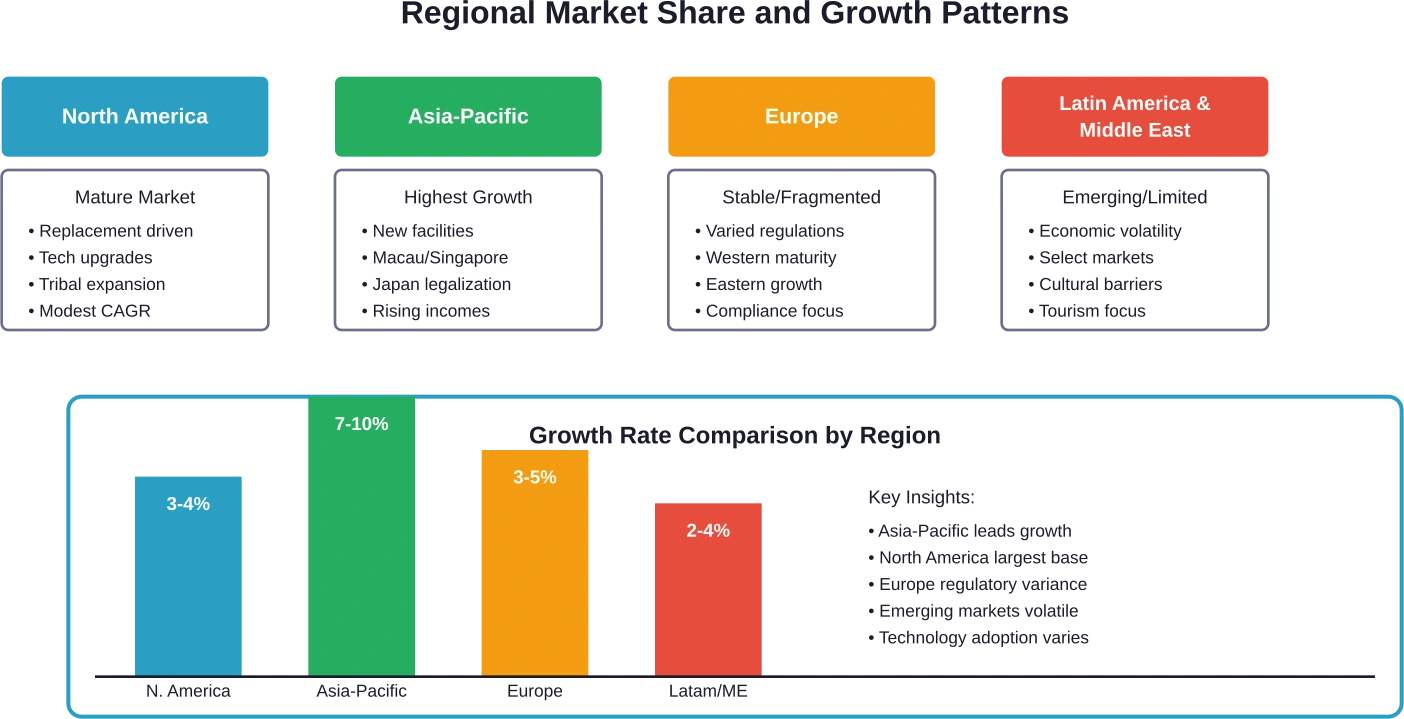
Geographic patterns in casino gaming equipment demand reflect regulatory environments, economic conditions, and cultural attitudes toward gambling.
North America
North America represents a mature but evolving market. The United States, with its state-by-state regulatory framework, creates complexity for manufacturers who must navigate varying compliance requirements across jurisdictions.
Casino expansion in tribal lands continues, driven by exclusive gaming rights granted to Native American tribes. These facilities often feature premium equipment to differentiate from commercial competitors.
Canada maintains a more conservative approach with provincial crown corporations controlling most gaming operations. Equipment procurement follows structured bidding processes emphasizing reliability and regulatory compliance.
Asia-Pacific
The Asia-Pacific region demonstrates the highest growth rates globally. Macau’s casino industry drives significant equipment demand despite regulatory pressures and periodic market contractions.
Japan’s recent legalization of integrated resorts creates substantial new market opportunities. The first facilities entering operation require comprehensive equipment installations spanning thousands of machines and gaming positions.
Singapore maintains a controlled market with two major integrated resorts. Equipment refresh cycles and technology upgrades generate consistent demand despite limited facility expansion.
Emerging markets across Southeast Asia—Cambodia, Vietnam, the Philippines—continue developing gaming infrastructure. These markets favor cost-effective equipment with proven reliability over cutting-edge innovation.
Europe
European markets display considerable fragmentation across national regulatory frameworks. The United Kingdom maintains a well-established casino sector with stringent equipment certification requirements.
Eastern European markets demonstrate growth potential as regulatory frameworks mature and disposable incomes rise. Countries like Poland, Czech Republic, and Romania expand gaming footprints gradually.
Western European countries generally maintain stable but slow-growing markets, with equipment demand driven primarily by replacement cycles rather than facility expansion.
Latin America and Middle East
Latin America shows moderate growth constrained by economic volatility and inconsistent regulatory approaches. Argentina, Chile, and Mexico represent the largest markets with established casino industries.
Middle Eastern markets remain limited by religious and cultural restrictions on gambling. However, certain jurisdictions explore gaming as tourism development tools, potentially opening new markets.
Technological Innovation Trends
Technology reshapes casino gaming equipment at an accelerating pace. Innovations span hardware capabilities, software sophistication, connectivity options, and data analytics integration.
Smart Gaming Machines and IoT Integration
Modern slot machines function as sophisticated computers rather than mechanical devices. High-definition displays, multi-touch interfaces, and immersive audio create engaging player experiences that rival home entertainment systems.
Internet of Things connectivity enables real-time monitoring of machine performance, player behavior, and revenue generation. Operators receive instant alerts about malfunctions, suspicious activity, or machines requiring service attention.
Remote software updates eliminate the need for technician visits to modify game configurations, adjust payout percentages, or deploy new content. This capability reduces operational costs while enabling dynamic floor optimization based on performance data.
Cashless Gaming and Digital Payment Systems
The migration toward cashless gaming accelerates, driven by operational efficiency, security benefits, and player convenience. Digital wallets linked to player accounts enable seamless deposits, withdrawals, and rewards redemption.
Mobile payment integration allows players to fund gaming sessions via smartphone apps, eliminating trips to ATMs or cashier cages. This friction reduction correlates with increased player engagement and longer gaming sessions.
Cryptocurrency adoption remains experimental in select jurisdictions, with regulatory uncertainty limiting widespread implementation. However, blockchain-based loyalty programs and provably fair gaming algorithms attract developer interest.
Artificial Intelligence and Predictive Analytics
AI algorithms analyze player behavior patterns to identify high-value customers, predict churn risk, and recommend personalized offers. This capability transforms generic marketing campaigns into targeted interventions maximizing lifetime value.
Predictive maintenance models process equipment telemetry to forecast component failures before breakdowns occur. This proactive approach minimizes downtime and extends asset lifespans through timely preventive service.
Responsible gaming applications use AI to detect problematic gambling patterns and trigger interventions ranging from self-exclusion prompts to counselor referrals. Regulatory pressure drives adoption of these player protection technologies.
Skill-Based Gaming and Hybrid Models
Traditional slot machines rely entirely on random number generation, offering no player agency beyond bet sizing and game selection. Skill-based variants incorporate interactive elements where player decisions influence outcomes within regulated parameters.
These hybrid games target younger demographics raised on video games who find pure chance mechanics less engaging. Early implementations show mixed results, with regulatory complexity and player education challenges limiting adoption.
The tension between gambling regulation—which traditionally requires outcome independence from player skill—and engaging gameplay creates design constraints manufacturers continue navigating.
Virtual Reality and Immersive Experiences
VR gaming remains largely experimental in casino environments. Hardware costs, hygiene concerns with shared headsets, and limited content libraries constrain mainstream adoption.
However, augmented reality applications show more promise. AR overlays on table games can display statistics, game history, and interactive tutorials without requiring dedicated headsets.
The metaverse concept inspires exploration of hybrid physical-digital gaming experiences, though practical implementations remain nascent.
Competitive Landscape and Key Players
The casino gaming equipment market concentrates among several major manufacturers with global reach, alongside regional specialists serving local markets.
Leading Equipment Manufacturers
International Game Technology (IGT) ranks among the largest slot machine manufacturers globally. Their product portfolio spans video slots, video poker, electronic table games, and casino management systems.
Scientific Games Corporation (now Light & Wonder following corporate restructuring) maintains substantial market share across gaming machines, table games, and lottery systems. Their content library includes licensed brands commanding premium floor positions.
Aristocrat Leisure Limited dominates certain regional markets, particularly Asia-Pacific. Their focus on premium gaming experiences and cabinet innovation supports market positioning despite higher price points.
Novomatic AG operates across gaming equipment manufacturing, casino operations, and technology services. This vertical integration provides market insights informing product development.
Konami Gaming represents Japanese manufacturing expertise applied to casino equipment. Their video slot innovations frequently introduce industry trends competitors later adopt.
Emerging and Regional Players
Casino Technology Ltd. focuses on emerging markets with cost-competitive products meeting regulatory requirements without premium pricing.
APEX gaming technology GmbH serves European markets with products tailored to regional regulatory frameworks and operator preferences.
Galaxy Gaming, acquired by Evolution AB for $85 million, specializes in table game content and side bet products. This acquisition reflects larger operators expanding beyond slots into comprehensive gaming solutions.
Aruze Gaming America develops innovative cabinet designs and game mechanics targeting differentiated player experiences in competitive markets.
Competitive Strategies
Product differentiation centers on game themes, bonus features, cabinet ergonomics, and technological capabilities. Licensed content from entertainment brands commands floor space through player recognition and engagement.
Geographic expansion strategies vary between pursuing high-growth emerging markets versus deepening presence in mature regions. Risk tolerance for regulatory uncertainty influences these decisions.
Vertical integration attracts certain operators seeking control over gaming content, distribution, and operational systems. Others maintain focus on core manufacturing competencies while partnering for complementary capabilities.
Merger and acquisition activity reshapes competitive dynamics as companies pursue scale economies, technology acquisition, and market access. Consolidation pressures smaller manufacturers lacking resources for sustained R&D investment.
Regulatory Environment and Compliance Considerations
Gaming equipment faces stringent regulatory oversight governing fairness, security, and operational transparency. Compliance requirements vary dramatically across jurisdictions, creating complexity for manufacturers serving global markets.
Testing and Certification Requirements
Independent testing laboratories evaluate gaming equipment against technical standards before regulatory approval. These assessments verify random number generation integrity, payout percentage accuracy, and security against tampering.
The Nevada Gaming Control Board’s Technology Division publishes approval statistics demonstrating submission volumes and approval timelines. Their processes often serve as benchmarks for other jurisdictions developing certification frameworks.
Certification costs and timelines create barriers to market entry, particularly for smaller manufacturers. Approval in one jurisdiction doesn’t guarantee acceptance elsewhere, requiring duplicate testing and documentation.
Responsible Gaming and Player Protection
Regulatory frameworks increasingly mandate responsible gaming features including session time limits, loss limits, and self-exclusion capabilities. Equipment must support these interventions through software configuration and player account integration.
Data retention requirements specify minimum periods for game outcome logs, player transaction histories, and equipment diagnostic records. Storage and security of this data falls under comprehensive audit requirements.
Anti-money laundering compliance drives transaction monitoring capabilities and reporting mechanisms. Equipment supporting cashless gaming must integrate with casino-wide compliance systems tracking fund flows.
Technical Standards Evolution
Gaming standards organizations develop consensus technical specifications balancing innovation enablement with consumer protection. Participation in these standards bodies allows manufacturers to influence requirements affecting product development.
Cybersecurity standards address growing connectivity of gaming equipment to casino networks and external systems. Encryption requirements, access controls, and vulnerability management protocols create baseline security expectations.
Environmental and accessibility standards expand regulatory scope beyond traditional gaming integrity concerns. Energy efficiency, materials recyclability, and accessibility for disabled players increasingly factor into equipment design.
Market Challenges and Constraints
Despite positive growth trajectories, the casino gaming equipment market confronts significant headwinds affecting development pace and profitability.
Regulatory Uncertainty and Fragmentation
Jurisdictional differences in gaming regulations create compliance complexity and market fragmentation. Products designed for one market may require substantial modifications for others, increasing development costs and time-to-market.
Regulatory changes introduce risk into long-term product planning. Equipment designed around specific regulatory frameworks may become obsolete if requirements shift, stranding development investments.
Economic Sensitivity and Discretionary Spending
Casino gaming represents discretionary spending highly correlated with economic confidence and disposable income. Economic downturns disproportionately impact gaming revenues, creating cyclical demand patterns for equipment.
Operators delay equipment purchases during revenue contractions, extending replacement cycles and deferring facility expansions. This dynamic creates lumpy demand patterns challenging for manufacturers managing production capacity.
Technology Transition Costs
Migration from legacy systems to modern networked equipment requires substantial capital investment. Smaller operators with limited budgets struggle to justify these expenditures despite long-term benefits.
Integration complexity between new equipment and existing casino management systems creates implementation risks. Failed deployments damage manufacturer reputations and create customer hesitancy toward innovation adoption.
Competition from Online Gaming
Online gambling platforms compete for entertainment spending, particularly among younger demographics comfortable with digital experiences. This competition pressure affects land-based casino traffic and indirectly impacts equipment replacement demand.
However, this dynamic also drives land-based operators toward equipment upgrades creating differentiated experiences unavailable online. Physical presence, social interaction, and premium amenities become competitive advantages requiring supporting technology.
Future Outlook and Emerging Opportunities
Looking forward, several trends position the casino gaming equipment market for sustained evolution beyond simple expansion.
Convergence of Online and Land-Based Gaming
Omnichannel gaming strategies blur boundaries between online and physical casino experiences. Players increasingly expect seamless account portability, unified loyalty programs, and consistent game availability across channels.
Equipment supporting this convergence—enabling players to begin gaming sessions online and continue in physical locations—represents growth opportunities. Technical challenges around jurisdiction restrictions and identity verification require navigation.
Data-Driven Personalization
Advanced analytics enable unprecedented personalization of gaming experiences. Dynamic game recommendations, customized bonus structures, and individualized marketing interventions become standard capabilities rather than premium features.
Privacy regulations constrain certain data collection and usage practices, creating tension between personalization ambitions and compliance requirements. Balancing these competing demands shapes product development priorities.
Sustainability and Environmental Considerations
Environmental sustainability emerges as a procurement criterion for equipment purchases. Energy efficiency, materials sourcing, and end-of-life recyclability influence buying decisions beyond traditional performance and cost factors.
Manufacturers investing in sustainable product design and manufacturing processes gain competitive advantages with environmentally conscious operators and jurisdictions implementing green gaming initiatives.
Expansion into Non-Traditional Venues
Gaming equipment deployment beyond traditional casinos—airports, hotels, entertainment venues—creates incremental demand. These installations typically feature smaller footprints with curated game selections optimizing space efficiency.
Regulatory frameworks governing gaming outside dedicated casino facilities vary significantly. Successful expansion requires navigating complex approval processes while designing products appropriate for mixed-use environments.
Investment Considerations and Market Entry Strategies
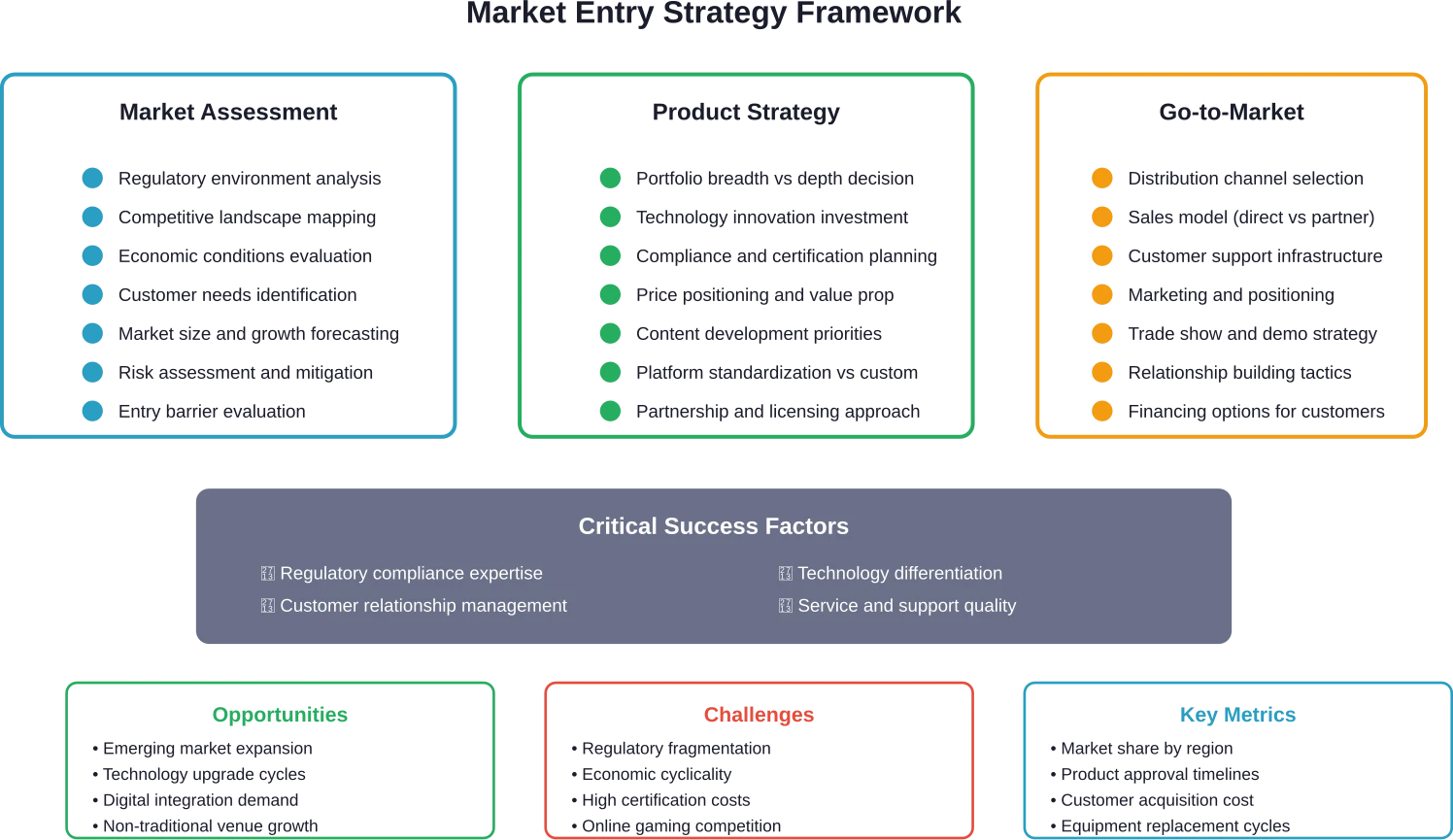
For companies considering market entry or expansion, several strategic factors warrant evaluation.
Geographic Market Selection
High-growth markets attract investment but often feature regulatory uncertainty, underdeveloped infrastructure, and competitive intensity. Mature markets offer stability but limited expansion potential beyond replacement demand.
Strategic market selection balances growth potential against risk tolerance and competitive positioning. Regional specialists may achieve better returns focusing on underserved markets versus competing against established manufacturers in contested territories.
Product Portfolio Strategy
Broad product portfolios enable one-stop shopping for casino operators while requiring substantial R&D investment across multiple equipment categories. Specialists focusing on narrow segments may achieve superior products within their niches.
The choice between breadth and depth depends on target customer segments, competitive dynamics, and internal capabilities. Partnerships and licensing arrangements offer middle-ground approaches.
Technology Investment Priorities
Determining technology investment allocation requires assessing regulatory trajectories, customer readiness, and competitive positioning. Cutting-edge innovation creates differentiation but risks market timing miscalculations.
Balancing innovation with proven reliability remains fundamental in an industry where equipment failures directly impact operator revenues. Conservative operators prefer evolutionary improvements over revolutionary changes introducing operational risk.
Industry Consolidation and M&A Activity
Merger and acquisition activity reshapes the competitive landscape as companies pursue growth, technology acquisition, and geographic expansion through corporate combinations.
Evolution AB’s $85 million acquisition of Galaxy Gaming exemplifies strategic acquisitions targeting US market expansion and product portfolio diversification. This transaction provided Evolution with established table game content and customer relationships complementing their existing capabilities.
Scale economies drive consolidation pressures particularly affecting smaller manufacturers lacking resources for sustained R&D investment. Development costs for modern gaming equipment—spanning hardware engineering, software development, regulatory compliance, and content creation—create barriers favoring larger organizations.
Technology acquisition motivates certain transactions as established manufacturers purchase innovative startups rather than developing capabilities internally. This approach accelerates time-to-market while acquiring specialized expertise.
Geographic expansion through acquisition provides immediate market access with existing customer relationships, regulatory approvals, and local operational knowledge. Organic expansion into unfamiliar markets carries substantially higher risk and longer timelines.
Source the Right Casino Equipment and Partners in One Place

As the casino gaming equipment market evolves, operators are dealing with more choices across hardware, platforms, integrations, and service providers. The challenge is less about availability and more about finding the right combination that actually works together. Sologe brings that process into one place – a B2B marketplace where operators and developers can discover, compare, and connect with providers across equipment, technology, and supporting services.
If you’re reviewing suppliers or planning new investments, this is usually where things get fragmented and time-consuming. Instead of handling it piece by piece, it’s easier to structure it properly from the start. Get in touch, explore available providers, and connect directly with Sologe to build the right setup for your casino operation.
Frequently Asked Questions
What’s the current size of the casino gaming equipment market?
The market is estimated between USD 7.5 billion and USD 14.4 billion depending on methodology and scope.
What growth rate can the industry expect through 2035?
Most forecasts suggest steady growth of around 4–6% annually, with some higher estimates.
Which region shows the highest growth potential?
Asia-Pacific leads growth due to expanding economies and new casino developments.
What percentage of casino revenue comes from slot machines?
Slots generate about 70% of casino revenue, making them the most important gaming product.
What are the main technology trends affecting the market?
Trends include cashless gaming, AI analytics, IoT connectivity, and mobile integration.
How does regulatory complexity impact equipment manufacturers?
Different regulations increase compliance costs and slow down product deployment across markets.
Who are the leading companies in the casino gaming equipment market?
Key players include IGT, Light & Wonder, Aristocrat, Novomatic, and Konami Gaming.
Conclusion
The casino gaming equipment market stands at the intersection of tradition and innovation. While fundamental gaming concepts remain largely unchanged, the technology delivering those experiences evolves rapidly.
Market growth trajectories—whether the conservative 2.52% CAGR or aggressive 9.8% projections—point toward expansion driven by regulatory liberalization, technological advancement, and rising global prosperity. Geographic variation creates opportunities for manufacturers willing to navigate complex regulatory environments and cultural preferences.
Technology continues reshaping competitive dynamics. Manufacturers investing in connectivity, analytics, cashless systems, and player engagement features position themselves for sustained relevance. Those clinging to legacy approaches face increasing pressure from innovative competitors and changing customer expectations.
The regulatory landscape presents both challenges and moats. Compliance complexity creates barriers protecting established manufacturers while limiting innovation pace. Successfully navigating these frameworks requires specialized expertise becoming competitive advantages in itself.
For casino operators, equipment decisions increasingly factor beyond initial purchase costs to consider total cost of ownership, operational efficiency, player engagement metrics, and technology roadmaps. Vendors demonstrating partnership orientation rather than transactional relationships build sustainable competitive positions.
Looking ahead, the convergence of physical and digital gaming, data-driven personalization, and expansion into non-traditional venues creates opportunities for innovative manufacturers. Success requires balancing proven reliability with forward-looking innovation—no small feat in a conservative industry where equipment failures directly impact operator revenues.
The casino gaming equipment market’s evolution continues, shaped by technology, regulation, economics, and shifting consumer preferences. Companies anticipating these forces position themselves to capture disproportionate growth as the industry navigates its next chapter.
Ready to explore how gaming equipment trends might impact your operations? Stay informed about market developments, regulatory changes, and technological innovations shaping this dynamic industry.
Related Articles

September 29, 2026Is the Casino Legal in Japan? The Real Answer...

September 29, 2026Is the Casino Legal in Gambia? What the Law...