 Nothing found for the request

Casino Hotel Market 2026: Growth, Trends & Forecast
Sologe March 27, 2026
Share:


Market Size and Growth Projections
The numbers tell a compelling story. Market size reached $172.33 billion in 2024, with projections showing growth to $182.61 billion in 2025. By 2035, the market is expected to reach $325.85 billion, representing a compound annual growth rate of 5.96% from 2025 through 2035.
Different research methodologies produce varying estimates. Future Market Insights analysis projects the 2026 market at USD 127.8 billion, with growth to USD 239.9 billion by 2036 at a 6.5% CAGR. The variance reflects different segmentation approaches and regional coverage.
What’s consistent across forecasts? Sustained growth momentum. The casino hotel industry isn’t experiencing explosive expansion like emerging tech sectors, but it’s demonstrating steady, reliable growth that attracts long-term capital investment.
IBISWorld data indicates the U.S. casino hotels industry market size at $84.6 billion. This represents roughly half the global market, underscoring North America’s dominance in gaming hospitality.
Growth rates aren’t uniform across regions or segments. Markets with newly legalized gaming see higher initial growth rates. Mature markets like Nevada show more moderate but stable expansion.
Show Your Hospitality or Gaming Solution to the Right Buyers

For companies working around the casino hotel market, getting in front of relevant operators and partners can be difficult through general channels alone. Sologe provides a more direct route. The platform is a dedicated iGaming marketplace where vendors list products and services, and buyers use the site to evaluate suppliers and start conversations.
Want to Present Your Offering to Gaming Buyers?
Use Sologe to:
- list your company inside a marketplace built for the gaming industry
- make your offering easier for operators to find
- stay visible on a platform focused on vendor discovery
👉 Get in touch with Sologe to discuss how your company can be listed on the platform.
Key Market Drivers and Trends
Several forces propel casino hotel market expansion. Understanding these drivers helps explain why growth persists despite economic headwinds and regulatory challenges.
Gambling Tourism Expansion
Gambling tourism represents the core growth engine. Travelers increasingly seek integrated entertainment experiences where gaming is one component among many attractions.
According to the American Hotel & Lodging Association’s economic impact analysis, hotel operations—including casino hotels—contribute significantly to state economies through both direct operations and guest ancillary spending. The research analyzed hotel guest spending patterns, revealing substantial economic multiplier effects.
Casino hotels capitalize on this by offering comprehensive destination experiences. Guests spend on accommodations, dining, entertainment, spa services, and shopping in addition to gaming.
Regulatory Evolution
Regulatory changes unlock new markets and revenue streams. The Nevada Gaming Control Board has issued guidance including Race and Sports Minimum Internal Control Standards (Notice 2026-04), reflecting the growing importance of sports betting integration.
Japan’s casino market opening represents one of the most significant regulatory shifts. Sovereign wealth-backed projects create entirely new gaming revenue pools. The UAE’s regulatory evolution similarly opens Middle Eastern markets previously closed to casino operations.
Sports betting legalization across U.S. states drives additional traffic to casino hotels. Properties integrate sports books as destination amenities, attracting demographics that might not traditionally visit casinos.
Integrated Entertainment Models
Modern casino hotels function as entertainment complexes. Gaming revenue, while substantial, increasingly shares space with concerts, sporting events, fine dining, nightlife, and luxury retail.
This diversification insulates properties from gaming revenue volatility. When slot and table game revenue moderates, entertainment and hospitality revenue can offset declines.
Las Vegas exemplifies this model. The city maintained solid operating fundamentals in 2026 despite gaming metric moderation, supported by a strong calendar of major events and sports-related visitation.
Technology Integration
Technology reshapes casino hotel operations and guest experiences. Cloud-based hospitality software systems can enable personalized guest experiences, mobile services, and contactless transactions that modern travelers expect.
Property management systems, point of sale integration, and analytics platforms help operators optimize revenue across gaming and non-gaming segments. Data-driven insights inform everything from room pricing to table game offerings.
Digital integration extends beyond operations. Online gaming platforms create hybrid models where digital and physical experiences connect, driving traffic to resort properties.
Regional Market Dynamics
Casino hotel market performance varies significantly by region. Geographic analysis reveals distinct growth patterns, regulatory environments, and competitive landscapes.
North America: Mature But Evolving
North America dominates global casino hotel revenue. The region benefits from established gaming infrastructure, high consumer spending, and ongoing regulatory expansion through sports betting legalization.
Las Vegas continues as the flagship market. While 2025 showed moderation relative to 2024’s exceptional performance, the market demonstrated resilience. Growth patterns normalized following post-pandemic rebounds, but fundamentals remain solid.
Regional casino markets across the U.S. provide geographic diversity. Tribal gaming operations represent a substantial segment, with unique ownership structures and regulatory frameworks under tribal sovereignty.
Atlantic City represents a regional market where operational improvement methodologies have been applied across gaming operations in multiple markets.
Asia-Pacific: Explosive Growth Potential
Asia-Pacific represents the highest growth potential. Macau remains the global gaming revenue leader, though regulatory oversight from Chinese authorities creates volatility.
Japan’s integrated resort openings mark a watershed moment. The market combines massive consumer spending power with previously untapped gaming demand. Projects in development represent multi-billion dollar investments from major international operators.
Singapore’s duopoly model—Marina Bay Sands and Resorts World Sentosa—demonstrates how limited-license markets can generate substantial revenue through ultra-premium positioning.
Middle East: Emerging Frontier
The UAE’s gaming market emergence reshapes Middle Eastern hospitality. Wynn Al Marjan Island’s 2027 opening creates the region’s first major integrated resort with gaming.
This represents sovereign wealth diversification strategies. As oil economies transition, entertainment and tourism infrastructure becomes increasingly important for economic development.
The Middle East market remains nascent, but capital commitment is substantial. Projects leverage luxury hospitality expertise developed through non-gaming resort operations.
Europe: Regulatory Fragmentation
European casino hotels operate within fragmented regulatory frameworks. Each country maintains distinct gaming laws, creating operational complexity for multi-jurisdiction operators.
Established markets like Monaco and Baden-Baden maintain traditional casino operations alongside modern resort amenities. Newer markets experiment with integrated resort models adapted from Asian and American precedents.
Market Segmentation Analysis
The casino hotel market segments across multiple dimensions. Understanding these segments reveals competitive dynamics and growth opportunities.
By Property Type
Land-based casino hotels dominate the market. These properties range from small regional casinos with limited hotel inventory to mega-resorts with thousands of rooms.
Online gaming represents a separate but increasingly connected segment. While purely digital platforms operate differently than physical properties, hybrid models emerge where online operations drive traffic to resort locations.
The distinction between land-based and online continues blurring. Operators increasingly view them as complementary channels rather than competing models.
By Gaming Offerings
Gaming product mix significantly impacts revenue composition. Slot machines typically generate the largest gaming revenue share, followed by table games.
Sports betting integration accelerates across casino hotel properties. Sports books attract younger demographics and drive food and beverage spending around major sporting events.
Other casino games—poker rooms, race books, specialty games—contribute smaller revenue shares but enhance property differentiation and attract specific customer segments.
By Target Audience
Casino hotels target diverse customer segments with varying preferences and spending patterns.
Leisure travelers represent the core market. These guests seek entertainment experiences combining gaming with dining, shows, and resort amenities.
Business travelers utilize casino hotels for meetings, conventions, and corporate events. Properties invest heavily in convention space and business services to capture this segment.
High-rollers generate disproportionate revenue despite representing a small guest count. VIP services, private gaming salons, and luxury accommodations cater to this segment.
Families increasingly represent a target audience as properties develop non-gaming attractions. This segment diversifies revenue and reduces gaming-centric positioning.
By Ownership Structure
Ownership models significantly impact operations and strategic direction.
Corporate ownership dominates the large resort segment. Publicly traded companies like Wynn Resorts, MGM Resorts, and Caesars Entertainment operate multiple properties across jurisdictions.
Tribal gaming represents a substantial segment under unique regulatory frameworks. Tribal sovereignty creates distinct legal and operational environments.
Independent properties, while smaller in aggregate share, provide market diversity and local competition in regional markets.
Segment Type | Key Characteristics | Growth Outlook |
|---|---|---|
Land-Based Resorts | Integrated entertainment, 500+ rooms, multiple gaming formats | Moderate growth, market maturity |
Regional Casinos | Local draw, smaller footprint, limited hotel inventory | Stable, tied to regional economy |
Luxury Integrated Resorts | Ultra-premium positioning, extensive non-gaming amenities | High growth in emerging markets |
Tribal Gaming | Sovereign operation, regional monopolies, reinvestment focus | Steady expansion in tribal territories |
Hybrid Online/Physical | Connected digital and resort experiences, cross-channel marketing | Highest growth potential |
Competitive Landscape
The casino hotel market features concentrated competition among major operators alongside fragmented regional players.
Major Operators
Large integrated resort companies dominate revenue share. These operators benefit from brand recognition, sophisticated loyalty programs, and capital access for major projects.
Wynn Resorts exemplifies the luxury integrated resort model. The company’s UAE expansion demonstrates how established operators leverage expertise to enter emerging markets.
These major players compete on brand differentiation, property quality, and entertainment offerings rather than purely on gaming product.
Regional Competition
Regional casino hotels operate within specific geographic markets. Competition focuses on local and drive-in visitation rather than destination tourism.
These properties often enjoy quasi-monopolistic positions within their regions due to regulatory licensing limitations. Market performance ties closely to local economic conditions.
Emerging Market Entrants
New market openings attract international competition. Japan’s integrated resort licensing process saw proposals from global operators competing for limited licenses.
Sovereign wealth-backed projects bring new capital and competitive dynamics. These operators leverage government support and long-term investment horizons.
Technology and Innovation Trends
Technology increasingly differentiates casino hotel operations and guest experiences.
Operational Systems
Cloud-based property management systems streamline operations across gaming and hospitality functions. These platforms integrate reservations, point of sale, analytics, and customer relationship management.
Cloud-based solutions lead in providing comprehensive technology integration. These systems enable mobile check-in, contactless services, and personalized guest experiences that modern travelers expect.
Automation improves operational efficiency. Hotels implement automated processes while maintaining personalized service in high-touch guest interactions.
Guest Experience Technology
Mobile applications connect guests with property services. Apps handle reservations, gaming rewards, dining bookings, and entertainment ticketing through unified platforms.
Contactless payments and digital wallets accelerate adoption. These technologies improved during pandemic periods and remain preferred by many guests.
Personalization engines use guest data to customize offers and experiences. Properties leverage analytics to understand preferences and optimize marketing.
Gaming Technology
Slot machines evolve with sophisticated graphics, bonus features, and networked progressive jackpots. Technology keeps gaming products fresh and engaging.
Table game technology includes electronic betting interfaces, automated shufflers, and tracking systems that improve game pace and security.
Sports betting platforms integrate real-time odds, multiple betting markets, and mobile wagering. Technology enables sports book operations that would be impossible manually.
Challenges Facing the Market
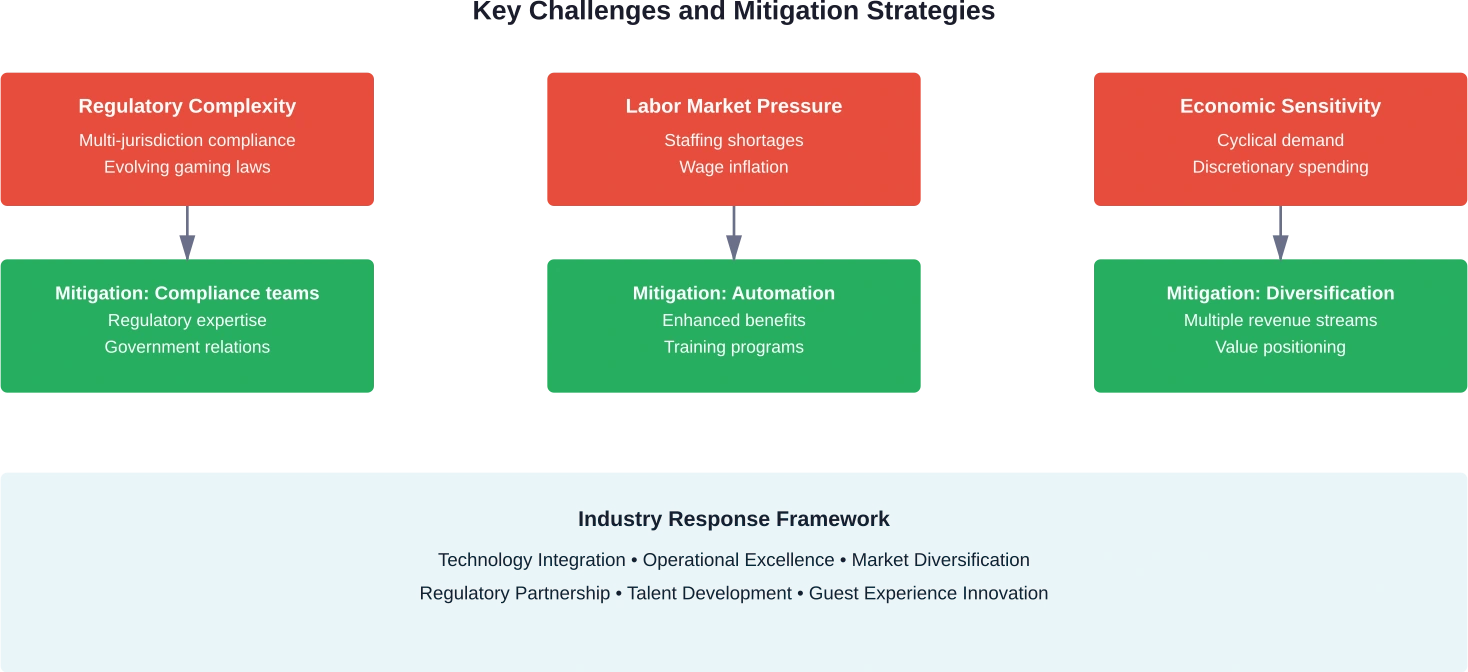
Despite positive growth projections, casino hotels navigate significant challenges.
Regulatory Complexity
Multi-jurisdiction operations require compliance with diverse regulatory frameworks. Gaming regulations vary substantially across states and countries.
The Nevada Gaming Control Board maintains rigorous oversight with detailed statutes and regulations. Operators must navigate compliance requirements that impact everything from game rules to internal controls.
Regulatory changes create both opportunities and risks. New market openings offer growth, but increased regulation in existing markets can constrain operations.
Labor Market Pressures
Casino hotels require substantial staffing across gaming, hospitality, food and beverage, and entertainment functions. Labor markets remain tight post-pandemic.
Wage pressures impact operating margins. Properties compete with other hospitality operators and service industries for workers.
Training and retention challenges persist. Skilled positions like table game dealers and specialized hospitality roles require significant training investment.
Economic Sensitivity
Gaming and leisure travel demonstrate economic cyclicality. Economic downturns impact discretionary spending on casino entertainment.
However, the market shows resilience. Gaming often demonstrates less volatility than other discretionary sectors, with regional properties particularly stable.
Competition from Alternative Entertainment
Casino hotels compete within the broader entertainment and leisure economy. Sports venues, entertainment districts, and other attractions vie for consumer spending.
The integrated resort model addresses this by becoming comprehensive entertainment destinations. Properties diversify offerings to capture spending across categories.
Investment and Development Trends
Capital flows into casino hotel development reveal market confidence and strategic priorities.
New Market Development
Emerging markets attract substantial investment. The UAE projects, Japan integrated resorts, and potential Brazil developments represent multi-billion dollar commitments.
These projects leverage lessons from established markets. Operators apply proven integrated resort models adapted to local regulatory environments and cultural preferences.
Development timelines extend multiple years. The Wynn Al Marjan Island project, announced years ago, reaches opening in 2026, illustrating typical development cycles.
Renovation and Reinvestment
Existing properties require continuous reinvestment. Gaming products need regular refresh cycles. Hotel rooms demand periodic renovation to maintain competitive positioning.
According to the American Hotel & Lodging Association’s economic impact research, capital investment in hotels—including renovations and new construction—generates substantial economic activity beyond operational spending.
Renovation strategies balance maintaining operations during construction with the need for comprehensive updates. Phased approaches minimize disruption.
Technology Infrastructure Investment
Properties invest heavily in technology infrastructure. Cloud-based systems, mobile platforms, and security infrastructure require ongoing capital allocation.
These investments improve operational efficiency and guest experience while generating data for business intelligence.
Sustainability and Responsible Gaming
Environmental sustainability and responsible gaming practices increasingly influence operations and brand positioning.
Environmental Initiatives
Large resort properties consume substantial energy and water. Sustainability programs address resource efficiency through building systems, renewable energy, and waste reduction.
Leadership in Energy and Environmental Design (LEED) certification and similar standards guide construction and renovation projects.
Sustainable practices also generate cost savings. Energy efficiency reduces operating expenses while supporting environmental goals.
Responsible Gaming Programs
Casino operators implement responsible gaming programs addressing problem gambling concerns. These include self-exclusion programs, responsible gaming messaging, and staff training.
Regulatory requirements mandate certain responsible gaming measures. Industry best practices often exceed minimum requirements.
Academic research published in journals like the International Journal of Gaming, Hospitality and Tourism examines responsible gaming effectiveness and industry practices.
Future Outlook and Predictions
Looking forward, several trends will shape casino hotel market evolution through 2035.
Continued Geographic Expansion
New markets will continue opening. Beyond current developments in the UAE and Japan, other jurisdictions consider gaming legalization as economic development strategy.
Latin America represents potential growth markets. Brazil’s gaming regulation discussions could unlock a massive market, though political complexities create uncertainty.
Digital-Physical Integration
Online and land-based operations will become increasingly interconnected. Operators will view them as complementary rather than competing channels.
Loyalty programs will bridge digital and physical experiences. Guests will accumulate and redeem rewards across channels seamlessly.
Entertainment Evolution
Non-gaming amenities will continue growing in importance. Properties will invest in unique entertainment offerings that differentiate brands and attract diverse audiences.
Sports betting integration will deepen. As more leagues and teams embrace sports wagering, casino hotels will enhance sports book amenities and viewing experiences.
Market Consolidation
Consolidation among major operators may continue. Scale benefits and capital requirements favor larger organizations, though regulatory considerations limit consolidation in some jurisdictions.
Real estate investment trust structures and asset-light operating models will likely expand. Separating property ownership from operations creates financial flexibility.
Trend | Impact Timeline | Market Implications |
|---|---|---|
UAE and Japan Market Openings | 2026-2028 | New revenue pools, competitive dynamics shift |
Sports Betting Integration | Ongoing through 2030 | Younger demographics, event-driven traffic |
Digital-Physical Convergence | Accelerating 2026-2035 | Seamless guest experiences, data advantages |
Sustainability Requirements | Increasing through 2035 | Capital investment, operational changes |
Entertainment Diversification | Ongoing | Reduced gaming dependence, broader appeal |
Market Research and Data Sources
Understanding the casino hotel market requires diverse data sources and research methodologies.
Academic institutions contribute research through publications like the International Journal of Gaming, Hospitality and Tourism, which bridges industry practitioners and academic researchers. Topics span casino gaming, hospitality, tourism, and event management.
University libraries maintain specialized research guides. The University of Denver’s Resort and Casino Management guide identifies key scholarly journals including Annals of Tourism Research and Cornell Hospitality Quarterly.
Government agencies provide authoritative data. The Nevada Gaming Control Board publishes industry notices, regulations, and statistical information. The Securities and Exchange Commission provides financial disclosure through 10-K filings from publicly traded operators.
Industry organizations like the American Hotel & Lodging Association conduct economic impact research analyzing hotel operations, guest spending, and capital investment across hotel categories including casino hotels.
Real talk: the fragmentation of data sources reflects the market’s complexity. No single source captures the full picture. Effective analysis requires synthesizing multiple perspectives and methodologies.
Frequently Asked Questions
How big is the casino hotel market?
The global casino hotel market reached $172.33 billion in 2024 and is projected to grow to $325.85 billion by 2035, representing a 5.96% compound annual growth rate. The U.S. market alone represents approximately $84.6 billion. Market size varies by source depending on segmentation methodology and regional coverage.
What drives casino hotel market growth?
Growth is driven by gambling tourism expansion, regulatory changes opening new markets, integrated entertainment models that diversify revenue, and technology integration improving operations and guest experiences. Sports betting legalization and emerging markets like the UAE and Japan contribute significantly to projected growth.
Which region dominates the casino hotel market?
North America dominates with approximately 48% of global market share, led by Las Vegas and regional U.S. markets. Asia-Pacific represents about 28% and shows the highest growth potential, driven by Macau, Singapore, and emerging markets like Japan. Europe accounts for roughly 16% of the market.
How does Las Vegas casino market perform in 2026?
Las Vegas maintained solid operating fundamentals in 2026 despite some metric moderation relative to 2024’s exceptional performance. The market demonstrated resilience supported by major events, sports-related visitation, and diversified entertainment offerings. Growth patterns normalized following post-pandemic rebounds.
What challenges do casino hotels face?
Key challenges include regulatory complexity across multiple jurisdictions, labor market pressures with staffing shortages and wage inflation, economic sensitivity affecting discretionary spending, and competition from alternative entertainment options. Operators address these through compliance investment, automation, operational efficiency, and entertainment diversification.
How important is technology to casino hotel operations?
Technology is increasingly critical. Cloud-based property management systems, mobile applications, contactless services, and analytics platforms improve operational efficiency and personalize guest experiences. Gaming technology advances product offerings, while sports betting platforms enable real-time wagering. Technology integration differentiates competitive positioning.
What is the future outlook for casino hotels?
The outlook remains positive through 2035 with sustained growth projected. New market openings in the UAE, Japan, and potentially Latin America will drive expansion. Digital-physical integration will deepen, entertainment diversification will continue, and technology adoption will accelerate. Market consolidation among major operators may increase while regional properties maintain geographic niches.
Conclusion
The casino hotel market stands at a compelling inflection point. With projected growth from $172.33 billion in 2024 to $325.85 billion by 2035, the industry demonstrates remarkable resilience and evolution.
This isn’t just about more casinos. It’s about transformation. Integrated entertainment models replace gaming-centric operations. Technology reshapes guest experiences and operational efficiency. Regulatory evolution unlocks entirely new markets from the UAE to Japan.
North America maintains dominance while Asia-Pacific shows explosive potential. Mature markets like Las Vegas demonstrate stability through diversification. Emerging markets attract billions in capital investment.
Challenges remain significant—regulatory complexity, labor pressures, economic sensitivity. But operators adapt through technology adoption, operational excellence, and strategic diversification.
The competitive landscape evolves as sovereign wealth-backed mega-projects compete with established operators. Digital and physical experiences converge. Sports betting integration attracts new demographics. Entertainment offerings broaden appeal beyond traditional gaming audiences.
For investors, operators, and industry observers, the casino hotel market offers sustained growth opportunities anchored in fundamental human desires for entertainment, leisure, and social experiences. The properties that succeed will master the complex balance of gaming excellence, hospitality quality, entertainment diversity, and technological innovation.
The next decade will determine which operators navigate this transformation successfully and which new markets fulfill their ambitious projections. One thing is certain: the casino hotel industry of 2035 will look substantially different than today’s market—more diversified, more technological, more global, and more integrated into the broader entertainment economy.
Related Articles

September 29, 2026Is the Casino Legal in Japan? The Real Answer...

September 29, 2026Is the Casino Legal in Gambia? What the Law...