 Nothing found for the request

Casino Industry Market Size 2026: Global Growth Data
Sologe March 30, 2026
Share:


Global Casino Market Size Overview
The casino gambling market reached significant scale in 2024, with multiple research firms reporting figures in the $300+ billion range. Market projections indicate sustained growth through the next decade, driven by both traditional land-based operations and rapidly expanding digital channels.
According to the American Gaming Association (AGA), the U.S. commercial gaming industry generated a record $60.42 billion in revenue in 2022. That figure has continued climbing as markets mature and new jurisdictions legalize various forms of gambling.
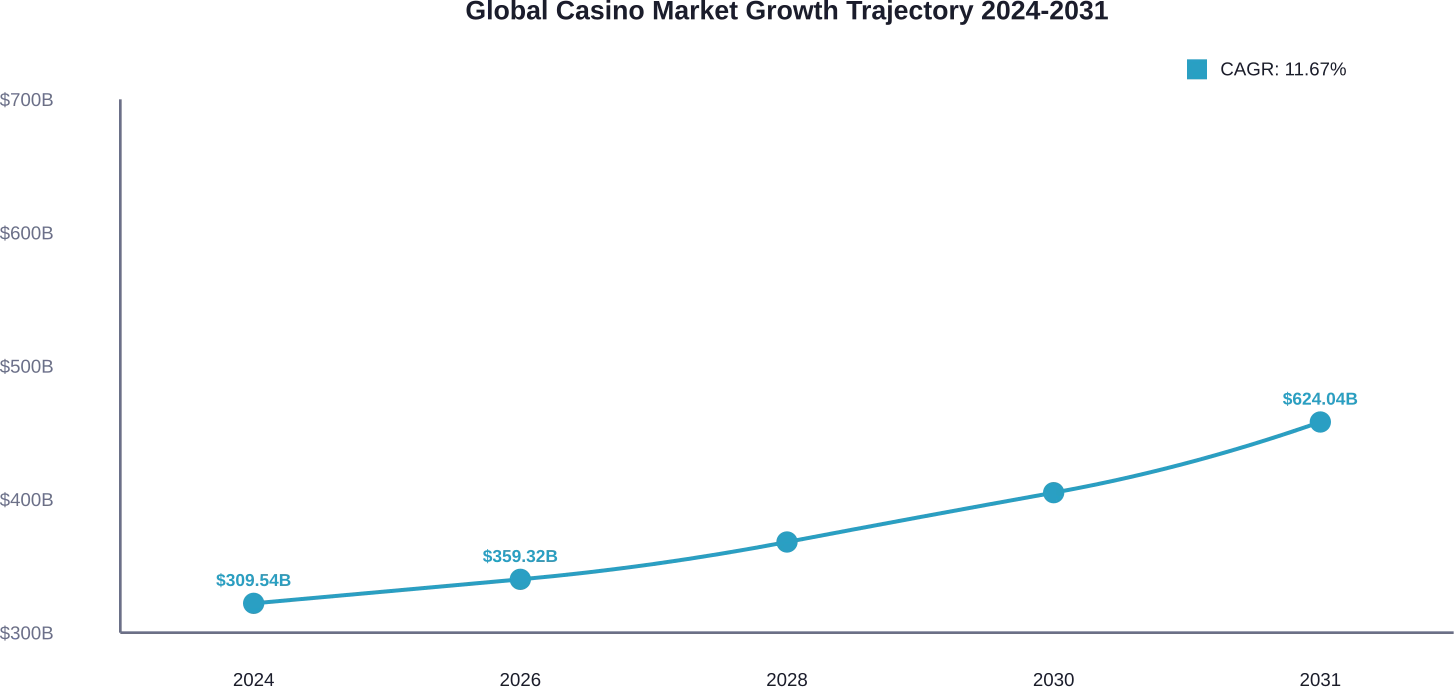
Recent market analysis shows the casino gambling market size estimated at USD 359.32 billion in 2026, with growth at an 11.67% CAGR to reach USD 624.04 billion by 2031 (2026-2031 forecast period). This represents one of the more aggressive growth forecasts, factoring in rapid digital adoption and geographic expansion.
Market Size by Segment
The casino industry comprises two primary segments: land-based casino gaming and online casino gaming. Each segment demonstrates distinct growth patterns and market characteristics.
Land-based casinos still command the majority of total market revenue, though their share is gradually declining relative to digital channels. Physical casino resorts continue to evolve, integrating technology, expanding entertainment offerings beyond gaming, and focusing on experience-driven hospitality.
The online casino market represents the faster-growing segment. The global online casino market size was estimated at USD 19.11 billion in 2024 and is projected to reach USD 38.00 billion by 2030, growing at a CAGR of 12.2% from 2025 to 2030.
That’s nearly double the growth rate of traditional land-based operations.
Market Segment | 2024 Market Size | 2030 Projection | CAGR |
|---|---|---|---|
Total Casino Market | USD 309.54 Billion | USD 511.6 Billion* | 6.48-11.67% |
Online Casino Market | USD 19.11 Billion | USD 38.00 Billion | 12.2% |
Land-Based Casino Market | ~USD 290 Billion | ~USD 473 Billion | ~6% |
Social Casino Market | USD 8.51 Billion | USD 14.31 Billion | 8.9% |
The social casino market occupies a unique niche. Valued at USD 8.51 billion in 2024, this segment is projected to reach USD 14.31 billion by 2030, growing at a CAGR of 8.9% from 2025 to 2030 (though 2024-2030 spans 6 years). Social casinos operate on a different model—players engage with casino-style games without real money wagering, typically through mobile apps with in-app purchases for virtual currency.
Key Market Drivers
Several factors are propelling casino market expansion globally.
Technological advancement stands out as a primary catalyst. Mobile gaming platforms, live dealer technology, secure payment systems, and enhanced user interfaces have made online gambling more accessible and engaging than ever before.
Regulatory liberalization continues across multiple jurisdictions. More countries and U.S. states are legalizing various forms of gambling, creating new revenue streams and bringing previously informal markets into regulated frameworks.
In 2024, 55 percent of U.S. adults reported participating in gambling activities, up significantly from 43 percent in 2019. This participation rate increase reflects both changing attitudes toward gambling and expanded legal access.
Demographic shifts also play a role. Younger demographics show higher comfort levels with digital entertainment and online financial transactions, making them natural adopters of online casino platforms.
Regional Market Analysis
Casino market performance varies dramatically by region, with distinct leaders in different segments and growth trajectories shaped by local regulatory environments, cultural attitudes, and economic conditions.
Asia-Pacific: The Dominant Region
Asia-Pacific represents the largest casino market globally and the fastest-growing region for land-based casino operations. Macau and Singapore anchor this regional dominance, functioning as destination resort hubs that attract international visitors.
According to the Macau Gaming Inspection and Coordination Bureau, gross gaming revenues in Macau have shown strong recovery patterns following pandemic disruptions. The region’s integrated resort model—combining gaming with luxury hospitality, entertainment, and shopping—has proven particularly successful.
Regional growth extends beyond these established hubs. Selective greenfield projects in emerging markets are expanding the footprint of casino entertainment across Asia-Pacific territories.
North America: Mature Market with Digital Growth
North America maintains significant market share, particularly for the United States, which hosts iconic gambling destinations like Las Vegas and Atlantic City.
The Nevada Gaming Control Board publishes monthly revenue reports tracking nonrestricted gaming activity. These reports reflect the health of the Nevada market, which remains the benchmark for U.S. land-based casino performance.
But the real story in North America is online gambling expansion. The U.S. online casino market generated revenue of USD 3,461.5 million in 2024 and is expected to reach USD 6,635.3 million by 2030, growing at a CAGR of 11.5%, growing at a CAGR of 11.5%.
State-by-state legalization drives this growth. As more states authorize online casino gaming, the addressable market expands significantly. Pennsylvania, for example, has developed one of the largest commercial casino industries with the highest effective tax rate in the United States, according to research from Western Michigan University.
Europe: Established Digital Market
Europe held the largest share of the online casino market in 2024, benefiting from mature regulatory frameworks and high internet penetration rates.
European markets were early adopters of online gambling legalization, creating established player bases and sophisticated operational environments. Countries like the United Kingdom, Malta, and Gibraltar have become regulatory and operational centers for online gambling companies.
Middle East and Africa: Emerging Frontier
The Middle East and Africa region represents the fastest-growing market according to some forecasts, though from a smaller base.
Selective resort developments in the Middle East are establishing new destination gaming properties that blend casino entertainment with ultra-luxury hospitality. These projects target international visitors and aim to diversify regional economies beyond traditional industries.
Online Casino Market Deep Dive
The online casino segment warrants particular attention given its rapid growth trajectory and evolving dynamics.
Market Size and Projections
Multiple market research reports confirm the online casino sector’s explosive growth potential.
Another source estimates the U.S. online casino market size at USD 6.78 billion in 2024, projecting 11.7% CAGR from 2025 to 2030. This represents just the U.S. market alone, highlighting the concentrated opportunity in North America as state-level legalization expands.
Globally, the online gambling market (which includes sports betting alongside casino games) reached USD 78.66 billion in 2024 and is projected to hit USD 153.57 billion by 2030, growing at a CAGR of 11.9%.
The sports betting segment dominated with a revenue share exceeding 50% in 2024, but casino games represent a substantial and growing portion of the overall online gambling market.
Device Preferences
Desktop and mobile devices split the online casino market, with interesting patterns emerging across different regions and demographics.
The desktop segment accounted for the largest revenue share, over 47% in the U.S. online casino market in 2024. Desktop gambling continues to play a significant role, particularly for certain game types and player demographics who prefer larger screens and more complex interfaces.
But mobile growth is undeniable. Mobile apps serve as particularly strong revenue generators, offering convenience and accessibility that desktop platforms can’t match. Younger players especially favor mobile access, and the trend points toward continued mobile share expansion.
Game Type Analysis
Online casinos offer various game categories, each with distinct player bases and revenue characteristics.
The slots segment captured the largest market share, exceeding 56% in 2024 within the social casino market, and similar dominance exists in real-money online casinos. Slots appeal to a broad audience due to their visual engagement and straightforward gameplay mechanics.
Table games—including blackjack, roulette, baccarat, and others—represent the second-largest category. Live dealer versions of table games have gained significant traction, bridging the gap between online convenience and the social atmosphere of physical casino tables.
Poker and specialty games round out the offerings, serving niche but dedicated player communities.
United States Market Focus
The U.S. casino market deserves special attention given its size, growth trajectory, and unique regulatory structure.
Overall U.S. Gambling Participation
American gambling participation has increased substantially in recent years. In 2024, 55% of U.S. adults reported participating in gambling, up from 43% in 2019.
This increase reflects multiple factors: expanded legal access through state-level legislation, normalization of gambling in mainstream culture, digital convenience, and extensive marketing by gambling operators.
State-Level Legalization Impact
The U.S. operates under a state-by-state regulatory framework for gambling. Each state determines which forms of gambling to authorize, creating a patchwork of legal environments across the country.
Pennsylvania provides an instructive case study. Research from Western Michigan University examining Pennsylvania’s casino gaming industry from 1999-2017 found that casino-born factors—including revenue agreements, hosting/bordering proximity, casino size, and location demographics—significantly impact county revenues.
The study found that revenue sharing agreements increase county revenues, as does hosting a casino. However, bordering a casino-hosting county showed negative revenue impact, suggesting that proximity without direct hosting creates competitive disadvantages rather than spillover benefits.
Interestingly, the research found counterintuitive results regarding casino size. Against expectations, casino size (measured by gross terminal revenues or employee count) didn’t correlate with increased county revenue in the expected patterns, suggesting that the relationship between casino operations and local economic impact is more complex than simple linear scaling.
Nevada: The Benchmark Market
Nevada remains the heart of the U.S. land-based casino industry. The Nevada Gaming Control Board publishes comprehensive monthly revenue reports tracking nonrestricted gaming activity across the state.
These reports reflect 1-month, 3-month, and 12-month data, providing detailed insights into Nevada’s casino performance. The data covers Las Vegas Strip properties, downtown Las Vegas, regional Nevada markets, and Lake Tahoe operations.
Nevada’s gaming regulatory framework is considered the gold standard globally, balancing consumer protection, operator sustainability, and government revenue generation.
Competitive Landscape
The casino industry features a mix of established multinational operators, regional specialists, and digital-native online platforms.
Major Industry Players
Several companies dominate the global casino landscape, each with distinct operational footprints and strategic focuses.
Las Vegas Sands, MGM Resorts International, and Caesars Entertainment represent the traditional powerhouses of the U.S.-based casino industry. These operators run major integrated resort properties in Las Vegas and have expanded internationally, particularly into Asian markets.
Galaxy Entertainment and Genting Group are significant Asian operators, with strong positions in Macau and other regional markets. Their integrated resort developments have set new standards for scale and luxury in the casino-resort category.
The online casino segment features different competitive dynamics. Digital operators like Flutter Entertainment (which owns FanDuel), DraftKings, BetMGM, and international players like Bet365 and 888 Holdings compete for market share in jurisdictions where online gambling is legal.
Market Concentration
Market concentration varies by segment and geography. The casino gambling market overall shows medium concentration—no single player dominates globally, but a handful of major operators control significant market share in key regions.
Land-based casino markets tend toward higher concentration in specific geographic markets (like Macau or Las Vegas) where the number of prime locations is limited and capital requirements are substantial.
Online casino markets show more fragmentation, with lower barriers to entry (relative to building physical casinos) and regional operators competing alongside global brands.
Market Trends Shaping the Industry
Several key trends are influencing casino market evolution and future growth trajectories.
Technology Integration
Technology continues to transform both online and land-based casino operations.
Online casinos are investing heavily in innovation to stay competitive. Live dealer technology, virtual reality experiments, gamification features, and personalized user experiences represent areas of active development.
Land-based casinos are incorporating digital elements. Mobile apps for loyalty programs, cashless payment systems, digital slot machines with social features, and data analytics for customer relationship management blur the lines between physical and digital experiences.
Regulatory Evolution
Regulatory frameworks continue to evolve globally, generally in the direction of liberalization and legalization, though with significant regional variation.
In the United States, the pace of state-level online casino legalization has accelerated. More states are considering or implementing legal online casino gaming, expanding the addressable market substantially.
Internationally, regulatory approaches vary widely. European markets maintain generally mature regulatory systems, Asian markets show selective development focused on integrated resort models, and emerging markets in Latin America and Africa are establishing new frameworks.
Responsible Gaming Focus
The industry faces increasing pressure and internal commitment toward responsible gaming initiatives.
Operators are implementing tools for player self-limitation, enhanced age verification systems, problem gambling identification algorithms, and partnerships with treatment organizations. These efforts reflect both regulatory requirements and industry recognition that sustainable long-term growth requires protecting vulnerable players.
Experience Economy Integration
Land-based casinos increasingly position themselves within the broader experience economy rather than purely as gambling venues.
Integrated resorts combine gaming with luxury accommodations, fine dining, entertainment shows, nightlife, shopping, spa services, and convention facilities. This diversification attracts non-gaming visitors, creates multiple revenue streams, and differentiates properties in competitive markets.
Economic Impact and Revenue Distribution
Casino operations generate substantial economic impacts beyond direct gaming revenue, affecting employment, tax revenue, tourism, and regional development.
Employment Impact
The casino industry is a significant employer globally. Large integrated resort properties employ thousands of workers across gaming operations, hospitality, food and beverage, entertainment, retail, and support services.
Beyond direct employment, casinos create indirect jobs through supply chains, construction, and induced spending by casino employees in local economies.
Tax Revenue Generation
Casino gaming produces substantial tax revenues for governments at multiple levels.
Tax structures vary dramatically by jurisdiction. Pennsylvania, for instance, maintains the highest effective tax rate in the United States for commercial casinos, generating significant state revenue from gaming operations.
Tax revenue from casino gaming often funds specific public purposes, including education, infrastructure, and problem gambling treatment programs. This earmarked funding creates political constituencies supporting casino legalization and operation.
Tourism and Regional Development
Destination casino resorts drive tourism and regional economic development.
Las Vegas and Macau represent extreme examples where casino gaming catalyzed transformation of entire regional economies. These markets attract millions of international visitors annually, supporting extensive hospitality and entertainment ecosystems far beyond gaming floors.
Smaller regional casino markets also generate local economic activity, though typically serving more localized customer bases with different impact patterns.
Challenges Facing the Casino Industry
Despite strong growth projections, the casino industry confronts several significant challenges.
Regulatory Complexity and Uncertainty
Navigating diverse regulatory environments remains a constant challenge, especially for operators pursuing multi-jurisdiction strategies.
Regulatory requirements vary substantially across markets in licensing procedures, tax rates, game restrictions, marketing limitations, and responsible gaming obligations. Compliance requires significant resources and legal expertise.
Regulatory uncertainty affects investment decisions. Operators making long-term capital commitments face the risk that regulatory changes could materially affect project economics.
Problem Gambling Concerns
Problem gambling represents both a social concern and an industry risk.
Research consistently shows that a small percentage of gamblers develop problematic gambling behaviors with serious personal, family, and financial consequences. The casino industry faces scrutiny regarding its responsibility for preventing and mitigating problem gambling.
Increasing regulatory requirements around responsible gaming may affect operator practices and potentially revenue. The industry must balance commercial interests with social responsibility and sustainability concerns.
Competition for Entertainment Spending
Casinos compete for consumer entertainment spending against an expanding array of alternatives.
Digital entertainment, streaming services, video games, sports, dining, and travel all vie for the same discretionary dollars that might go to casino gaming. This competition intensifies as consumer preferences shift and new entertainment categories emerge.
Technology Investment Requirements
Both online and land-based operators face continuous pressure to invest in technology to remain competitive.
Online casinos must constantly update platforms, develop new games, enhance user experience, and maintain security infrastructure. Land-based casinos need to modernize slot floors, implement data systems, and create digital integration across physical properties.
These investments require substantial capital with uncertain returns, particularly as technology cycles accelerate.
Set Up the Right Partners Behind Casino Growth

As the global casino market grows, operators are dealing with more providers across platforms, games, payments, and services. Managing everything separately quickly becomes inefficient. Sologe brings this together as a B2B marketplace where operators and developers can find and connect with the right partners across the full setup.
If you’re entering the market or scaling an existing operation, getting the structure right early makes a difference. Review your setup, align the right providers, and get in touch with the Sologe team to move forward with a clearer, more workable approach.
Future Outlook Through 2030
Looking ahead through the end of the decade, several scenarios and projections emerge for the casino industry.
Growth Projections
Market forecasts consistently project strong growth, though specific numbers vary by source and methodology.
The global casino market is expected to grow from approximately $310-330 billion in 2024-2025 to somewhere between $540-625 billion by 2030-2031, depending on which forecast model proves most accurate. This represents compound annual growth rates ranging from 6.5% to 12%.
Online segments are projected to grow faster than land-based operations, potentially reaching $38 billion globally by 2030 for online casinos specifically, and $153+ billion for the broader online gambling market including sports betting.
Geographic Expansion Patterns
Regional growth will likely follow different patterns.
Asia-Pacific should maintain its position as the largest regional market, with continued strength in established hubs like Macau and Singapore plus selective expansion in emerging markets. Regulatory developments in Japan, Thailand, and other countries could significantly affect regional growth trajectories.
North America will likely see land-based market maturity with continued strength in Nevada and regional markets, while online casino growth accelerates as more U.S. states legalize digital gambling.
Europe’s online gambling market should remain strong and stable with incremental growth, while land-based operations face more challenging dynamics in some markets.
The Middle East and Africa represent the wildcard region with potentially very high growth rates from small bases as new projects come online and regulatory frameworks develop.
Segment Evolution
The relative balance between land-based and online casino gaming will continue shifting toward digital channels, though land-based operations will remain significant.
Within online gambling, mobile platforms will likely capture increasing share relative to desktop, driven by younger demographics and technological improvements in mobile gaming experiences.
Game type preferences may evolve as new formats emerge and player demographics shift. Live dealer games could capture additional share within online casinos, bridging the gap between digital convenience and social interaction.
Frequently Asked Questions
What is the current global casino industry market size?
The industry exceeded $300 billion in 2024, making it one of the largest entertainment sectors globally.
How fast is the casino market growing?
Growth ranges from 6% to over 11% annually, with online casinos growing the fastest.
Which region leads the casino market?
Asia-Pacific dominates globally, followed by North America.
How big is the U.S. online casino market?
The U.S. market is worth several billion dollars and growing rapidly as more states legalize online gaming.
What percentage of U.S. adults gamble?
Approximately 55% of adults in the U.S. participate in gambling activities.
What are the main casino market segments?
The market includes land-based casinos, online casinos, and social casino platforms.
Which games generate the most revenue?
Slots dominate revenue due to their simplicity and mass appeal.
Conclusion
The casino industry market size demonstrates robust health and strong growth prospects through 2030 and beyond. From a 2024 baseline of approximately $310 billion, the global market is projected to nearly double over the next 6-7 years, reaching $540-625 billion depending on which forecast proves most accurate.
This growth isn’t uniform. Online casino segments are expanding at roughly double the rate of land-based operations, driven by technological advancement, regulatory liberalization, and demographic shifts toward digital-native consumers. Regional patterns vary dramatically, with Asia-Pacific maintaining market leadership while the Middle East and Africa represent emerging frontiers.
The U.S. market deserves particular attention. State-by-state legalization of online casino gaming is creating a rapidly expanding addressable market, with the U.S. online casino segment alone projected to potentially double from approximately $3.5-6.8 billion in 2024 to $6.6 billion or higher by 2030.
Challenges exist. Regulatory complexity, problem gambling concerns, intense competition for entertainment spending, and continuous technology investment requirements will test operators’ strategic capabilities. But the fundamental demand drivers remain strong.
For investors, operators, suppliers, regulators, and communities considering casino development, understanding market size dynamics, growth trajectories, and segment-specific trends provides essential context for strategic decision-making. The data confirms that casino gaming—both in its traditional land-based format and rapidly evolving digital incarnations—remains a major global industry with substantial economic impact and continued growth potential.
Visit official gaming regulatory bodies like the Nevada Gaming Control Board and research reputable market intelligence providers for the most current data and analysis as market conditions evolve.
Related Articles

September 29, 2026Is the Casino Legal in Japan? The Real Answer...

September 29, 2026Is the Casino Legal in Gambia? What the Law...