 Nothing found for the request
Casino Management System Market 2026: Size & Growth
Sologe March 27, 2026
Share:


What Exactly Is a Casino Management System?
Before diving into market dynamics, let’s establish what these systems actually do.
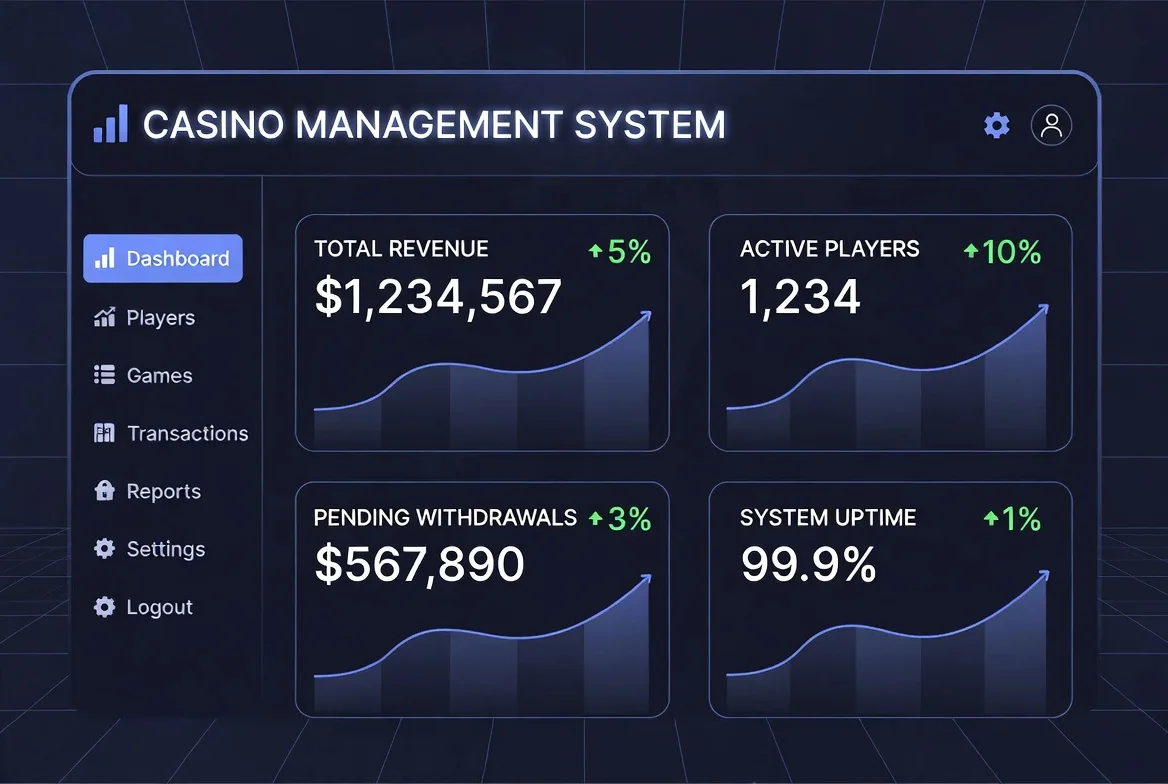
A casino management system is an integrated software platform that connects and coordinates all critical gaming floor operations. Think of it as the operating system for a casino—touching every aspect of the business from the moment a guest walks through the door until they cash out and leave.
These platforms typically include modules for:
- Security and surveillance integration
- Player tracking and loyalty management
- Accounting and cash management
- Analytics and business intelligence
- Slot and table game monitoring
- Hotel and hospitality integration
- Digital content management
- Marketing and promotional campaign automation
The best systems work seamlessly across all departments, breaking down data silos and providing casino operators with a unified view of their entire operation.
Get Your Casino Product in Front of iGaming Buyers

In a market full of similar platforms and service providers, visibility matters. Sologe is an iGaming marketplace where operators and gaming businesses look for suppliers, software, platforms, and service partners. Companies use it to present products, company profiles, and offerings in one place, without relying only on exhibitions, cold outreach, or restricted ad channels.
Want to Reach Buyers Looking for Gaming Solutions?
Use Sologe to:
- show your product to companies actively searching for vendors
- present your company and offering in one place
- stay visible year-round inside a dedicated iGaming marketplace
👉 Get in touch with Sologe to discuss listing your product as a vendor.
Market Size and Growth Projections
The numbers tell a compelling story about the casino management system industry’s trajectory.
According to Grand View Research, the global market generated USD 9,459.8 million in revenue in 2024. By 2030, that figure is expected to climb to USD 21,818.5 million, growing at a CAGR of 14.9% between 2025 and 2030.
Breaking down the regional picture, the U.S. market alone accounted for USD 3,049.7 million in 2024 and is projected to reach USD 6,470.8 million by 2030, with a CAGR of 13.4% during the forecast period.
The UAE represents another high-growth market, expected to reach USD 240.1 million by 2030 with an impressive CAGR of 16.6% from 2025 to 2030.
According to various research firms, projections vary slightly, with some forecasting market growth through 2032 at comparable CAGR rates. While the exact figures vary between research firms, the overall narrative remains consistent: robust, sustained growth across the forecast period.
North America currently dominates the market, holding the largest share in 2024. This shouldn’t surprise anyone familiar with the gaming industry—Las Vegas, Atlantic City, and the proliferation of tribal gaming operations across the United States have created a massive installed base of casino technology.
But here’s where it gets interesting. Asia Pacific is emerging as the fastest-growing regional market, driven by expanding gaming operations in Macau, Singapore, and increasingly across integrated resort developments in Japan and other Asian markets.
Key Market Segments and Applications
Casino management systems aren’t monolithic products. The market breaks down into several distinct application segments, each addressing specific operational needs.
Analytics: The Fastest Growing Segment
According to Grand View Research, analytics represents the most lucrative application segment, registering the fastest growth during the forecast period.
This makes perfect sense when thinking about modern casino operations. Gaming floor managers can’t rely on gut instinct anymore—they need data-driven insights about which games are performing, which promotions are converting, and which customer segments are most profitable.
Advanced analytics platforms now leverage AI and machine learning to predict customer behavior, optimize slot floor layouts, identify high-value players for targeted marketing, and even detect problem gambling patterns before they escalate.
Security and Surveillance
Security has always been paramount in casino operations, but the technological sophistication of modern security systems has evolved dramatically.
Contemporary casino management systems integrate high-definition camera networks, facial recognition technology, behavior analytics, and automated alert systems. Security incidents have demonstrated the importance of robust surveillance systems in preventing theft—illustrating exactly why robust security and surveillance integration remains non-negotiable.
The security personnel challenge is real: on busy nights, thousands of people move through entrances and exits, making manual monitoring virtually impossible. Automated systems fill this gap, flagging suspicious behaviors and tracking known bad actors across multiple properties.
Accounting and Cash Management
Managing cash flow in a casino environment is uniquely complex. Money moves constantly—from cashiers to the gaming floor, from slot machines to count rooms, from cage operations to bank deposits.
Casino management systems provide end-to-end tracking of all currency movements, automated reconciliation, real-time reporting, and audit trail documentation. These capabilities aren’t just convenient—they’re regulatory requirements in most jurisdictions.
Player Tracking and Loyalty Programs
Player tracking systems monitor gaming activity across slots, table games, and other gambling products, automatically calculating player value and triggering rewards based on activity levels.
The most sophisticated systems now integrate with mobile apps, allow real-time point redemption, enable personalized promotional offers, and provide predictive modeling to identify players at risk of churning to competitors.
Market Drivers: What's Fueling This Growth?
Several powerful forces are propelling the casino management system market forward.
Gambling Legalization and Market Expansion
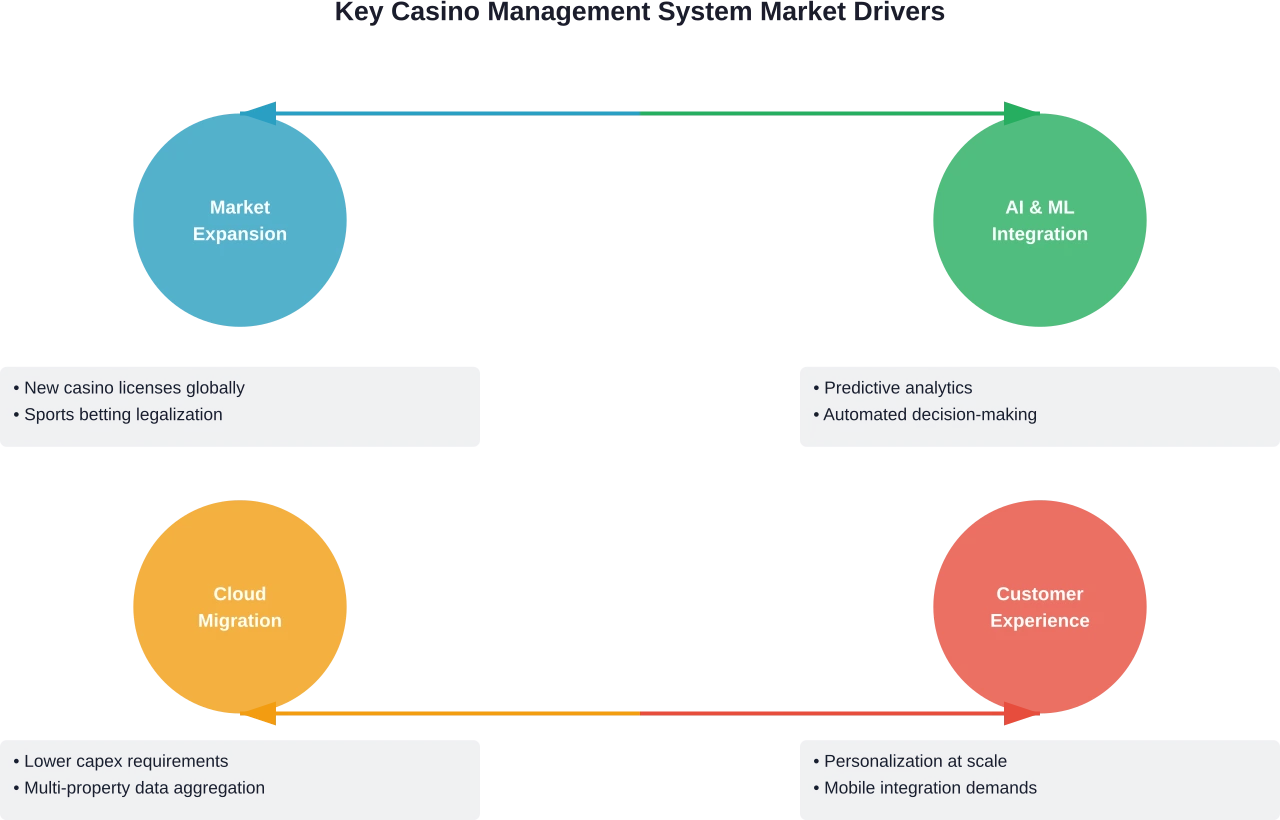
The regulatory landscape continues shifting toward legalization and expansion. Sports betting has exploded across U.S. states following regulatory changes that legalized sports betting across U.S. states. Online gaming is gaining acceptance. New casino licenses are being issued in emerging markets.
Each new casino, whether physical or online, needs a management system. The expanding addressable market naturally drives software demand.
The AI and Machine Learning Revolution
Artificial intelligence and machine learning capabilities are transforming what casino management systems can do. Pattern recognition, predictive analytics, automated decision-making, and personalization at scale—these aren’t buzzwords anymore. They’re operational realities that deliver measurable ROI.
Casinos using AI-powered analytics can optimize nearly every aspect of operations: staffing levels based on predicted foot traffic, game mix based on profitability analysis, promotional spending based on player lifetime value calculations, and security resources based on risk assessment.
Cloud Migration and Hybrid Deployments
The gaming industry has been historically conservative about cloud adoption due to security and regulatory concerns. That’s changing.
Cloud-based and hybrid casino management systems offer significant advantages: lower upfront capital expenditure, easier scalability, automatic updates and patches, disaster recovery capabilities, and the ability to aggregate data across multiple properties.
According to Mordor Intelligence competitive analysis, vendors offering API-first architectures, outcome-based pricing models, and hybrid deployment options are gaining market share. The flexibility to keep sensitive data on-premises while leveraging cloud computing for analytics workloads represents a compelling middle ground.
Enhanced Customer Experience Demands
Modern casino guests expect seamless, personalized experiences. They want to track their rewards on mobile devices, receive offers tailored to their preferences, and move effortlessly between different gaming products and amenities.
Delivering this level of experience requires integrated systems that maintain a unified customer view across all touchpoints. Siloed legacy systems simply can’t compete.
Market Restraints and Challenges
Despite the rosy growth projections, the casino management system market faces legitimate headwinds.
High Implementation Costs
Enterprise-grade casino management systems represent significant capital investments. Implementation costs include not just software licensing but also hardware infrastructure, system integration, data migration, staff training, and ongoing support.
For smaller casino operators, these upfront costs can be prohibitive. This partially explains why large casinos represent a distinct end-user segment from small and medium casinos in market segmentation analyses.
Integration Complexity
Most casinos operate a patchwork of legacy systems accumulated over decades. Integrating a modern management platform with aging slot systems, antiquated point-of-sale terminals, and custom-built back-office applications can be nightmarishly complex.
Failed integration projects aren’t uncommon, and the operational disruption during cutover can be significant. This creates natural resistance to system replacement, even when the existing infrastructure is clearly inadequate.
Data Privacy and Security Concerns
Casino management systems process incredibly sensitive data: personally identifiable information, financial transactions, gameplay patterns, and surveillance footage.
A single data breach can result in regulatory penalties, legal liability, and devastating reputational damage. The security stakes are higher in gaming than almost any other industry, which makes operators understandably cautious about new technology adoption.
Regulatory Complexity
Gaming is one of the most heavily regulated industries globally. Each jurisdiction has its own requirements for system certification, data retention, reporting, and auditing capabilities.
Casino management system vendors must navigate this regulatory maze, obtaining certifications in each market they serve. This creates barriers to entry and slows product development cycles.
Regional Market Analysis
North America: The Established Leader
North America represents the largest regional market for casino management systems. The United States alone generated USD 3,049.7 million in 2024 and is projected to reach USD 6,470.8 million by 2030.
The region’s dominance stems from several factors: a mature casino industry with hundreds of tribal and commercial operations, high technology adoption rates, substantial capital resources for system upgrades, and a competitive landscape that rewards operational efficiency.
Las Vegas continues serving as the industry’s innovation hub, where new technologies are piloted before rolling out globally. What works on the Vegas Strip eventually makes its way to casino floors worldwide.
Asia Pacific: The Growth Powerhouse
While North America holds the largest market share, Asia Pacific is growing fastest. Macau’s gaming revenue exceeds Las Vegas by a substantial margin. Singapore’s integrated resorts represent some of the most technologically advanced casino operations globally. Japan is developing its integrated resort framework, promising significant new opportunities.
Beyond these established markets, casino development is accelerating across Vietnam, the Philippines, South Korea, and other Asian nations. This expansion drives demand for management systems capable of operating in multilingual, multi-currency environments with varying regulatory frameworks.
Europe: Steady Modernization
European casino operators are steadily modernizing their technology infrastructure, driven by competitive pressure from online gaming operators and changing customer expectations.
The region presents unique challenges, including GDPR compliance requirements for data handling, diverse regulatory frameworks across countries, and a mix of state-owned and private operators with different investment priorities.
Middle East: Emerging Opportunity
The UAE market, though smaller in absolute terms, represents an emerging high-growth opportunity. Expected to reach USD 240.1 million by 2030 with a CAGR of 16.6%, the UAE is developing integrated resort projects that will require sophisticated management systems.
Other Middle Eastern markets are watching closely, and regulatory liberalization could unlock additional opportunities in the coming years.
Competitive Landscape and Key Players
The casino management system market is characterized by a mix of established gaming technology giants and innovative software specialists.
Market concentration falls in the medium range—not dominated by a single player, but not completely fragmented either. According to market analysis, International Game Technology PLC, Aristocrat Leisure Ltd., Novomatic AG, Light & Wonder, Inc. (formerly Scientific Games Corp.), and Konami Gaming Inc. are identified as major companies operating in this space.
Competitive dynamics increasingly favor vendors offering several key capabilities:
- API-first architectures that facilitate integration with third-party systems and enable composable technology stacks
- Outcome-based pricing models that align vendor success with customer results rather than traditional perpetual licensing
- Hybrid deployment options that balance security requirements with cloud economics
- Data sovereignty controls particularly important for tribal gaming operations and international markets
- Vertical-specific functionality tailored to unique operational requirements of different casino types
The most successful vendors understand that casino management systems aren’t just technology products—they’re business transformation partners. Implementation success depends as much on change management and training as on software functionality.
Component Analysis: Solutions vs. Services
The casino management system market divides into two primary components: solutions (the software itself) and services (consulting, deployment, integration, and ongoing support).
According to market analysis, services accounted for approximately 40% of revenue in 2025 and are forecast to grow at a faster rate than pure software sales. This reflects the complexity of implementation and the ongoing support requirements for enterprise-scale systems.
Services typically break down into three subcategories:
- Consulting services help operators assess needs, design system architectures, and develop implementation roadmaps
- Deployment and integration services handle the actual installation, configuration, data migration, and connection to existing systems
- Support and maintenance services provide ongoing technical assistance, updates, patches, and optimization
For vendors, services represent a higher-margin revenue stream than software licensing and create stickier customer relationships. For operators, comprehensive service offerings reduce implementation risk and ensure access to specialized expertise.
Component Type | Revenue Share (2025) | Growth Characteristics | Key Considerations |
|---|---|---|---|
Solutions (Software) | ~60% | Steady growth aligned with new installations | Upfront capital expense, licensing complexity |
Services (Consulting) | ~15% | Fast growth in complex deployments | Critical for successful implementation |
Services (Deployment) | ~15% | Correlates with solution sales | Integration capability determines success |
Services (Support) | ~10% | Recurring revenue, stable growth | Essential for ongoing optimization |
End-User Segmentation: Size Matters
Not all casinos have the same needs or budgets. The market segments into distinct end-user categories based primarily on operational scale.
Large Casinos
Large casino operations—major commercial casinos, mega-resorts, and flagship tribal properties—represent the highest-value customer segment. These operations require enterprise-grade platforms with extensive functionality, support for thousands of gaming positions, integration across multiple properties, and 24/7 reliability.
Large casinos have the capital budgets for comprehensive implementations and typically demand customization to match their specific operational workflows. They’re also the most likely to adopt emerging technologies like AI-powered analytics and predictive modeling.
Small and Medium Casinos
Smaller operations face different constraints. They need core functionality at accessible price points, faster implementation timelines, minimal customization requirements, and lower ongoing support costs.
Cloud-based SaaS offerings are particularly attractive to this segment, converting capital expenditure to operational expense and reducing the need for in-house technical expertise. This end-user segment is driving vendor innovation around simplified deployment models and standardized configurations.
Emerging Trends Shaping the Market
Mobile-First Design
Casino guests increasingly expect mobile access to all services. Check rewards balances on smartphones. Receive personalized offers via push notifications. Make reservations through apps. Even control some aspects of gameplay from mobile devices.
Casino management systems are evolving from desktop-centric platforms to mobile-first architectures where the smartphone serves as the primary interface for customer engagement.
Cryptocurrency and Blockchain
Some forward-thinking operators are experimenting with cryptocurrency payment options and blockchain-based loyalty programs. While still niche, these technologies could fundamentally change how casinos handle payments and rewards.
Casino management systems will need to adapt to accommodate these new payment methods while maintaining regulatory compliance and audit capabilities.
Responsible Gaming Tools
Regulatory pressure and social responsibility concerns are driving demand for sophisticated responsible gaming features. Systems now include capabilities for self-exclusion management, spending limit enforcement, behavioral pattern detection, and intervention workflows.
These features aren’t just regulatory checkboxes—they’re becoming competitive differentiators as socially conscious guests choose operators who demonstrate commitment to player welfare.
Contactless and Frictionless Experiences
The pandemic accelerated trends toward contactless interactions. Mobile check-in. Digital room keys. Cashless gaming. QR code interactions.
Casino management systems are incorporating these capabilities, reducing physical touchpoints while simultaneously collecting richer data about customer journeys and preferences.
Investment and M&A Activity
The casino management system market is attracting significant investment and merger-and-acquisition activity.
Strategic buyers in the gaming equipment manufacturing sector view management software as essential to complete platform offerings. Private equity investors see attractive recurring revenue characteristics and growth potential. Technology companies identify opportunities to leverage AI, analytics, and cloud capabilities in a new vertical.
Expect continued consolidation as smaller vendors get acquired by larger platforms seeking to fill functionality gaps or expand geographic reach. At the same time, venture funding continues flowing to innovative startups targeting underserved segments or offering disruptive approaches.
Implementation Considerations for Operators
For casino operators evaluating management system investments, several factors deserve careful consideration.
Total Cost of Ownership
Look beyond initial licensing fees. Factor in hardware requirements, integration costs, training expenses, ongoing support fees, and internal IT resources required. The cheapest upfront option is rarely the most cost-effective over a five to ten-year timeframe.
Vendor Viability
Casino management systems are long-term commitments. Assess vendor financial stability, market position, customer retention rates, and product development roadmaps. A vendor acquisition or bankruptcy mid-implementation can be catastrophic.
Scalability and Future-Proofing
Gaming operations evolve. New gaming positions get added. Properties expand. Regulatory requirements change. Select systems with architectural flexibility to accommodate growth and change without requiring complete replacement.
Integration Ecosystem
No casino management system operates in isolation. Evaluate the vendor’s track record integrating with existing systems, the breadth of pre-built connectors, API documentation quality, and the partner ecosystem.
Regulatory Compliance
Ensure the system holds necessary certifications for all jurisdictions where it will operate. Understand how the vendor handles regulatory updates and what responsibilities fall to the operator versus the vendor.
The Road Ahead: Future Outlook
The casino management system market stands at an inflection point. The convergence of AI capabilities, cloud economics, mobile ubiquity, and expanding gaming legalization creates unprecedented opportunity.
Double-digit growth rates through 2030 appear sustainable based on current market drivers. The projected increase from USD 9.46 billion in 2024 to USD 21.82 billion by 2030 represents real expansion, not just optimistic forecasting.
That said, success isn’t guaranteed for individual vendors or implementations. The market will reward innovation, integration capability, and customer outcomes. It will punish complexity, rigidity, and vendor lock-in.
For the gaming industry broadly, sophisticated management systems are becoming table stakes. The competitive advantage comes not from having a system, but from how effectively operators leverage the insights and capabilities these platforms provide.
What happens on the casino floor tomorrow is being architected in software today. The management systems being deployed now will shape operational models, customer experiences, and industry economics for the next decade.
Frequently Asked Questions
What is the current size of the casino management system market?
According to Grand View Research, the global casino management system market was valued at USD 9,459.8 million in 2024. Different research firms report slightly varying figures, but all converge around the $9-10 billion range for the current market size.
How fast is the casino management system market growing?
The market is growing at a compound annual growth rate (CAGR) of 14.9% from 2025 to 2030, according to Grand View Research. This represents robust double-digit growth that’s expected to more than double the market size over six years, reaching USD 21,818.5 million by 2030.
Which region dominates the casino management system market?
North America represents the largest regional market, with the U.S. alone generating USD 3,049.7 million in 2024. However, Asia Pacific is the fastest-growing region, driven by expansion in Macau, Singapore, Japan, and other emerging markets.
What are the main applications of casino management systems?
Casino management systems include modules for security and surveillance, analytics and business intelligence, accounting and cash management, player tracking and loyalty programs, slot and table game monitoring, hotel and hospitality integration, digital content management, and marketing automation. Analytics is currently the fastest-growing application segment.
What factors are driving growth in this market?
Key growth drivers include gambling legalization and market expansion globally, integration of AI and machine learning capabilities, migration to cloud-based and hybrid deployment models, heightened security and regulatory requirements, and increasing demand for personalized customer experiences and data-driven decision making.
What challenges does the casino management system market face?
Major challenges include high upfront implementation costs particularly for smaller operators, integration complexity with legacy systems, data security and privacy concerns in a heavily regulated industry, regulatory compliance requirements that vary across jurisdictions, and resistance to change within conservative casino operations.
Who are the major players in the casino management system market?
According to market analysis, major companies include International Game Technology PLC, Aristocrat Leisure Ltd., Novomatic AG, Light & Wonder, Inc. (formerly Scientific Games Corp.), and Konami Gaming Inc. The market shows medium concentration, with both established gaming technology giants and innovative software specialists competing for share.
Conclusion: Betting on Digital Transformation
The casino management system market isn’t just growing—it’s fundamentally transforming how gaming operations function.
From $9.46 billion in 2024 to a projected $21.82 billion by 2030, this market expansion reflects something deeper than simple technology adoption. It represents the gaming industry’s recognition that competitive advantage in modern casino operations comes from data, insights, and operational excellence, not just gaming content and property aesthetics.
For operators, the message is clear: sophisticated management systems have evolved from nice-to-have technology to mission-critical infrastructure. The question isn’t whether to invest, but how to invest strategically in platforms that will deliver value over the long term.
For vendors, opportunities abound—but so does competition. Success requires not just functional software but genuine partnership, integration expertise, and commitment to customer outcomes.
The gaming industry’s digital transformation is well underway. Casino management systems are the foundation on which that transformation is being built. The next five years will determine which operators and vendors position themselves to capitalize on this remarkable growth trajectory.
Ready to modernize casino operations with a comprehensive management system? The market is moving fast—operators who delay risk falling behind competitors who are already leveraging these powerful platforms to optimize every aspect of their business.
Related Articles

September 29, 2026Is the Casino Legal in Japan? The Real Answer...

September 29, 2026Is the Casino Legal in Gambia? What the Law...