 Nothing found for the request

Casino Market Forecast 2026-2034: Growth & Trends
Sologe April 21, 2026
Share:


Quick Summary
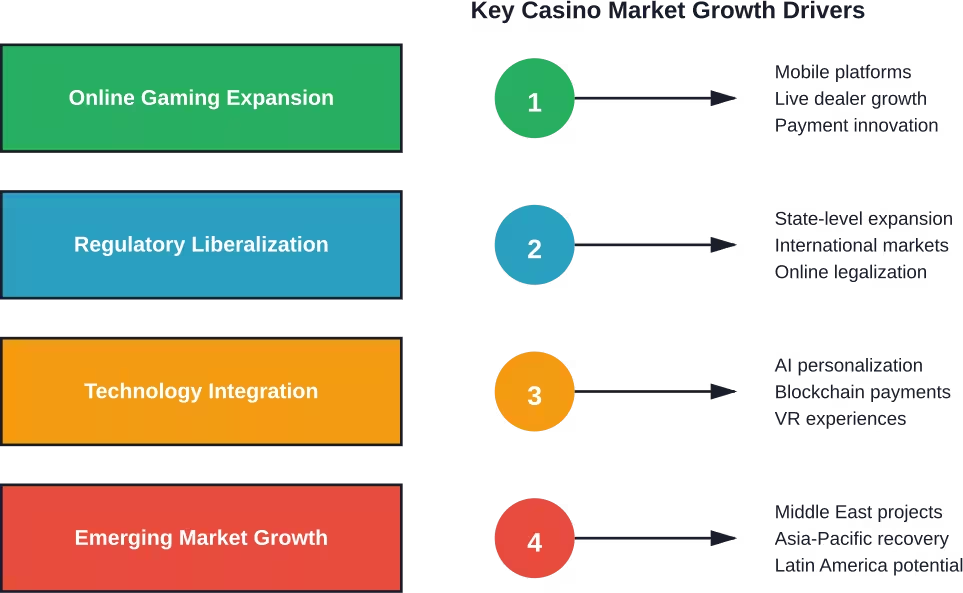
Quick Summary: The global casino market is projected to grow from $329-359 billion in 2025 to $624 billion by 2031-2032, driven by online gaming expansion, regulatory liberalization, and technological innovation. Asia-Pacific leads regional growth with Macau and Singapore anchoring recovery, while the Middle East emerges as a new frontier. The U.S. market alone is expected to expand from $75.65 billion in 2024 to $126.19 billion by 2033.
The casino industry stands at a fascinating inflection point. After weathering pandemic disruptions and regulatory shifts, the market is experiencing a robust resurgence that’s reshaping how people think about gaming and entertainment.
What’s driving this explosive growth? It’s not just about slot machines and blackjack tables anymore. The convergence of technology, changing consumer preferences, and evolving regulatory frameworks has created a perfect storm of opportunity.
Global Casino Market Size and Projections
The numbers tell a compelling story. According to multiple industry analyses, the global casino market was valued at approximately $328-329 billion in 2025, with projections showing substantial expansion through the next decade.
Market research indicates the industry will reach $624 billion by 2031-2032, depending on regulatory developments and economic conditions. That’s a compound annual growth rate (CAGR) ranging from 6.5% to 11.67%.
But here’s where it gets interesting. These growth rates vary significantly by segment and geography, creating distinct investment opportunities across the landscape.
Regional Market Breakdown
Asia-Pacific dominates the global casino landscape, with regional growth anchored by established gaming hubs in Macau and Singapore. According to the Macau Gaming Inspection and Coordination Bureau, gross gaming revenue in these markets has shown resilient recovery patterns.
North America represents approximately 41.4% of market opportunity, driven primarily by continued U.S. expansion. The Middle East and Africa emerge as the fastest-growing regions, with selective greenfield projects linking gaming with high-end hospitality.
Region | Market Share | Growth Rate | Key Drivers |
|---|---|---|---|
Asia-Pacific | Largest | High | Macau recovery, Singapore expansion |
North America | 41.4% | Moderate-High | State legalization, online gaming |
Middle East & Africa | Emerging | Fastest | Destination resorts, tourism |
Europe | Mature | Moderate | Regulatory harmonization |
Show Your Product in a Marketplace Built for Gaming

Sologe helps vendors place gaming-related products inside a dedicated marketplace. The platform is organized around industry categories, making it easier to present software, equipment, services, traffic, and payment solutions in a setting designed for gaming businesses rather than a broad directory.
Need a Place to Publish Your Offer?
Talk to Sologe to:
- add your product to a gaming-specific marketplace
- place it in front of buyers browsing by category
- present your offer alongside other industry listings
👉 Get in touch with Sologe to add your product to the platform.
United States Casino Market Dynamics
The U.S. casino gambling industry deserves special attention. The market is projected to expand from $75.65 billion in 2024 to $126.19 billion by 2033, reflecting a CAGR of 5.85%.
What’s fueling this growth? Increased legalization at the state level plays a massive role. As more states authorize casino gaming and online betting platforms, the addressable market expands dramatically.
Enhanced online platforms have transformed accessibility. Players no longer need to travel to Las Vegas or Atlantic City to experience casino gaming. Mobile apps and responsive web platforms bring the casino floor to smartphones and tablets.
But it’s not just about convenience. Casinos now offer diverse entertainment experiences that extend far beyond gaming. Concert venues, celebrity chef restaurants, luxury retail, and experiential attractions create integrated entertainment destinations that boost tourism and generate significant economic benefits.
State-by-State Expansion
The regulatory landscape across U.S. states remains complex. Each state maintains its own gaming commission, licensing requirements, and operational frameworks. This fragmentation creates both challenges and opportunities for operators.
Major players like MGM Resorts, Caesars Entertainment, and Las Vegas Sands navigate these regulatory hurdles through strategic partnerships and localized approaches. Their ability to adapt to state-specific requirements while maintaining brand consistency determines market success.
Online Casino Gaming Revolution
Here’s where the market gets really interesting. The global online gambling market was estimated at approximately USD 91.63 billion in 2025 and is projected to reach USD 168.71 billion by 2031.
That growth rate nearly doubles the overall casino market expansion. Online platforms aren’t just a complement to land-based operations anymore—they’re becoming the primary growth engine.
Technology advancements drive this shift. Live dealer games using high-definition streaming create authentic casino experiences from home. Virtual reality experiments push boundaries further, though mainstream adoption remains nascent.
Mobile Gaming Dominance
Mobile devices account for an increasingly large share of online casino activity. Responsive design and native apps optimized for iOS and Android provide seamless experiences that rival desktop platforms.
Payment integration represents another critical factor. Digital wallets, cryptocurrency options, and instant banking connections remove friction from deposits and withdrawals. When players can fund accounts and collect winnings effortlessly, engagement increases substantially.
Market Segmentation Analysis
Breaking down the casino market by gaming type reveals distinct performance patterns. Poker segments demonstrate sophisticated evolution through the interplay between high-profile live tournaments and robust digital platforms.
Operators utilize omnichannel strategies that leverage loyalty program integration to foster unified player journeys. Online satellite events feed into major live tournaments, creating engagement loops that span both digital and physical venues.
Slot machines and electronic gaming continue to generate the bulk of casino revenue, particularly in land-based venues. These games require minimal player skill, offer rapid play cycles, and can be densely packed on casino floors.
Table games like blackjack, roulette, and baccarat maintain steady popularity among more engaged players. Live dealer online versions of these games bridge the gap between convenience and authentic casino atmosphere.
Player Demographics and Segments
Understanding who plays casino games matters as much as what they play. Market analyses typically segment players into several categories:
- Dabblers: Occasional players who view casino gaming as entertainment rather than investment
- Gambling Enthusiasts: Regular players with higher frequency and spend levels
- Lottery Loyalists: Players who prefer lottery-style games and progressive jackpots
- Social Exuberants: Players motivated by social interaction and entertainment experiences
Each segment responds to different marketing messages, loyalty incentives, and platform features. Successful operators tailor experiences to match segment preferences rather than applying one-size-fits-all approaches.
Technology and Innovation Trends
Technological advancement reshapes casino operations at every level. Artificial intelligence powers personalized recommendations, fraud detection, and customer service chatbots that handle routine inquiries.
Data analytics platforms process massive volumes of player behavior data to identify patterns, optimize game placement on casino floors, and predict churn before it happens. Predictive models help operators intervene with targeted offers when player engagement shows concerning declines.
Blockchain technology and cryptocurrency integration represent emerging trends with uncertain trajectories. Some operators embrace crypto payments for their lower transaction costs and appeal to tech-savvy demographics. Others remain cautious due to regulatory ambiguity and volatility concerns.
Responsible Gaming Technology
The industry faces increasing pressure to address gambling addiction and promote responsible gaming. Technology offers solutions through self-exclusion databases, deposit limits, and reality check notifications that interrupt extended play sessions.
Sophisticated algorithms now attempt to identify problem gambling patterns based on behavioral signals. When detected, systems can trigger interventions ranging from cooling-off periods to direct outreach from responsible gaming counselors.
According to the Bureau of Labor Statistics, employment in entertainment and recreation management—which includes casino operations—continues to evolve. The average annual pay for a Recreation Manager in the United States is $64,815 as of April 2026, reflecting the professional nature of modern casino operations.
Competitive Landscape and Key Players
Market concentration in the casino industry registers as medium, with several major players commanding significant market shares alongside numerous regional operators.
Las Vegas Sands, MGM Resorts International, and Caesars Entertainment dominate the U.S. market. Galaxy Entertainment and Genting lead in Asia-Pacific markets. Wynn Resorts, Hard Rock, and Boyd Gaming maintain strong regional presences.
Strategic partnerships and acquisitions reshape competitive dynamics regularly. Operators pursue both vertical integration—controlling more of the value chain—and horizontal expansion into new markets and gaming segments.
Operator | Primary Markets | Strategic Focus |
|---|---|---|
Las Vegas Sands | Asia-Pacific, U.S. | Integrated resorts, conventions |
MGM Resorts | U.S., Asia | Entertainment, sports betting |
Caesars Entertainment | U.S. | Loyalty programs, regional expansion |
Galaxy Entertainment | Macau | Premium positioning, VIP focus |
Genting | Asia, U.K. | Diversified gaming, cruise ships |
Regulatory Environment and Challenges
Regulatory complexity represents perhaps the single greatest challenge facing casino operators. Each jurisdiction maintains unique licensing requirements, taxation structures, and operational restrictions.
The fragmented U.S. state-by-state approach creates particular complications. Operators must navigate different regulations for land-based casinos, online gaming, sports betting, and lottery products—with minimal consistency across state lines.
Social responsibility requirements continue to tighten. Regulators increasingly mandate responsible gaming programs, problem gambling resources, and advertising restrictions designed to protect vulnerable populations.
But here’s the thing—regulatory liberalization drives more market growth than restriction. As more jurisdictions legalize casino gaming to capture tax revenue and economic development benefits, the addressable market expands despite compliance burdens.
Taxation and Economic Impact
Casino taxation varies dramatically by jurisdiction. Some markets impose revenue-based taxes exceeding 40%, while others maintain more operator-friendly rates below 20%. These tax structures fundamentally shape profitability and investment decisions.
Economic impact studies consistently show casinos generate substantial benefits beyond direct tax revenue. Job creation, tourism spending, real estate development, and supply chain effects multiply the economic footprint of casino operations.
Investment Opportunities and Market Outlook
Looking forward, several trends will shape investment narratives and strategic positioning. Online gaming expansion represents the clearest growth opportunity, with mobile platforms driving penetration in both established and emerging markets.
The Middle East emergence as a casino destination creates greenfield opportunities for operators willing to navigate cultural sensitivities and regulatory frameworks. Integrated resorts that position gaming as one component of broader entertainment and hospitality offerings show particular promise.
Sports betting integration—both at physical casinos and online platforms—adds another growth vector. As more jurisdictions legalize sports wagering, operators with omnichannel capabilities gain competitive advantages.
Risk Factors
Every investment opportunity carries risks. For casinos, these include:
- Regulatory changes that restrict operations or impose higher taxes
- Economic downturns that reduce discretionary spending on entertainment
- Competition intensification as new operators enter legalized markets
- Technology disruption that favors nimble digital-native competitors over established land-based operators
- Social backlash against gambling that constrains expansion or increases compliance costs
Successful operators balance growth ambitions against these risks through diversification, regulatory engagement, and responsible gaming commitments that build social license to operate.
Frequently Asked Questions
What is the projected size of the global casino market by 2032?
The global casino market is projected to reach approximately $624 billion by 2031–2032, growing from a 2025 baseline of around $329–359 billion. Growth rates are estimated between 6.5% and 11.67% CAGR, depending on market conditions and regulatory developments.
Which region shows the fastest casino market growth?
The Middle East and Africa region is expected to show the fastest growth, driven by new integrated resort developments. However, Asia-Pacific remains the largest market overall due to established hubs like Macau and Singapore.
How fast is the online casino market growing compared to land-based venues?
Online gambling is growing nearly twice as fast as land-based casinos. The market is projected to expand from about USD 91.63 billion in 2025 to USD 168.71 billion by 2031, reflecting strong demand for digital gaming experiences.
What are the main drivers of U.S. casino market expansion?
Growth in the U.S. is driven by state-level legalization, the expansion of online platforms, and the evolution of casinos into integrated entertainment destinations combining gaming, hospitality, and leisure experiences.
How do casino operators address problem gambling concerns?
Operators implement responsible gaming measures such as self-exclusion programs, deposit limits, session reminders, and behavioral monitoring systems. Advanced analytics help detect risky behavior and trigger interventions to protect players.
Which companies dominate the global casino market?
Leading companies include Las Vegas Sands, MGM Resorts International, Caesars Entertainment, Galaxy Entertainment, Genting, Wynn Resorts, Hard Rock, and Boyd Gaming. The market is moderately concentrated with strong regional competition.
What role does technology play in casino market forecasts?
Technology is a key growth driver, enabling mobile gaming, AI-powered personalization, advanced analytics, digital payments, and emerging innovations like virtual reality. These technologies enhance user experience and operational efficiency.
Conclusion
The casino market forecast through 2034 reveals an industry in transformation. Traditional land-based operations continue generating substantial revenue, but online platforms drive the most aggressive growth trajectories.
Regional dynamics create distinct opportunities. Asia-Pacific maintains market leadership while recovering from pandemic disruptions. North America expands through state-level legalization and online gaming adoption. The Middle East emerges as an unexpected growth frontier with destination resort developments.
Technology integration, regulatory evolution, and shifting consumer preferences will determine which operators thrive in this expanding market. Those balancing growth ambitions with responsible gaming commitments while navigating complex regulatory environments position themselves for long-term success.
For investors, developers, and operators, the casino market presents compelling opportunities—but success requires understanding regional nuances, segment dynamics, and technology trends that reshape competition at every level.
Want to explore specific investment opportunities in emerging casino markets? Research individual operators’ financial disclosures and regional market reports to identify the best strategic fit for your objectives.
Related Articles

September 29, 2026Is the Casino Legal in Japan? The Real Answer...

September 29, 2026Is the Casino Legal in Gambia? What the Law...