 Nothing found for the request

Casino Market Size 2026: Stats, Growth & Future Forecast
Sologe March 30, 2026
Share:


Global Casino Market Size: Current State and Historical Context
According to market research data, the casino market size stood at $309.54 billion in 2024. That’s the total value of all casino-based activities conducted through physical venues and online platforms combined.
To put this in perspective, the market value reached $131 billion in 2021. The trajectory from 2021 to 2024 represents substantial recovery and growth following the pandemic-related disruption.
Looking ahead, projections indicate the market will reach $329.6 billion in 2025, maintaining steady upward momentum through the forecast period.
Market Breakdown: Land-Based vs. Online
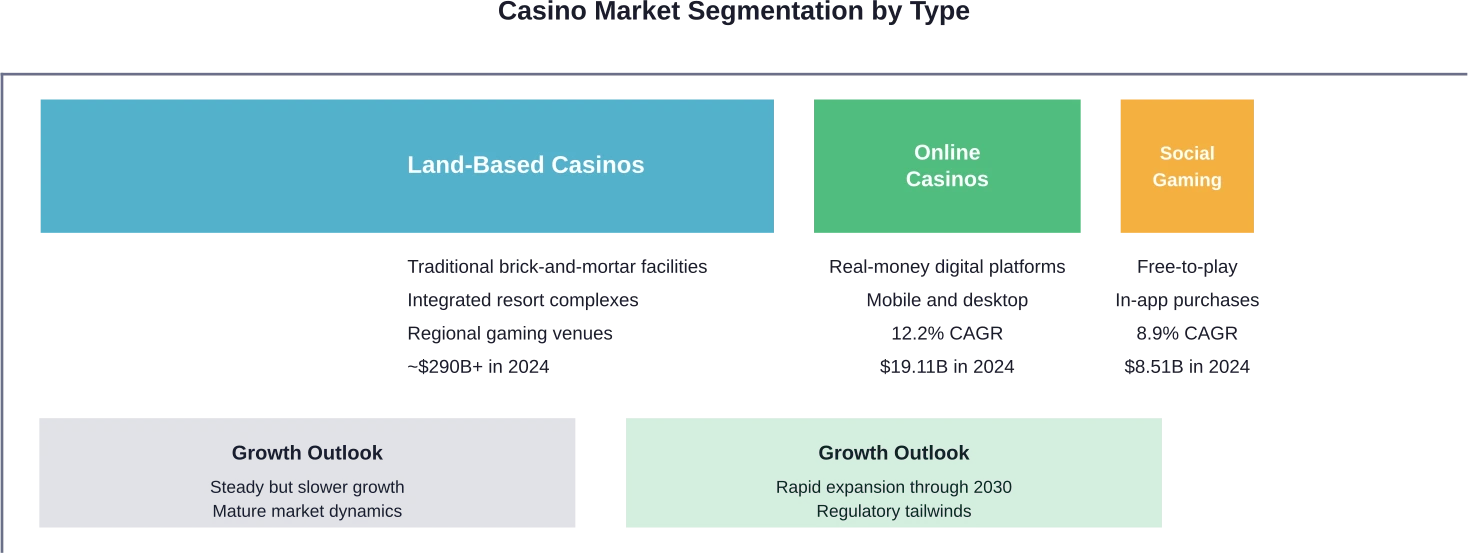
The casino market splits into two primary segments that operate under different dynamics and growth patterns.
Land-based casino gaming continues to dominate in terms of absolute revenue. These are the traditional brick-and-mortar establishments—from sprawling resort complexes to regional gaming facilities. They generate revenue through slot machines, table games, poker rooms, and increasingly integrated entertainment offerings.
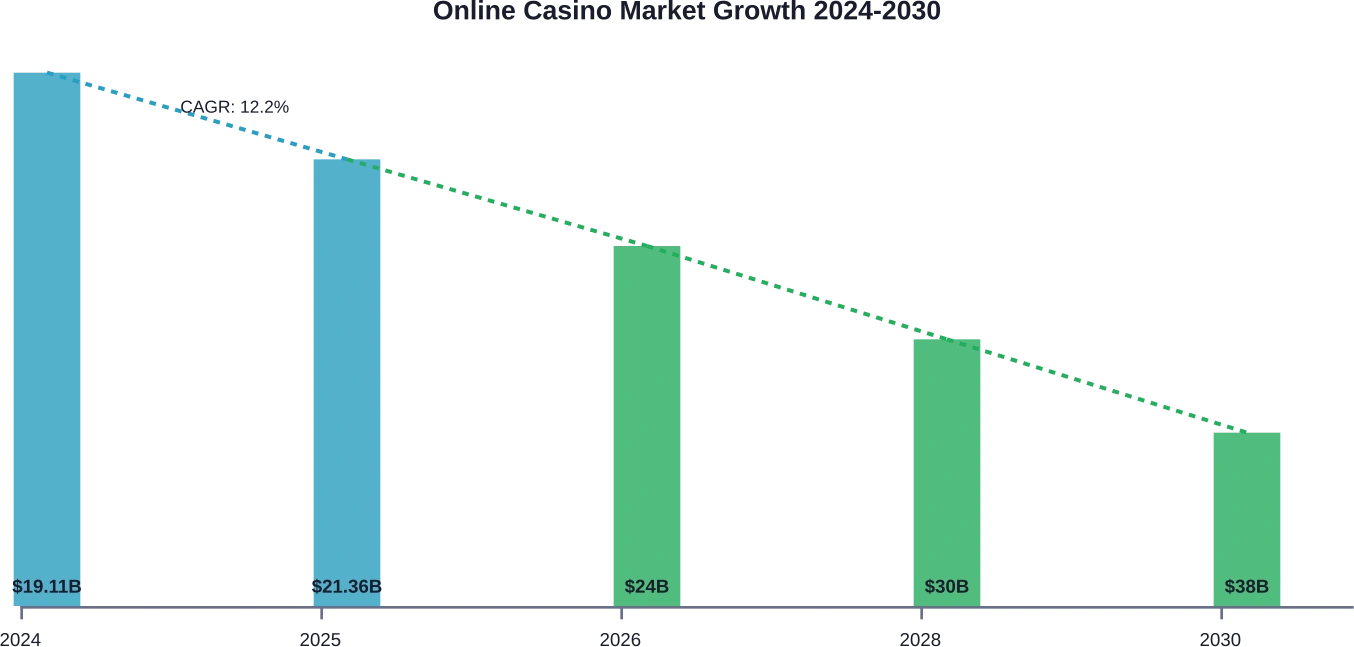
The online casino market, meanwhile, represents the faster-growing segment. Valued at $19.11 billion in 2024, online casinos are projected to reach $38 billion by 2030, reflecting a compound annual growth rate of 12.2% from 2025 to 2030.
That’s significantly faster growth compared to the overall market’s 6.48% CAGR.
Market Segment | 2024 Value | 2030 Projection | CAGR |
|---|---|---|---|
Total Casino Market | $309.54 billion | $617.67 billion (2035) | 6.48% |
Online Casino Market | $19.11 billion | $38.00 billion | 12.2% |
Social Casino Market | $8.51 billion | $14.31 billion | 8.9% |
The Broader Gaming Context
Casino gaming exists within the larger video game industry ecosystem. Revenue in the global video games market reached an estimated $522.5 billion in 2024, with projections indicating it’ll hit $564.27 billion in 2026 and $733.22 billion by 2030.
Mobile gaming generated approximately $126 billion of that total, highlighting the shift toward portable, accessible gaming experiences. This broader trend directly impacts casino offerings, as operators increasingly prioritize mobile-first strategies.
The esports market, while distinct from casino gaming, adds another dimension with projected revenue of US$5.1 billion in 2026, expected to grow to US$6.2 billion by 2030 at a 4.83% CAGR.
Online Casino Market: The Digital Revolution
The online casino segment deserves special attention given its outsized growth trajectory and transformative impact on the industry.
As of 2024, the online casino market size reached $19.11 billion. Industry forecasts project this will expand to $21.36 billion in 2025 and ultimately $38 billion by 2030.
What’s driving this expansion?
Technology and Accessibility
The desktop segment held the largest revenue share across the online casino industry in 2024. But mobile is rapidly gaining ground, reflecting broader consumer behavior shifts.
The desktop segment’s dominance makes sense when considering the immersive experience and extended play sessions typical of online casino users. Larger screens, better graphics rendering, and comfortable multi-hour sessions favor desktop usage.
That said, mobile platforms are closing the gap. Smartphone penetration, improved mobile networks, and app-based experiences have made mobile gaming more viable for casino content than ever before.
Product Categories in Online Casinos
Online casinos break down into three primary type categories: iSlots, iTable games, and iDealer experiences.
iSlots—digital versions of slot machines—dominate the category. The slots segment captured over 56% of the social casino market share in 2024 and over 65% of the online casino market in 2024, driven by visually engaging content and simple gameplay mechanics that translate well to digital formats.
iTable games include digital versions of blackjack, roulette, baccarat, and other classic casino table games. These appeal to traditional casino players seeking familiar experiences in online environments.
iDealer games, particularly live dealer offerings, represent the fastest-growing category. These combine real dealers broadcasting from studios with online player participation, bridging the gap between physical and digital experiences.
Sound familiar? The appeal lies in authenticity—real cards, real wheels, real dealers—with the convenience of playing from anywhere.
Regional Market Analysis: Where the Money Flows
Casino market dynamics vary dramatically by geography, shaped by regulatory frameworks, cultural attitudes toward gambling, and economic factors.
North America: Regulatory Evolution
The North America online gambling market reached $16.56 billion in 2024, with projections indicating growth at a 12.2% CAGR from 2025 to 2030.
The United States drives much of this expansion. The U.S. online gambling market size was estimated at USD 12.68 billion in 2024 and is expected to grow at a CAGR of 9.8% from 2025 to 2030.
The sports betting segment accounted for the largest market share of over 49% in 2024 in North America, reflecting the post-PASPA legal landscape that’s enabled state-by-state sports wagering expansion since 2018.
Canada presents another growth story. The Canadian online gambling market is projected to reach $8.72 billion by 2030, growing at an impressive 14.3% CAGR from 2025 to 2030.
But wait—there’s a crucial distinction between online and land-based performance. Traditional casino resorts in Las Vegas, Atlantic City, and tribal gaming facilities continue generating substantial revenue, though growth rates trail digital channels.
Europe: The Mature Market Leader
Europe held the largest share of the online casino market in 2024. This reflects the region’s early regulatory acceptance, established operator infrastructure, and high internet penetration.
Countries like the United Kingdom, Malta, and Gibraltar have developed sophisticated licensing frameworks that balance consumer protection with market access. This regulatory clarity has attracted major operators and fostered competitive markets.
The liberalization of previously restricted markets—including Germany, the Netherlands, and others—continues driving growth. Each market opening represents hundreds of millions in potential annual revenue.
Asia Pacific: The Sleeping Giant
Asia Pacific represents both the largest opportunity and the most complex regulatory environment. Markets like the Philippines and Indonesia show gaming penetration exceeding 95% of internet users, though much of this activity occurs in social and skill-gaming categories rather than real-money gambling.
Macau remains the world’s largest physical casino market by revenue, though it’s heavily dependent on Chinese visitors and subject to regulatory pressures from Beijing.
Generally speaking, regulatory restrictions in mainland China, India, and other major markets limit legal online casino growth. But where legal frameworks exist—such as the Philippines’ PAGCOR licensing system—the market demonstrates enormous potential.
Latin America and Middle East & Africa
These regions represent emerging opportunities with varying degrees of market development. Latin American countries are gradually opening to regulated online gambling, with Brazil’s pending market entry representing a potential game-changer given its population size and economic scale.
The Middle East faces significant cultural and religious barriers to gambling expansion, though some jurisdictions permit limited gaming activities.
Market Segmentation: Understanding the Player Base
Not all casino customers look alike. The market segments into distinct user categories based on engagement patterns and preferences.
Gambling Enthusiasts
This segment represents the most engaged players—individuals who gamble regularly, understand game mechanics, and often pursue gambling as a primary entertainment activity. They generate disproportionate revenue relative to their numbers.
Enthusiasts gravitate toward table games, poker, and sports betting. They’re more likely to use desktop platforms for extended sessions and respond to sophisticated loyalty programs.
Dabblers
Dabblers engage with casino gaming occasionally, often as part of broader entertainment experiences. They might play slots during a resort visit or try online casino apps periodically.
This segment values convenience and simplicity. Mobile-friendly slots, quick-play games, and integrated resort experiences appeal to dabblers more than complex table games or strategy-heavy offerings.
Lottery Loyalists
These players primarily engage with lottery products but occasionally cross over into casino gaming. They prefer games with simple mechanics and jackpot-style payouts.
Progressive slot machines, which accumulate jackpots similar to lottery prizes, tend to attract this demographic.
Social and Casual Players
The social casino market reached $8.51 billion in 2024, projected to grow to $14.31 billion by 2030 at an 8.9% CAGR. This segment plays casino-style games without real-money wagering, typically through free-to-play apps with optional in-app purchases.
Social casinos serve multiple purposes—entertainment for non-gamblers, skill development for potential real-money players, and alternatives in jurisdictions where real-money gambling remains restricted.
The line between gaming and gambling continues blurring, with social features becoming essential differentiators even in real-money offerings.
Key Growth Drivers Shaping the Casino Market
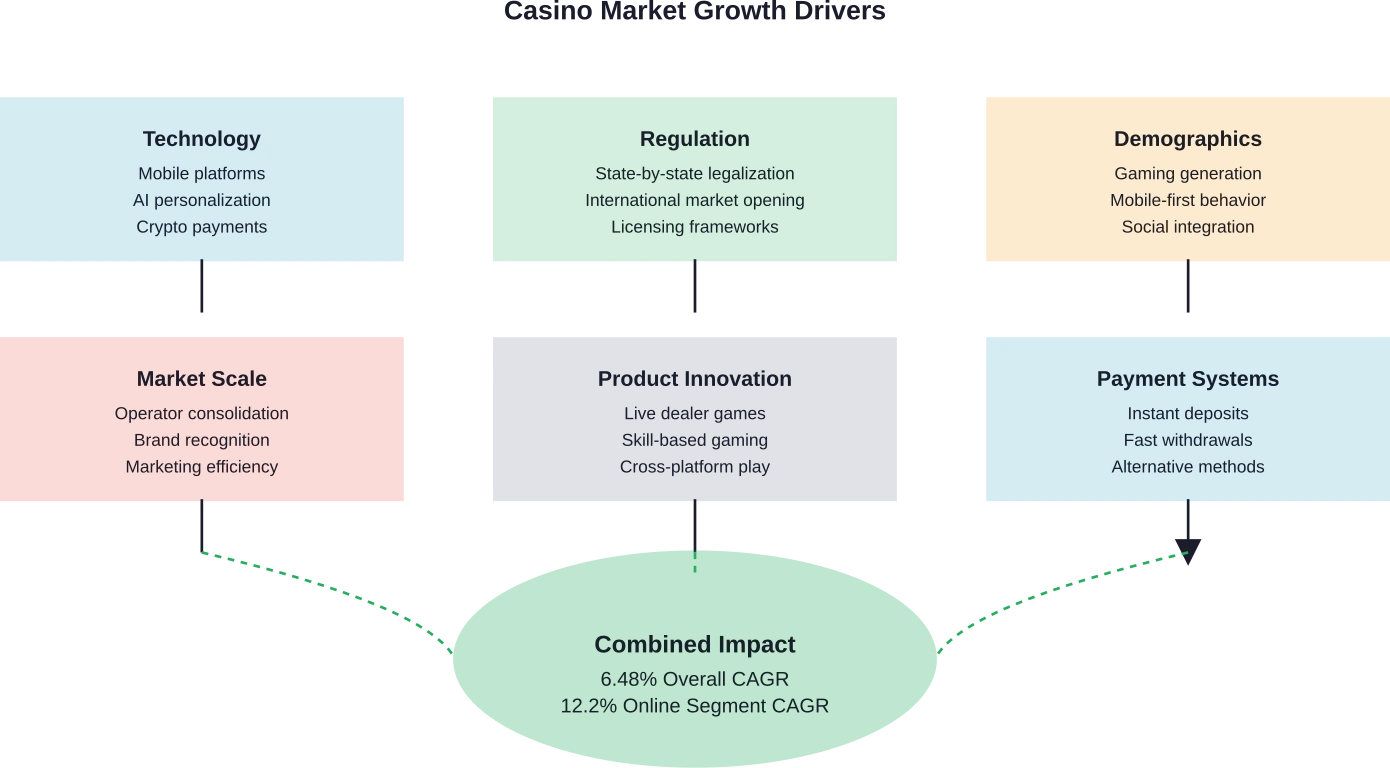
Several powerful forces are propelling casino market expansion across both online and land-based segments.
Technological Advancement
Technology sits at the heart of industry transformation. Mobile platforms, improved payment systems, live streaming capabilities, and sophisticated software have made online gambling more accessible and engaging.
Cryptocurrencies are gaining traction as payment methods, particularly in markets with banking restrictions or players seeking transaction privacy. As digital currencies mature, their role in online gambling is expected to expand significantly.
Artificial intelligence and machine learning enable personalized game recommendations, fraud detection, responsible gambling interventions, and dynamic bonus offerings tailored to individual player patterns.
Regulatory Liberalization
The single biggest factor in market growth? Regulatory change. When jurisdictions shift from prohibition to regulation, previously underground activity moves into legal channels, new operators enter, tax revenue flows to governments, and markets rapidly scale.
The United States exemplifies this dynamic. State-by-state legalization of sports betting and online casinos has unlocked billions in market value since 2018. Each new state represents incremental market expansion.
Similar patterns play out globally. Countries recognize gambling as inevitable—the question becomes whether it occurs illegally or within regulated frameworks that provide consumer protection and generate tax revenue.
Changing Consumer Preferences
Younger demographics consume entertainment differently than previous generations. They expect mobile-first experiences, social features, and integration across platforms.
The gaming generation—raised on video games and digital interaction—finds casino gaming more accessible when it incorporates familiar elements. Skill-based gaming, competitive features, and gamification techniques borrowed from video games are reshaping casino offerings.
This demographic shift favors online and mobile platforms over traditional land-based experiences, though integrated resorts that offer comprehensive entertainment remain attractive for occasional visits.
Market Consolidation and Scale
Major operators are consolidating market share through acquisitions, partnerships, and multi-jurisdictional expansion. Scale provides advantages in technology investment, marketing efficiency, and regulatory compliance.
DraftKings, FanDuel, BetMGM, Flutter Entertainment, and other major players compete for market leadership across multiple product categories and jurisdictions. Their substantial marketing budgets and brand recognition create barriers for smaller competitors.
Challenges and Headwinds Facing the Industry
Growth projections look compelling, but the casino industry faces real obstacles that could impact trajectory and profitability.
Regulatory Uncertainty
Regulations can open markets—but they can also restrict them. China’s crackdown on junket operators devastated Macau’s casino industry. Potential federal taxation or restrictions on online gambling in the United States could significantly impact growth models.
Each jurisdiction maintains unique requirements around licensing, taxation, player verification, responsible gambling measures, and advertising restrictions. Compliance costs scale with geographic expansion.
Responsible Gambling Concerns
Problem gambling affects a small but significant percentage of players, generating public health concerns and political pressure. Regulatory bodies increasingly mandate operator-funded treatment programs, self-exclusion systems, and behavioral monitoring.
These requirements are appropriate and necessary. But they add operational complexity and cost. Operators who fail to implement effective responsible gambling measures face regulatory sanctions, license revocation, and reputational damage.
Market Saturation and Competition
As more operators enter legalized markets, customer acquisition costs increase. Marketing spend in newly opened U.S. states has been astronomical, with major operators accepting losses to gain market share.
This isn’t sustainable long-term. Markets will consolidate, marginal operators will exit, and customer acquisition economics will need to rationalize. The transition period could be painful for some operators.
Payment Processing and Banking Restrictions
Many banks and payment processors remain hesitant about gambling transactions, even in legal markets. This creates friction in deposit and withdrawal processes, impacting user experience and potentially limiting market growth.
Alternative payment methods—including e-wallets, prepaid cards, and cryptocurrencies—help address these limitations but introduce their own complexities.
Technology and Security Risks
Online platforms face constant threats from cyberattacks, fraud, and technical failures. A major security breach could undermine player trust and trigger regulatory intervention.
Operators must invest continuously in security infrastructure, fraud detection systems, and technical redundancy. These aren’t optional expenses—they’re the cost of operating in digital environments.
Turn Market Growth Into Execution – Get the Right Setup

Market size numbers are useful, but they do not explain why some operators scale faster than others. In most cases, it comes down to how well the underlying setup is built – platforms, content providers, and the technical layer that keeps everything running. Sologe focuses on that side of the industry, bringing together casino developers, operators, and service providers in one place so teams can actually move from planning to execution.
Instead of relying on scattered contacts or slow partner searches, Sologe gives a clearer way to explore and connect with companies across the iGaming stack. That makes it easier to build or improve a setup that can keep up with market growth.
If you are looking at where the casino market is heading and want your product and infrastructure to match that pace, contact Sologe and start the conversation.
Casino Market Forecast: 2026 Through 2035
So where’s all this heading? The data points toward continued expansion, though growth rates vary significantly by segment and geography.
Near-Term Outlook: 2026-2030
The casino market is projected to reach approximately $329.6 billion in 2025, continuing upward through 2026 as recovery from pandemic disruption completes and new markets mature.
Online casinos will grow faster than land-based facilities. The $19.11 billion online market in 2024 should reach roughly $24 billion by 2026 and $38 billion by 2030, assuming regulatory expansion continues and mobile adoption increases.
Sports betting integration with casino offerings will blur product boundaries, with operators pushing cross-product engagement to maximize customer lifetime value.
North American markets, particularly the United States and Canada, will drive substantial incremental growth as additional states legalize and initial market entries mature beyond the loss-making customer acquisition phase.
Long-Term Trajectory: 2030-2035
By 2035, the total casino market size is projected to reach $617.67 billion—essentially doubling from the 2024 baseline of $309.54 billion.
This projection assumes continued regulatory liberalization in major markets, sustained technological advancement, and no major economic disruptions or regulatory reversals.
Real talk: that’s a lot of assumptions over an 11-year period. Markets don’t move in straight lines.
Likely scenarios include:
- Continued online segment outperformance relative to land-based gaming
- Consolidation around major multi-product operators with scale advantages
- Maturation of currently emerging markets as they move from high-growth to steady-state
- Integration of casino gaming with broader entertainment and media ecosystems
- Potential regulatory setbacks in some jurisdictions offset by openings in others
Year | Total Casino Market | Online Casino Segment | Social Casino Market |
|---|---|---|---|
2024 | $309.54 billion | $19.11 billion | $8.51 billion |
2025 | $329.6 billion | $21.36 billion | $9.27 billion (est.) |
2026 | $351 billion (est.) | $23.97 billion (est.) | $10.09 billion (est.) |
2030 | $467 billion (est.) | $38.00 billion | $14.31 billion |
2035 | $617.67 billion | $68 billion (est.) | $23 billion (est.) |
Wild Cards and Uncertainties
Several factors could significantly alter these projections—either accelerating or decelerating growth.
Major market openings represent upside potential. If Brazil, India, or other large markets fully legalize online gambling with clear regulatory frameworks, growth could exceed current forecasts substantially.
Conversely, a major scandal, security breach, or problem gambling crisis that generates political backlash could trigger restrictive regulations that curtail expansion.
Economic recession would likely impact discretionary spending on gambling, particularly in premium land-based segments. Online gambling has historically shown relative resilience during economic downturns compared to land-based alternatives.
Technology disruption—whether through virtual reality, artificial intelligence, blockchain integration, or yet-unknown innovations—could reshape the competitive landscape and accelerate digital migration beyond current projections.
Competitive Landscape: Who Dominates the Casino Market
The casino industry features diverse operators ranging from global integrated resort companies to digital-native online gambling platforms.
Integrated Resort Operators
Companies like Las Vegas Sands, MGM Resorts International, Wynn Resorts, and Caesars Entertainment operate large-scale physical casino resorts. These businesses combine gaming with hotels, restaurants, entertainment venues, convention facilities, and retail.
Their strength lies in destination appeal and comprehensive experiences. Weaknesses include high fixed costs, geographic concentration risk, and slower growth compared to digital alternatives.
Many traditional operators have expanded into online markets, either through proprietary platforms or partnerships with specialized digital operators.
Pure-Play Online Operators
Flutter Entertainment (owner of PokerStars, FanDuel, and other brands), Entain, Kindred Group, and similar companies focus primarily or exclusively on online gambling. They operate across multiple markets with relatively asset-light business models.
These operators excel at technology, data analytics, and customer acquisition in digital channels. They face intense competition, high marketing costs, and regulatory compliance complexity across numerous jurisdictions.
Regional and Tribal Operators
Many markets feature strong regional players or tribal gaming operations (particularly in the United States). These operators understand local markets deeply and often enjoy favorable regulatory treatment or monopoly positions.
Tribal casinos represent a significant portion of U.S. casino revenue. They operate under different regulatory frameworks than commercial casinos and often serve as anchors for economic development in tribal communities.
Technology and Platform Providers
Behind the visible operators sits an ecosystem of technology providers, game developers, payment processors, and platform suppliers. Companies like Evolution Gaming (live dealer), Playtech, IGT, and Scientific Games provide the infrastructure enabling casino operations.
These B2B providers often maintain higher margins and lower regulatory risk than consumer-facing operators, while participating in overall market growth.
Sports Betting: The Crossover Category
Sports betting deserves specific attention given its explosive growth and strong crossover with casino gaming.
The sports betting segment accounted for the largest market share of over 49% in 2024 in North America. In the United States specifically, the sports betting segment accounted for a significant market share of over 24% of the online gambling market.
Why does this matter for casino market analysis? Because the same operators, same platforms, and increasingly the same customers engage across both products.
Integrated operators encourage cross-product play. A customer might deposit funds to bet on football but then play slots while waiting for game results. This integration increases engagement and customer lifetime value.
The esports market adds another dimension. With projected revenue of US$5.1 billion in 2026 growing to US$6.2 billion by 2030, competitive gaming creates betting opportunities and attracts younger demographics who might then explore casino products.
Sports betting serves as an acquisition channel and engagement driver for broader gambling offerings, making it strategically important even in casino-focused market analysis.
Social Casinos: Free-to-Play Growth
The social casino market reached $8.51 billion in 2024 and is projected to grow to $14.31 billion by 2030 at an 8.9% CAGR.
These platforms offer casino-style games without real-money wagering. Revenue comes from in-app purchases of virtual currency, power-ups, and premium features.
Why do social casinos matter in real-money market analysis?
First, they serve as talent development systems. Players learn game mechanics in free-to-play environments before potentially transitioning to real-money platforms when legally able and interested.
Second, they provide alternatives in restricted markets. Where real-money gambling remains illegal, social casinos offer legal casino-style entertainment.
Third, they represent a distinct business model that successfully monetizes casino content without gambling risk—demonstrating the entertainment value separate from wagering.
The slots segment dominated social casinos with over 56% market share in 2024, driven by visually engaging, easy-to-learn gameplay that translates well to mobile formats.
Platform distribution favors mobile, though significant desktop usage persists. Social features—including competitive leaderboards, social sharing, and multiplayer elements—differentiate social casino experiences from solitary gambling.
Investment and M&A Activity
The casino market has seen substantial merger and acquisition activity as operators seek scale, market access, and technological capabilities.
Consolidation trends include:
- Traditional casino operators acquiring online gambling platforms and technology
- Sports betting companies expanding into online casino offerings
- Private equity investment in gaming technology and platform providers
- Cross-border acquisitions as operators seek multi-jurisdictional presence
Valuations in the online gambling sector have fluctuated significantly based on regulatory developments and growth expectations. Early-stage market entries in newly legalized jurisdictions often accept losses to establish market position, making near-term profitability less relevant than market share capture.
Technology providers and B2B platforms often command premium valuations relative to consumer-facing operators, reflecting their diversified customer bases and lower regulatory risk profiles.
Future Trends Shaping the Casino Market
Looking beyond current market dynamics, several emerging trends will likely influence the industry’s evolution.
Cryptocurrency and Blockchain Integration
Digital currencies offer potential solutions for payment friction, particularly in cross-border transactions and markets with banking restrictions. As cryptocurrencies gain mainstream acceptance, their role in online gambling will likely expand.
Blockchain technology could enable provably fair gaming, transparent operations, and decentralized gambling platforms—though regulatory acceptance remains uncertain.
Virtual and Augmented Reality
VR casino experiences could bridge the gap between online convenience and land-based immersion. Current technology limitations and adoption rates keep VR niche, but continued advancement may unlock new possibilities.
AR applications might enhance land-based casino experiences or create hybrid offerings that blend physical and digital elements.
Artificial Intelligence and Personalization
AI-powered personalization will likely become increasingly sophisticated, delivering customized game recommendations, bonuses, and experiences based on individual preferences and behavior.
Responsible gambling applications of AI—identifying problem gambling patterns and intervening proactively—will become both regulatory requirements and competitive differentiators.
Convergence with Gaming and Entertainment
The boundaries between video gaming, gambling, and entertainment continue blurring. Skill-based gambling games, esports betting, and gamified casino experiences appeal to younger demographics raised on video games.
Media companies, game developers, and casino operators increasingly recognize opportunities in adjacent markets, potentially driving partnerships or acquisitions across industry boundaries.
Regulatory Evolution
Regulatory frameworks will continue evolving—likely in diverse directions across different jurisdictions. Some markets will liberalize further, others may impose additional restrictions.
The tension between revenue generation, consumer protection, and social concerns will shape policy decisions. Operators who can navigate this complexity while maintaining consumer trust will gain competitive advantages.
Frequently Asked Questions
What is the current size of the global casino market?
The global casino market reached $309.54 billion in 2024 and is projected to exceed $617 billion by 2035.
How fast is the online casino market growing?
The online segment is expanding rapidly, with projected growth to $38 billion by 2030 at a 12.2% CAGR.
Which region has the largest casino market?
Europe leads online casino markets, while the U.S. dominates overall revenue. Asia Pacific remains key for land-based casinos.
What’s the difference between online casinos and social casinos?
Online casinos use real money, while social casinos rely on virtual currency and in-app purchases.
How much is the U.S. online gambling market worth?
The market is valued at around USD 12.68 billion and continues to grow steadily.
What are the main growth drivers for the casino industry?
Growth is fueled by technology, mobile usage, regulatory expansion, and changing consumer behavior.
Will online casinos replace land-based casinos?
Both formats are expected to coexist, with online platforms growing faster but land-based casinos maintaining experiential advantages.
Conclusion: A Market in Transformation
The casino market stands at a pivotal moment. With a current value exceeding $300 billion and projections pointing toward doubling over the next decade, the industry’s scale and growth trajectory are undeniable.
But scale alone doesn’t tell the complete story. The more interesting narrative involves transformation—how an industry traditionally centered on physical locations, interpersonal interactions, and destination travel is reimagining itself for digital-first consumers who expect mobile access, seamless experiences, and integrated entertainment.
Online casinos growing at 12.2% annually while the overall market expands at 6.48% illustrates this shift. The gap between those growth rates represents ongoing industry restructuring that will reshape competitive dynamics, operator strategies, and regulatory approaches.
Regulatory evolution remains the wild card. Market openings in major jurisdictions could accelerate growth beyond current forecasts. Conversely, restrictions or scandals could curtail expansion. The industry’s ability to implement effective responsible gambling measures while maintaining profitability will significantly influence regulatory sentiment.
Technology will continue driving change—sometimes in predictable ways like mobile adoption, sometimes through innovations we can’t yet fully envision. Operators who remain adaptable and technologically sophisticated will gain advantages over those who lag.
For investors, operators, regulators, and observers, the casino market offers a fascinating case study in how traditional industries adapt to digital disruption, regulatory complexity, and evolving consumer expectations.
The $617.67 billion projection for 2035 isn’t guaranteed—it’s contingent on continued progress along multiple dimensions. But the fundamental drivers appear robust: people enjoy gambling and gaming entertainment, technology makes access easier, and jurisdictions increasingly recognize legal frameworks as preferable to prohibition.
That combination suggests the casino market’s growth story has considerable runway ahead, even as the industry itself continues transforming into something quite different from its historical form.
Want to stay current on casino industry developments and market statistics? Monitor regulatory announcements in relevant jurisdictions, follow major operator earnings reports, and track technology trends shaping digital gambling experiences. The market moves quickly—what’s current today may be outdated tomorrow.
Related Articles

September 29, 2026Is the Casino Legal in Japan? The Real Answer...

September 29, 2026Is the Casino Legal in Gambia? What the Law...