 Nothing found for the request

Casino Market Trends 2026: Growth, Data & Insights
Sologe March 30, 2026
Share:


Global Casino Market Size and Projections
Market sizing establishes the foundation for understanding where the casino industry stands today and where it’s headed over the next several years.
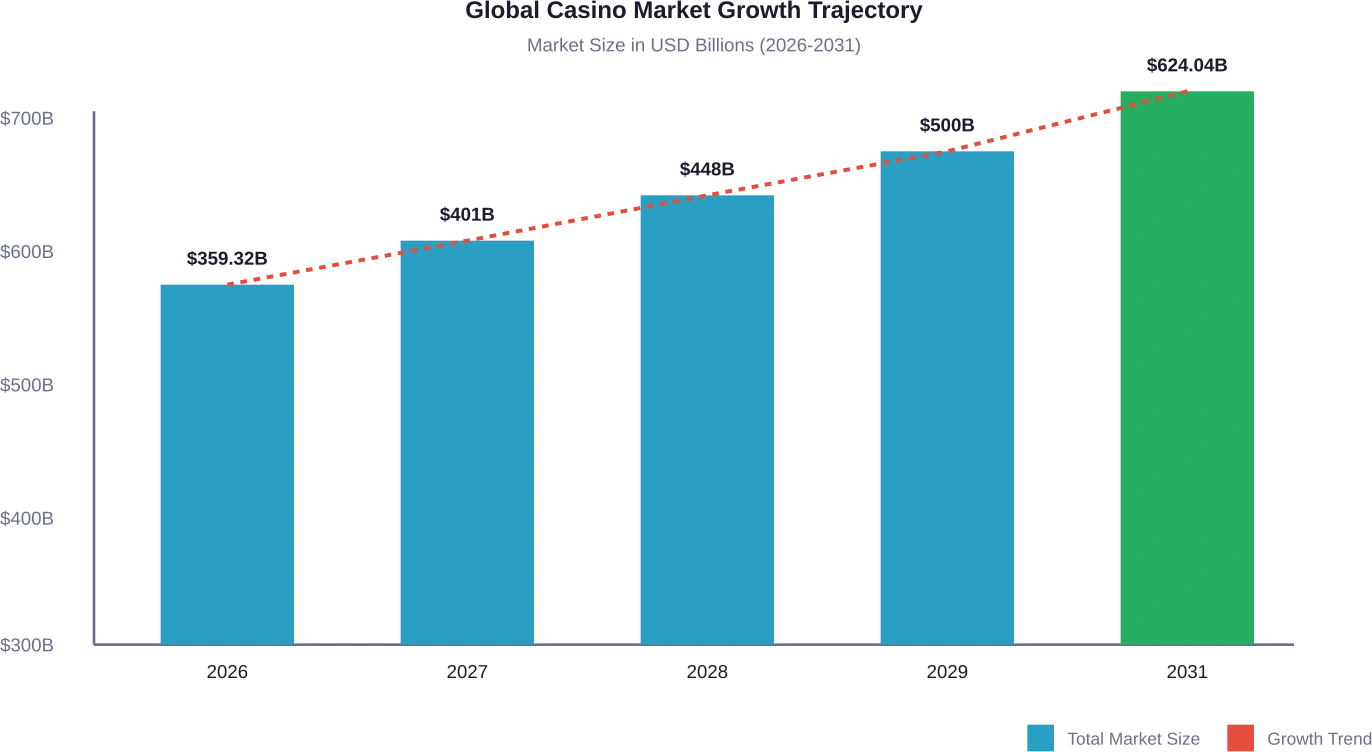
The overall casino gambling market encompasses both land-based venues and digital platforms. Based on data from Mordor Intelligence, the market reached USD 359.32 billion in 2026, and analysts project growth to USD 624.04 billion by 2031 at an 11.67% CAGR.
Within this broader market, the online casino segment represents one of the fastest-growing components. Grand View Research reports that the online casino market size was estimated at $19.11 billion in 2024 and is projected to reach $38.00 billion by 2030, growing at a CAGR of 12.2% from 2025 to 2030.
That means online casinos are expanding nearly twice as fast as the overall market—a shift that reflects changing player preferences and improved digital infrastructure.
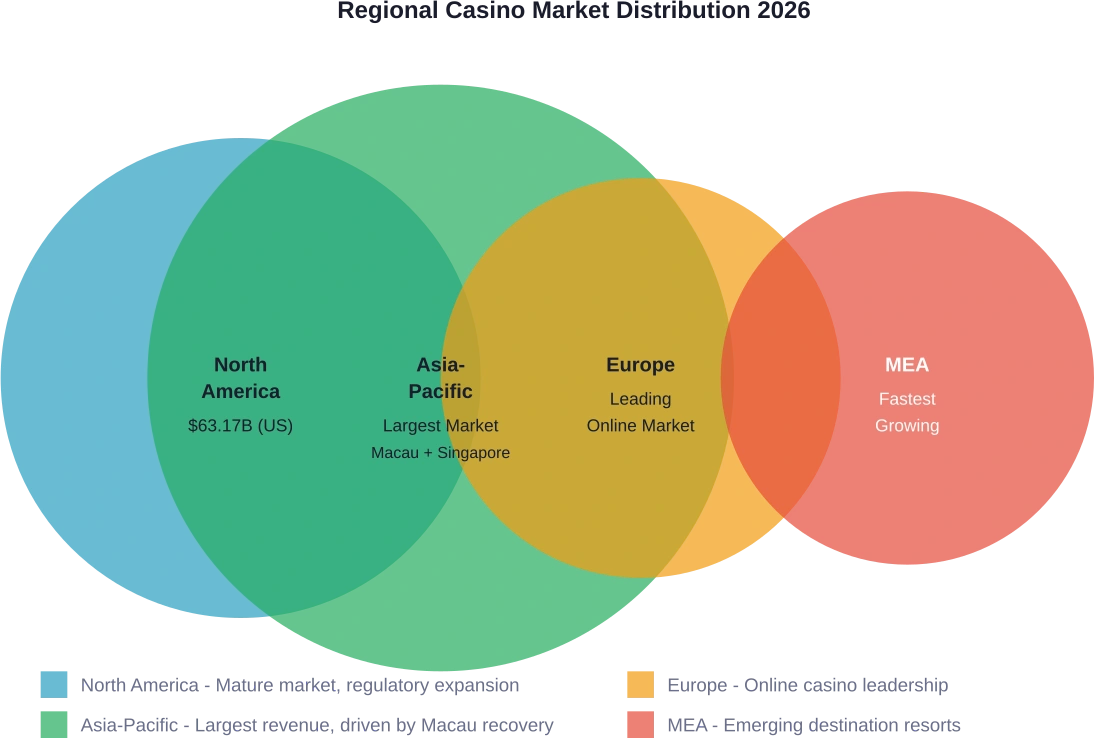
Regional variations add another layer of complexity. According to available data, the U.S. remains the largest casino gaming market worldwide, forecast to generate $63.17 billion in 2025. Europe held the largest share of the online casino market in 2024, while Asia-Pacific is identified as the fastest-growing region for casino gambling overall.
Ontario’s regulated iGaming market generated CAD 2.2 billion in total gaming revenue in fiscal 2023-24 (the period covering most of calendar 2024), with online casino products as the dominant segment.
Stay Visible in the Gaming Industry

As the market shifts, vendors still need a steady way to be found by operators and industry buyers. Sologe is a dedicated iGaming marketplace built to help gaming businesses find suppliers, software, platforms, and service partners. Vendors use it to present their products, services, and company profiles in one place, while buyers use the platform to search, compare, and start business conversations.
Want Ongoing Visibility in the Gaming Industry?
Use Sologe to:
- present your company in a marketplace built for gaming businesses
- make your products or services easier for buyers to find
- stay visible year-round on a dedicated industry platform
👉 Get in touch with Sologe to discuss listing your company as a vendor.
Online Casino Market Expansion
Digital transformation represents the most significant structural shift in casino gaming over the past decade. Online platforms aren’t just supplementing land-based casinos—they’re creating entirely new market dynamics.
Grand View Research data shows the online casino industry reaching $21.36 billion in 2025, with projections to $38.00 billion by 2030. That 12.2% CAGR outpaces traditional casino growth substantially.
Historical context reveals the acceleration. Historical data from H2 Gambling Capital cited in market reports indicates the online gambling market was valued at approximately $37.5 billion in 2015, showing significant expansion by 2023.
According to aggregated market forecasts, the casino gaming industry is projected to reach a market volume of $280.70 billion by 2029 when combining both online and offline segments. This represents significant growth from the $245.40 billion market size projected for 2025.
Device Preferences Shaping Access
How players access online casinos matters enormously for operator strategy and technology investment.
According to Grand View Research, the desktop segment held the largest revenue share across the online casino industry in 2024. Desktop platforms continue to dominate for serious gaming sessions, particularly among table game players who prefer larger screens and more precise controls.
But mobile is closing the gap rapidly.
Mobile casino access offers convenience that desktop can’t match—players can engage during commutes, lunch breaks, or wherever they happen to be. This flexibility drives higher session frequency, even if individual session duration skews shorter than desktop usage.
The shift toward mobile-first experiences is forcing casino operators to rethink their entire technology stack, from game design to payment processing to customer support interfaces.
Game Type Performance
Not all casino games perform equally in the online environment. Player preferences show distinct patterns that inform content strategy for operators.
Online slots dominate digital casino revenue across most markets. These games translate exceptionally well to digital formats, offering visual appeal, varied themes, and gameplay mechanics that work on both desktop and mobile devices.
Table games—including blackjack, roulette, and baccarat—represent the second major category. Live dealer variants have gained significant traction by bridging the gap between digital convenience and the social atmosphere of physical casinos.
The emergence of live dealer games deserves particular attention. These offerings use real dealers broadcast via video stream, allowing players to interact with human croupiers while playing from home. The format addresses one of the primary objections to online casinos: the lack of human interaction and atmosphere.
Regional Market Dynamics
Casino market growth doesn’t distribute evenly across the globe. Regional differences in regulation, cultural attitudes toward gambling, economic development, and tourism infrastructure create distinct market characteristics.
Asia-Pacific Leadership
Mordor Intelligence identifies the Middle East and Africa as the fastest-growing market, while Asia-Pacific represents the largest market overall for casino gambling.
Macau and Singapore anchor the Asian casino ecosystem. These destinations developed into global gaming hubs through deliberate policy choices that legalized and regulated casino operations while building integrated resort infrastructure.
Regional growth in Asia-Pacific benefits from Macau and Singapore’s recovery following pandemic-related disruptions, according to market analysis. Selective greenfield projects in the Middle East are establishing a new frontier for destination resorts that link gaming with high-end hospitality.
The Macau Gaming Inspection and Coordination Bureau provides official data on gross gaming revenue that analysts use to track market health in the world’s largest gambling center by revenue.
North American Market Maturity
The United States remains the largest single casino gaming market globally. Projections indicate the U.S. market will generate $63.17 billion in 2025, representing a substantial portion of worldwide casino revenue.
Several factors drive this dominance. Las Vegas and other Nevada properties continue attracting domestic and international visitors. Atlantic City maintains its position as a regional hub on the East Coast. And tribal gaming operations span numerous states, creating widespread access to casino gaming.
But the most significant recent development involves sports betting and online casino legalization across multiple states. This regulatory shift opened new revenue channels and legitimized digital gaming in jurisdictions that previously restricted it.
Nevada Gaming Control Board data provides authoritative statistics on gaming revenue through monthly reports. The Board publishes Gaming Revenue Information that summarizes revenue data for nonrestricted gaming activity, with each report reflecting 1-month, 3-month, and 12-month data.
The Nevada Gaming Control Board also releases an Abstract Report annually—a financial analysis of nonrestricted gaming licensees producing $1 million or more in gaming revenue. This report covers the July-June fiscal year and becomes available in mid-January for the prior fiscal year.
European Market Characteristics
Europe held the largest share of the online casino market in 2024, according to Grand View Research. The region benefits from relatively mature regulatory frameworks that legalized online gambling earlier than most other markets.
The United Kingdom established the UK Gambling Commission decades ago, creating a licensing regime that many other jurisdictions later emulated. This early regulatory clarity allowed British operators to develop sophisticated online platforms and build consumer trust.
Continental European markets show more variation. Some countries maintain state monopolies on certain gaming activities. Others have opened competitive licensing. Still others restrict or prohibit online gambling entirely.
This regulatory patchwork creates complexity for operators seeking pan-European reach, but it also generates opportunities for companies willing to navigate the licensing requirements in multiple jurisdictions.
Technology Trends Reshaping Casino Operations
Technology isn’t just enabling online casinos—it’s transforming how physical casinos operate and how players interact with gaming experiences across all channels.
Cashless Payment Systems
Cash has dominated casino floors since gaming began. But that’s changing rapidly.
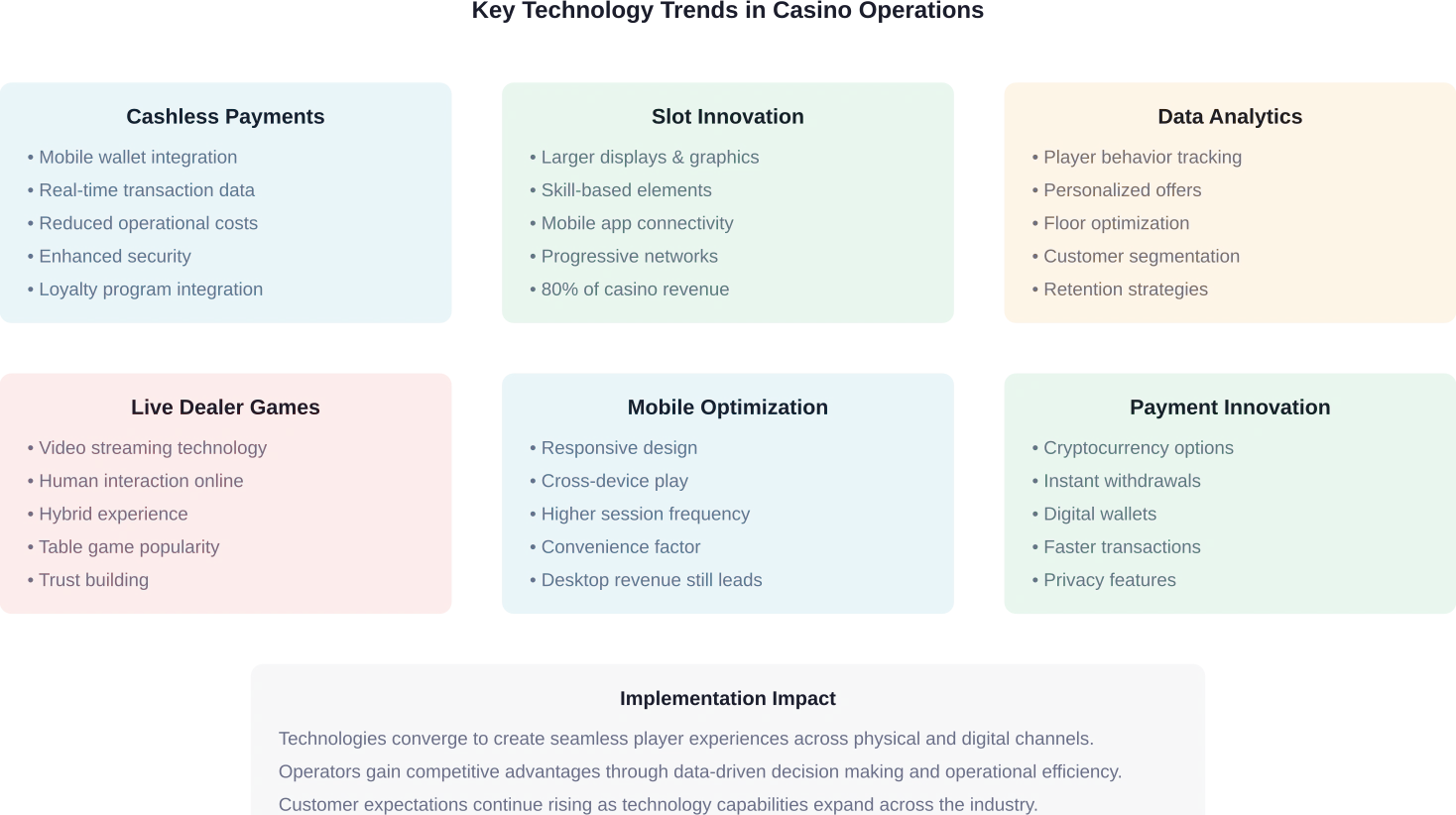
According to Acres Manufacturing analysis, cashless payment systems are transforming casino operations by allowing players to access loyalty programs and conduct transactions through a single mobile interface. The technology enables streamlined payment processing, offering casino operators critical real-time data while players gain convenient access to funds.
Cashless systems offer multiple advantages. They reduce the operational costs associated with cash handling, improve security by minimizing physical currency on the floor, and create better data for understanding player behavior.
For players, cashless means faster transactions, integrated loyalty rewards, and the ability to move seamlessly between different games and areas of the casino without carrying chips or currency.
Real talk: the transition won’t happen overnight. Many casino customers prefer cash for various reasons, including privacy concerns and simple habit. But the direction of travel is clear.
Slot Machine Evolution
Slot machines have been the bread and butter for most brick-and-mortar casinos, sometimes occupying more than 80 percent of floor space. The machines generate roughly 80 percent of casino revenue in many properties, making their performance critical to overall profitability.
Acres Manufacturing notes that slot machine upgrades and floor space optimization can ensure that approximately 80 percent of floor space generates significant revenue returns. Modern slot technology incorporates larger screens, more complex graphics, skill-based elements, and progressive jackpot networks that link machines across multiple properties.
The integration of mobile apps with physical slot machines creates hybrid experiences. Players can receive notifications about progressive jackpots, reserve machines, or continue play on mobile devices when leaving the casino floor.
Data Analytics and Personalization
Casino operators now collect unprecedented amounts of data about player preferences, gaming patterns, spending habits, and response to marketing offers.
This information enables sophisticated personalization. Loyalty programs can trigger customized offers based on individual play history. Floor managers can optimize machine placement based on actual usage patterns. Marketing teams can segment customers with precision and target messages that resonate with specific player profiles.
The casinos that leverage data analytics effectively gain competitive advantages in player acquisition and retention—critical factors in markets where numerous operators compete for the same customer base.
Regulatory Environment and Market Access
Regulation shapes every aspect of casino market dynamics. Where gambling is legal, how it’s licensed, what forms are permitted, and how it’s taxed all determine market structure and growth potential.
The Nevada Gaming Control Board serves as one of the most established regulatory bodies globally. The Board oversees gaming regulation in Nevada through multiple divisions, providing various data and statistics through public reports.
Regulatory approaches vary dramatically by jurisdiction. Some governments maintain tight control through limited licensing and state-owned operations. Others embrace competitive markets with numerous licensed operators. Still others prohibit most forms of gambling entirely.
Liberalization Trends
The general trend globally tilts toward liberalization—more jurisdictions are legalizing previously prohibited forms of gambling or opening markets that were previously state monopolies.
This shift reflects several motivations. Governments recognize that prohibition doesn’t eliminate demand; it simply pushes activity to illegal operators who don’t pay taxes or follow consumer protections. Regulated markets generate tax revenue while creating jobs and economic activity.
Competition from neighboring jurisdictions also drives liberalization. When nearby regions legalize gambling and capture revenue and tourism, political pressure builds to match those policies rather than losing economic benefits.
Online gambling regulation particularly demonstrates this dynamic. Once a few jurisdictions licensed online operators, others faced pressure to follow or watch their residents gamble with offshore sites beyond regulatory reach.
Compliance Challenges
Operating casinos across multiple jurisdictions creates significant compliance complexity. Each market has unique licensing requirements, operational standards, reporting obligations, and tax structures.
Large casino operators maintain dedicated regulatory compliance teams that track rule changes, ensure adherence to local requirements, and manage relationships with gaming authorities.
This regulatory burden creates economies of scale that favor larger operators with resources to navigate complex compliance landscapes. Smaller operators may struggle to expand across multiple markets given the fixed costs of maintaining compliance infrastructure.
Player Demographics and Behavior Patterns
Understanding who plays casino games and how their behavior is evolving provides critical context for market trends.
Market forecasts indicate growth in user numbers within the casinos and casino games market, though specific user penetration figures vary by region and segment. This expansion reflects both population growth in key markets and increasing participation rates among demographic groups that historically showed lower gambling engagement.
Age and Generational Shifts
Younger generations show different preferences than older casino customers. Traditional slot machines and table games that dominated casino floors for decades don’t always resonate with millennials and Gen Z players who grew up with video games, esports, and mobile apps.
This generational shift drives demand for skill-based gaming elements, social features, and digital integration. Casinos that stick exclusively with traditional offerings risk losing relevance as their customer base ages.
But here’s the thing—younger players also represent uncertain revenue. They may engage more frequently with lower stakes, creating different economics than high-rolling older customers who make fewer visits but spend more per session.
Gender Patterns
Historically, casino gaming skewed heavily male. That’s changing, particularly in online environments where participation shows greater gender balance.
Certain game types attract different demographic profiles. Slot machines and bingo traditionally show higher female participation, while poker and sports betting skew male. Understanding these patterns helps operators tailor game offerings and marketing approaches.
Geographic Variation
Player preferences vary substantially by region based on cultural factors, game familiarity, and regulatory history.
Asian markets show strong preference for baccarat and games involving chance-based outcomes. European players gravitate toward roulette and sports betting. North American customers favor slot machines and increasingly sports betting following widespread legalization.
These regional differences influence game floor composition in physical casinos and content strategies for online operators targeting specific markets.
Competitive Landscape and Market Concentration
The casino industry exhibits medium market concentration according to Mordor Intelligence analysis. Major players include Las Vegas Sands, MGM Resorts, Caesars Entertainment, Galaxy Entertainment, and Genting Group among others.
These large operators benefit from brand recognition, loyalty programs spanning multiple properties, economies of scale in marketing and operations, and financial resources to develop major resort projects.
Integrated Resort Model
The integrated resort approach combines casinos with hotels, restaurants, entertainment venues, convention facilities, and retail to create destination experiences that appeal to both gamblers and non-gamblers.
This model reduces dependence on gaming revenue alone. When a property offers world-class dining, shows, nightlife, and shopping, it attracts visitors who may not be primary gambling customers but contribute to overall revenue.
The strategy also positions casinos as broader entertainment and hospitality destinations rather than single-purpose gambling facilities—an important distinction in markets where gambling carries social stigma or regulatory uncertainty.
Online Operator Competition
The online casino space shows different competitive dynamics than land-based markets. Digital operations require less capital investment than physical properties, lowering barriers to entry.
This creates more fragmented competition with numerous operators competing for player attention. Brand becomes critical—players need to trust that an online casino will pay out winnings, protect their data, and offer fair games.
Established land-based casino brands increasingly launch online operations, leveraging existing brand equity and customer relationships. But digital-native operators with strong technology platforms and customer acquisition capabilities also capture significant market share.
Market Segment | Key Characteristics | Growth Rate | Primary Drivers |
|---|---|---|---|
Land-Based Casinos | Physical venues, destination resorts, integrated properties | Moderate growth | Tourism recovery, regional expansion, premium experiences |
Online Casinos | Digital platforms, mobile-first, diverse game libraries | 12.2% CAGR to 2030 | Regulatory liberalization, mobile adoption, convenience |
Live Dealer | Streaming video, human dealers, hybrid experience | Rapid expansion | Authenticity demand, technology maturity, trust building |
Sports Betting | Wager on sporting events, in-play betting, mobile apps | Very high growth | Legalization wave, fan engagement, technology platforms |
Revenue Drivers and Economic Impact
Casino revenue comes from multiple sources beyond simple wagering losses. Understanding this revenue composition reveals how the industry creates economic value.
Gaming Revenue Components
Direct gaming revenue—the amount players lose through wagering—forms the foundation. This revenue is typically categorized by game type: slots, table games, poker rooms, sports betting, and other specialty offerings.
Slot machines generate roughly 80 percent of gaming revenue in many properties, making them the economic engine of most casinos. Table games contribute the remainder, though they often occupy more floor space relative to their revenue contribution.
The Nevada Gaming Control Board tracks total gaming win and percentage fee tax collections for nonrestricted licensees through monthly abbreviated revenue releases. These reports provide comparative data from one year prior, allowing analysis of growth trends.
Non-Gaming Revenue
Integrated resorts generate substantial revenue from non-gaming sources: hotel rooms, food and beverage, entertainment, retail, conventions, and other amenities.
This diversification stabilizes revenue streams. Gaming revenue can fluctuate based on player luck and economic conditions, but hotel bookings, restaurant covers, and show tickets provide more predictable income.
The ratio of gaming to non-gaming revenue varies by property type. Las Vegas Strip properties typically show higher proportions of non-gaming revenue given their extensive amenity offerings. Regional casinos with fewer resort features remain more gaming-dependent.
Economic Multiplier Effects
Casino developments create economic impact beyond their direct revenue through employment, supplier relationships, and induced spending by casino employees.
Large casino resorts employ thousands of workers in gaming operations, hospitality services, food and beverage, entertainment, and support functions. These jobs create household income that gets spent in local economies.
Casinos also purchase goods and services from local suppliers—food, beverages, linens, maintenance services, professional services—creating business opportunities throughout the regional economy.
Academic research on this topic includes studies examining economic development impacts. Boise State University and University of Massachusetts scholars have produced research analyzing casino operations’ economic effects, though JavaScript must be enabled to access these resources through their institutional repositories.
Challenges Facing the Casino Industry
Market growth projections don’t tell the whole story. The casino industry faces significant headwinds that could impact future performance.
Regulatory Uncertainty
While the general trend favors liberalization, regulatory changes cut both ways. Governments can tighten restrictions, increase taxes, impose stricter responsible gambling requirements, or reverse previous liberalization.
This regulatory uncertainty complicates long-term planning and investment decisions. Casino operators must evaluate political risk alongside market opportunity when considering new jurisdictions or major capital investments.
Competition for Entertainment Spending
Casinos don’t just compete with other casinos—they compete with all forms of entertainment and leisure spending.
Consumers choosing how to spend discretionary income weigh casinos against restaurants, travel, concerts, sporting events, streaming services, video games, and countless other options. As entertainment alternatives multiply and become more accessible, casinos must work harder to capture consumer attention and spending.
Responsible Gambling Pressures
Increasing awareness of problem gambling creates pressure for stronger player protections, self-exclusion programs, spending limits, and other responsible gambling measures.
These requirements add operational complexity and potentially limit revenue from customers who would otherwise spend more. But they also build long-term sustainability by reducing social harm and maintaining public acceptance of regulated gambling.
Casinos that embrace responsible gambling proactively position themselves better than those that resist until forced by regulation or public pressure.
Technology Investment Requirements
Keeping pace with technology evolution requires ongoing investment. Digital platforms need constant updates. Cybersecurity threats demand robust defenses. Data analytics capabilities require sophisticated tools and skilled personnel.
These technology costs create ongoing pressure on margins, particularly for smaller operators without economies of scale.
Future Outlook and Emerging Opportunities
Looking beyond current trends reveals emerging opportunities that could reshape the casino landscape over the next several years.
Virtual Reality and Immersive Experiences
Virtual reality technology could bridge the gap between online convenience and physical casino atmosphere. VR casinos would allow players to interact in virtual gaming environments that replicate the social aspects of physical casinos while maintaining digital accessibility.
The technology isn’t quite there yet for mass adoption. VR headsets remain expensive and somewhat cumbersome. But as hardware improves and becomes more affordable, VR gaming could capture players seeking immersive experiences.
Cryptocurrency and Blockchain
Cryptocurrency adoption in online casinos offers faster transactions, enhanced privacy, and lower processing costs compared to traditional payment methods.
Blockchain technology also enables provably fair gaming where players can verify the randomness of outcomes—addressing one of the primary trust concerns with online gambling.
Regulatory uncertainty around cryptocurrency remains a barrier. But jurisdictions that develop clear frameworks for crypto gambling could attract operators and players seeking these benefits.
Esports and Skill-Based Gaming
Esports betting represents a growth opportunity as competitive gaming viewership and mainstream acceptance expand. Younger demographics that don’t engage with traditional sports betting show interest in wagering on esports competitions.
Skill-based gaming elements incorporated into casino games appeal to players who prefer influence over outcomes rather than pure chance. This trend reflects broader shifts in entertainment preferences toward interactive experiences.
Personalization and AI
Artificial intelligence enables unprecedented personalization in game recommendations, bonus offers, customer service interactions, and marketing communications.
AI chatbots can handle routine customer inquiries 24/7, improving service while reducing costs. Predictive analytics can identify players at risk of problem gambling, enabling early intervention. And dynamic game difficulty or volatility adjustment could optimize player engagement.
The casinos that effectively deploy AI while maintaining human touchpoints where customers value them will gain advantages in customer satisfaction and operational efficiency.
Investment Considerations and Market Entry
Market attractiveness for investors and new entrants depends on multiple factors beyond simple growth projections.
Capital Requirements
Physical casino development requires enormous capital investment. Integrated resorts can cost billions of dollars and take years to develop before generating revenue.
This capital intensity creates high barriers to entry and limits the player base to well-funded companies, often with access to public markets or institutional investors.
Online casinos require far less capital to launch—primarily technology platform development and licensing costs. This lower barrier enables more competition but also means less defensible market positions.
Licensing and Market Access
Obtaining gaming licenses represents the critical gating factor for market entry. Licensing processes evaluate financial stability, ownership backgrounds, operational capabilities, and compliance infrastructure.
Some jurisdictions limit license numbers, creating artificial scarcity that benefits existing licensees but blocks new entrants. Others maintain open licensing that allows any qualified operator to enter the market.
Understanding the licensing landscape in target markets is essential before committing resources to market entry strategies.
Partnership and Acquisition Strategies
Many companies enter new markets through partnerships with established local operators or acquisitions of existing licensees.
This approach provides immediate market access, established customer relationships, and local operational expertise while avoiding lengthy licensing processes and greenfield development risks.
The trade-off involves higher upfront costs and potential integration challenges when combining different organizational cultures and systems.
Key Trend | Impact Level | Timeline | Strategic Implications |
|---|---|---|---|
Mobile-First Gaming | Very High | Current | Platforms must prioritize mobile experience; desktop-only approaches become obsolete |
Cashless Transactions | High | 1-3 years | Infrastructure investment required; data capabilities improve with adoption |
Live Dealer Expansion | High | Current | Hybrid online/offline experience gains share; streaming infrastructure essential |
Regulatory Liberalization | Very High | Ongoing | New markets open regularly; compliance capabilities determine expansion pace |
Responsible Gambling | Medium | Ongoing | Proactive implementation builds trust; reactive approaches create regulatory risk |
VR/Immersive Tech | Medium | 3-5 years | Early experimentation warranted; mass adoption depends on hardware improvements |
Cryptocurrency Payments | Medium | 2-4 years | Regulatory clarity needed; early movers gain niche advantages |
Frequently Asked Questions
What is the current size of the global casino market?
The global casino market is valued at approximately USD 359.32 billion in 2026 and is projected to exceed USD 624 billion by 2031.
How is online casino growth comparing to traditional casinos?
Online casinos are growing faster, driven by mobile access, regulatory changes, and digital adoption trends.
What technology trends are most impacting casino operations?
Key trends include cashless payments, live dealer games, AI-driven analytics, and mobile-first platforms.
What are the main challenges facing the casino industry?
Challenges include regulatory complexity, competition for consumer spending, compliance requirements, and rising operational costs.
How do land-based casinos generate revenue beyond gambling?
Casinos diversify revenue through hotels, dining, entertainment, retail, and events, creating integrated resort experiences.
What is the outlook for casino market growth through 2030?
The market outlook remains strongly positive, with continued expansion driven by online growth and new market development.
Conclusion
The casino market stands at an inflection point where traditional gaming meets digital innovation, creating opportunities for operators who can navigate regulatory complexity while delivering experiences that resonate with evolving player preferences.
Market growth projections—11.67% CAGR for the overall market, 12.2% for online casinos—reflect genuine expansion driven by regulatory liberalization, technology adoption, and geographic diversification. These aren’t speculative figures; they’re grounded in observable trends across established and emerging markets.
But growth doesn’t distribute evenly. Winners in this environment will be operators who invest in mobile-first platforms, embrace cashless transactions and data analytics, maintain regulatory compliance across multiple jurisdictions, and balance revenue optimization with responsible gambling practices.
The shift from physical to digital isn’t eliminating land-based casinos—integrated resorts continue thriving by offering comprehensive entertainment destinations. Rather, digital and physical channels are converging into hybrid experiences where players move seamlessly between casino floors and mobile apps, between slot machines and live dealer streams.
Regional dynamics matter enormously. Asia-Pacific’s dominance reflects Macau’s unique position and broader Asian market preferences. North American regulatory expansion creates new opportunities as states legalize online gaming. European markets maintain sophisticated online ecosystems. And the Middle East positions itself as the next frontier for destination gaming resorts.
For investors, operators, technology providers, and anyone tracking entertainment industry trends, the casino market presents a compelling study in how traditional industries adapt to digital transformation while managing regulatory constraints and social responsibility considerations.
The Nevada Gaming Control Board, Macau Gaming Inspection and Coordination Bureau, and other regulatory bodies publish detailed revenue data that provides transparency into market performance. These authoritative sources enable evidence-based analysis beyond marketing claims and projections.
Looking ahead, emerging technologies like virtual reality, blockchain, and artificial intelligence will likely reshape casino experiences in ways we’re only beginning to understand. Operators who experiment intelligently with these innovations while maintaining operational excellence in current formats will position themselves for sustained success.
The casino market isn’t just growing—it’s evolving. And that evolution creates opportunities for those prepared to adapt to changing player expectations, regulatory environments, and competitive dynamics.
Ready to capitalize on casino market trends? Stay informed about regulatory changes in target markets, invest in mobile-first technology platforms, and develop data capabilities that enable personalized player experiences. The operators who combine these elements with responsible gambling practices will capture disproportionate share of the $624 billion market taking shape through 2031.
Related Articles

September 29, 2026Is the Casino Legal in Japan? The Real Answer...

September 29, 2026Is the Casino Legal in Gambia? What the Law...