 Nothing found for the request
Casino Tourism Market 2026: $127.8B Industry Analysis
Sologe March 27, 2026
Share:


Market Size and Growth Trajectory
The casino hotel market reached $127.8 billion in 2026, according to recent industry analysis. By 2036, projections indicate the market will expand to $239.9 billion, representing a compound annual growth rate of 6.5%.
Breaking down the numbers further reveals interesting regional variations. Casino tourism specifically—as distinct from the broader casino hotel market—stands at approximately $61.4 billion in 2024, with forecasts suggesting growth to $103.9 billion by 2034 at a 5.4% CAGR based on one analysis, while another projects $91.93 billion by 2035 with a 3.78% CAGR.
These varying projections reflect different methodologies, but all point toward steady growth. The discrepancy between casino tourism and casino hotel figures highlights how integrated resorts derive substantial revenue from non-gaming amenities.
Consumer Behavior Patterns
According to survey data, 32% of U.S. adults have visited a casino, with 18% frequenting smaller local casinos for day or evening trips. This suggests the market extends well beyond destination tourism to include regional entertainment venues.
But these numbers tell only part of the story. Length of stay emerges as a critical factor in economic impact, according to research from the University of Nevada, Las Vegas examining sport tourism in gaming destinations. The longer visitors remain, the more they spend across both gaming and non-gaming amenities.
Show Your Casino-Focused Offering Where Gaming Buyers Look

In segments like casino tourism, growth often depends on being visible to the right operators, partners, and service buyers. Sologe is built for that. It is a dedicated iGaming marketplace where gaming businesses search for suppliers, software, platforms, and services, while vendors use the platform to present their offering and company profile in one place.
Want to Reach More Gaming Businesses?
Use Sologe to:
- show your company to buyers already searching in the industry
- present your services and profile in one place
- build year-round visibility inside a dedicated iGaming marketplace
👉 Get in touch with Sologe to discuss listing your business as a vendor.
Regional Market Dynamics
North America maintains its position as the dominant casino tourism region, accounting for more than 35% of global revenue. Las Vegas remains the archetypal gaming destination, though regional casinos have proliferated across states as regulatory frameworks evolved.
The UNLV International Gaming Institute found that integrated casino-resorts tend to stimulate local economies rather than cannibalize existing businesses, contrary to common concerns. Research on a proposed Toronto development concluded it would likely generate positive economic effects for the Greater Toronto Area.
Asia-Pacific Expansion
Asia-Pacific represents the fastest-growing casino tourism market. Singapore’s Marina Bay Sands demonstrated how integrated resorts could transform a city’s tourism profile virtually overnight.
Japan’s entrance into legalized casino gaming creates entirely new revenue pools. The regulatory framework approval has attracted major international operators competing for limited licenses in key cities.
Research from UNLV examining sport tourism noted that gaming destinations benefit significantly when they can attract visitors for multiple purposes beyond gambling alone.
Middle East Emergence
The United Arab Emirates represents a fascinating case study. In January 2026, Wynn Resorts confirmed that Wynn Al Marjan Island remains on track for a 2027 opening, featuring 1,530 rooms and gaming facilities in a region traditionally opposed to gambling.
This development signals how sovereign wealth-backed mega-projects can create entirely new gaming markets where none existed before. The competitive landscape shifts when governments themselves become stakeholders in casino tourism development.
Major Industry Players and Market Share
The casino tourism market concentrates around several dominant operators who have expanded from regional strongholds to global portfolios.
Company | 2022 Revenue | Key Markets |
|---|---|---|
MGM Resorts International | $13.1 billion | Las Vegas, Macau, Regional U.S. |
Caesars Entertainment | $10.8 billion | Las Vegas, Atlantic City, Regional |
Las Vegas Sands | Major operator | Singapore, Macau |
Wynn Resorts | Major operator | Las Vegas, Macau, UAE |
These operators compete not just on gaming floors but on the entire resort experience. MGM’s portfolio demonstrates the integrated resort model—properties generate substantial revenue from conventions, entertainment, dining, and retail alongside traditional gaming.
Caesars Entertainment’s expansion through regional markets shows a different strategy, building brand presence in areas with legalized gaming across multiple states rather than concentrating exclusively in traditional hubs.
Integrated Resort Model Evolution
The term “casino” increasingly undersells what these properties offer. Modern integrated resorts function as self-contained entertainment cities.
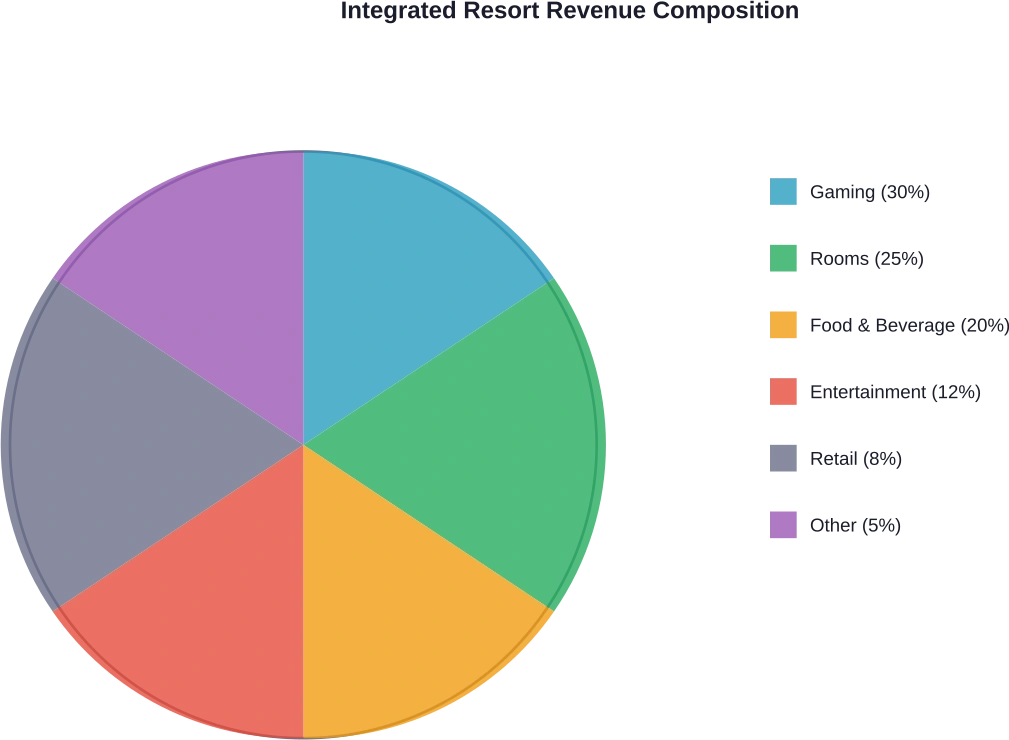
Look at what a contemporary casino resort includes: multiple hotel towers with thousands of rooms, convention centers spanning hundreds of thousands of square feet, celebrity chef restaurants, nightclubs, shopping districts, spas, pools, theaters hosting residency shows, and yes—gaming floors.
Gaming represents approximately 30% of integrated resort revenue in modern properties. Non-gaming revenue streams now rival or exceed traditional gambling income at many integrated resorts.
The Sports Tourism Connection
UNLV research on sport tourism in Las Vegas examined six major sporting events over a ten-year period. The findings revealed that sporting events significantly boost economic impact in gaming destinations, with length of stay again emerging as the critical variable.
This helps explain the rush to attract professional sports franchises. Las Vegas now hosts NFL, NHL, and WNBA teams, with major UFC events held regularly. These attractions draw visitors who might not have traveled solely for gaming.
Technology and Digital Transformation
Online casinos create both competition and complementary opportunities for physical casino tourism. Some operators feared digital gaming would cannibalize destination visits, but the relationship proves more nuanced.
Many integrated resort operators now run online gaming platforms in jurisdictions where legal. These digital offerings can serve as marketing channels, introducing players to brands they might later visit in person.
On the gaming floor itself, technology continues evolving. Slot machines now incorporate skill-based elements appealing to younger demographics. Table games integrate digital displays and automated tracking.
Market Segmentation Analysis
The casino tourism market segments along multiple dimensions that help operators target specific demographics.
By Target Audience
High-net-worth individuals receive targeted marketing and dedicated facilities. VIP gaming rooms, luxury suites, private gaming hosts, and exclusive amenities cater to whales—the industry term for highest-spending gamblers.
Mass tourists represent the largest segment by volume. These visitors seek entertainment value, social experiences, and affordable luxury rather than high-stakes gambling.
Business travelers constitute a third segment. Convention facilities drive significant traffic, with attendees gambling during downtime.
By Gaming Preference
Table games including roulette, blackjack, baccarat, and poker attract players seeking social interaction and perceived skill elements. Slot machines dominate floor space in most casinos due to higher profit margins and lower staffing requirements. Sports betting has exploded following regulatory changes in numerous jurisdictions.
Segment | Characteristics | Growth Outlook |
|---|---|---|
Slots | High margin, low staffing | Stable, evolving technology |
Table Games | Social, skill perception | Steady with premium growth |
Sports Betting | Event-driven, mobile-friendly | Rapid expansion |
Poker | Player-vs-player, tournaments | Niche but loyal following |
By Purpose of Visit
Gaming and entertainment remains primary for some visitors, but many now cite socializing and networking or relaxation and leisure as equal or greater motivations. This shift drives the continued investment in non-gaming amenities.
Employment and Economic Impact
According to the U.S. Bureau of Labor Statistics, gambling services workers earned a median annual wage of $35,630 in May 2024. This category includes dealers, slot supervisors, and gaming surveillance personnel.
Lodging managers at casino hotels—who plan, direct, and coordinate activities to ensure facilities run efficiently—earned a median of $68,130 annually. Most reach management positions either through hospitality degrees or by advancing from entry-level positions after several years of experience.
Security guards and gambling surveillance officers patrol and protect casino properties. Most states require licensing for these positions, especially when carrying firearms.
The employment picture extends far beyond gaming positions. Integrated resorts employ chefs, entertainers, retail staff, convention specialists, and countless other roles that wouldn’t traditionally be considered casino jobs.
Regulatory Landscape and Challenges
Casino tourism operates in a complex regulatory environment that varies dramatically by jurisdiction. Some regions embrace gaming as economic development, while others maintain strict prohibitions.
The regulatory landscape shifted substantially from 2021 to 2025, according to industry analysis. New jurisdictions legalized various forms of gaming, while existing markets implemented updated frameworks addressing online gambling, sports betting, and responsible gaming measures.
Licensing remains extraordinarily expensive and time-consuming. Operators must demonstrate financial stability, undergo background checks, and meet capital requirements that can run into billions of dollars for integrated resort licenses.
Responsible Gaming Initiatives
The industry faces ongoing scrutiny regarding problem gambling. Major operators have implemented self-exclusion programs, training for identifying problem gamblers, and partnerships with treatment organizations.
These initiatives serve dual purposes—addressing genuine social concerns while potentially forestalling more restrictive regulation.
Emerging Trends Reshaping the Market
Several trends are actively reshaping casino tourism beyond the growth projections.
Sustainability and ESG Focus
Integrated resorts consume enormous amounts of energy and water. Major operators now tout sustainability initiatives, from LEED-certified buildings to renewable energy adoption.
Whether driven by genuine environmental concern or investor pressure around Environmental, Social, and Governance (ESG) criteria, these efforts are changing how properties are designed and operated.
Experiential Entertainment
Younger visitors show less interest in traditional gaming but strong interest in experiences. Operators respond with immersive entertainment concepts, celebrity chef restaurants, and Instagram-worthy attractions.
The goal? Create memorable experiences worth sharing on social media, generating organic marketing while diversifying revenue beyond gaming.
Wellness Integration
Luxury spas, fitness centers, and wellness programming now feature prominently in integrated resorts. This seems counterintuitive given gambling’s health associations, but operators target affluent travelers who expect wellness amenities everywhere they stay.

Market Challenges and Risk Factors
Despite strong growth projections, the casino tourism market faces significant headwinds.
Economic sensitivity tops the list. Discretionary spending on gambling correlates closely with economic conditions. Recessions hit casino revenues hard as consumers cut entertainment budgets first.
Political instability affects international tourism flows. Properties dependent on visitors from specific countries face concentration risk when relationships deteriorate or travel restrictions emerge.
Competition intensifies as more jurisdictions legalize gaming. Each new market potentially diverts visitors from established destinations.
Future Outlook Through 2036
The casino tourism market trajectory through 2036 depends on several variables, but the fundamentals suggest continued expansion.
Emerging markets in Asia-Pacific and the Middle East offer the highest growth potential. These regions combine large populations, growing middle classes, and governments viewing gaming as economic development strategy.
Established markets in North America and Europe face slower growth but demonstrate resilience. The shift toward integrated resorts with diversified revenue streams provides stability even as pure gaming matures.
Technology will continue reshaping both operations and customer experience. Cashless gaming systems, mobile integration, and data analytics promise efficiency gains and enhanced marketing precision.
But here’s the thing—market size projections assume regulatory environments remain generally favorable. Significant policy reversals in key markets could alter growth trajectories substantially.
Frequently Asked Questions
What is driving casino tourism market growth?
Multiple factors drive growth including rising disposable incomes in emerging markets, expansion of integrated resort models that appeal beyond gambling enthusiasts, legalization in new jurisdictions, and the diversification of offerings to include entertainment, dining, and wellness experiences that attract broader demographics.
Which region dominates the casino tourism market?
North America currently dominates with more than 35% of global casino tourism revenue, led by Las Vegas and regional markets across the United States. However, Asia-Pacific shows the fastest growth rates, with Singapore, Macau, and emerging markets like Japan reshaping the competitive landscape.
How much revenue do major casino operators generate?
Based on 2022 figures, MGM Resorts International generated approximately $13.1 billion in revenue, while Caesars Entertainment produced roughly $8 billion. These figures include both gaming and non-gaming revenue streams from their global portfolios of integrated resorts and regional properties.
What percentage of casino resort revenue comes from gambling?
Modern integrated resorts generate increasingly diverse revenue streams. Gaming might represent only 30-40% of total revenue at many properties, with rooms, food and beverage, entertainment, retail, and convention business contributing the majority. This varies significantly by property type and location.
How does online gambling affect physical casino tourism?
The relationship between online and physical casino gambling proves more complementary than competitive. Online platforms serve as marketing channels introducing players to casino brands, while the integrated resort experience combining gaming with entertainment, dining, and leisure activities offers experiences digital platforms cannot replicate.
What are the employment prospects in casino tourism?
According to the Bureau of Labor Statistics, gambling services workers earned a median annual wage of $35,630 in May 2024, while lodging managers at casino properties earned $68,130. The industry employs diverse roles from gaming positions to hospitality, entertainment, food service, and management, with varying educational requirements and career paths.
What challenges does the casino tourism industry face?
Key challenges include economic sensitivity during recessions, regulatory uncertainty as jurisdictions update gaming laws, competition from new markets cannibalizing established destinations, responsible gambling concerns and potential for stricter regulation, and the need for continuous capital investment to maintain competitive properties.
Conclusion
The casino tourism market stands at a fascinating inflection point. With projections showing growth from $127.8 billion in 2026 to $239.9 billion by 2036, the industry demonstrates remarkable resilience and adaptability.
What was once primarily about gambling has evolved into a sophisticated blend of entertainment, hospitality, dining, and leisure experiences. Integrated resorts now compete as much on celebrity chef restaurants and arena entertainment as on gaming floors.
Emerging markets in Asia-Pacific and the Middle East offer tremendous growth potential, while established markets in North America continue generating substantial revenue through diversification and regional expansion. Technology reshapes both operations and customer experiences, creating efficiency while enabling personalized marketing.
The industry faces legitimate challenges—economic sensitivity, regulatory uncertainty, and intensifying competition among them. But the fundamental trend toward experiential luxury travel aligns perfectly with what integrated casino resorts offer.
For investors, operators, and destinations considering casino tourism development, the data suggests opportunity. The market isn’t just growing—it’s evolving into something far more sophisticated than traditional gambling destinations ever represented.
Related Articles

September 29, 2026Is the Casino Legal in Japan? The Real Answer...

September 29, 2026Is the Casino Legal in Gambia? What the Law...