 Nothing found for the request
France Casino Market 2026: Size, Growth & Trends
Sologe March 27, 2026
Share:


Market Size and Revenue Overview
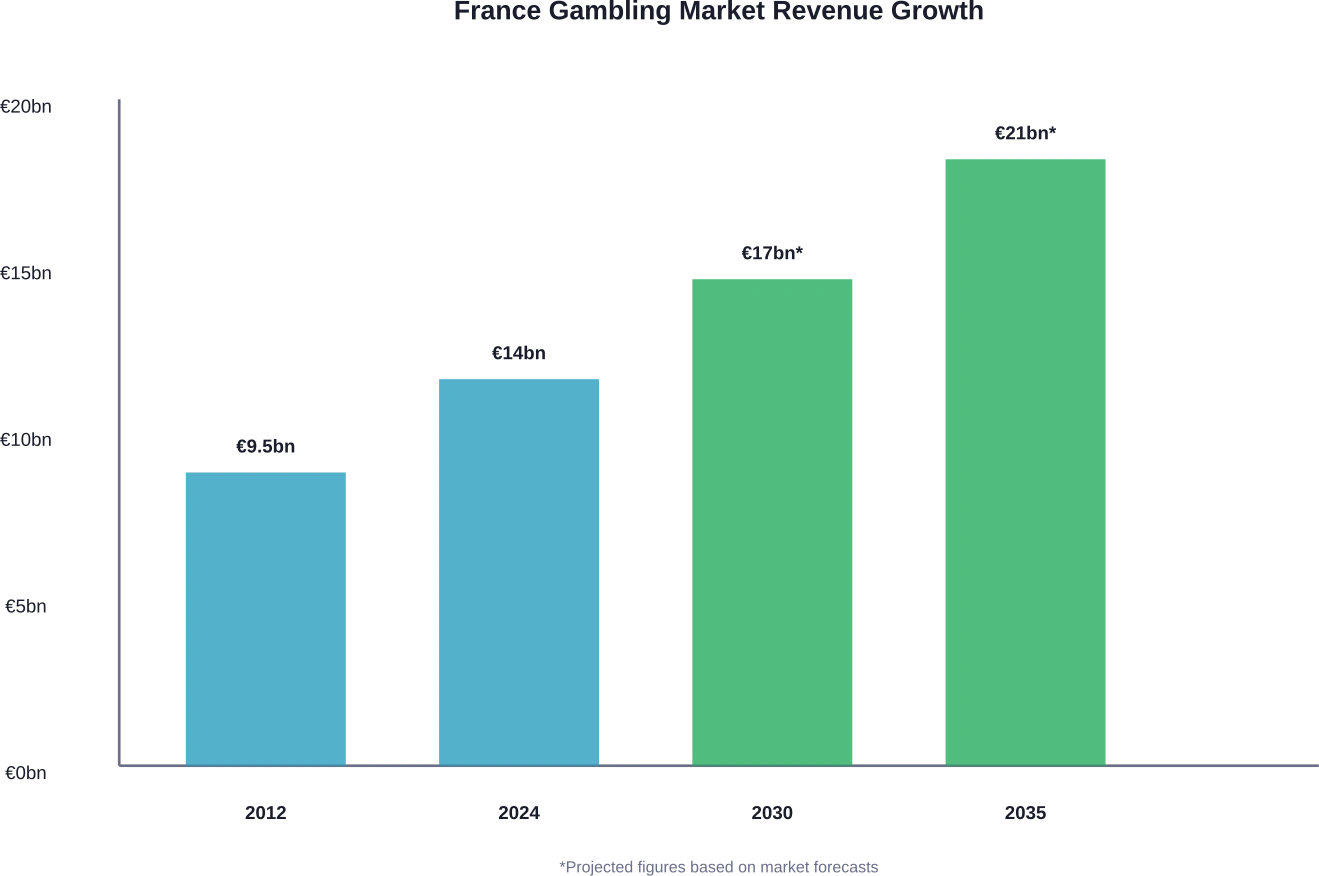
France’s gambling market reached €14 billion ($15.9 billion) in GGR in 2024, positioning it as one of Europe’s most substantial gaming markets.
The market breakdown reveals distinct segments with varying growth trajectories. Land-based casino gaming maintains a strong presence, particularly in tourist destinations and major urban centers.
According to Insee data (2012), French players wagered 46.2 billion euros annually, with net expenditures (after winnings) reaching 9.5 billion euros. The average player stakes around 2,000 euros per year, with net expenses (after winnings) of approximately 400 euros.
The French market’s composition reflects broader gambling consumption patterns. Gambling represented approximately 0.8% of household consumption in 2012, down slightly from a peak of 0.9% in 2004-2006, according to Insee statistics.
Reach Gaming Buyers in France Through a Dedicated Marketplace

In the France casino market, being easy to find can matter just as much as the offering itself. Sologe is built for that. It is a dedicated iGaming marketplace where operators and gaming businesses search for suppliers, software, platforms, and service partners, while vendors use the platform to present their company and products in one place.
Want More Gaming Buyers to Find You?
Use Sologe to:
- show your offering to companies actively looking for vendors
- present your company and products in one place
- stay visible year-round inside a dedicated iGaming marketplace
👉 Get in touch with Sologe to discuss listing your company as a vendor.
Online Gambling Growth Trajectory
The digital transformation of France’s gambling sector accelerates year over year. Online gambling revenue reached €2.6 billion in GGR, with online sports betting accounting for 43% of overall market growth.
What’s driving this surge? Several factors converge to fuel online expansion. Smartphone adoption provides 24/7 access to betting platforms. Improved payment processing removes friction from deposits and withdrawals. And frankly, younger demographics prefer digital experiences over visiting physical locations.
Grand View Research projects the France online gambling market will reach US$9,399.5 million by 2030, representing a CAGR of 12.5% from 2025 to 2030. That’s significantly faster than the land-based segment’s growth rate.
Market Segment | 2024 Size | 2030 Projection | CAGR |
|---|---|---|---|
Online Gambling | ~€2.6bn GGR | $9.4bn (€8.6bn) | 12.5% |
Total Casino Market | $9.29bn (€8.5bn) | Not specified | 6.48% to 2035 |
Online Sports Betting | Significant portion | Major growth driver | Above average |
The online segment’s expansion doesn’t occur in isolation. Locally-licensed online gambling revenue across Europe reached €30.4 billion in 2023, up from €27.8 billion in 2022. This European total is projected to grow at a compound annual rate of 7.7% to reach €40.8 billion in 2027.
France captures a meaningful share of this European online gambling growth, though it faces stiff competition from the UK, Spain, Italy, and emerging markets in Eastern Europe.
Casino Tourism and Land-Based Operations
Land-based casinos remain a cornerstone of France’s gambling ecosystem. The casino tourism market is estimated at USD 10.5 billion in 2025 and is forecast to reach USD 16.7 billion by 2035, growing at a CAGR of 4.7%.
French casinos cluster in several key locations. Coastal resorts like Deauville and Cannes attract international visitors. Paris maintains multiple gaming establishments serving both tourists and locals. And border regions near Switzerland, Germany, and Belgium capture cross-border traffic.
Tourism synergy plays a critical role in land-based performance. According to Eurostat data cited in market research, a majority of EU residents took at least one personal tourism trip in 2023, with cross-border travel facilitating regional casino visits. Areas like the Rhine Valley, where regulatory differences create destination appeal, benefit particularly from this pattern.
Real talk: land-based casinos offer something online platforms can’t replicate—the full entertainment experience. Fine dining, live shows, luxury accommodations, and the social atmosphere of table games create a value proposition beyond mere gambling.
The casino end-user segments break down into distinct categories: gambling enthusiasts who visit frequently, dabblers who participate occasionally during vacations, lottery loyalists who prefer simpler games, and an unengaged audience that casinos attempt to convert through integrated entertainment offerings.
Regulatory Framework and Market Challenges
France operates one of Europe’s most restrictive gambling regulatory environments. The Autorité Nationale des Jeux (ANJ) oversees all gambling activities, maintaining strict licensing requirements, advertising restrictions, and player protection measures.
This regulatory stance creates both barriers and opportunities. On one hand, high compliance costs and operational restrictions limit market entry. On the other, licensed operators benefit from a framework that legitimizes their operations and, theoretically, limits illegal competition.
But wait. Here’s a significant problem: France’s illegal gambling market has grown substantially. Recent reports indicate that illegal gambling operations may even surpass the regulated sector in some segments, particularly in online betting and casino games.
This black market growth stems from several factors. French regulations impose higher tax rates on operators compared to some neighboring countries. Advertising restrictions limit licensed operators’ ability to attract customers. And illegal offshore sites often offer better odds, bonuses, and game variety without regulatory overhead.
The ANJ continuously works to combat illegal operators through website blocking, payment processor pressure, and public awareness campaigns. However, the technology enabling illegal gambling evolves faster than enforcement mechanisms can adapt.
Key Market Drivers and Trends
Several forces shape France’s casino market trajectory. Understanding these drivers provides insight into where the market heads next.
- Digital Transformation: Technology adoption accelerates across all demographics. Mobile-first platforms, live dealer games, and cryptocurrency payment options attract tech-savvy players while improving accessibility for traditional demographics.
- Regulatory Evolution: While France maintains strict controls, incremental regulatory adjustments occur. The government balances revenue generation against social protection concerns, occasionally loosening restrictions in response to black market pressure.
- Demographic Shifts: Younger players gravitate toward skill-based gaming, esports betting, and social casino experiences. Traditional table games and slots must adapt to maintain relevance with Gen Z and younger Millennials.
- Economic Conditions: Discretionary spending on gambling correlates with economic confidence. France’s economic performance, employment rates, and disposable income levels directly impact gambling expenditure.
- Cross-Border Competition: France’s position within the EU creates competitive dynamics. Players can access operators based in Malta, Gibraltar, or other jurisdictions, forcing French operators to remain competitive despite higher regulatory costs.
Competitive Landscape and Major Players
France’s casino market features both established domestic operators and international gaming companies. La Française des Jeux (FDJ) dominates the lottery and sports betting segments, having expanded significantly since its partial privatization.
Casino Barrière operates multiple high-end casino resorts across France, targeting premium segments with integrated hospitality offerings. Partouche manages a portfolio of casinos and poker clubs, while international operators like Betclic and Winamax compete aggressively in the online space.
The competitive dynamics differ substantially between land-based and online segments. Physical casinos compete on location, amenities, and overall experience. Online operators compete on technology, game variety, bonus offers, and user experience—though French regulations significantly restrict promotional activities.
Market consolidation continues as operators seek scale advantages. Larger players absorb smaller casinos, particularly those struggling with profitability in secondary markets. The online segment sees ongoing partnerships between technology providers, payment processors, and licensed operators.
Market Segmentation Analysis
France’s casino market segments along multiple dimensions. By casino type, the split between land-based and online operations represents the primary division. Land-based facilities further subdivide into full-service casino resorts, urban gaming establishments, and smaller regional casinos.
Online casino gaming encompasses various subcategories: traditional casino games (slots, table games), live dealer experiences, poker rooms, and sports betting. Each subcategory attracts distinct player demographics and generates different margin profiles.
Segment | Primary Audience | Growth Rate | Key Characteristics |
|---|---|---|---|
Land-Based Luxury | High-net-worth tourists | Moderate | Integrated resorts, premium service |
Land-Based Regional | Local players | Slow | Convenient access, casual atmosphere |
Online Sports Betting | Young males 25-40 | High | Mobile-first, in-play betting |
Online Casino Games | Broad demographics | Very High | 24/7 access, game variety |
Poker (Online/Live) | Skill-focused players | Moderate | Competitive, tournament-driven |
By user type, the market divides into gambling enthusiasts who generate disproportionate revenue, occasional dabblers who participate during leisure activities, lottery loyalists who prefer simpler, lower-stakes options, and an unengaged segment that represents potential growth opportunities.
Future Outlook and Projections
The trajectory for France’s casino market points toward continued growth, though at varying rates across segments. The total casino market is expected to reach USD 18.53 billion by 2035, growing at a CAGR of 6.48% from its 2024 baseline of USD 9.29 billion.
Online gambling will significantly outpace land-based growth. The online segment’s projected 12.5% CAGR to 2030 reflects structural advantages: lower operational costs, superior convenience, and alignment with digital-native consumer preferences.
Casino tourism shows steady expansion, with forecasts indicating growth from USD 10.5 billion in 2025 to USD 16.7 billion by 2035. This 4.7% CAGR reflects France’s enduring appeal as a tourist destination and the integration of casinos into broader entertainment and hospitality offerings.
Several wildcards could accelerate or decelerate these projections. Regulatory liberalization—particularly around advertising and game offerings—would likely boost licensed operator growth. Conversely, increased taxation or restrictions could push more activity toward black market alternatives.
Technological innovation presents opportunities and challenges. Blockchain-based gambling, virtual reality casinos, and artificial intelligence-driven personalization could differentiate operators and attract new demographics. However, these technologies also complicate regulatory oversight and may face resistance from conservative regulators.
Economic headwinds pose risks to growth projections. Recession, unemployment spikes, or erosion of disposable income would pressure discretionary gambling spending. The casino and tourism segments would feel these impacts more acutely than online gambling, which demonstrates greater resilience during economic downturns.
Frequently Asked Questions
What is the current size of France’s casino market?
France’s casino market reached €14 billion in gross gaming revenue in 2024. The broader casino market, including both land-based and online operations, stood at USD 9.29 billion in 2024 and is projected to grow to USD 18.53 billion by 2035 at a compound annual growth rate of 6.48%.
How fast is online gambling growing in France?
Online gambling in France is experiencing rapid expansion. According to Grand View Research, the online gambling market is expected to reach US$9,399.5 million by 2030, representing a CAGR of 12.5% from 2025 to 2030. Online sports betting alone accounts for 43% of overall market growth, with recent GGR reaching €2.6 billion.
Who regulates gambling in France?
The Autorité Nationale des Jeux (ANJ) serves as France’s gambling regulator, overseeing all gambling activities including land-based casinos, online gambling, sports betting, and lotteries. The ANJ enforces licensing requirements, advertising restrictions, player protection measures, and combats illegal gambling operations.
What challenges does France’s legal gambling market face?
France’s regulated gambling sector faces significant competition from illegal operators. The black market has grown substantially, with some reports suggesting illegal gambling may surpass the regulated sector in certain segments. This stems from higher tax rates on licensed operators, strict advertising limitations, and offshore sites offering better odds and bonuses without regulatory overhead.
How does casino tourism contribute to France’s gambling market?
Casino tourism represents a substantial segment, valued at USD 10.5 billion in 2025 and forecast to reach USD 16.7 billion by 2035, growing at a CAGR of 4.7%. French casino resorts in locations like Deauville, Cannes, and Paris attract international visitors, while border regions capture cross-border traffic from neighboring EU countries. Tourism synergy supports land-based operations through integrated entertainment, dining, and hospitality offerings.
What are the main types of players in the French casino market?
The market segments into four primary user categories: gambling enthusiasts who visit frequently and generate disproportionate revenue, dabblers who participate occasionally during vacations or leisure time, lottery loyalists who prefer simpler low-stakes games, and an unengaged audience that casinos target through marketing and integrated entertainment experiences.
How does France’s gambling market compare to other European countries?
France ranks among Europe’s largest gambling markets, generating $2.7 billion in gambling profits according to global statistics. This positions France behind the UK ($3.8 billion) and Germany ($4 billion) but ahead of Spain ($1.8 billion) and Italy ($1.74 billion). Within the European online gambling landscape, which reached €30.4 billion in 2023, France captures a meaningful but not dominant share.
Conclusion
France’s casino market stands at an inflection point. Traditional land-based operations maintain relevance through tourism integration and premium experiences, while the digital segment accelerates rapidly, reshaping player expectations and competitive dynamics.
The €14 billion market of 2024 will look substantially different by 2030 and beyond. Online gambling’s projected growth to US$9.4 billion by 2030 signals a fundamental shift in how French consumers engage with gambling entertainment. Land-based casinos must evolve—integrating technology, enhancing non-gaming amenities, and targeting specific demographic segments to maintain growth trajectories.
Regulatory challenges persist. The ANJ faces the delicate task of protecting consumers and generating tax revenue while preventing market share erosion to illegal operators. France’s regulatory framework will likely undergo incremental liberalization, though not to the extent seen in some other European jurisdictions.
For investors, operators, and industry observers, France represents a mature yet dynamic market. Growth opportunities exist, particularly in digital channels and casino tourism, but success requires navigating complex regulations, intense competition, and evolving consumer preferences. The coming decade will determine which operators successfully balance innovation, compliance, and customer experience in Europe’s third-largest gambling market.
Related Articles

September 29, 2026Is the Casino Legal in Japan? The Real Answer...

September 29, 2026Is the Casino Legal in Gambia? What the Law...