 Nothing found for the request

India Online Casino Market 2026: Ban Impact & Reality
Sologe April 21, 2026
Share:


Quick Summary
Quick Summary: India’s online casino market has undergone a seismic transformation in 2025-2026, with the government enacting the Promotion and Regulation of Online Gaming Act, 2025, which effectively bans all real-money gambling while promoting e-sports and social gaming. This regulatory shift has redirected a market previously valued at $60 billion toward offshore platforms and created enforcement challenges as authorities blocked over 1,410 betting websites between 2022-25.
The india online casino market stands at a crossroads. What was once a rapidly expanding digital ecosystem—projected to reach $10.78 billion by 2030 according to earlier forecasts—has been fundamentally reshaped by sweeping regulatory intervention.
In March 2026, the Indian government enacted legislation that changed everything. But here’s the thing: bans rarely eliminate demand. They redirect it.
This analysis examines the current state of India’s online casino market, the regulatory earthquake that hit in 2025, and what’s actually happening on the ground as millions of users navigate a dramatically altered landscape.
The Market Before the Ban: Understanding the Scale
Prior to the regulatory crackdown, India’s gambling market represented one of the most dynamic growth stories in digital entertainment. The numbers tell a compelling story.
According to Wikipedia’s analysis of gambling in India, the Indian gambling market is estimated to be worth US$60 billion per year. Much of this activity occurred in the shadows, unregulated and untaxed.
The legitimate online gambling segment showed remarkable growth trajectories. Market research from IMARC Group indicated the India online gambling market was valued at USD 3.13 Billion in 2025 and is projected to reach USD 6.13 Billion by 2034, growing at a CAGR of 7.47%.
Grand View Research offered more aggressive estimates, projecting the online gambling market would reach US$ 10,776.7 million (approximately $10.78 billion) by 2030, representing a compound annual growth rate of 13.7% from 2025 to 2030.
Sports Betting Dominated the Landscape
Sports betting wasn’t just popular—it was dominant. According to market segmentation data, sports betting commanded a 52% market share in 2025, driven almost entirely by cricket’s cultural significance and the explosion of fantasy sports platforms.
Cricket betting and fantasy sports apps like Dream11 had attracted massive user bases, creating an ecosystem where millions engaged with sports through financial stakes.
Mobile devices accounted for 78% of market activity, reflecting India’s mobile-first internet adoption pattern and the proliferation of affordable smartphones.
Market Segment | Share (2025) | Primary Driver |
|---|---|---|
Sports Betting | 52.0% | Cricket culture, fantasy sports |
Mobile Devices | 78.0% | Smartphone penetration |
West & Central India | 36.0% | Urban concentration, disposable income |
Put Your Offer in Front of Gaming Industry Buyers

Sologe is built around product discovery in the gaming and iGaming space. Vendors can use the platform to present products and services in a structured marketplace where buyers browse by category, region, and type of offer. That makes it useful for companies that want a more targeted place to showcase what they sell.
Looking for a Marketplace Built Around Gaming Products?
Talk to Sologe to:
- publish products and services in an industry-focused platform
- reach buyers browsing by category and market segment
- present your offer in a marketplace made for gaming vendors
👉 Get in touch with Sologe to add your offer to the platform.
The 2025 Gaming Act: A Regulatory Earthquake
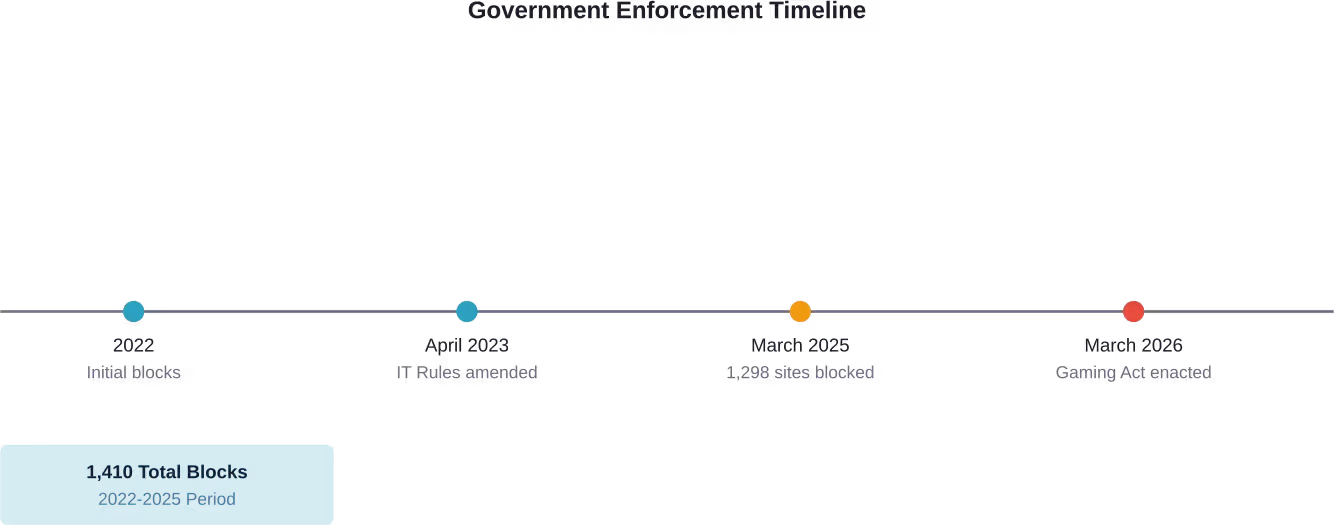
On March 18, 2026, the government announced the enactment of the Promotion and Regulation of Online Gaming Act, 2025. This wasn’t incremental regulation—it was a comprehensive ban on real-money gaming.
According to the Press Information Bureau, the Gaming Act prohibits all forms of online money games while promoting innovation in e-sports and online social gaming. The stated objective centers on creating a safe, responsible, and accountable online gaming ecosystem.
What the Ban Actually Prohibits
The legislation targets several specific activities:
- All online games involving financial stakes, regardless of skill classification
- Advertisements for online money gaming services
- Financial transactions related to prohibited gaming activities
- Payment gateway processing for real-money gaming platforms
Banks and payment gateways cannot legally process transactions for online gambling. Severe penalties await those who violate the new framework.
As reported by Economic Times Brand Equity, this represents a seismic shift for an industry that had attracted significant investment and built substantial user bases.
The Enforcement Record
The government hasn’t just legislated—it’s actively enforced. According to PIB data, the Ministry of Electronics and IT issued 1,410 blocking directions related to online betting, gambling, and gaming websites between 2022-25.
MeitY issued 1,298 blocking directions between 2022-24 (as of March 19, 2025) and 1,410 blocking directions between 2022-25 (as of March 26, 2025). This aggressive blocking strategy demonstrates serious intent behind the regulatory framework.
What Actually Happened After the Ban
Sweeping prohibitions rarely produce the intended outcomes cleanly. India’s gaming ban proved no exception.
According to analysis published in ET Government, offshore operators launched aggressive marketing campaigns immediately following the ban’s announcement. Platforms like JackBit, 1xBet, Parimatch, Odds96, and 4RaBet unleashed promotional blitzes offering bonuses ranging from 120% to 700% on deposits.
These platforms are located in tax havens like Malta, Curacao, and Cyprus—jurisdictions beyond Indian enforcement reach.
The Offshore Migration Pattern
Users didn’t stop gambling. They migrated to platforms the government can’t easily block or regulate.
The offshore platforms offer several advantages from a user perspective:
- Aggressive bonus structures not available domestically
- Cryptocurrency payment options that bypass traditional banking restrictions
- VPN compatibility that circumvents blocking attempts
- International licensing that provides perceived legitimacy
But these platforms operate without Indian consumer protections. Disputes have no legal recourse. Addiction resources are nonexistent. Financial fraud risks multiply.
The Judicial Pushback
State-level bans have faced significant judicial scrutiny. According to ET Legal’s expert analysis, the Madras High Court ruling against Tamil Nadu’s online gaming ban highlighted the constitutional tensions these prohibitions create.
The judicial crisis threatens constitutional balance and investor confidence while raising questions about whether blanket bans represent sound policy for a $3 billion digital sector.
Several legal experts argue that evidence-based national regulation would serve public interests better than outright prohibition, which simply pushes activity into unregulated channels.
Casino Tourism: The Physical Alternative
While online gambling faces prohibition, physical casino tourism presents a contrasting picture.
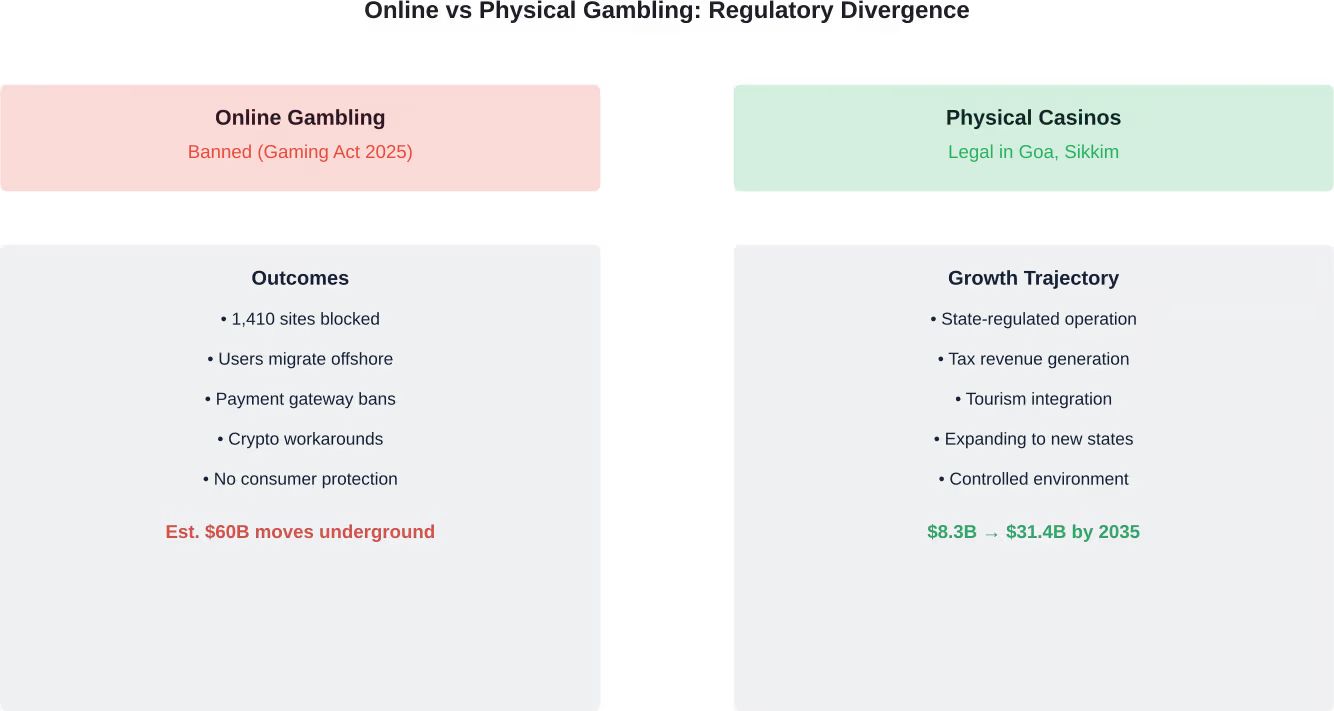
According to market projections, the India casino tourism market is projected to grow from USD 8.3 billion in 2025 to USD 31.4 billion by 2035, at a CAGR of 14.2%. This growth occurs even as online alternatives face regulatory headwinds.
Goa remains India’s primary casino destination, with both offshore (floating) casinos and land-based establishments operating legally under state law. Sikkim also permits casino operations, though on a smaller scale.
Visakhapatnam is reportedly under consideration as an additional casino destination, though concrete developments remain pending.
The contrast is striking: physical gambling in designated locations receives state sanction, while online gambling—potentially more controllable and traceable—faces comprehensive prohibition.
State-Level Variations Create Legal Complexity
India’s federal structure means gambling regulation varies dramatically by state. Some states permit certain activities while others maintain comprehensive prohibitions.
Goa has legalized casinos. Tamil Nadu attempted comprehensive online gaming bans that courts subsequently challenged. Sikkim permits limited gambling operations. Most other states prohibit gambling under various legacy laws.
This patchwork creates enforcement challenges and jurisdictional confusion. An activity legal in one state becomes criminal across the border.
The Skill vs Chance Debate
According to PIB documentation from April 2023, Supreme Court judgments have held that certain games of skill are constitutionally valid, while betting and gambling activities based on chance remain banned under various state laws.
Fantasy sports platforms initially operated under the “game of skill” exception, arguing that cricket knowledge and team selection strategy constituted skill elements that distinguished them from pure gambling.
The 2025 Gaming Act ended this distinction by prohibiting all online money games regardless of skill classification, eliminating the legal grey area many platforms had occupied.
The Black Market Reality
Prohibition creates black markets. India’s experience follows this pattern exactly.
The estimated $60 billion annual gambling market didn’t evaporate with legislative action. Instead, it fragmented into harder-to-trace channels.
Cryptocurrency transactions surge when traditional payment rails face restrictions. VPN usage spikes when websites get blocked. Offshore platforms advertise aggressively when domestic competition faces elimination.
Consumer Protection Evaporates
Regulated markets offer consumer protections: dispute resolution mechanisms, responsible gambling resources, self-exclusion programs, and financial safeguards.
Offshore platforms operating illegally provide none of these protections. Users who experience fraud, addiction, or financial disputes have zero legal recourse.
As noted in ET Government analysis, healthy online gaming requires informed choice, ethical industry practices, and responsible oversight. Sweeping bans produce the opposite outcome.
E-Sports and Social Gaming: The Permitted Path
While real-money gaming faces prohibition, the Gaming Act explicitly promotes e-sports and online social gaming as acceptable digital entertainment forms.
E-sports—competitive video gaming without financial wagering—represents a rapidly growing global industry. India’s large young population and improving internet infrastructure position the country as a potential e-sports hub.
Social gaming—games played for entertainment without money at stake—also receives regulatory approval. These games monetize through advertisements, in-app purchases for cosmetic items, or premium features rather than gambling mechanics.
Market Size Projections: Before and After
Pre-ban projections painted an aggressive growth picture. Those projections now require substantial revision.
IMARC Group projected the India online gambling market was valued at USD 3.13 Billion in 2025 and is projected to reach USD 6.13 Billion by 2034, growing at a CAGR of 7.47%.
Grand View Research offered more bullish estimates, forecasting US$ 10,776.7 million (approximately $10.78 billion) by 2030 at a 13.7% growth rate.
These projections assumed regulatory stability or gradual tightening. The comprehensive 2025 ban invalidates those assumptions for the legitimate market.
Source | Base Year | Projected Value | Target Year | Status |
|---|---|---|---|---|
IMARC Group | 2025: $3.13B | $6.13B | 2034 | Invalidated by ban |
Grand View Research | 2024: $5.02B | $10.78B | 2030 | Invalidated by ban |
Casino Tourism (FMI) | 2025: $8.3B | $31.4B | 2035 | Still valid |
The underground market—potentially still $60 billion annually—doesn’t appear in official projections or economic statistics. This creates a distorted picture where official market size shrinks while actual gambling activity persists in untracked channels.
Regional Market Dynamics
West and Central India accounted for 36% of market share in 2025 according to segmentation data, driven by urban concentration, higher disposable incomes, and better digital infrastructure.
Metropolitan areas like Mumbai, Delhi, Bangalore, and Hyderabad represented the core user base for online gambling platforms before the ban.
Post-ban, regional enforcement varies. States with more sophisticated cyber infrastructure can more effectively block offshore platforms. States with less technical capacity see continued access through VPNs and alternative DNS services.
Technology Versus Regulation
As noted in ET Government analysis, technology has long outpaced regulatory capacity. This gap widens with prohibition-based approaches.
Website blocking proves ineffective when users deploy VPNs. Payment restrictions fail when cryptocurrency offers alternatives. Advertising bans lose impact when social media and messaging apps provide promotion channels.
Effective regulation requires technical sophistication that matches platform capabilities. Blanket bans sidestep this challenge but also surrender any regulatory influence over actual user behavior.
International Comparison and Best Practices
India’s prohibitionist approach contrasts with regulatory models adopted elsewhere.
Several countries license and regulate online gambling with emphasis on consumer protection and responsible gambling measures.
Australia regulates online gambling with emphasis on harm minimization and consumer protection.
The United States takes a state-by-state approach to online gambling regulation, with some jurisdictions permitting and regulating the activity while others maintain prohibitions.
According to ET Government commentary on illegal online gambling regulations, India should actively engage with other jurisdictions to share best practices, exchange information, and coordinate enforcement actions against illegal operators.
Strategic partnerships with like-minded countries could strengthen regulatory capabilities and amplify impact in combating gambling-related crimes globally.
The Road Ahead: Scenarios and Possibilities
Where does India’s online casino market go from here? Several scenarios present themselves.
Scenario 1: Status Quo Prohibition
The government maintains the comprehensive ban. Enforcement continues through website blocking and payment restrictions.
Outcome: The $60 billion market operates entirely offshore and underground. No consumer protections exist. No tax revenue flows to government. Addiction problems persist without support infrastructure.
Scenario 2: Selective Liberalization
The government creates a regulated framework for specific activities like fantasy sports while maintaining bans on traditional casino games.
Outcome: Partial market formalization. Some tax revenue generation. Limited consumer protections for permitted activities. Continued underground activity for prohibited games.
Scenario 3: Comprehensive Regulated Framework
India adopts a UK-style licensing system with strict consumer protections, responsible gambling requirements, and substantial taxation.
Outcome: Market formalization. Significant tax revenue. Consumer protections and addiction support. Reduced offshore migration. Industry investment and job creation.
Which scenario materializes depends on political will, judicial decisions, and public pressure. Current trajectory suggests continued prohibition with gradual erosion as offshore platforms prove unstoppable.
Frequently Asked Questions
Is online gambling legal in India in 2026?
No. The Promotion and Regulation of Online Gaming Act, 2025, enacted in March 2026, prohibits all forms of online money games regardless of skill classification. This includes sports betting, casino games, and real-money fantasy sports. Physical casinos remain legal in states like Goa and Sikkim.
What happened to the Indian online gambling market after the ban?
The legal market effectively collapsed, but activity shifted to offshore platforms operating outside Indian jurisdiction. These platforms serve Indian users via VPNs and cryptocurrency payments. Despite blocking over 1,400 websites, new platforms continue to emerge.
How big was India’s online gambling market before the ban?
Estimates suggest the legal market ranged from $3.13 to $5.02 billion in 2025. The broader gambling market, including illegal activity, was estimated at around $60 billion annually, with sports betting accounting for approximately 52% of the legal segment.
Can Indians still access online casinos despite the ban?
Technically yes, but it is illegal. Offshore platforms accept Indian users, often accessed through VPNs. Cryptocurrency enables payments when traditional methods are restricted. However, these platforms provide no legal protections and expose users to potential penalties.
What is the difference between online gambling and casino tourism in India?
Online gambling is banned nationwide, while physical casino tourism remains legal in specific states. The casino tourism market is growing, with projections rising from $8.3 billion in 2025 to $31.4 billion by 2035. Goa is the primary hub for legal casino activity.
Will India ever regulate online gambling instead of banning it?
The future remains uncertain. While some experts advocate regulation for consumer protection and tax revenue, the current policy favors prohibition due to concerns about addiction and financial harm. Legal and judicial developments may influence future changes.
What activities are still legal under the Gaming Act?
E-sports and social games without real-money wagering remain legal and are actively promoted. These platforms can monetize through ads, in-app purchases, and premium features, but cannot include gambling mechanics.
Conclusion: A Market in Transformation
The india online casino market stands at a critical juncture. What was once a rapidly expanding digital ecosystem projected to reach over $10 billion by 2030 has been fundamentally reshaped by comprehensive regulatory prohibition.
But prohibition hasn’t eliminated demand. The estimated $60 billion annual gambling market continues—just in channels beyond regulatory oversight or consumer protection.
Offshore platforms aggressively target Indian users. Cryptocurrency circumvents payment restrictions. VPNs bypass website blocking. The underground market thrives while the government surrenders any regulatory influence.
Meanwhile, physical casino tourism grows dramatically, projected to reach $31.4 billion by 2035. The regulatory divergence between online prohibition and physical permissiveness creates logical inconsistencies that undermine policy coherence.
International experience suggests regulated frameworks with strong consumer protections, responsible gambling requirements, and effective taxation serve public interests better than blanket bans that simply push activity underground.
Whether India eventually adopts such an approach remains to be seen. For now, the market exists in a state of regulatory limbo—officially prohibited, practically persistent, and entirely unprotected.
Understanding this complex landscape requires looking beyond official pronouncements to examine actual user behavior, offshore platform growth, and enforcement limitations. The india online casino market in 2026 is not what regulators intended—but it is the reality millions navigate daily.
Related Articles

September 3, 2026Is the Casino Legal in Denmark? 2026 Guide

September 3, 2026Is the Casino Legal in Angola? What the 2026...