 Nothing found for the request
Is the Casino Legal in Armenia? 2026 Laws & Regulations
Sologe July 11, 2026
Share:


Legal Status: Are Casinos Legal in Armenia?
Yes. Casinos are fully legal and regulated in Armenia.
The current framework is based on the Law of the Republic of Armenia “On Regulation of Game Activities” (No. ZR-263), adopted on June 26, 2024. This law established comprehensive rules for land-based casinos, online casinos, sports betting, poker, and lotteries.
The legislation explicitly permits both physical and remote (online) gambling, provided operators hold a valid license and meet strict operational, financial, and technical requirements.
What the Law Actually Covers
The law defines “game activities” broadly, including:
- Casino games (roulette, blackjack, baccarat, slots)
- Sports and event betting
- Poker rooms and card games
- Lotteries
- Online and remote gambling platforms
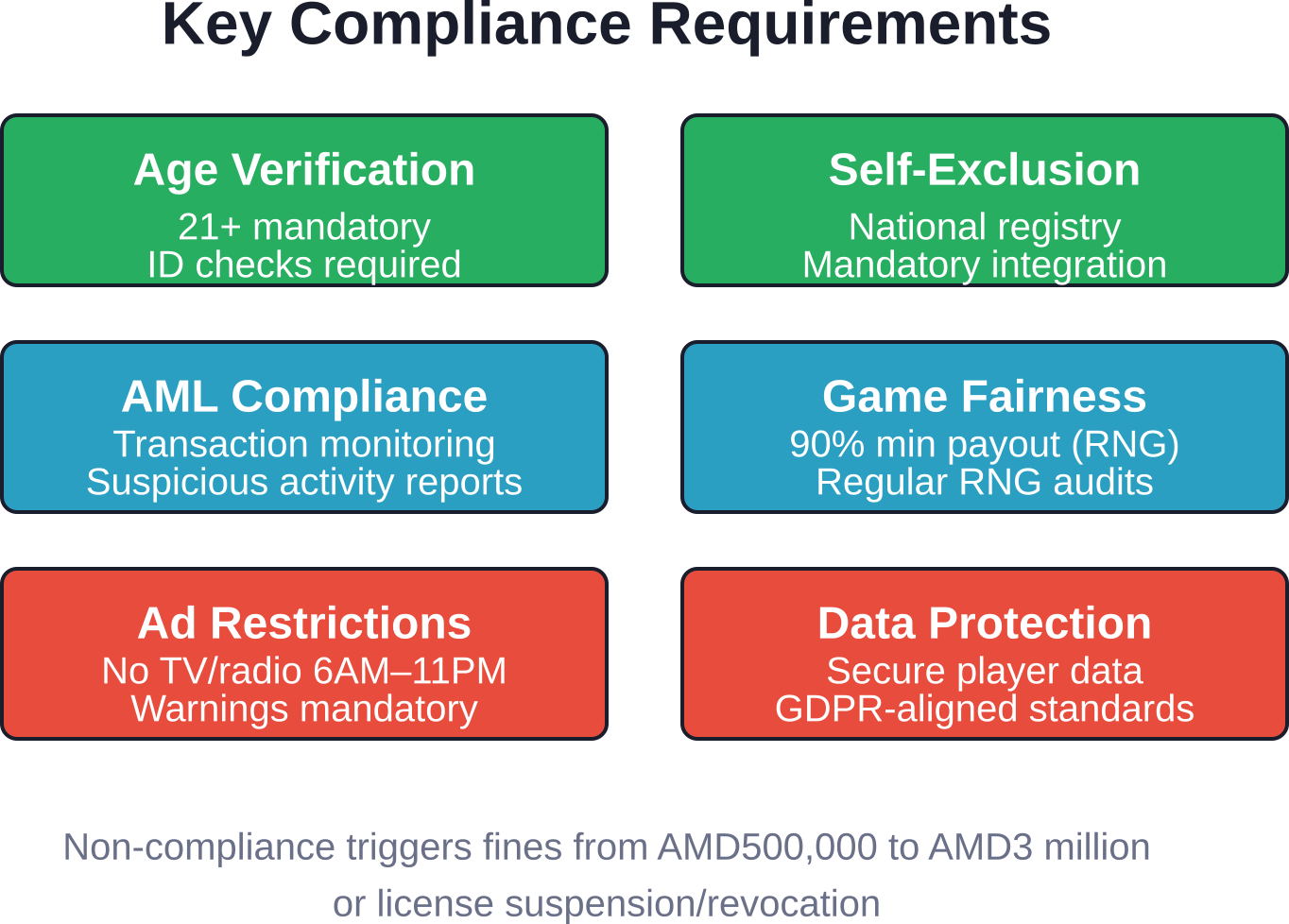
It sets a 90% minimum payout ratio for RNG-based games and includes responsible gambling requirements such as self-exclusion, age verification (21+), and advertising restrictions.
Who Regulates Gambling in Armenia?
The Ministry of Economy currently handles licensing and supervision. A dedicated Armenian Gambling Authority is being developed, with funding partly coming from increased licence fees.
That said, regulatory responsibilities are in transition. According to Chambers Global Practice Guides, Armenia is developing a dedicated Armenian Gambling Authority—a standalone regulatory body funded in part by increased online casino and sports betting license fees.
This shift mirrors international best practice (think UK Gambling Commission, Malta Gaming Authority). A specialized regulator can enforce compliance more effectively than a general economic ministry.
Enforcement and Penalties
Unlawful gambling in Armenia triggers both administrative and criminal sanctions.
Common administrative penalties include:
- AMD200,000–AMD300,000 for operating beyond permitted hours
- AMD500,000 for repeat violations
- AMD1,000,000 for telecom operators failing to block unlicensed foreign platforms
- AMD3,000,000 for repeated telecom violations
Criminal sanctions apply to organizers of unlicensed gambling operations, with potential imprisonment depending on the scale and nature of the offense.
Build Stronger Gaming Business with Sologe
Businesses researching Armenia’s gaming sector often need to evaluate suppliers, technologies, and operational categories alongside legal requirements. Sologe helps companies compare different areas of the iGaming industry, including platforms, traffic, payments, sports betting, and operations management.
With Sologe, companies can:
- Compare online gaming platform options
- Review sports betting software
- Explore payment categories
- Assess traffic and affiliate channels
- Research operations management tools
👉Contact Sologe to review payments, sports betting software, traffic categories, operational tools, and other B2B iGaming resources.
Licensing Requirements and Costs
Operating a casino in Armenia — whether land-based or online — requires an annual license issued by the Ministry of Economy (with oversight from the State Revenue Committee).
The cost structure is tiered by location for land-based operations. Here is the breakdown of 2024 annual state fees for organizing games with winnings:
Location / Platform | Annual State Fee (AMD) | Approximate USD |
Tsakhkadzor city | 180,000,000 | ~$450,000 |
Sevan city | 150,000,000 | ~$375,000 |
Jermuk city | 100,000,000 | ~$250,000 |
Meghri city | 35,000,000 | ~$87,500 |
Other locations | 5,500,000,000 | ~$13.75 million |
Online gambling licenses carry even steeper costs. In April 2025, the annual licence fee was raised to AMD 350 million (~US$ 890,000) for online casinos and AMD 100 million for online betting operators. These fees are subject to progressive annual multipliers (3.0× in 2026 and higher in subsequent years) until the new gambling regulatory authority is fully established.
This significant increase aims to tighten oversight of Armenia’s rapidly growing online gambling sector and fund the development of a new dedicated gambling authority.
Application Process and Timeline
License applicants must demonstrate:
- Financial solvency and transparent ownership structures
- Technical infrastructure meeting data protection and game fairness standards
- Anti-money laundering (AML) compliance programs
- Responsible gambling measures (self-exclusion, session limits, age verification)
The Ministry of Economy reviews applications on a rolling basis. Licenses are valid for one year and require annual renewal.
Operators must also post financial guarantees to ensure player funds remain protected, and any acquisition of 10% or more of an operator’s charter capital requires prior regulatory approval.
Taxation of Gambling Operators
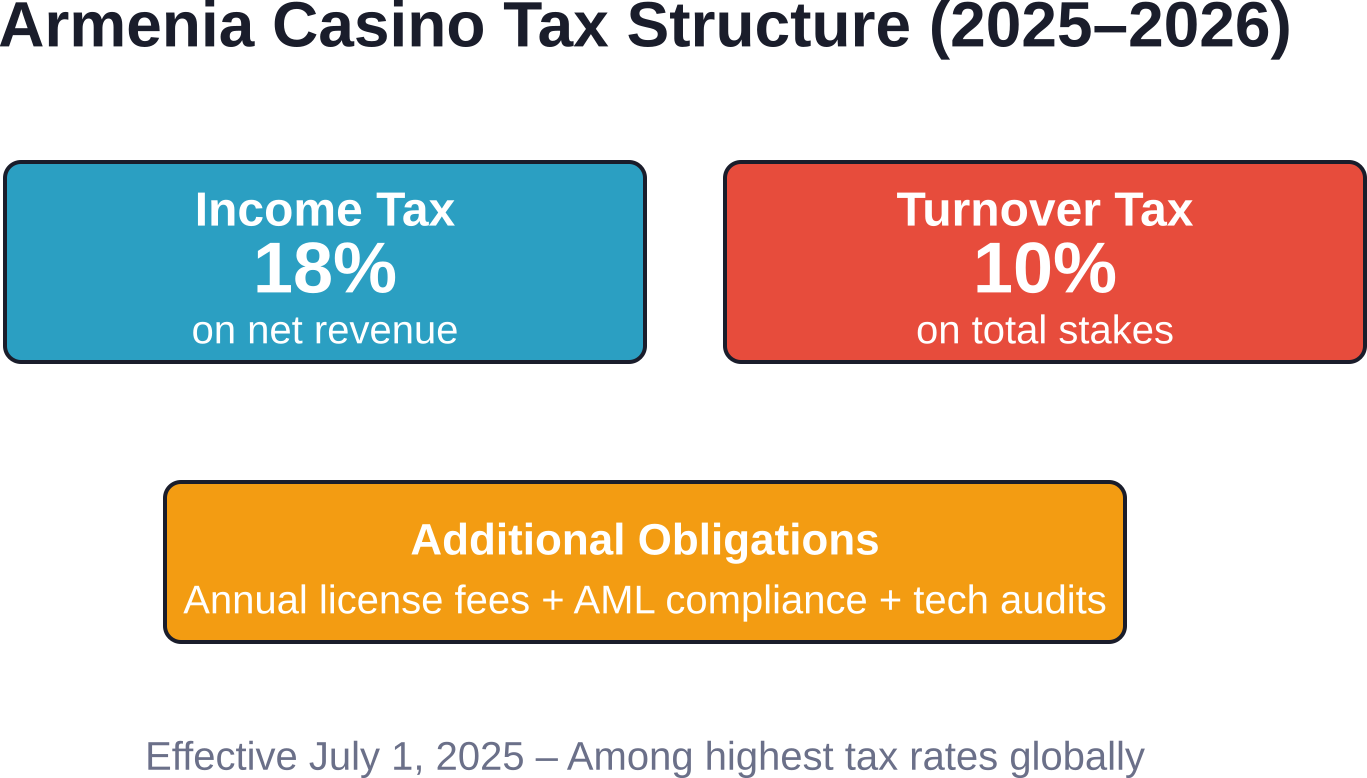
Armenia’s gambling tax framework underwent major reform in 2025. Operators now face a two-tier tax burden:
1. Income Tax (18%)
Gambling operators pay an 18% income tax on their tax base (gross gaming revenue minus allowable deductions). This rate applies to all licensed operators, regardless of vertical.
2. Turnover Tax (10%, Effective July 2025)
Starting July 1, 2025, Armenia introduced a 10% turnover-based tax on all gambling activities. This tax applies to total stakes (player deposits), not just net revenue.
The turnover tax represents a fundamental shift. Previously, operators paid tax only on profit. Now they pay on volume—a model that can squeeze margins, especially for high-volume, low-margin verticals like sports betting.
The combined tax load (18% on profit + 10% on turnover) makes Armenia one of the more expensive regulated markets globally.
Impact on Operators
The turnover tax forces significant operational changes. Operators must:
- Recalibrate bonus strategies (bonuses increase turnover without proportional revenue)
- Adjust payout ratios carefully to stay profitable
- Invest in compliance infrastructure to accurately track and report stakes
Some smaller operators may find the economics unsustainable, leading to market consolidation. Larger, well-capitalized operators can absorb the costs more easily.
Land-Based vs. Online Casinos
Armenia licenses both land-based and online gambling operations, but the regulatory and economic environments differ sharply.
Land-Based Casinos
Physical casinos cluster in tourist zones: Yerevan (the capital), Tsakhkadzor (a ski resort), Sevan, and Jermuk. These venues cater primarily to tourists and affluent locals.
Land-based operators benefit from lower license fees (depending on location) and established customer bases. But they’re capital-intensive: real estate, staffing, security, and physical infrastructure all require upfront investment.
Online Casinos
Armenia’s online gambling sector has exploded, with significant growth in deposits and activity.
Online operators face steeper costs:
- AMD 350 million annual license fee (vs. tens of thousands for smaller land-based venues)
- 10% turnover tax on every bet placed
- Stringent technical audits of random number generators (RNGs) and game fairness
- Mandatory integration with the national self-exclusion registry
Real talk: Armenia’s online licensing model is expensive. The high fees and turnover tax create a challenging environment, especially for operators targeting the domestic market.
The B2B Wild Card
Here’s where it gets interesting. While B2C (business-to-consumer) gambling is tightly regulated, Armenia’s B2B (business-to-business) iGaming sector operates in a near-license-free zone.
Software developers, platform providers, payment processors, and game studios face minimal regulatory burden. This has attracted hundreds of global iGaming tech companies to Yerevan.
According to the World Bank, Armenia’s GDP stood at roughly $26 billion in 2024. Information and communication technology represents a significant portion of Armenia’s economy, with the high-tech sector (including iGaming services) contributing substantially to output.
So Armenia functions as two markets in one: a costly, regulated B2C space and a permissive, growing B2B hub.
Advertising and Responsible Gambling Rules
Armenia’s gambling law imposes strict advertising controls to protect minors and reduce problem gambling.
Key restrictions:
- No gambling ads on TV or radio between 6:00 AM and 11:00 PM
- No ads targeting or appealing to minors
- All ads must include responsible gambling warnings
- Improper use of gambling terminology in ads triggers fines of AMD1,000,000
Operators must also implement responsible gambling tools:
- Player self-exclusion (temporary or permanent)
- Deposit and session limits
- Age verification (21+ mandatory)
- Links to problem gambling support resources
Failure to comply results in fines or license suspension.
How Armenia Compares Regionally
Armenia’s gambling framework is more permissive than Turkey (where online gambling is banned and heavily penalized) but more expensive than Georgia, its neighbor to the north.
Georgia’s gambling market benefits from lower license fees and a longer-established regulatory history. Slot clubs are widespread, and each machine should envisage a minimum of 80% profit for each entry received—a player-friendly floor.
Meanwhile, Armenia’s high licensing costs and turnover tax make it less attractive for pure B2C operators. But the B2B opportunity—coupled with a strong domestic tech talent pool—keeps global iGaming service providers interested.
Compared to Malta or Curaçao (traditional offshore hubs), Armenia offers no real licensing advantage for international operators. It’s not a tax haven. It’s not a low-regulation zone. Instead, it’s carving out a niche as an iGaming tech and services hub rather than a B2C licensing jurisdiction.
What’s Next? Future Regulatory Trends
Armenia’s gambling sector is in flux. Several trends are shaping the next 12–24 months:
Standalone Gambling Authority
The planned Armenian Gambling Authority will centralize enforcement, technical audits, and player protection. Expect stricter compliance checks and faster penalty enforcement once it’s operational.
Continued Tax Pressure
The 10% turnover tax is generating significant revenue for the government. That said, if it drives operators offshore or underground, authorities may recalibrate. Watch for potential adjustments in 2027.
Telecom Blocking Enforcement
Unlicensed foreign operators remain a challenge. Armenia fines telecom providers AMD1,000,000 (rising to AMD3,000,000 for repeat violations) for failing to block unlicensed platforms.
Expect tighter IP blocking and DNS filtering as the new regulator gains operational capacity.
Player Data Integration
Armenia is building centralized systems for self-exclusion and player tracking. Operators will need to integrate APIs and share real-time data—raising both compliance costs and privacy concerns.
Frequently Asked Questions
Is online gambling legal in Armenia?
Yes. Online casinos and sports betting are legal in Armenia under the Law on Regulation of Game Activities (No. ZR-263), adopted in 2024 and subsequently amended. Operators must hold a valid Armenian license and comply with all regulatory requirements.
Can foreigners open a casino in Armenia?
Yes. Foreign investors may apply for a gambling license, but they must establish a legal entity registered in Armenia, demonstrate financial stability, and comply with licensing, anti-money laundering, technical, and responsible gambling requirements.
How much does a gambling license cost in Armenia?
As of April 2025, the annual license fee for an online casino is AMD 350 million. Licensed operators are also subject to a 10% turnover tax on all stakes, introduced in July 2025, along with other regulatory obligations.
What is the minimum gambling age in Armenia?
The minimum legal gambling age in Armenia is 21. This age requirement applies to casinos, sports betting, poker, lotteries, and all other licensed gambling activities. Operators must verify a player’s identity before allowing participation.
Are foreign online casinos blocked in Armenia?
Yes. Armenian internet service providers are required to block access to unlicensed foreign gambling websites. Operators that fail to comply with blocking requirements may face financial penalties, while players using unlicensed platforms do so outside Armenia’s regulated gambling system.
Can I play poker legally in Armenia?
Yes. Poker is legal in Armenia at licensed land-based venues and through licensed online operators. Poker providers must comply with the same licensing, age verification, and responsible gambling requirements that apply to other regulated gambling activities.
Final Thoughts
So, is the casino legal in Armenia? Absolutely. Armenia operates a fully regulated, legal gambling market for both land-based and online operators.
But legality doesn’t mean simplicity. The sector is expensive, heavily taxed, and increasingly complex. The annual online license fee and 10% turnover tax create real barriers to entry.
For international operators eyeing the Armenian market, the B2C opportunity is modest. The B2B opportunity, on the other hand, remains compelling: low regulatory friction, strong tech talent, and a growing ecosystem of iGaming service providers.
For players, Armenia offers legal, regulated options with player protections baked in. Just make sure you’re using a licensed operator—unlicensed platforms are blocked, and penalties apply.
Looking to launch, invest, or operate in Armenia’s gambling sector? Consult a local legal advisor to navigate licensing, tax obligations, and compliance requirements. The rules are clear, but the details matter.
Related Articles

September 3, 2026Is the Casino Legal in Denmark? 2026 Guide

September 3, 2026Is the Casino Legal in Angola? What the 2026...