 Nothing found for the request
Is the Casino Legal in Bosnia and Herzegovina? 2026 Guide
Sologe September 29, 2026
Share:


Quick Summary
Yes, casinos are legal in Bosnia and Herzegovina, but there’s no single national law governing them. Instead, the Federation of Bosnia and Herzegovina, Republika Srpska, and the Brčko District each regulate gambling separately, which means the rules, licenses, and tax treatment differ depending on where an operator or player is based. Land-based casinos operate legally in cities like Sarajevo and Banja Luka, and online casino play is permitted for residents, though oversight varies sharply by entity.
Ask someone in Sarajevo whether casinos are legal and they’ll say yes without blinking. Ask the same question in Banja Luka and you’ll get the same answer — but a completely different legal explanation. That’s Bosnia and Herzegovina in a nutshell: one country, three sets of gambling rules.
So, is the casino legal in Bosnia and Herzegovina? The short answer is yes. Casinos, sports betting, poker rooms, and online gambling all operate under legal frameworks somewhere in the country. But the long answer involves a patchwork of entity-level laws that makes Bosnia and Herzegovina one of the more confusing gambling jurisdictions in Europe. This guide breaks down exactly what’s legal, where, and under whose authority.
The Legal Structure Behind BiH’s Gambling Laws
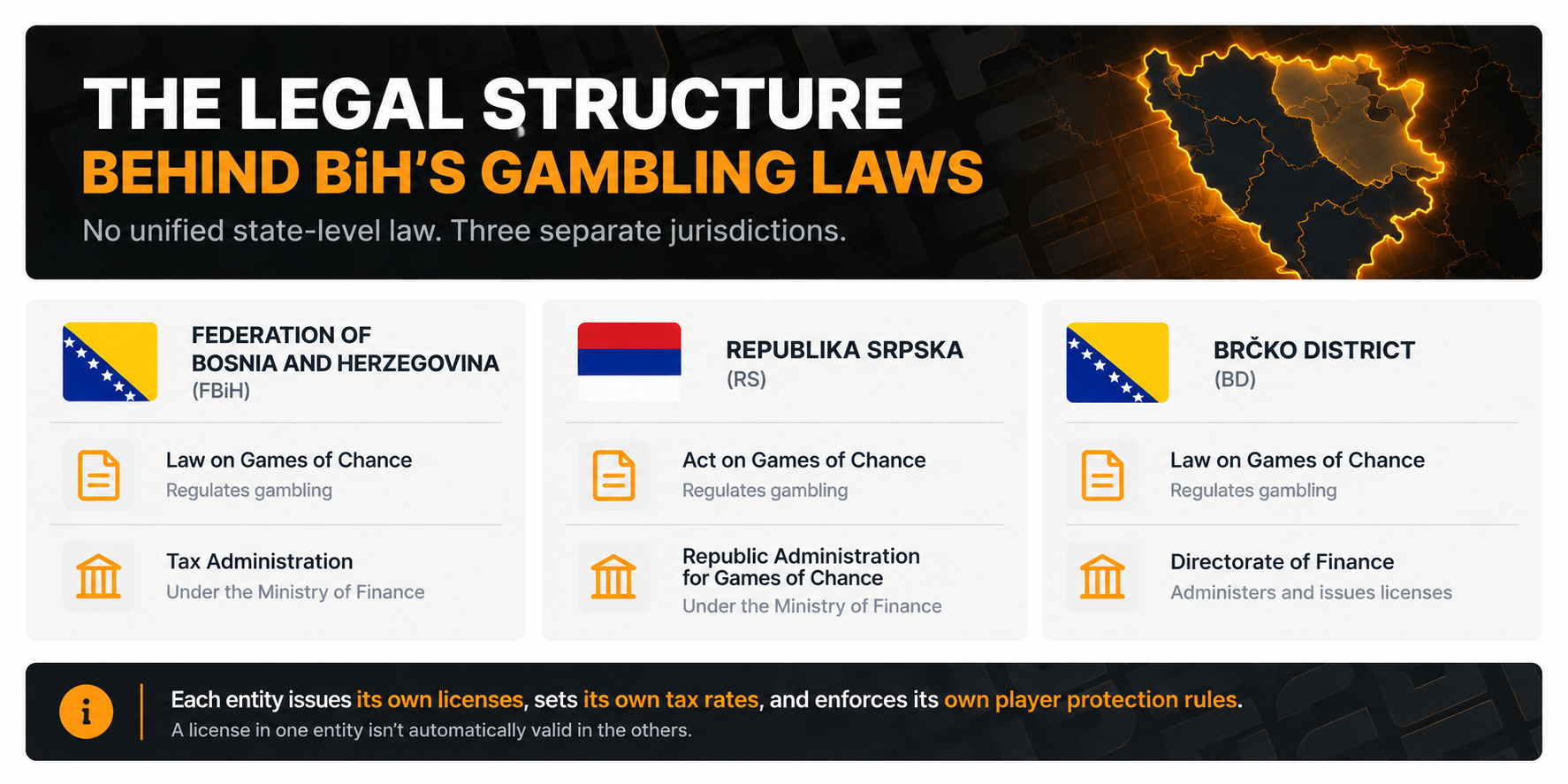
Bosnia and Herzegovina doesn’t have a unified, state-level gambling law. That’s the single most important fact to understand before anything else. The country is split into two entities plus one special district, each with its own government, its own finance ministry, and its own gambling legislation.
- Federation of Bosnia and Herzegovina (FBiH) — gambling is regulated under the Law on Games of Chance, with oversight from the Tax Administration under the Ministry of Finance.
- Republika Srpska (RS) — gambling falls under the Act on Games of Chance, supervised by the Republic Administration for Games of Chance, also under the Ministry of Finance.
- Brčko District (BD) — a smaller, self-governing district with its own Law on Games of Chance, administered through its Directorate of Finance.
Each of these bodies issues its own licenses, sets its own tax rates, and enforces its own player protection rules. An operator licensed in the Federation isn’t automatically allowed to operate in Republika Srpska, and vice versa. For casino operators and bettors alike, this means checking the specific entity’s rules matters more than checking any single “Bosnia and Herzegovina gambling law.”
Land-Based Casinos: What’s Actually Open
Physical casinos are legal and operating in Bosnia and Herzegovina, though the scene is small compared to bigger European gambling hubs. Sarajevo hosts one of the country’s best-known venues, generally cited as the Casino Coloseum Club, while Banja Luka — the administrative center of Republika Srpska — has its own established casino catering to both locals and visitors.
These venues offer the usual mix of table games and slot machines, and both require players to be 18 or older, matching the legal gambling age across all three entities. Compared to neighboring Croatia or Serbia, the land-based casino footprint in BiH is modest, but it’s not a gray-market operation — these venues hold entity-level licenses and pay entity-level taxes.
Sports Betting in Bosnia and Herzegovina
Sports betting is arguably the most visible form of gambling in the country. Betting shops are common on street corners in Sarajevo, Mostar, and Banja Luka alike, and estimates put the number of licensed betting outlets well into the hundreds nationwide. Each entity issues its own betting licenses, and both FBiH and RS allow domestic operators to run retail and online sportsbooks under their respective laws.
Because entity laws “point in different directions,” as one industry analysis put it, a sportsbook licensed in one entity often needs a separate license — or a local partner — to legally operate in the other. That duplication adds cost and slows down market entry for anyone trying to build a truly nationwide betting brand.
Online Casinos and Internet Gambling
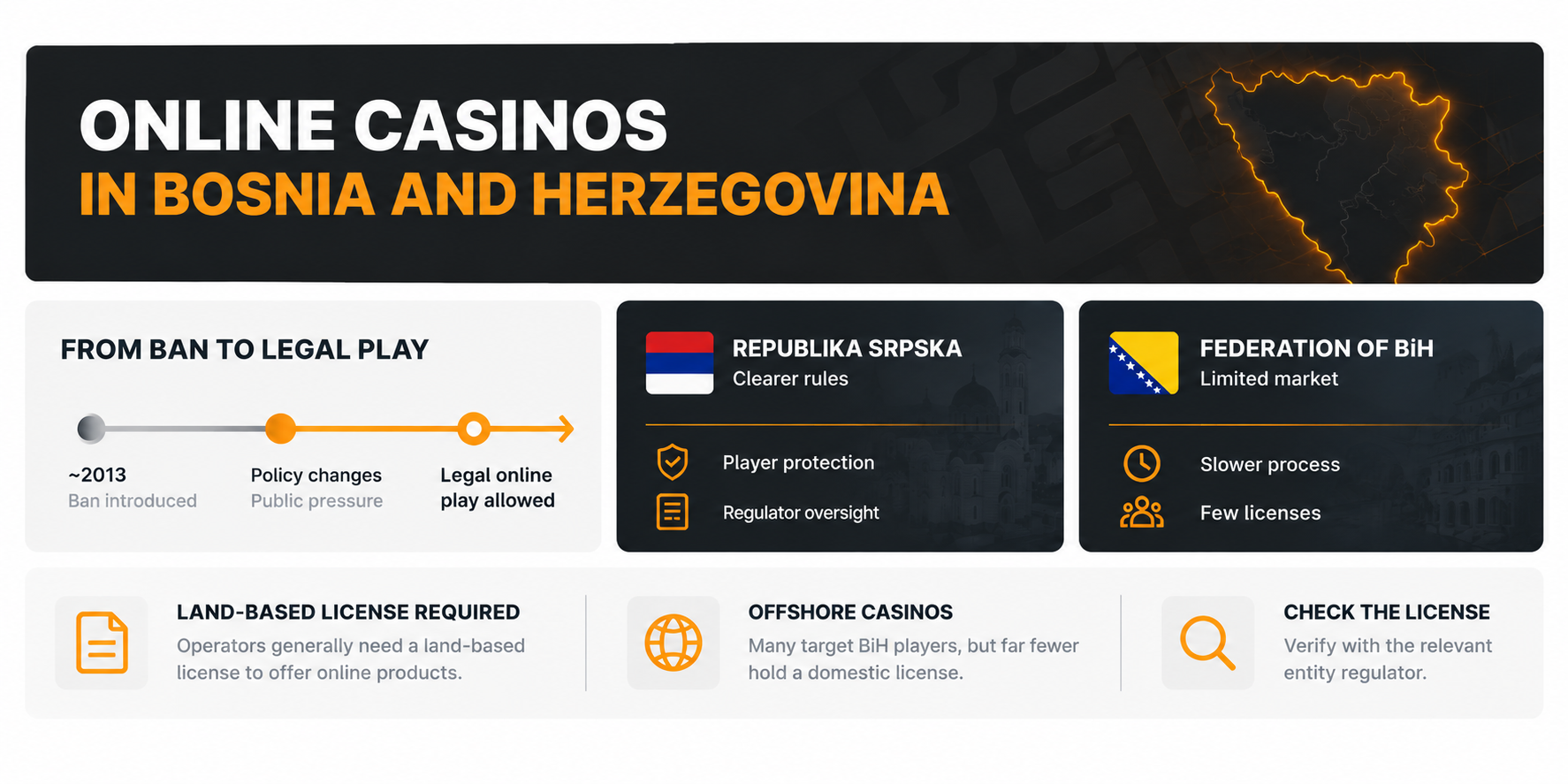
Here’s where things get genuinely interesting. Online gambling wasn’t always legal in Bosnia and Herzegovina — a ban introduced around 2013 restricted access for a period, before public pressure and shifting entity policy eventually opened the door to legal online play for residents.
Republika Srpska: Clearer Online Gambling Rules
Republika Srpska has moved somewhat faster on licensing clarity and has introduced basic player-protection tools, including complaint mechanisms and regulator oversight of operator conduct.
Federation of BiH: A More Limited Licensing Market
The Federation of BiH has a slower, less transparent licensing process, with only a handful of companies holding valid online gambling licenses at any given time. In both entities, online betting and casino games generally require operators to already hold a land-based license before they can offer digital products locally.
Offshore Casinos and Licensing Checks
For players, that fragmentation translates into a confusing landscape: dozens of offshore online casinos target Bosnian, Croatian, and Serbian-speaking players, but far fewer hold an actual domestic BiH license. Anyone checking whether a specific online casino is legal should verify licensing status with the relevant entity regulator rather than trusting the operator’s own claims.

Showcase Your iGaming Product with Sologe
AtSologe, we give iGaming vendors a dedicated marketplace for gaming software, platforms, payment solutions, sports betting products, equipment, services, and other industry offers. If Bosnia and Herzegovina is one of the markets you are exploring, we make it easier to present your business to people already looking for iGaming suppliers.
Want More Buyers to Discover What You Offer?
With Sologe, you can:
- add your company and solutions to an iGaming-focused marketplace
- place your offer in the category that best fits what you provide
- make your business easier to find during supplier research
- give potential partners a clear way to review your offer
👉Get in touch with us to add your product to Sologe.
Poker: Legal but Loosely Governed
Live poker is legal in Bosnia and Herzegovina. Poker rooms and card game nights exist in casinos and dedicated clubs, particularly in Sarajevo, and the game enjoys a genuine local following. That said, the same structural problem applies here as everywhere else in BiH gambling: there’s no centralized licensing body or nationwide standard specifically for poker. It’s typically folded into the broader “games of chance” licensing under whichever entity a venue operates in, rather than treated as its own regulated category.
Federation vs. Republika Srpska: A Side-by-Side Comparison
Aspect | Federation of BiH | Republika Srpska |
|---|---|---|
Governing law | Law on Games of Chance (2015) | Act on Games of Chance (2019) |
Regulator | Tax Administration, Ministry of Finance | Republic Administration for Games of Chance |
Online licensing process | Slower, less transparent | Relatively clearer, more established |
Player protection tools | Limited | Basic complaint systems, some regulator oversight |
Land-based license required for online | Generally yes | Generally yes |
Minimum gambling age | 18 | 18 |
Why Bosnia and Herzegovina Hasn’t Unified Its Gambling Laws
The obvious question is why the country hasn’t just merged everything into one national framework. The answer traces back to the Dayton Agreement, which created BiH’s decentralized political structure in 1995. That agreement gave the Federation and Republika Srpska broad autonomy over most domestic policy areas, gambling included, and the Brčko District its own special status on top of that.
Harmonizing gambling law would require all three entities to agree on taxation splits, licensing reciprocity, and enforcement standards — a tall order in a country where political consensus on far simpler matters can take years. Industry commentators have described the situation bluntly: there’s no quick fix, and vested interests in taxation and licensing on all sides make compromise difficult. Until that changes, expect the three-track system to persist.
What This Means for Players and Operators
For casual players, the practical takeaway is simple: casinos, betting shops, and licensed online platforms are legal to use in BiH, provided you’re 18 or older. Nobody’s getting arrested for placing a bet at a licensed shop in Sarajevo or Banja Luka.
For operators, though, the fragmentation is a real headache. Launching nationwide means navigating two — sometimes three — separate licensing regimes, each with its own paperwork, tax rate, and compliance timeline. That’s a big part of why foreign investment in BiH’s gambling sector has lagged behind neighboring markets, despite genuine local demand.
FAQ: Casino Legality in Bosnia and Herzegovina
Is gambling legal throughout all of Bosnia and Herzegovina?
Yes. Gambling is legal in the Federation of Bosnia and Herzegovina, Republika Srpska, and the Brčko District. There’s no nationwide ban – the complication is that each entity regulates it independently rather than under one law.
Are there real, physical casinos in Bosnia and Herzegovina?
Yes, land-based casinos operate legally, with notable venues in Sarajevo and Banja Luka. They function under entity-level licenses and require players to be 18 or older.
Can residents of Bosnia and Herzegovina legally play at online casinos?
Yes, online casino play is legal for residents, and both FBiH and RS license certain domestic operators. However, licensing standards and player protections differ between entities, and many offshore sites targeting BiH players aren’t actually locally licensed.
Is sports betting legal in Bosnia and Herzegovina?
Yes. Sports betting is widely legal and popular, with hundreds of licensed betting shops across the country operating under entity-specific laws.
Is poker legal to play in Bosnia and Herzegovina?
Live poker is legal, typically offered through casinos and dedicated poker rooms. There’s no separate national poker license – it’s generally covered under each entity’s broader games-of-chance regulation.
Why doesn’t Bosnia and Herzegovina have one national gambling law?
Because of the country’s post-Dayton political structure. The Federation, Republika Srpska, and Brčko District each hold significant legislative autonomy, and reaching agreement on a single gambling framework has proven politically difficult so far.
What’s the minimum age to gamble in Bosnia and Herzegovina?
18 years old, across all three entities, whether at a land-based casino, a betting shop, or a licensed online platform.
The Bottom Line
Casinos are legal in Bosnia and Herzegovina — full stop. But “legal” doesn’t mean “simple.” Between the Federation, Republika Srpska, and the Brčko District, the country runs three parallel gambling systems instead of one, and that fragmentation shapes everything from where casinos can operate to which online platforms actually hold valid licenses.
Anyone planning to gamble in BiH, whether at a Sarajevo casino table or through an online platform, should confirm which entity’s license actually applies before assuming a site or venue is fully compliant. And for operators eyeing this market, understanding the entity-by-entity licensing maze isn’t optional — it’s the whole game. Check the relevant entity regulator’s official resources for the latest licensing requirements before making any move.
Related Articles
September 29, 2026Is Sports Betting Legal in Kazakhstan? The...
September 29, 2026Is Sports Betting Legal in Mexico? The...