 Nothing found for the request
Is the Casino Legal in Central Africa? A Country-by-Country Reality Check
Sologe September 3, 2026
Share:


Quick Summary
Yes, land-based casinos are generally legal across Central Africa, including the Central African Republic, Cameroon, Chad, Gabon, and the two Congos, though most countries lack a dedicated online gambling framework. Online casinos operate in a legal gray zone throughout the region, tolerated rather than formally licensed, so players typically rely on offshore-licensed sites. Rules vary sharply by country, and there’s no single “Central Africa” gambling law.
Search “is the casino legal in Central Africa” and the results get muddled fast. Half the pages that show up are actually about South Africa’s 1965 Gambling Act, which has nothing to do with the Central African region at all. That’s a different country, a different legal system, and a different continent’s worth of confusion.
So let’s clear the air. Central Africa, in the strict geographic and political sense, covers the Central African Republic, Cameroon, Chad, Gabon, Equatorial Guinea, the Republic of the Congo (Congo-Brazzaville), and the Democratic Republic of the Congo. Each one sets its own gambling rules. None of them follow South Africa’s provincial licensing model, and none of them use the Gambling Act of 1965 that keeps popping up in search results.
The Short Answer: Land-Based Gambling Is Legal, Online Is Murky
Across most of Central Africa, brick-and-mortar casinos aren’t just tolerated — they’re legal and, in several countries, actively taxed as a revenue source. The Central African Republic itself permits land-based casinos and sportsbooks to operate under general provisions found in the penal code and annual budget laws, rather than a standalone gambling act.
Online gambling is a different story. Few countries in the region have passed legislation specifically addressing internet-based betting or virtual casino platforms. That gap doesn’t make online play illegal outright — it just means there’s no formal licensing body approving or policing it domestically. Players in Bangui, Douala, or N’Djamena who want to gamble online typically end up on offshore platforms licensed elsewhere, most commonly out of Curaçao.
Central African Republic: What the Law Actually Says
The Central African Republic doesn’t have a dedicated gambling commission or a modern gaming act sitting on the books. Instead, casino and sportsbook activity gets addressed through the country’s penal code alongside provisions tucked into yearly budget legislation. That’s a fairly common pattern in the region — gambling gets folded into broader fiscal or criminal law rather than getting its own regulatory framework.
Practically, that means land-based operations can run legally, but the oversight infrastructure that players in more developed markets take for granted — licensing boards, dispute resolution channels, responsible-gambling mandates — is thin or nonexistent. There’s also very little verifiable information about actual operating casinos in the country, which says a lot about how small and undocumented the formal market really is.
Online, the picture stays blank. No statute currently authorizes or bans internet gambling specifically in the CAR. That silence gets interpreted, correctly or not, as tacit permission — foreign-licensed sites accept CAR players without much friction, and nobody’s actively chasing individual bettors.
How Neighboring Countries Compare
It helps to see the Central African Republic next to its neighbors, because the regional pattern is strikingly consistent: legal land-based gambling, absent or weak online regulation, and enforcement that leans light-touch almost everywhere.
Country | Land-Based Gambling | Online Gambling Framework | Primary Legal Basis |
|---|---|---|---|
Central African Republic | Legal | None specific | Penal Code, Budget Law |
Cameroon | Legal | Legal (since 2015) | Law n°2015/012 |
Chad | Legal, regulated | Limited | Budget Law provisions |
Republic of Congo | Legal, regulated | Limited | Financial law regulations |
Democratic Republic of Congo | Legal | Overseen informally | Ministry of Finance / state lottery |
Gabon | Legal, casinos operate | No dedicated framework | General commercial law |
Cameroon stands out as the exception worth noting. It passed dedicated legislation in 2015 that explicitly covers online gambling, backed by an implementing decree a few years later. That puts it ahead of most of its neighbors on paper, even if enforcement in practice still lags the legislation.

Put Your iGaming Product in Front of Buyers
Sologe is an iGaming marketplace where vendors can list products such as gaming software, platforms, payment solutions, sports betting tools, services, traffic solutions, and equipment. If Central Africa is part of your target market, it gives you a straightforward way to put your offer in front of buyers already looking for gaming-related products and services.
Want to Get Your Product Listed?
Talk to Sologe to:
- add your product to a dedicated iGaming marketplace
- choose the category that fits your offer
- make it easier for gaming buyers to find what you provide
👉 Get in touch with Sologe to list your product.
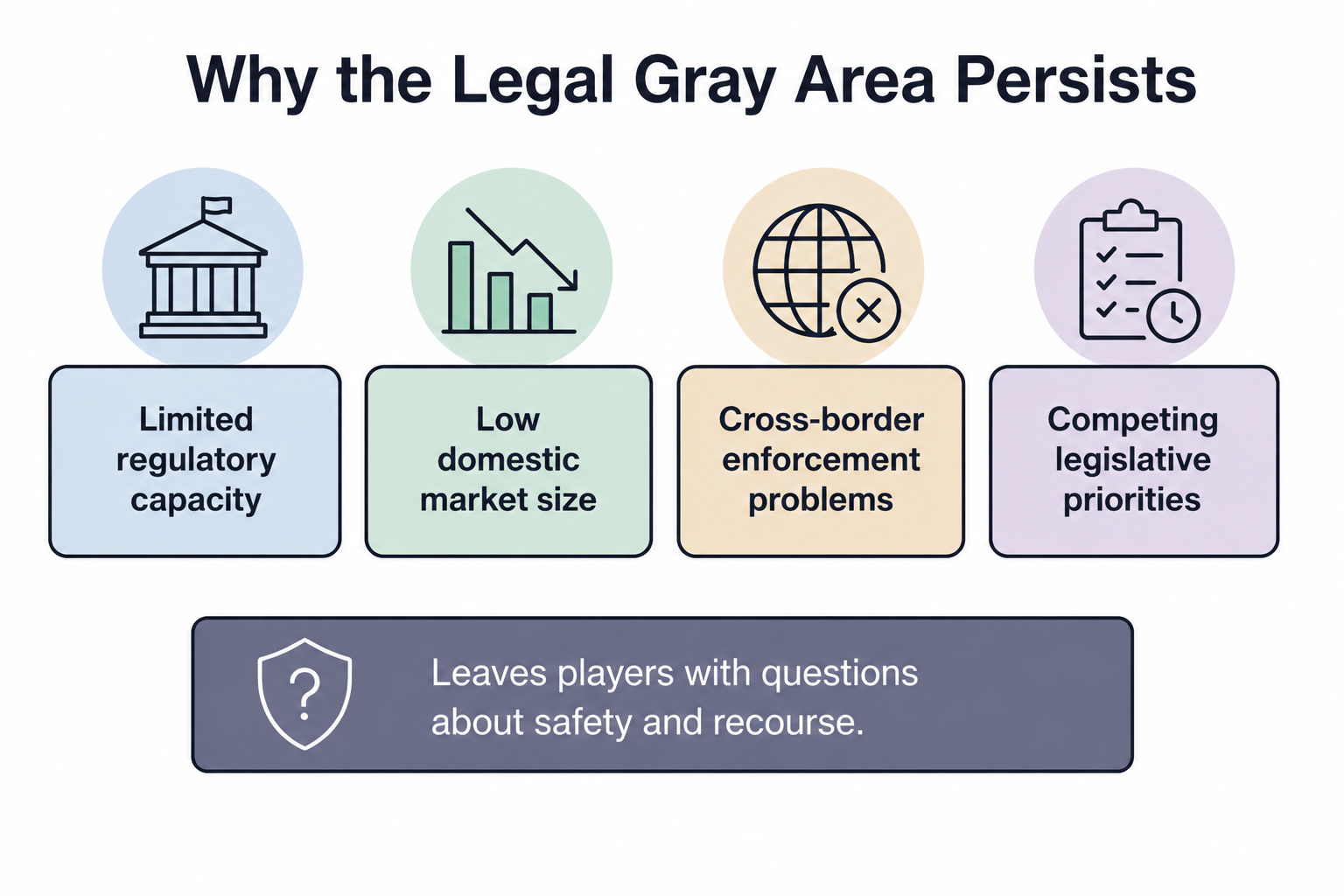
Why the Legal Gray Area Persists
A few structural reasons explain why online gambling regulation hasn’t caught up across the region:
- Limited regulatory capacity. Building and staffing a gaming commission takes money and technical expertise that smaller economies haven’t prioritized.
- Low domestic market size. Populations with limited internet penetration and lower disposable income don’t generate the tax revenue pressure that pushed places like South Africa or Kenya toward formal licensing.
- Cross-border enforcement problems. Offshore operators sit outside domestic jurisdiction anyway, so drafting a law to “ban” them accomplishes little without international cooperation.
- Competing legislative priorities. Gambling regulation typically ranks well below health, infrastructure, and security on national agendas.
None of that is unique to Central Africa — plenty of developing gambling markets worldwide show the same lag between land-based legalization and online rulemaking. But the gap does leave players with real questions about safety, payout reliability, and recourse if something goes wrong.
What This Means for Players
Anyone gambling online from Bangui, Yaoundé, or Brazzaville is, in practice, relying entirely on the reputation and licensing of a foreign operator. There’s no domestic regulator to complain to if a site refuses a withdrawal or manipulates odds. That’s the trade-off of an unregulated space: freedom of access, but zero institutional protection.
A few practical habits reduce risk even without local regulation backing it up:
- Stick to operators holding a recognized international license — Curaçao, Malta, or the UK Gambling Commission, in that order of ease-to-verify.
- Check independent review sites for a pattern of withdrawal complaints before depositing.
- Never wire funds through unverifiable local agents claiming to represent an “official” casino site.
- Treat any platform promising guaranteed wins as a red flag, regulated or not.
Where the South Africa Confusion Comes From
It’s worth addressing directly, since it dominates search results: South Africa’s Gambling Act of 1965 banned nearly all gambling except horse race betting, and the country later built a provincial licensing system through the National Gambling Board framework, with online casino operators still barred from legally offering services domestically as of the early 2010s regulatory updates. That’s a completely separate legal system from anything happening in the Central African Republic, Cameroon, or Chad. South Africa sits in the Southern African Development Community; Central Africa’s countries fall under entirely different regional and legal traditions, several rooted in French civil law rather than the British-influenced statutory model South Africa uses.
If a search result mentions “1965” or “National Gambling Board,” it’s talking about South Africa — not the Central African region this article covers.
Pros and Cons of the Current Regulatory Gap
Aspect | Advantage | Drawback |
|---|---|---|
Access | Players face few restrictions reaching offshore sites | No official guidance on which sites are trustworthy |
Taxation | Land-based venues contribute some government revenue | Online revenue largely escapes domestic taxation |
Consumer protection | Minimal red tape for operators and players | No dispute resolution or complaint mechanism |
Market growth | Low barrier to entry attracts investment interest | Lack of standards can attract unreliable operators |
FAQ
Is gambling legal in the Central African Republic?
Yes. Land-based casinos and sportsbooks are permitted under general provisions in the penal code and budget legislation. There’s no dedicated gambling act, and no formal licensing authority for online operators.
Can residents of Central African Republic play at online casinos?
Practically, yes. There’s no law explicitly banning online gambling, so residents typically access offshore-licensed platforms. That said, there’s also no domestic protection if something goes wrong with an operator.
Is the Central African Republic the same as South Africa for gambling law purposes?
No, and this mix-up is common in search results. South Africa has its own Gambling Act of 1965 and a provincial licensing structure through the National Gambling Board. The Central African Republic operates under a completely different, far less formalized legal framework.
Which Central African country has the clearest online gambling law?
Cameroon leads the region on this front, having passed specific legislation in 2015 covering online gambling, followed by an implementing decree. Most of its neighbors still lack comparable specificity.
Are there licensed casinos physically operating in Central Africa?
Some exist, particularly in larger cities like Yaoundé, Douala, and Brazzaville, though verifiable public information about active venues in the Central African Republic specifically remains limited.
What happens if an online casino refuses to pay out winnings in this region?
Without a domestic regulator, players have little formal recourse beyond appealing to the licensing body of the operator itself – typically Curaçao’s gaming authority – or relying on independent watchdog and review sites to escalate disputes publicly.
Is it safe to gamble online from Central Africa?
It can be, provided the chosen platform carries a recognized international license and has a track record of honoring withdrawals. Safety here depends entirely on operator due diligence rather than local law, since there’s no government body vetting sites on a player’s behalf.
The Bottom Line
Casinos aren’t outlawed anywhere in Central Africa — quite the opposite, land-based gaming operates openly in most of these countries. The real uncertainty sits online, where legislation simply hasn’t caught up to how people actually gamble in 2026. Until governments in the region draft dedicated digital gambling laws, players will keep relying on foreign licenses and personal judgment rather than domestic regulators.
Anyone considering online play from the region should verify an operator’s license directly on the regulator’s official site before depositing a single coin, and treat the absence of local law as a reason for extra caution, not less.
Related Articles

September 3, 2026Is the Casino Legal in Denmark? 2026 Guide

September 3, 2026Is the Casino Legal in Angola? What the 2026...