 Nothing found for the request
Is the Casino Legal in Congo? A Country-by-Country Breakdown
Sologe September 3, 2026
Share:


Quick Summary
Yes, casinos are legal in both Congos, but the two countries have separate laws. The Democratic Republic of the Congo (Kinshasa) has permitted casinos and games of chance since 2005 under a formal licensing system, while the Republic of Congo (Brazzaville) allows land-based casinos through COGELO and recently tightened its rules with Law No. 37-2024. Online gambling, however, remains a legal gray area in both nations.
Ask “is the casino legal in Congo?” and the honest answer starts with another question: which Congo? There are two countries carrying that name in Central Africa, and mixing them up is the single most common mistake people make when researching this topic. One is the Democratic Republic of the Congo (DRC), with its capital in Kinshasa. The other is the Republic of Congo, often called Congo-Brazzaville after its capital city. They border each other, share a name, and even share a river — but their gambling laws are their own.
Here’s the short version: casinos are legal in both. Land-based gaming halls operate openly in Kinshasa, Lubumbashi, Brazzaville, and Pointe-Noire, catering mostly to tourists, expats, and higher-income locals. Where things get murkier is online gambling, licensing enforcement, and how “regulated” the sector really is in practice. That’s what this guide untangles.
Two Countries, Two Laws: Why the Confusion Happens
The naming overlap isn’t an accident of history so much as a leftover of colonial-era borders. The DRC was formerly Zaire and is by far the larger of the two, both in population and land area. The Republic of Congo is smaller, sits just across the river from Kinshasa, and built its early gambling framework around a state lottery body rather than a dedicated gambling act.
Because search engines and travel forums often just say “Congo” without specifying which one, gambling guides get muddled together. A rule that applies in Brazzaville doesn’t automatically apply in Kinshasa, and vice versa. Treating them as one jurisdiction is where a lot of outdated or inaccurate advice online comes from.
Is the Casino Legal in the Democratic Republic of the Congo?
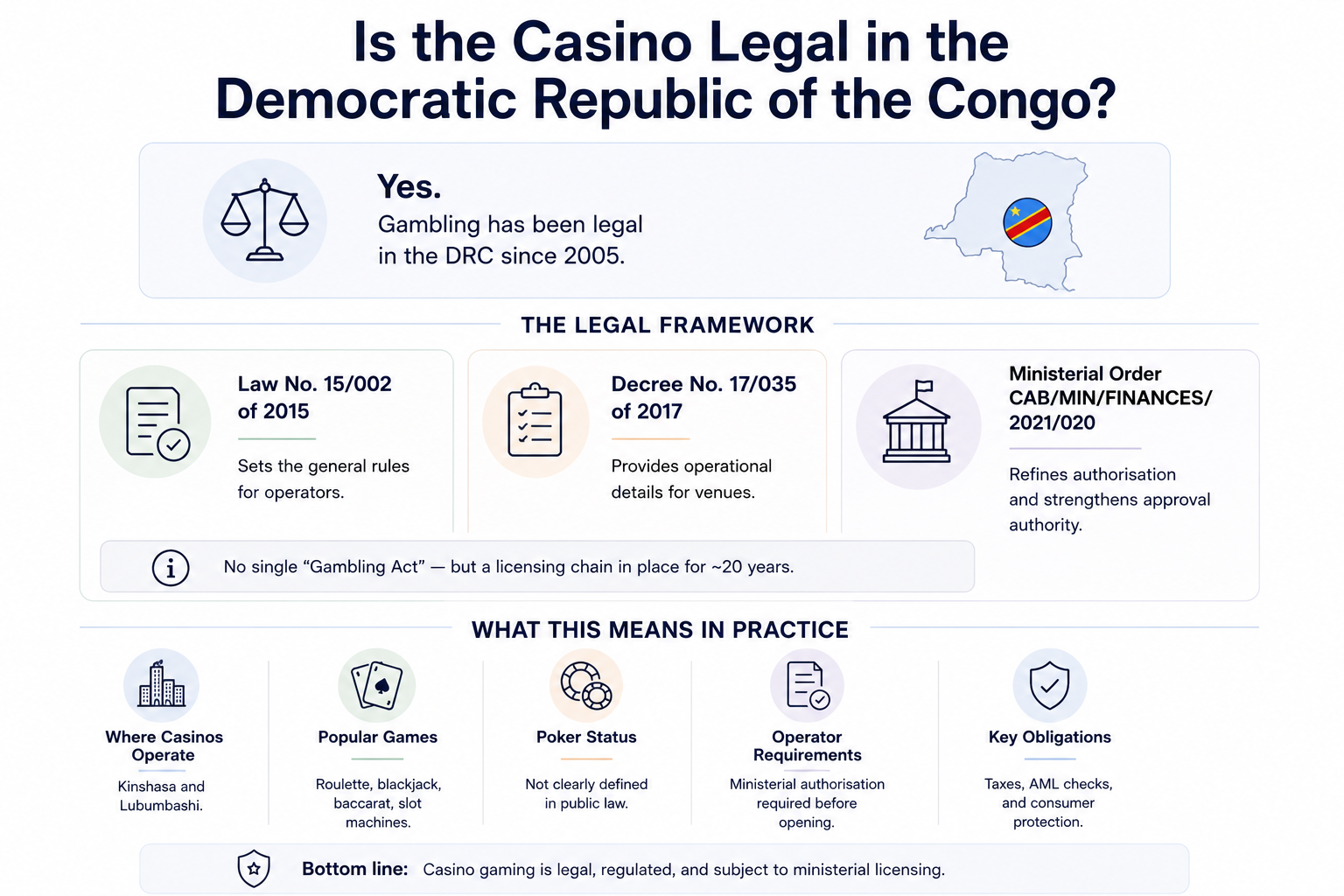
Yes. Gambling, including casino games, slot machines, and lottery products, has been legal in the DRC since 2005, when games of chance were first formally regulated. The legal backbone rests on a handful of texts rather than one single sweeping act: Law No. 15/002 of 2015 lays out the general rules for who can operate and under what conditions, while Decree No. 17/035 of 2017 goes into more operational detail on how casinos, betting shops, and gaming venues should run day to day.
More recently, a Ministerial Order (CAB/MIN/FINANCES/2021/020, dated 14 December 2021) refined the authorisation process further, giving the Ministry of Finance clearer authority over approvals. So while the DRC doesn’t have a single consolidated “Gambling Act” the way some countries do, it does have a working licensing chain that’s been added to and tightened over roughly two decades.
Land-based casinos in the DRC concentrate in Kinshasa and Lubumbashi, the country’s two largest urban centers. Games typically include roulette, blackjack, baccarat, and slot machines; whether poker counts as a licensed casino game is less clearly spelled out in the public text of the law. Operators need ministerial authorisation before opening, and licensing terms cover tax obligations, anti-money-laundering checks, and consumer protection standards — at least on paper.
Who Regulates Gambling in the DRC?
Oversight sits mainly with the Ministry of Finance, which issues authorisations and collects the associated taxes and fees. Some sources also point to a role for the Ministry of Sports and Leisure and a body referred to as SONAL in earlier regulatory texts, though the Finance Ministry’s authorisation role is the one that shows up most consistently across licensing guidance. Industry observers have noted that enforcement in practice sometimes lags behind what’s written in the law — a gap that’s fairly common across emerging gambling markets in the region.
What About Online Casinos in the DRC?
This is where the picture softens considerably. The DRC’s gambling statutes were drafted with land-based venues in mind, and none of them explicitly address internet gambling. That means there’s no licensing pathway for a locally-authorised online casino, but it also means there’s no specific law banning residents from accessing offshore gambling sites. In practice, players in the DRC who want to gamble online typically do so through foreign-licensed operators, since no domestic licence category exists yet for digital platforms.
Is the Casino Legal in the Republic of Congo (Brazzaville)?
Also yes — and this one has a more centralized regulator. Gambling in Congo-Brazzaville has traditionally run through the Caisse de Gestion de la Loterie, better known by its acronym COGELO, which was set up in the early 1990s under the Ministry of Finance to manage the national lottery. Over time its mandate expanded to cover scratch cards, sports pools, and land-based casinos in Brazzaville and Pointe-Noire.
Unlike the DRC, Congo-Brazzaville historically lacked a single dedicated gambling statute; the rules lived inside annual public finance laws that set licensing fees and tax rates year to year. That changed in December 2024, when the country adopted Law No. 37-2024, a more comprehensive framework covering licensing, taxation, and operational standards for casinos and sports betting alike. It’s a sign the government wants to formalize a sector that was, until recently, governed piecemeal.
Getting a casino licence in Congo-Brazzaville requires a presidential decree countersigned by the finance ministry, spelling out the venue, the permitted games, and a licence term usually running between five and ten years. Most of the country’s land-based casinos are upscale venues aimed at tourists and wealthier local players rather than mass-market gaming halls.
Online Gambling in Congo-Brazzaville
Same story as its neighbor, more or less. Online gambling isn’t formally banned, but it isn’t licensed or supervised by COGELO either. Residents can and do access international betting sites, but there’s no local regulator standing behind those platforms if a dispute comes up. Law No. 37-2024 may eventually extend into digital licensing, but as of now the practical situation for online play remains informal.

Put Your Gaming Offer in Front of Buyers in Congo
If you provide gaming software, betting tools, platforms, payment solutions, equipment, traffic services, or related products, Sologe gives you a focused place to present your offer. If Congo is part of your target market, it can help connect your product with people already browsing iGaming categories.
Want to Make Your Product Easier to Find?
You can use Sologe to:
- publish your offer in a gaming-focused marketplace
- choose the category that best matches your product
- give buyers a clearer way to discover what you sell
👉 Get in touch with Sologe to add your product to the marketplace.
DRC vs. Republic of Congo: Side-by-Side Comparison
Category | Democratic Republic of the Congo | Republic of Congo (Brazzaville) |
|---|---|---|
Capital | Kinshasa | Brazzaville |
Land-based casinos legal? | Yes, since 2005 | Yes, since the early 1990s |
Main regulator | Ministry of Finance | COGELO / Ministry of Finance |
Key legal texts | Law 15/002 (2015), Decree 17/035 (2017), Ministerial Order (2021) | Annual finance laws; Law No. 37-2024 |
Online gambling status | Not regulated, not banned | Not regulated, not banned |
Main casino cities | Kinshasa, Lubumbashi | Brazzaville, Pointe-Noire |
Typical target audience | Tourists, expats, higher-income locals | Tourists, affluent local players |
What Games Can You Actually Play?
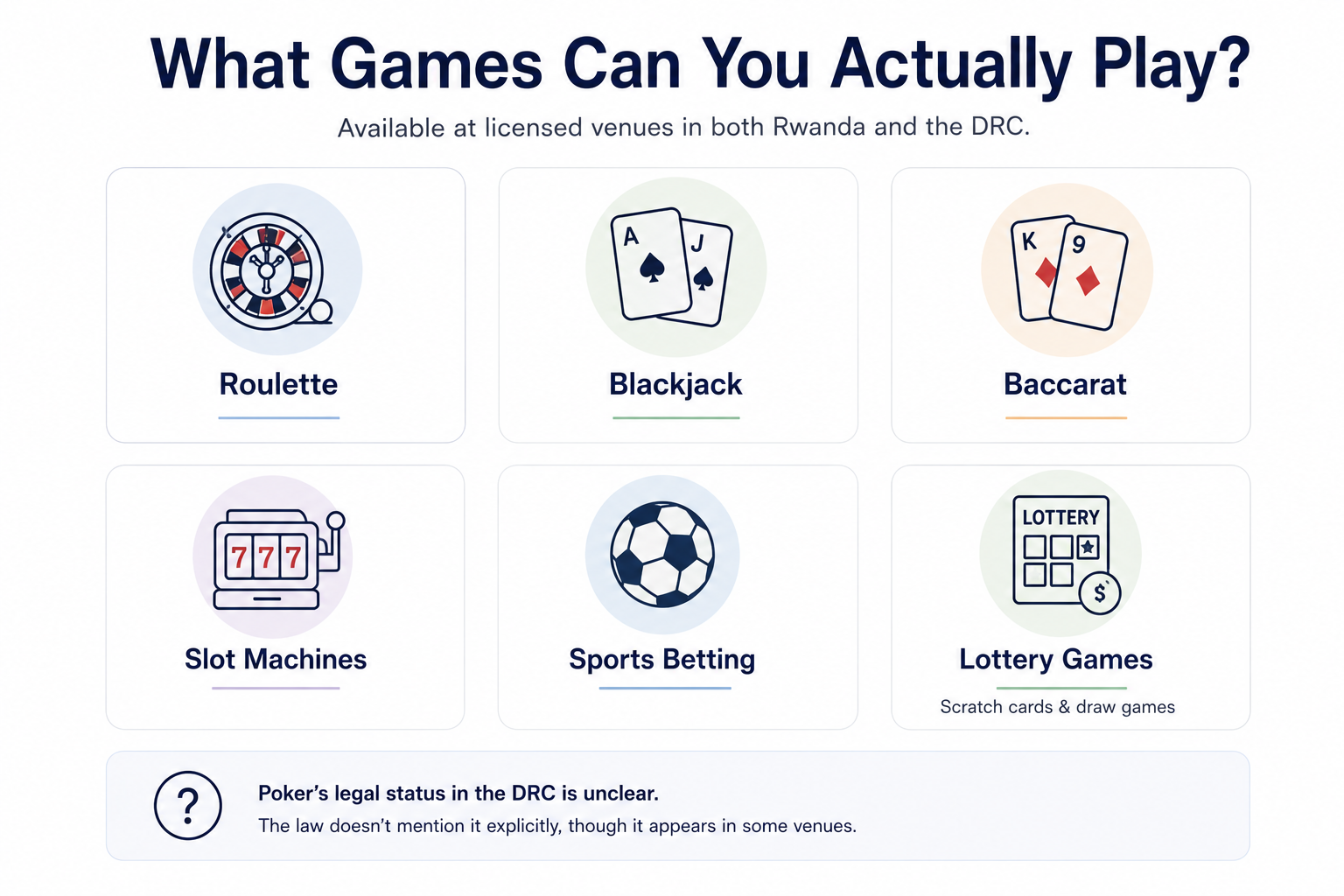
Across both countries, the games on offer at licensed venues look fairly familiar to anyone who’s visited a casino elsewhere in Africa or Europe: roulette, blackjack, baccarat, slot machines, and sports betting counters. Poker’s legal standing is a little fuzzier in the DRC specifically, since the law doesn’t name it explicitly, though it does show up on some venue floors regardless. Lottery products — scratch cards and draw-based games — round out the offering in both markets and tend to be the most widely accessed form of gambling since they don’t require visiting a physical casino.
Licensing: What Operators Actually Need to Do
For anyone thinking about opening a gambling business rather than just playing at one, the process differs slightly by country but follows a similar logic — apply, get vetted, pay fees, stay compliant.
- DRC: Submit an application to the Ministry of Finance, meet anti-money-laundering and consumer protection standards, and pay applicable taxes on gambling revenue.
- Congo-Brazzaville: Secure a presidential decree countersigned by the Ministry of Finance, specifying the venue and games, with licence terms typically lasting five to ten years.
- Both countries: Foreign investors generally can’t hold a licence solo as tourists; partnering with a local operator or registering a local business entity is the standard route in.
Regulation on Paper vs. Regulation in Practice
Here’s the thing though — having a law on the books and having that law consistently enforced are two different things. Several industry observers covering the DRC’s iGaming space have pointed out that regulatory oversight can exist more in theory than in daily practice, with enforcement resources stretched thin relative to the size of the informal gambling economy. Congo-Brazzaville’s shift toward Law No. 37-2024 suggests its government is trying to close that gap, but it’s still early days for how thoroughly the new framework gets applied on the ground.
For everyday players, this mostly means one thing: licensed venues in major cities operate openly and legally, but the online space in both countries runs largely without local supervision. That’s not necessarily illegal — it’s just unregulated, which is a different thing entirely.
Frequently Asked Questions
Is gambling legal in the Democratic Republic of the Congo?
Yes. Games of chance, including casinos, slot machines, sports betting, and lottery products, have been legal and regulated in the DRC since 2005, with the framework refined through later laws and ministerial orders.
Is gambling legal in the Republic of Congo (Brazzaville)?
Yes. Land-based casinos, lotteries, and betting are legal and overseen mainly by COGELO and the Ministry of Finance, with a more comprehensive framework introduced through Law No. 37-2024 in late 2024.
Are online casinos legal in either Congo?
Online gambling isn’t specifically banned in either country, but it also isn’t licensed or regulated locally. Residents typically play through offshore, internationally licensed platforms since no domestic online gambling licence category currently exists in either jurisdiction.
Which cities have the most casinos in the Congos?
In the DRC, Kinshasa and Lubumbashi host most land-based casinos. In the Republic of Congo, Brazzaville and Pointe-Noire are the main hubs, with venues typically catering to tourists and affluent local clientele.
Can foreigners open a casino business in Congo?
Foreign investors generally can’t obtain a gambling licence as a solo tourist applicant in either country. The usual path is forming a joint venture or registering a local business entity that then applies for authorisation through the relevant finance ministry.
What games are legal to play at Congolese casinos?
Roulette, blackjack, baccarat, slot machines, and sports betting are all commonly available and legally permitted at licensed venues. Poker’s status is less explicitly defined in DRC law, though it does appear at some venues in practice.
Is there a minimum gambling age in the Congos?
Regional gambling surveys typically list 18 as the standard minimum age across Central African jurisdictions, including both Congos, though venues should be checked individually for house policy since enforcement consistency can vary.
Bottom Line
So, is the casino legal in Congo? Yes — in both of them, actually. The Democratic Republic of the Congo has allowed regulated gambling since 2005 through a series of laws and ministerial orders anchored by the Ministry of Finance. The Republic of Congo has permitted land-based casinos for even longer under COGELO, and just tightened its framework with Law No. 37-2024. What neither country has nailed down yet is online gambling — that space remains legally unregulated in both, which isn’t the same as illegal, but does mean players are largely on their own if something goes wrong.
Anyone planning to gamble, invest, or open a venue in either Congo should verify current licensing requirements directly with the relevant Ministry of Finance or COGELO office, since regulatory details can shift as both governments continue updating their frameworks.
Related Articles
September 3, 2026Is the Casino Legal in Denmark? 2026 Guide
September 3, 2026Is the Casino Legal in Angola? What the 2026...