 Nothing found for the request
Is Casino Legal in the Czech Republic? 2026 Regulation Guide
Sologe July 11, 2026
Share:


Overview of Gambling Legality in the Czech Republic
Gambling activities in the Czech Republic are comprehensively regulated under a licensing framework administered by the Ministry of Finance. The regulatory structure encompasses both land-based and online gambling operations, with specific departments dedicated to oversight and policy development.
Department 73 – Procedural Agendas and Gambling Regulation within the Ministry of Finance examines issues in gambling regulation, gambling tax, and related procedural agendas. This department analyses current status and proposes measures to address emerging issues while streamlining regulatory processes.
The legal foundation rests on Act No. 186/2016 Coll., on Gambling (the “Gambling Act”).
What Types of Gambling Are Legal?
The Czech regulatory framework recognizes several distinct gambling categories, each subject to specific licensing and operational requirements:
- Casino games (roulette, blackjack, poker, baccarat)
- Technical games (slot machines, video gaming terminals)
- Live games (sports betting, odds betting)
- Lotteries and raffles
- Bingo
- Totalisator games
- Small-scale tournaments
- Online gambling (iGaming platforms, online sports betting)
Each category requires distinct authorization from the Ministry of Finance. The regulatory system doesn’t merely permit these activities—it actively structures how they must operate, from technical specifications to player protection mechanisms.
Evaluate iGaming Service Providers with Sologe
The Czech Republic has a well-established gaming sector, and businesses researching the market often need more than regulatory information. Sologe helps companies compare suppliers across different areas of the iGaming industry through a single B2B marketplace.
Through Sologe, businesses can:
- Compare gaming platform options
- Review licensing and certification solutions
- Explore payment issues
- Assess analytics and reporting tools
- Research casino equipment categories
Contact Sologe to review platforms, licensing options, payment solutions, equipment categories, and other B2B iGaming resources.
The Licensing Framework: Who Can Operate Casinos?
Operating a casino in the Czech Republic requires obtaining appropriate licenses from the Ministry of Finance. The licensing process involves rigorous scrutiny of financial stability, technical capabilities, and compliance infrastructure.
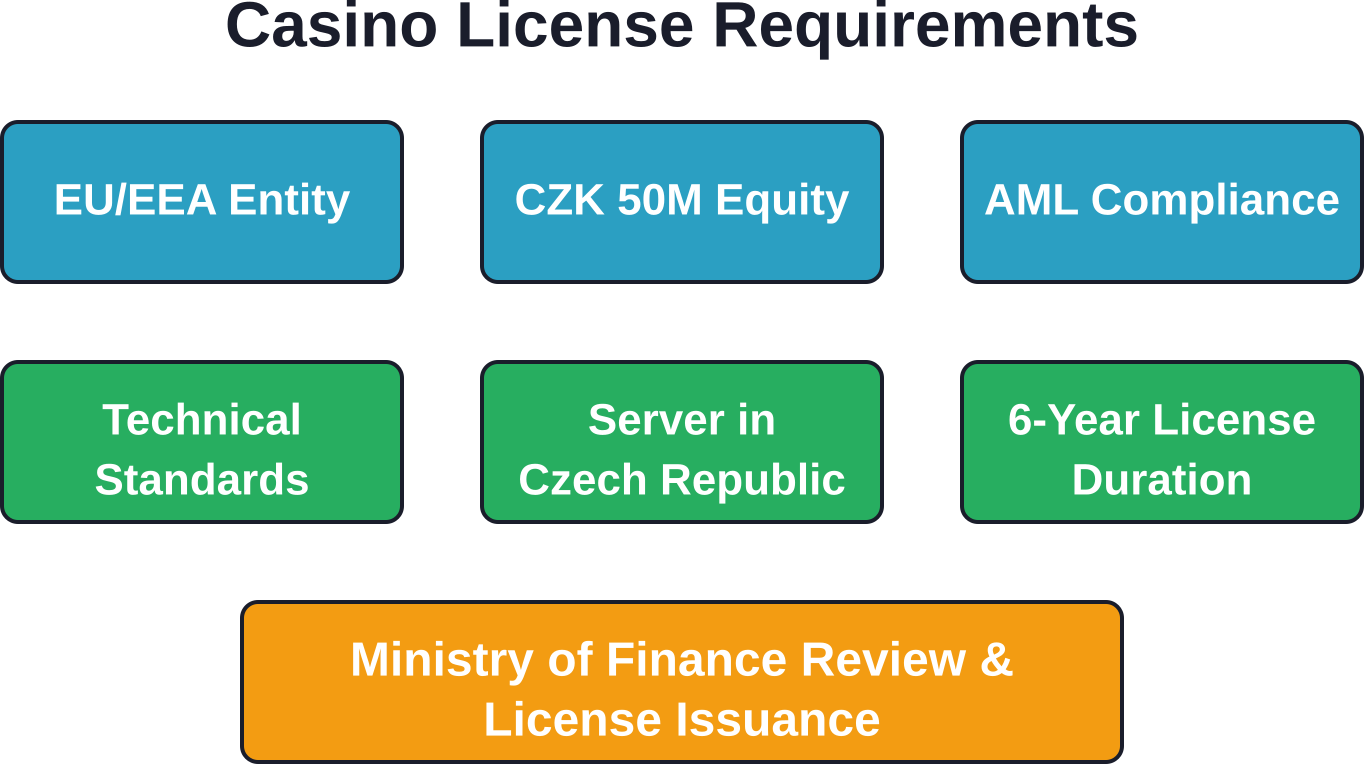
Applicants must meet several fundamental criteria. They must be legal entities established in a member state of the European Union (EU) or European Economic Area (EEA). This geographical restriction ensures operators fall within the EU regulatory perimeter and can be effectively supervised.
Financial Requirements for Casino Operators
Financial stability requirements are substantial. Applicants must demonstrate equity of at least 50 million Czech Korunas (approximately €2.06 million). This capital requirement serves multiple purposes: ensuring operators can withstand revenue fluctuations, protecting player funds, and demonstrating serious commercial commitment.
License Type | Duration | Financial Guarantee | Renewal Required |
|---|---|---|---|
Land-Based Casino | Up to 6 years | Required (minimum equity CZK 50 million) | Yes |
Technical Games (Slots) | Up to 6 years | Required | Yes |
Online Gambling | Up to 6 years | Required | Yes |
Sports Betting | Up to 6 years | Required | Yes |
License durations extend up to six years, after which renewal applications must be submitted. The renewal process involves reassessment of compliance history, financial standing, and operational integrity.
Technical and Compliance Standards
Technical requirements impose strict operational boundaries. For electronic gaming machines, regulations mandate a maximum betting speed of one bet per second. This limitation aims to reduce compulsive gambling behavior and provide players with natural decision-making intervals.
Wager limits vary by venue type. Gaming parlor machines face maximum wagers ranging from 2 to 5 CZK, while casino gaming machines can accept wagers up to 500 CZK. These tiered restrictions recognize different risk profiles across gambling environments.
Anti-money laundering (AML) compliance represents a critical licensing condition. The Financial Analytical Office (FAU) serves as the Czech Republic’s financial intelligence unit and enforces AML obligations across gambling operations. Licensed operators must register a contact person with the FAU and report suspicious transactions exceeding the €2,000 due diligence threshold.
Online Gambling: Digital Casino Operations
Online gambling received formal legal recognition and regulation in the Czech Republic, creating a licensed digital gambling market. The framework extends similar oversight principles from land-based operations to the digital realm.
A notable requirement mandates that servers used for online gambling operations must be physically located within the European Economic Area (EEA).
Online Licensing Process
Online gambling operators must obtain specific licenses for their digital platforms. The application process mirrors land-based requirements in rigor but adds technical specifications unique to digital environments.
To reduce underage betting risks, regulations previously required players to first register at a land-based shop before gaining online access. While enforcement of this requirement has evolved, the underlying principle—verified player identity before online participation—remains central to the regulatory philosophy.
Online operators face the same financial stability requirements as land-based casinos. They must demonstrate adequate equity, implement robust payment processing systems, and establish comprehensive player protection mechanisms including self-exclusion tools and deposit limits.
Tax Structure: What Operators Pay
The Czech gambling tax system operates on a gross gaming revenue (GGR) basis. GGR is calculated as the difference between amounts wagered (and not returned to players) and winnings paid out to players.
Tax rates vary by game type, reflecting different risk profiles and regulatory considerations:
- Lotteries and technical games: 35% of GGR
- Live games (sports betting, odds betting): 30% of GGR
- Totalisator games: 30% of GGR
- Raffles: 30% of GGR
- Bingo: 30% of GGR
- Small-scale tournaments: 30% of GGR
Unlicensed gambling operations face the same 35% rate on GGR, though operating without a license carries additional penalties including fines and potential criminal liability.
Land-Based Machine Taxes
Technical games in land-based venues face minimum quarterly tax obligations per machine, regardless of actual revenue. Minimum quarterly tax obligations per machine exist, though specific amounts vary by context. These amounts represent floors—operators pay whichever is higher between the minimum fixed amount and the percentage-based GGR calculation.
Corporate Income Tax
Beyond gambling-specific taxes, operators remain subject to standard corporate income tax at 21% on net profits. This applies after deducting the gambling tax itself, effectively creating a two-tier tax structure.
Player Winnings Tax
Players winning significant amounts in lotteries or raffles may face income tax obligations. This tax is typically withheld at source by the operator. Winnings from other game types don’t trigger this player-level tax, creating a distinction based on game classification.
Tax Payment Schedule
Tax returns and payments must be filed within 25 days after the end of each calendar quarter. This quarterly cadence requires operators to maintain robust accounting systems capable of accurately calculating GGR across potentially thousands of transactions.
Municipal Authority: Local Gambling Restrictions
While the national framework establishes baseline legality and licensing, municipalities retain significant authority to restrict gambling within their jurisdictions.
Section 12 of the Gambling Act grants municipalities power to issue decrees that require casino games to only operate at specific places and times, or ban them from certain locations—or even from the entire municipality. This local control has resulted in considerable geographic variation in gambling availability.
Some municipalities have implemented comprehensive bans on gaming machines or restricted casino operations to designated entertainment districts. Others have adopted time restrictions, limiting operating hours to reduce social impacts.
A court ruling recognized this local regulatory authority, potentially contributing to a reduction in the total number of gambling machines across the country. The Czech Republic is noted as one of the top jurisdictions for the total number of gambling machines, but local restrictions have shifted this landscape.
For operators, this means license approval at the national level doesn’t guarantee operational permission in every municipality. Site selection requires careful review of local ordinances and engagement with municipal authorities.
Enforcement and Sanctions
The Ministry of Finance maintains active oversight of licensed operations. Enforcement mechanisms include inspections, audits, and investigation of complaints.
Violations of licensing conditions can result in escalating sanctions. Initial violations might trigger warnings and corrective action requirements. Repeated or serious violations can lead to substantial fines.
More severe cases result in license suspension, during which the operator must cease all gambling activities. The most serious violations—fraud, money laundering facilitation, or persistent regulatory non-compliance—can trigger license revocation.
Revocation effectively ends an operator’s ability to conduct gambling business in the Czech Republic. The financial investments required for licensing and setup make revocation a severe commercial penalty, creating strong incentives for compliance.
Operating without a license constitutes a criminal offense in addition to regulatory violations. Unlicensed operators face potential criminal prosecution, asset seizure, and permanent exclusion from the Czech gambling market.
Market Dynamics and Recent Developments
The Czech gambling market has experienced significant evolution in recent years, particularly affecting online operations.
Tax rate adjustments have reshaped market participation. The balance between generating state revenue and maintaining a competitive, legally-attractive market remains an ongoing policy challenge.
The Ministry of Finance continues to analyze gambling tax revenues and their role in overall fiscal policy. As noted in the May 2026 Fiscal Forecast, the Ministry bases its projections on macroeconomic forecasts expecting 2.1% economic growth in 2026, driven mainly by domestic demand.
Gambling regulation interacts with broader economic conditions. During periods of economic expansion, gambling revenues typically increase as disposable income rises. Conversely, economic downturns can reduce gambling participation while potentially increasing problem gambling among vulnerable populations seeking financial relief.
Regulatory Reform Considerations
The regulatory framework continues to evolve in response to technological developments and social policy objectives. Department 73 actively examines current issues and proposes measures to streamline regulatory processes while addressing emerging challenges.
Areas under ongoing consideration include enhanced player protection mechanisms, adaptation to new gaming technologies, cross-border cooperation with other EU regulators, and optimization of the tax structure to balance revenue generation with market competitiveness.
Responsible Gambling Framework
Czech gambling regulation incorporates responsible gambling requirements intended to minimize social harms. Operators must implement several protective measures.
Self-exclusion programs allow individuals to voluntarily ban themselves from gambling establishments or online platforms. Once registered, excluded individuals cannot legally participate in gambling activities, and operators face penalties for allowing their participation.
Deposit and loss limits provide players with tools to control spending. Online platforms must enable users to set daily, weekly, or monthly limits on deposits or losses, and these limits cannot be increased immediately—cooling-off periods apply to limit increased requests.
Reality checks interrupt extended gambling sessions with notifications about time elapsed and amounts wagered. These interruptions create natural decision points where players consciously choose to continue or stop.
Advertising restrictions limit the content, placement, and targeting of gambling promotions. Advertisements cannot target minors, make misleading claims about winning probabilities, or suggest gambling solves financial problems.
Comparing Czech Gambling Laws to EU Neighbors
The Czech Republic’s approach falls within the range of EU gambling regulation models but incorporates distinctive features.
Like Germany and the Netherlands, the Czech Republic requires local licensing and prohibits unlicensed offshore operators. This contrasts with less restrictive jurisdictions that permit EU-licensed operators to offer services across borders with minimal additional requirements.
Tax rates in the Czech Republic—30-35% of GGR—sit toward the higher end of European rates but remain below some jurisdictions. The UK’s point-of-consumption tax ranges around 21% for remote gambling, while some Scandinavian countries impose even higher rates.
The requirement for servers to be physically located in the Czech Republic represents a stricter technical requirement than many EU jurisdictions impose. This server localization facilitates oversight but increases operational costs for international operators.
Requirement | Czech Republic | Typical EU Standard |
|---|---|---|
Local License | Required | Varies (some accept EU licenses) |
Server Location | Must be in Czech Republic | Often flexible within EU |
Tax Rate (Online) | 30-35% GGR | 15-25% GGR (typical range) |
Municipal Authority | Significant local control | Usually limited |
How to Verify Casino Legitimacy
For players concerned about whether a casino operates legally, several verification methods exist:
- Check for visible licensing information: Legitimate operators display their license number and issuing authority prominently on their websites or in physical establishments. This information should be readily accessible, not hidden in obscure footer links.
- Verify the license with the Ministry of Finance: The Ministry maintains public records of licensed operators. A quick inquiry can confirm whether a specific operator holds valid authorization.
- Look for responsible gambling tools: Licensed operators must provide self-exclusion options, deposit limits, and reality checks. The absence of these tools suggests unlicensed operation.
- Review payment methods: Licensed operators typically use established payment processors and banks that conduct due diligence on gambling merchants. Exclusive reliance on cryptocurrency or obscure payment systems may indicate questionable licensing status.
- Check physical location compliance: For online operators, legitimate platforms clearly state their Czech Republic server location and corporate registration details. Vague or offshore registration information raises red flags.
Frequently Asked Questions
Are online casinos legal in the Czech Republic?
Yes. Online casinos are legal in the Czech Republic when they are operated by companies licensed by the Ministry of Finance. Licensed platforms may offer online slots, table games, live dealer games, and sports betting while complying with Czech gambling regulations.
What is the gambling tax rate in the Czech Republic?
Gambling operators pay tax on Gross Gaming Revenue (GGR). Lotteries and technical games are taxed at 35%, while live games, sports betting, bingo, raffles, and several other gambling activities are taxed at 30%. Operators are also subject to corporate income tax on their profits.
Can municipalities ban casinos in the Czech Republic?
Yes. Municipalities have the authority to restrict or completely prohibit gambling within their territories. Even if an operator holds a national gambling license, it must also comply with local regulations governing casino operations.
Do I need to pay tax on casino winnings in the Czech Republic?
Tax treatment depends on the type of gambling. Significant lottery and raffle winnings may be subject to withholding tax, while winnings from casino games, slot machines, and sports betting are generally not taxed at the player level.
What are the minimum equity requirements to open a casino?
Applicants must demonstrate minimum equity of CZK 50 million. This financial requirement helps ensure operators have sufficient resources to protect players, maintain stable operations, and meet their regulatory obligations.
How long does a gambling license last in the Czech Republic?
A gambling license may be issued for a period of up to six years. Operators must apply for renewal before expiration and continue meeting all legal, financial, and technical requirements throughout the licensing period.
What happens if a casino operates without a license?
Operating a casino without a valid license is illegal and may result in substantial fines, asset seizure, and criminal prosecution. Unlicensed operators also lack the regulatory oversight and consumer protections required under Czech gambling law.
Final Thoughts: A Regulated and Legal Market
Casino gambling in the Czech Republic operates within a comprehensive, well-established legal framework. The Ministry of Finance maintains active oversight through licensing requirements, financial standards, technical specifications, and enforcement mechanisms.
Both land-based casinos and online gambling platforms function legally when properly licensed. The regulatory structure balances multiple objectives: generating tax revenue for public purposes, protecting players from predatory practices, preventing criminal exploitation of gambling operations, and maintaining market integrity.
The tax structure—with rates between 30-35% on GGR plus corporate income tax—positions the Czech Republic as a moderately high-tax jurisdiction within the European context. This fiscal approach has influenced market dynamics, with some international operators finding the economics challenging.
Municipal authority adds a layer of complexity, creating geographic variation in gambling availability. Operators must navigate both national licensing and local restrictions, making site selection and regulatory compliance more complex than in jurisdictions with purely centralized control.
For players, the regulated environment provides important protections: licensed operators must implement responsible gambling tools, maintain adequate financial reserves to honor winnings, submit to audits and inspections, and face meaningful penalties for violations. These protections make legal, licensed gambling substantially safer than unregulated alternatives.
The Czech gambling market continues evolving. Regulatory refinements address emerging technologies, changing social attitudes, and economic conditions. Department 73 within the Ministry of Finance actively monitors these developments and proposes policy adjustments.
If you’re considering participating in casino gambling in the Czech Republic—whether as a player or operator—verify licensing status through official Ministry of Finance channels. For operators, engage qualified legal counsel familiar with both national regulations and relevant municipal ordinances. For players, confirm an operator’s licensing before depositing funds or participating in games.
The Czech Republic’s approach demonstrates that comprehensive gambling regulation can coexist with a functional, commercially viable market. The system isn’t perfect—debates continue about optimal tax rates, the balance between centralized and local control, and the effectiveness of player protection measures. But the fundamental question—is casino gambling legal?—has a clear answer: yes, within a structured regulatory framework designed to balance commercial activity with public policy objectives.
Related Articles

September 3, 2026Is the Casino Legal in Denmark? 2026 Guide

September 3, 2026Is the Casino Legal in Angola? What the 2026...