 Nothing found for the request
Is the Casino Legal in Guatemala? What the Law Really Says in 2026
Sologe September 3, 2026
Share:


Quick Summary
Gambling is technically illegal under Article 477 of Guatemala’s Penal Code, yet enforcement is almost nonexistent, so land-based casinos, video lottery arcades, and offshore online betting sites operate openly across the country. There’s no licensing body, no age-verification system enforced by the state, and no dedicated online gambling law, which puts both operators and players in a legal gray zone rather than a clearly regulated or clearly banned market. Congress has debated formal regulation for years, but as of 2026 nothing has passed.
Walk into Zona 10 in Guatemala City on a Friday night and there’s a good chance a casino sign is glowing somewhere nearby. That’s a strange sight in a country where gambling is, on paper, against the law. So what’s actually going on? The short answer: Guatemala’s gambling rules are outdated, poorly enforced, and stuck in a legal limbo that neither bans casinos outright nor makes them fully legitimate.
This guide breaks down what the law says, why casinos keep operating anyway, what online gambling looks like for Guatemalans, and where regulation might be headed next.
A Little Context: Where This Law Came From
Guatemala’s gambling statute wasn’t written with modern casinos, slot machines, or online betting platforms in mind. It dates back to a much older penal framework, drafted long before video lottery terminals or internet gambling existed. Lawmakers at the time were reacting to street gambling and unregulated card games, not resort-style casino floors catering to tourists.
That gap between old text and modern reality is exactly why enforcement has become so inconsistent. Nobody rewrote the rulebook when the games changed, so regulators are left applying 19th and early 20th-century thinking to a 21st-century gaming industry that includes mobile apps, live dealer streams, and international payment processors.
What Guatemalan Law Actually Says About Gambling
The core of the issue traces back to Article 477 of Guatemala’s Penal Code, a provision that criminalizes running or operating games of chance without authorization. It’s old legislation, written for a different era, and it doesn’t distinguish clearly between a backroom card game and a full-scale resort casino. In theory, it should shut down every casino, slot parlor, and betting shop in the country.
In practice, that’s not what happens. Prosecutions are rare. There’s no dedicated gaming commission, no licensing framework, and no government agency actively policing casino floors. The law exists, but the machinery to enforce it consistently doesn’t.
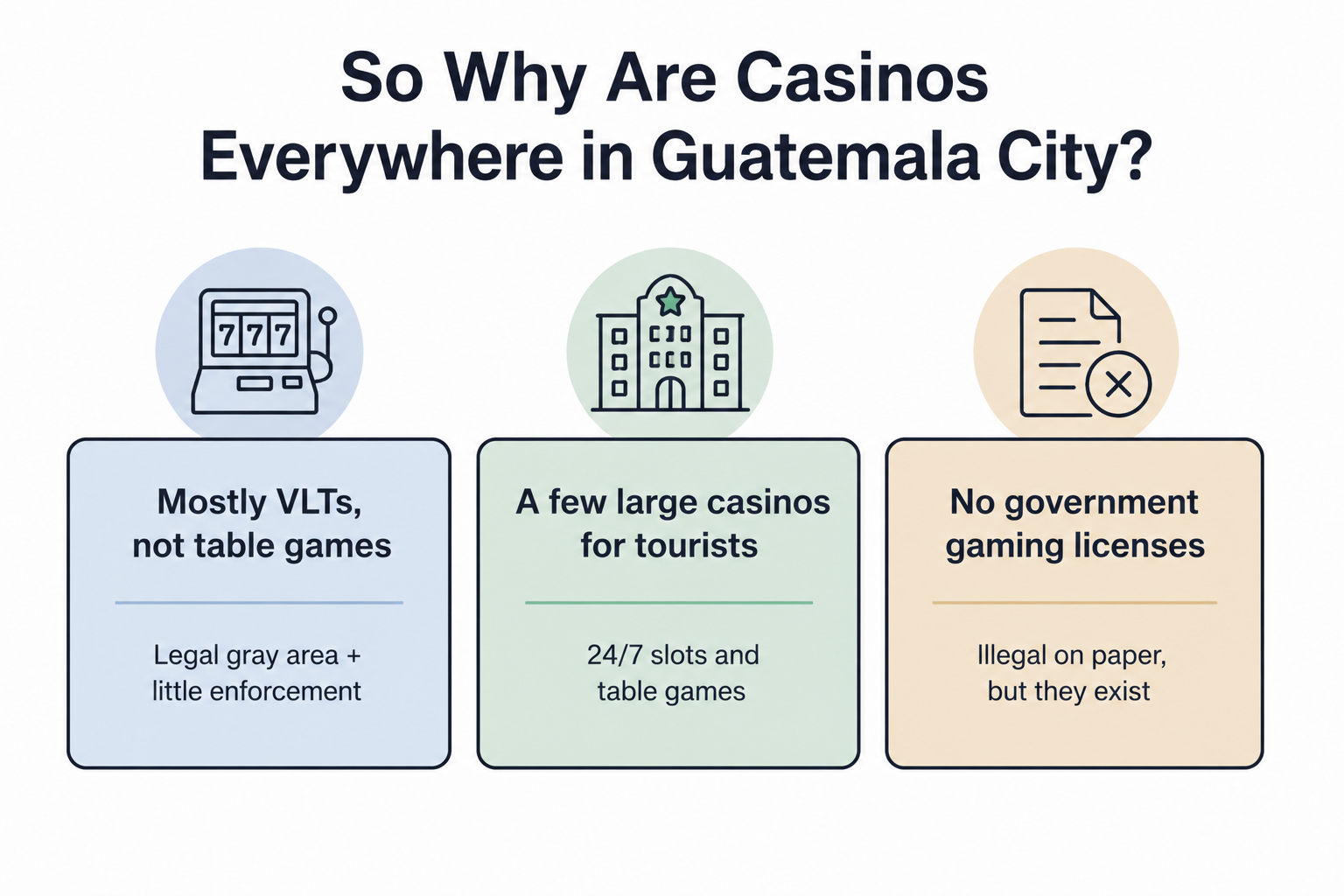
So Why Are Casinos Everywhere in Guatemala City?
Here’s the thing though—many of the venues locals call “casinos” aren’t classic table-game halls. A large share run on video lottery terminals, or VLTs, which occupy a slightly different legal category than traditional roulette wheels and blackjack tables. Operators have leaned on that distinction, along with the general lack of enforcement, to keep doors open for decades.
On top of the VLT arcades, a handful of larger properties cater specifically to tourists and business travelers. Guatemala Princess Casino, located in Guatemala City, is probably the best-known example — it runs around the clock, offering slots and table games in a setting built for visitors rather than locals looking for a quick VLT session.
None of these venues hold a government-issued gaming license in the way a casino in Nevada or Macau would. They simply exist, largely unchallenged, inside a legal system that criminalizes their core activity without actually stopping it.

Bring Your Gaming Offer to the Guatemala Market
If you sell gaming software, payment tools, platforms, betting products, equipment, or related services, Sologe gives you a dedicated place to present that offer. It is designed for the iGaming industry, so buyers can browse products by category rather than sort through unrelated listings.
Want to Put Your Offer on Sologe?
You can use the marketplace to:
- add your product under the right gaming category
- show buyers exactly what type of solution you provide
- build a clearer presence around your iGaming offer
👉 Get in touch with Sologe to start your listing.
Land-Based Casinos: What to Expect
Anyone planning to visit a Guatemalan casino should go in with realistic expectations. These aren’t Vegas-style megaresorts. Most are modest gaming floors attached to hotels or standalone buildings, offering slots, video poker, and a limited spread of table games.
Venue Type | Typical Games | Who Uses It | Regulatory Oversight |
|---|---|---|---|
Tourist-oriented casinos (e.g., Guatemala Princess Casino) | Slots, blackjack, poker, roulette | Tourists, business travelers | None formal; self-regulated |
Video lottery terminal (VLT) arcades | Electronic slot-style games | Locals, casual players | Operates in a legal gray zone |
Card rooms / small gaming halls | Poker, card games | Locals | Unregulated, largely tolerated |
Age restrictions of 18 and up are commonly enforced at the door of larger venues, though there’s no national law consistently mandating age checks the way there would be in a regulated jurisdiction.
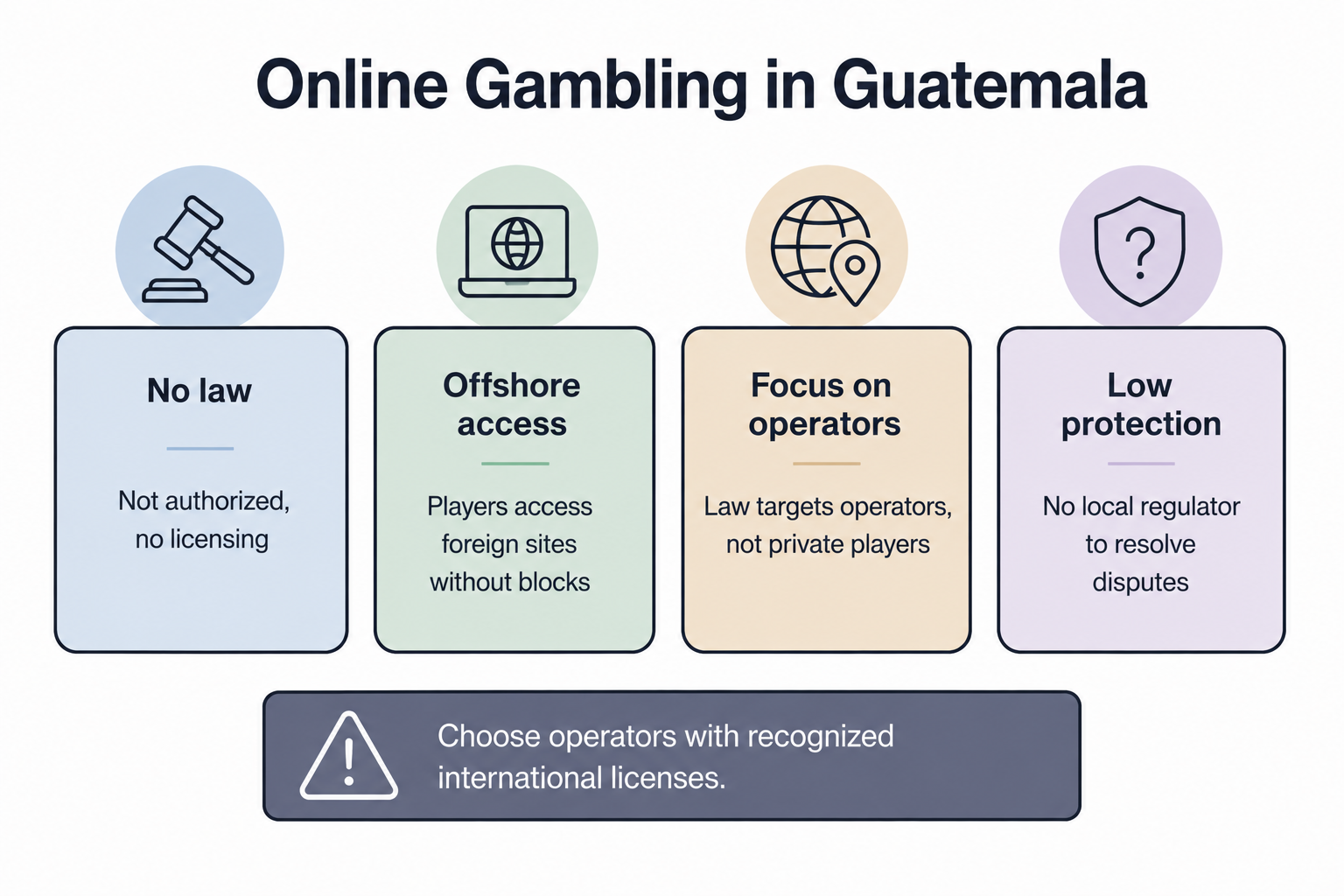
Online Gambling in Guatemala
Online gambling sits in an even murkier spot than land-based casinos. There’s no legislation authorizing it, no licensing regime, and no local operator legally permitted to run an online casino from within the country. Yet Guatemalans routinely access offshore betting sites and international online casinos without much friction.
That’s possible because Article 477 focuses on operating a gambling business, not on the act of a private citizen placing a bet from home. Foreign platforms — often licensed in Curaçao, Malta, or similar jurisdictions — simply accept Guatemalan players, and nobody in the country is actively blocking the traffic.
The catch is protection. If an offshore site refuses a withdrawal or shuts down a player’s account, there’s no Guatemalan regulator to appeal to. Players are entirely at the mercy of whichever license — if any — the platform holds abroad. That’s why choosing an operator with a recognized international license matters far more in Guatemala than in a fully regulated market.
Attempts to Regulate: Where Things Stand
Guatemala isn’t the only country wrestling with outdated gambling law, but lawmakers there have made repeated attempts to modernize it. Proposals like the long-discussed Law on Games of Chance have floated through Congress for years, aiming to create two regulatory bodies — one for oversight, one for licensing — and to formalize taxation on casinos, video lotteries, and bingo halls.
Momentum has picked up recently. Industry coverage in the past few years has noted that Guatemala’s Congress and Economic Committee have reviewed bills that would finally bring casinos and iGaming operators under a licensing framework, partly to capture tax revenue currently going untaxed and partly to attract foreign investment in tourism-linked gaming.
As of 2026, none of these proposals have become law. So the market keeps running the way it always has: tolerated, unlicensed, and technically illegal all at once. Anyone following this space closely should check Guatemala’s official congressional records or a reputable iGaming news source for the latest status, since this is exactly the kind of detail that can shift without much public notice.
Weighing the Risks: Pros and Cons for Players
Factor | Advantage | Drawback |
|---|---|---|
Land-based casinos | Easy access, tourist-friendly venues, no strict entry barriers | No licensing means no formal consumer protection |
Online gambling | Wide choice of international platforms | No local regulator to resolve disputes |
Legal enforcement | Almost never targets ordinary players | Ambiguous law creates uncertainty for operators and investors |
Future regulation | Could bring tax revenue and consumer safeguards | Timeline remains unclear; bills have stalled before |
Is It Actually Safe to Gamble in Guatemala?
Safety here means two different things: personal safety at a physical venue, and financial safety when money’s on the line. Established tourist casinos like the Guatemala Princess generally maintain professional standards simply because their business depends on repeat visitors and hotel partnerships. Smaller VLT arcades vary a lot more in quality and atmosphere.
On the money side, the absence of a regulator is the real issue. Winnings at an unlicensed local venue, or a dispute with an offshore online casino, don’t come with the kind of legal recourse players get in places like the UK or Malta. Sticking to well-reviewed, internationally licensed platforms and reputable in-person venues is the closest thing to a safety net available right now.
FAQ: Casino Gambling in Guatemala
Is gambling illegal in Guatemala?
Technically yes – Article 477 of the Penal Code criminalizes operating games of chance without authorization. In practice, enforcement is minimal, so casinos and gambling venues operate largely unchallenged.
Are online casinos legal in Guatemala?
There’s no law that specifically legalizes online gambling, but there’s also no law effectively banning individuals from playing on offshore sites. Most Guatemalan players use foreign-licensed platforms.
What is the legal gambling age in Guatemala?
Most venues enforce a minimum age of 18, though this isn’t backed by a consistently applied national gambling law the way it would be in a fully regulated country.
Can tourists visit casinos in Guatemala City?
Yes. Casinos like the Guatemala Princess Casino cater specifically to tourists and operate around the clock, offering standard slots and table games without special entry requirements beyond age verification.
Will Guatemala regulate casinos and online gambling soon?
Lawmakers have discussed formal regulation for years, including proposals to create licensing bodies for casinos and iGaming. As of 2026, no such law has passed, so timing remains uncertain.
Are video lottery terminals (VLTs) different from casino slot machines?
They occupy a slightly different legal category and are often found in smaller arcades rather than resort-style casinos, but functionally they offer a similar slot-style experience to players.
What happens if an online casino refuses to pay out winnings in Guatemala?
There’s no local regulator to intervene. Recourse depends entirely on the offshore operator’s own licensing jurisdiction, which is why picking a platform with a recognized international license matters.
Bottom Line
Guatemala’s casino scene is a contradiction that’s lasted for decades: illegal by statute, tolerated by practice. Land-based venues from tourist resorts to neighborhood VLT arcades keep running because nobody’s actively shutting them down, and online players lean on offshore platforms since no local licensing option exists. That doesn’t make the activity risk-free — it just means the risks are different from what they’d be in a properly regulated market.
Anyone planning to gamble in Guatemala, online or in person, should stick with well-known venues, verify any online platform’s international license before depositing, and keep an eye on Congress’s regulatory proposals, since a real licensing framework could reshape the market once it finally passes. Until then, check official sources directly for the latest legal updates before placing a single bet.
Related Articles

September 3, 2026Is the Casino Legal in Denmark? 2026 Guide

September 3, 2026Is the Casino Legal in Angola? What the 2026...