 Nothing found for the request
Is the Casino Legal in India? 2026 Laws Explained
Sologe July 10, 2026
Share:


The Federal Framework: Understanding India's Core Gambling Laws
India’s primary gambling legislation dates back to 1867—yes, you read that right. The Public Gambling Act of 1867 remains the foundational federal law, and it’s straightforward: it prohibits running or visiting gambling houses.
But here’s the catch. The Act grants individual states the authority to modify or enact their own gambling laws. This creates a patchwork of regulations where what’s legal in Goa is criminal in Tamil Nadu.
The Skill Versus Chance Distinction
Indian courts have consistently upheld a crucial distinction that shapes the entire gambling landscape: games of skill are protected under Article 19(1)(a) of the Constitution (freedom of expression), while games of chance can be regulated or prohibited by states.
The Supreme Court established this principle in the 1996 case K.R. Lakshmanan vs. State of Tamil Nadu. The court noted that Rummy, for instance, requires memorizing card fall patterns, strategic holding and discarding—skills that differentiate it from pure chance games like three-card.
This distinction becomes critically important when we talk about both physical casinos and online gaming platforms.
Where Are Casinos Actually Legal in India?
Only three jurisdictions in India currently permit land-based casinos with proper licensing frameworks: Goa, Sikkim, and Daman.
Goa: India’s Casino Capital
Goa legalized casinos in 1992 and has since become synonymous with Indian gambling. The state permits both offshore casinos (floating on the Mandovi River) and onshore casinos (within five-star hotels).
The licensing fees are substantial. According to official data, annual licence fee for a land-based casino in a five-star hotel ranges from INR 11,00,00,000 (approx. USD 1,240,635) to INR 44,00,00,000 (approx. USD 4,962,540), depending on the casino’s area.
These casinos offer traditional games like roulette, blackjack, poker, and slot machines. They’re legitimate businesses operating under state regulation, contributing significantly to Goa’s tourism economy.
Sikkim’s Regulated Gaming
Sikkim took a different approach, enacting the Sikkim Online Gaming (Regulation) Act in 2008. This forward-thinking legislation permits both games of chance and combinations of skill and chance—including poker and blackjack—after obtaining a state license.
Sikkim has also been noted for its lottery terminals, where draws occur frequently. The state has positioned itself as a regulatory innovator in the Indian gaming space.
Daman’s Casino Operations
The union territory of Daman also permits licensed casino operations, though on a smaller scale than Goa. It’s emerged as an alternative destination for casino tourism, particularly for visitors from nearby Gujarat and Maharashtra.
States That Strictly Prohibit Gambling
On the opposite end of the spectrum, several states have enacted stringent anti-gambling legislation that goes beyond the 1867 Act.
Tamil Nadu’s Evolving Stance
Tamil Nadu has adopted one of the strictest approaches to online gaming in India.
The Tamil Nadu Gaming and Police Laws (Amendment) Act, 2021 initially imposed a blanket prohibition on all games played for stakes, regardless of whether they were skill-based or chance-based. The Madras High Court struck down this broad ban as arbitrary and disproportionate.
In response, the state introduced the Tamil Nadu Prohibition of Online Gambling and Regulation of Online Games Ordinance, 2022 (later enacted as an Act). This law specifically prohibits online gambling and certain online games of chance played for money — explicitly including rummy and poker.
This triggered a significant legal battle. While the Madras High Court in November 2023 ruled in favour of classifying rummy and poker as games of skill and struck down the ban on them, the Supreme Court in May 2026 upheld Tamil Nadu’s restrictions. The apex court held that states have the power to prohibit online real-money gaming, including betting on skill-based games, as there is no fundamental right to engage in such activities.
The Act’s definition of “games of chance” remains controversial. It includes games involving cards or dice that use random number generators (RNG). Since almost all online card games rely on RNG for shuffling, this broad criterion could potentially affect a wide range of titles.
Andhra Pradesh and Telangana’s Prohibitions
Both states enacted laws (Andhra Pradesh in 2020, Telangana in 2017) prohibiting online gaming, betting, and wagering. These laws define online games broadly as games played to win money or stakes.
Challenges to these laws are pending before their respective High Courts, with operators arguing they improperly restrict games of skill that enjoy constitutional protection.
Karnataka’s Struck-Down Amendment
Karnataka attempted similar restrictions with the Karnataka Police (Amendment) Act, 2021, prohibiting wagering in any game of chance or skill. The Karnataka High Court struck this down in October 2021, finding it manifestly arbitrary for banning all games of skill and violating Article 14 of the Constitution.
The 2026 Online Gaming Revolution: New Federal Framework
Now here’s where things get interesting—and current.
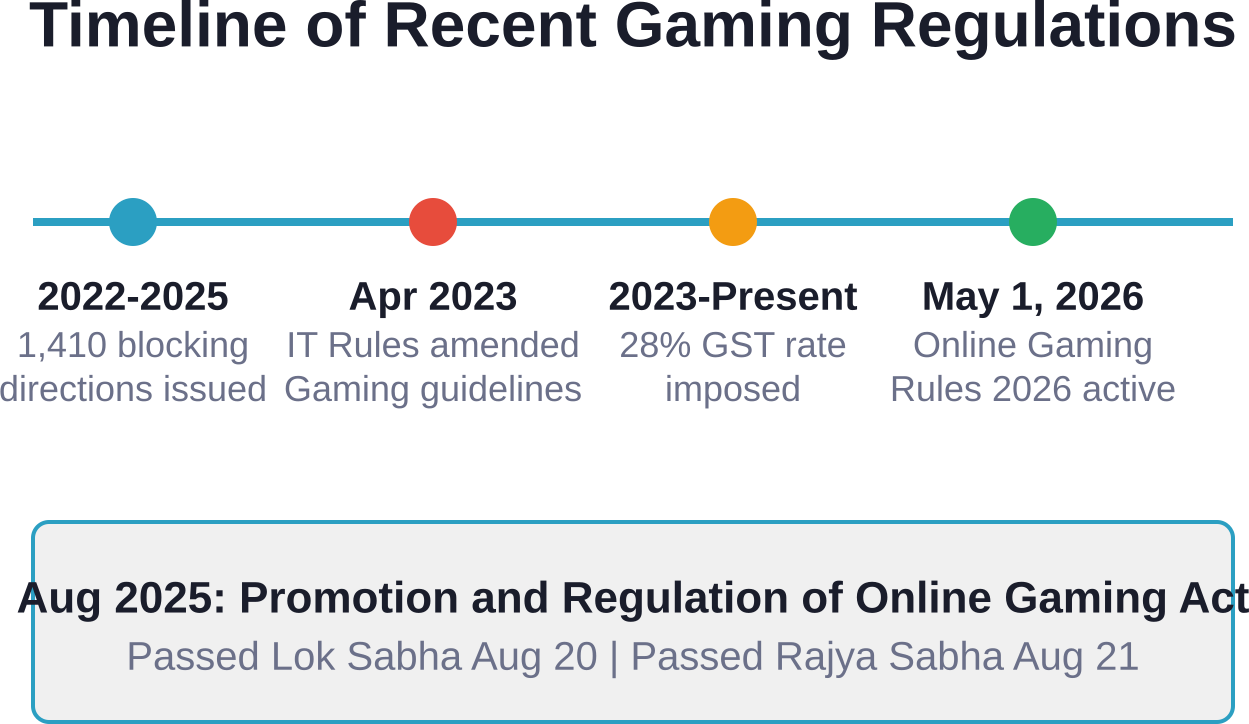
The Promotion and Regulation of Online Gaming Act, 2025 was passed by Parliament in August 2025. The accompanying Promotion and Regulation of Online Gaming Rules, 2026 came into force on May 1, 2026.
This represents the most significant federal intervention in online gaming regulation in Indian history.
What the 2026 Rules Establish
According to official government communications from the Ministry of Electronics and Information Technology, the 2026 framework establishes a structured system to govern online games with a focus on user safety and accountability.
The Promotion and Regulation of Online Gaming Act, 2025 comprehensively prohibits all forms of online money games, whether involving games of chance, games of skill, or any combination thereof.
The rules operationalize this by creating registration requirements, grievance mechanisms, and compliance standards for gaming intermediaries.
Between 2022-2025: Blocking Directions
Before the 2026 framework, the government took enforcement action against platforms it deemed illegal. According to official data from the Ministry of Electronics and Information Technology, MeitY issued 1,410 blocking directions related to online betting, gambling, and gaming websites between 2022 and 2025.
These blocking orders targeted platforms operating without regulatory compliance or offering prohibited gambling services.
The Controversial 28% GST on Online Gaming
In a move that sent shockwaves through the industry, India imposed a 28% Goods and Services Tax on online gaming, casinos, and horse racing.
This tax rate—the highest GST slab—applies to the full face value of bets placed, not just the platform’s commission. Industry stakeholders argued this makes many legitimate skill-gaming businesses economically unviable, as their margins are typically far below 28%.
The tax doesn’t distinguish between games of skill and games of chance, treating fantasy sports, poker, and slot machines identically for tax purposes—despite their different legal statuses.
Advertising Restrictions and Celebrity Endorsements
The Central Consumer Protection Authority (CCPA) took a firm stance on gambling promotion in March 2024.
According to an official advisory from the Ministry of Consumer Affairs, Food & Public Distribution, betting and gambling are strictly prohibited. The CCPA warned that promoting online gambling and betting—even when camouflaged as gaming—holds equal liability for illegal activity.
The advisory specifically cautioned celebrities and influencers that endorsing prohibited gambling activities makes them liable. This has led to a noticeable reduction in celebrity-fronted gambling promotions across Indian media.
What About Horse Racing and Lotteries?
These two activities occupy a special place in Indian gambling law.
Horse Racing: The Protected Exception
Horse racing with betting has consistently been recognized as a game of skill. The Supreme Court in K.R. Lakshmanan vs. State of Tamil Nadu (1996) established that betting on horse races involves substantial skill in analyzing form, track conditions, and horse performance.
Most states exempt licensed horse racing from their gambling prohibitions. Clubs like the Hyderabad Race Club in Andhra Pradesh operate legally despite the state’s otherwise strict anti-gambling stance.
State Lotteries: A Revenue Source
Several states run government lotteries as revenue-generation mechanisms. Drawing lotteries is typically restricted to one draw per week under most state frameworks, though some states have been permitted to operate terminals with more frequent draws.
States like Sikkim are known for abundant lottery terminals where draws occur even every 15 minutes, functioning as significant revenue sources.
The Underground Gambling Economy
Here’s the uncomfortable reality. Despite extensive prohibitive legislation, illegal gambling thrives throughout India.
The Indian gambling market is estimated at around US$60 billion per year, with the vast majority occurring through illegal channels. This includes underground betting on cricket matches, card games in illegal dens, and unregulated online platforms.
The gap between legal framework and ground reality remains substantial. Enforcement is inconsistent, and the profit potential of illegal gambling operations continues to fuel a shadow economy.
Online Gaming: The Blurred Lines
Online gaming remains one of the most legally ambiguous areas in Indian gambling law.
Skill-Based Platforms
Platforms offering fantasy sports, online poker, and rummy have long argued — often successfully in court — that these are games of skill protected under constitutional freedoms (Article 19(1)(g)).
Multiple High Court rulings have supported this position:
- The Rajasthan High Court in Ravindra Singh Chaudhary vs Union of India (2020) recognized fantasy sports as a game of skill.
- The Kerala High Court in Head Digital Works Private Limited vs State of Kerala recognized online rummy as a game of skill.
The Tamil Nadu Contradiction
In 2022, Tamil Nadu introduced an Ordinance (later enacted as the Tamil Nadu Prohibition of Online Gambling and Regulation of Online Games Act, 2022) that sought to ban online rummy and poker by classifying them as games of chance. This created a direct conflict with earlier judicial recognitions of these games as skill-based.
The Madras High Court in November 2023 struck down the ban on rummy and poker. However, in May 2026 the Supreme Court of India upheld Tamil Nadu’s (and Karnataka’s) restrictions, ruling that states have the legislative competence to prohibit online real-money gaming, including betting on games of skill. The Court held that there is no fundamental right to engage in betting or wagering, even on skill-based games.
The Act’s definition criteria remain controversial. One provision classifies games involving cards or dice that use random number generators (RNG) as games of chance. Since virtually every online card game relies on RNG to simulate shuffling, this broad approach could potentially affect other games. For example, online Bridge — officially recognized by the International Olympic Committee as a sport — could fall under the same classification.
This situation underscores the ongoing tension between state-level regulatory powers and constitutional protections for skill-based activities.
Compliance Requirements for Online Gaming Platforms
The 2023 amendments to the IT Rules (notified via G.S.R. 275(E) on April 6, 2023) established compliance requirements for online gaming intermediaries.
Platforms must ensure compliance with rules and regulations, privacy policies, and user agreements. They must make reasonable efforts to prevent users from creating, uploading, or sharing prohibited content.
Grievance Redressal Mechanisms
The IT Rules require intermediaries to acknowledge complaints regarding violation of rules within 24 hours. They must dispose of such complaints within 15 days. For complaints regarding specified prohibited content, the response time is 72 hours.
The government established Grievance Appellate Committees to hear appeals against decisions of grievance officers. Orders passed by these committees must be complied with by intermediaries, with compliance reports uploaded on their websites.
Due Diligence for Non-Local Providers
Gaming platforms based outside specific states but accessible to residents must either geo-block prohibited content or exercise due diligence.
Due diligence requirements include entering contracts with customers stipulating they won’t play if physically present in restricting states, collecting personal details to establish physical location, and ensuring access restrictions are technically enforced.
However, there’s a jurisdictional question. Can Tamil Nadu regulate a platform and user both based in Sikkim simply because the platform doesn’t geo-block Tamil Nadu? The Supreme Court’s 1957 decision State of Bombay vs. R.M.D. Chamarbaugwala established that territorial connection must be real, not illusory, and the liability imposed must be pertinent to that connection.
State/Territory | Casino Status | Online Gaming Stance | Key Regulations |
|---|---|---|---|
Goa | Legal (offshore & onshore) | Permitted with licensing | License fees: ₹11-44 Cr annually |
Sikkim | Legal (licensed operations) | Regulated under 2008 Act | Permits skill & chance games |
Daman | Legal (licensed casinos) | Permitted with regulation | Smaller scale than Goa |
Tamil Nadu | Prohibited | Strict prohibition | Bans online Rummy & Poker |
Andhra Pradesh | Prohibited except horse racing | Banned since 2020 | Challenge pending in High Court |
Telangana | Prohibited | Banned since 2017 | Challenge pending in High Court |
Karnataka | Prohibited | 2021 ban struck down | High Court found ban arbitrary |
Discover Gaming Providers with Sologe
India’s gaming landscape is complex and often varies by jurisdiction, making market research especially important. Sologe is a B2B iGaming marketplace that brings together suppliers across technology, software, and business categories.
Companies can use Sologe to:
- Compare online gaming platforms
- Explore gaming software options
- Review mobile application categories
- Assess analytics tools
- Find marketing technology solutions
Contact Sologe to review platforms, software categories, mobile solutions, and other gaming technologies.
What About Indians Playing on International Platforms?
This is where enforcement becomes practically impossible.
Many Indians access offshore gambling platforms based in jurisdictions like Malta, Curacao, or Gibraltar. These platforms operate legally in their home jurisdictions and accept Indian players.
Technically, participating in prohibited gambling activities remains illegal for Indians regardless of where the platform is based. But enforcement is nearly impossible when the transaction occurs entirely outside Indian jurisdiction.
The government’s blocking orders attempt to address this by instructing ISPs to block access to specified international gambling domains. Between 2022 and 2025, those 1,410 blocking directions targeted many such platforms.
But blocking is a game of whack-a-mole. Platforms create mirror sites, and users access blocked sites through VPNs. The technical reality makes comprehensive enforcement unfeasible.
The Regulatory Future: What’s Coming Next?
The 2026 regulations mark a shift from prohibition-focused thinking toward regulation-focused governance—at least for skill-based gaming.
Self-Regulatory Organizations
Industry discussions suggest the emergence of self-regulatory organizations (SROs) that would certify games as skill-based, establish responsible gaming standards, and handle first-level compliance monitoring.
This model, common in mature gambling jurisdictions, could help distinguish legitimate skill-gaming operators from illegal gambling fronts.
Uniform National Framework Debates
The patchwork of state laws creates operational complexity. A fantasy sports platform legal in Maharashtra faces criminal liability if it doesn’t properly geo-block Tamil Nadu users.
Some policy advocates argue for a uniform national framework that would provide clarity. But federalism complicates this—gambling is a state subject under the Constitution, limiting the Centre’s authority to impose uniform rules.
The 2025 Act and 2026 Rules represent the Centre’s attempt to establish baseline standards while respecting state autonomy to prohibit or further regulate within their borders.
The Skill Certification Challenge
One unresolved question: who determines whether a game is skill or chance?
Courts have used the “substantial skill” or “preponderance of skill” test. But applying this to thousands of digital games—from complex strategy games to simple card variants—requires expertise and resources.
Tamil Nadu’s 2022 Ordinance empowered a state Gaming Authority to identify games of chance and recommend adding them to the prohibition schedule. Whether such determinations will withstand judicial scrutiny when they conflict with Supreme Court precedents remains to be seen.
Responsible Gaming and User Protection
The 2026 Rules emphasize user safety—a recognition that even legal gaming can cause harm without proper safeguards.
Age Verification and KYC
Platforms must implement robust age verification to prevent minors from accessing real-money gaming. Know Your Customer (KYC) requirements help ensure this and assist with anti-money laundering compliance.
Deposit Limits and Self-Exclusion
Responsible gaming features include deposit limits that users can set, cooling-off periods, and self-exclusion options allowing users to voluntarily ban themselves from platforms.
Whether these measures will be mandated uniformly or left to platform discretion remains to be clarified in implementation guidelines.
Addiction Awareness
The Tamil Nadu Ordinance’s explanatory statement noted that online games are addictive and have negative consequences, especially for children. While prohibition may not be proportionate, the underlying concern about gambling-related harm is legitimate.
Effective regulation should balance adult autonomy with protections against compulsive behavior and financial ruin.
The Economic Stakes
India’s online gaming industry has seen explosive growth. Before the 28% GST, industry estimates valued the sector at multiple billions of dollars with projections of continued rapid expansion.
The taxation and regulatory changes have altered that trajectory. Some operators have reduced India operations or restructured. Others argue the 28% GST rate makes sustainable business models impossible.
Yet the market remains massive. With smartphone penetration increasing and digital payments ubiquitous, India represents one of the world’s largest potential gaming markets.
The question is whether regulatory uncertainty and high taxation will drive activity underground or toward offshore platforms—or whether a mature regulatory framework will eventually emerge that captures revenue while permitting legitimate operations.
Practical Guidance for Operators and Players
For Gaming Operators
If operating in India’s gaming space, legal compliance requires navigating multiple layers of law. Operators must understand federal regulations under the IT Rules and the 2026 framework, state-specific prohibitions, tax obligations including the 28% GST, and implement robust responsible gaming measures.
Legal advice specific to the states where users are located is essential. Geo-blocking capabilities to restrict access from prohibiting states are technically necessary.
For Players
Understanding the legal status of activities before participating is crucial. In states like Goa and Sikkim, licensed casinos operate legally. For online gaming, platforms offering skill-based games in non-prohibiting states operate in a legal gray area that courts have often resolved favorably.
But in states with explicit prohibitions like Tamil Nadu, Andhra Pradesh, and Telangana, participation in online real-money gaming carries legal risk regardless of whether the platform is based elsewhere.
Responsible gaming practices matter. Set limits, recognize when activity becomes compulsive, and use self-exclusion tools if needed.
Frequently Asked Questions
Are casinos completely illegal in India?
No. Casinos are legal in certain states, including Goa, Sikkim, and the Union Territory of Dadra and Nagar Haveli and Daman and Diu, where they operate under state licensing systems. In most other parts of India, casino gambling remains prohibited under state laws and the Public Gambling Act of 1867 or equivalent legislation.
Can I legally play online poker or rummy in India?
It depends on where you live. Indian courts have recognized poker and rummy as games of skill in certain circumstances, but individual states regulate them differently. Some states permit these games, while others, including Tamil Nadu, Andhra Pradesh, and Telangana, have introduced restrictions or prohibitions on online real-money gaming.
What is the 28% GST on online gaming?
India applies a 28% Goods and Services Tax (GST) to the full face value of bets or entry fees in online gaming. The tax applies regardless of whether the game is classified as one of skill or chance.
What are the Online Gaming Rules of 2026?
The Promotion and Regulation of Online Gaming Rules, 2026, came into force on May 1, 2026, to implement the Promotion and Regulation of Online Gaming Act, 2025. The rules establish a regulatory framework for online gaming, prohibit online money games, and introduce oversight for permitted skill-based gaming activities.
Is betting on cricket legal in India?
No. Betting on cricket is generally illegal throughout India under existing gambling laws. Horse racing remains one of the few sports on which betting is legally permitted in certain jurisdictions through licensed operators.
Can the government block access to international gambling websites?
Yes. The Indian government has the authority to direct internet service providers to block access to gambling and betting websites. Authorities regularly issue blocking orders against unauthorized online gambling platforms, although enforcement remains technically challenging.
What happens if I’m caught gambling in a state where it’s prohibited?
Penalties vary depending on the state’s gambling laws. They may include fines, imprisonment, or both, with operators and organizers generally facing much harsher penalties than individual players.
Conclusion: Navigating India’s Gambling Landscape in 2026
So, are casinos legal in India? The answer is decisively “it depends.”
Three jurisdictions permit licensed casinos operating within regulatory frameworks. Most states maintain prohibition rooted in colonial-era legislation. Online gaming occupies a complex middle ground where skill-based games enjoy constitutional protection while chance-based gambling faces prohibition—but states define these categories differently, sometimes in ways that conflict with Supreme Court precedents.
The 2026 regulatory framework represents an attempt to bring structure to this chaos, at least at the federal level. It establishes baseline standards for permitted gaming while explicitly prohibiting online money games. But state autonomy means the patchwork persists.
What’s clear is that India’s gambling landscape is evolving rapidly. The gap between extensive illegal gambling activity and limited legal options creates ongoing tension. Whether India moves toward more comprehensive regulation that channels activity into legal, taxed, and safer frameworks—or maintains a prohibitive stance that drives activity underground—will shape the industry for years to come.
For anyone involved in or considering entering India’s gaming market, legal compliance requires careful attention to both federal regulations and the specific laws of each state where operations or users are located. The stakes are high, the rules are complex, and the landscape is still shifting.
Stay informed, seek legal counsel, and understand that what’s legal in Goa may land you in serious trouble in Tamil Nadu.
Related Articles

September 3, 2026Is the Casino Legal in Denmark? 2026 Guide

September 3, 2026Is the Casino Legal in Angola? What the 2026...