 Nothing found for the request
Is the Casino Legal in Iraq? 2026 Legal Guide
Sologe July 11, 2026
Share:


The Legal Framework: Why Gambling Is Banned
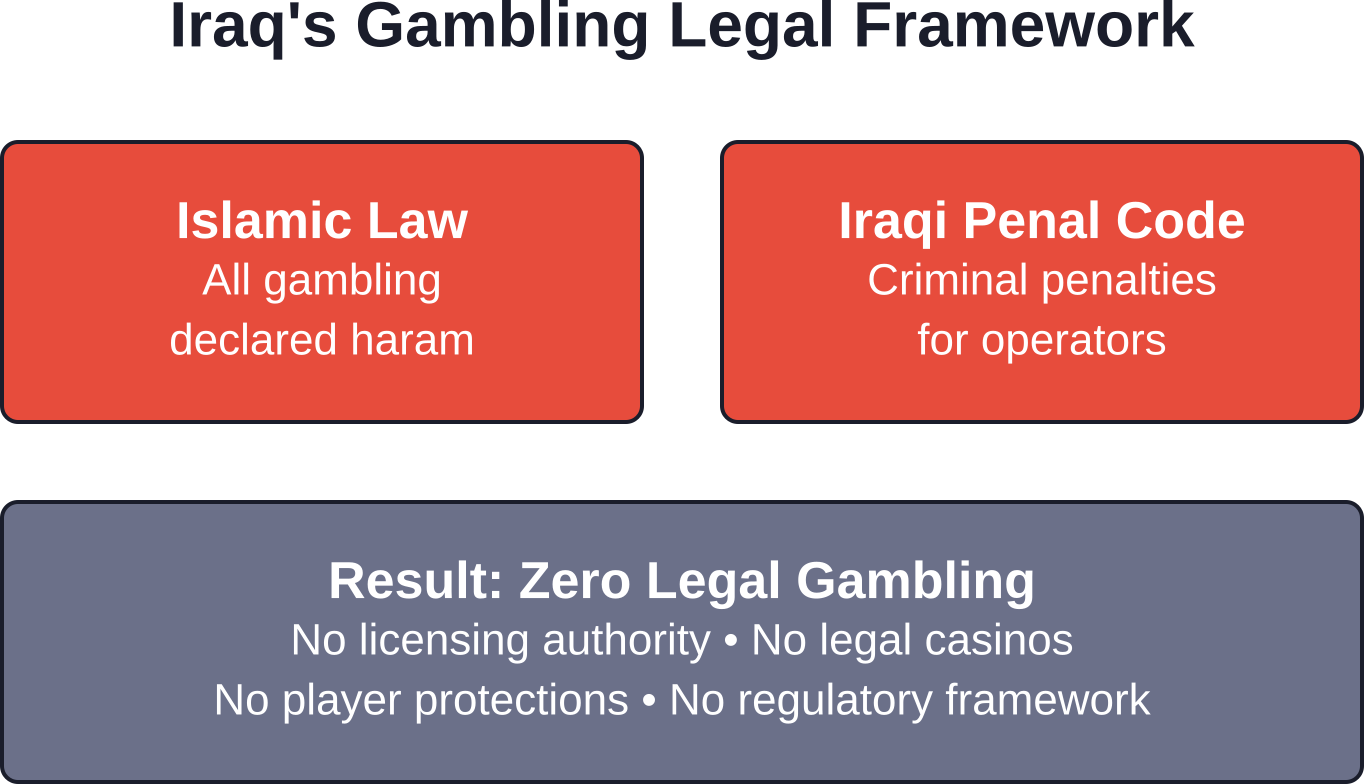
Iraq’s prohibition on gambling stems from two primary sources: religious law and civil legislation.
Islamic law, which forms the foundation of Iraq’s legal system, explicitly forbids gambling in all forms. The practice is considered haram—religiously prohibited—because it involves risking money or possessions on uncertain outcomes.
The Iraqi Penal Code reinforces this religious prohibition with civil law. Organizing, operating, or facilitating gambling activities carries criminal penalties, including fines and imprisonment.
There are no exceptions carved out for casinos, sports betting, lotteries, or any other form of wagering. The ban is comprehensive and applies to both land-based and online gambling.
No Licensing Authority Exists
Iraq has no regulatory body that issues gambling licenses. This means there’s no legal pathway for operators to offer casino services within the country.
Some countries with religious prohibitions still maintain regulatory frameworks for tourism or specific zones. Iraq does not. The ban is absolute.
For players, this creates a situation with zero consumer protections. Because no legal gambling exists, there are no safeguards, dispute resolution mechanisms, or responsible gaming frameworks.
Recent Enforcement Actions: The Ludo Ban
Iraqi authorities don’t just maintain laws on paper—they actively enforce them, especially as digital platforms create new gambling avenues.
In December 2025, the Iraqi Ministry of Communications banned the popular Ludo game app. While Ludo itself is a traditional board game, the ministry cited specific risks that transformed the app into a gambling concern.
The ban highlighted three primary issues: gambling addiction risks, family discord caused by financial losses, and sexual exploitation through the app’s private chat features.
This action demonstrates Iraq’s proactive stance. Authorities monitor digital platforms and don’t hesitate to block access when apps facilitate gambling or related harms.
What This Means for Players
The Ludo ban wasn’t an isolated incident. It reflects ongoing scrutiny of gaming and gambling apps accessible to Iraqi users.
Iraqi players accessing any platform—whether branded as a game, casino, or betting site—face the risk of sudden access loss if authorities decide to block it. There’s no guarantee of continuity with any offshore service.
Beyond access issues, the enforcement creates legal uncertainty. While prosecution of individual players is rare, the legal risk exists.
The Reality: Offshore Online Casinos
Here’s where theory meets practice. Despite the comprehensive ban, some Iraqi residents access offshore online casinos.
These platforms operate from jurisdictions where online gambling is legal and licensed. They accept Iraqi players through international payment methods and typically offer Arabic language options.
But let’s be clear: just because something is technologically possible doesn’t make it legal.
How Offshore Access Works
Offshore casinos target international markets, including regions where domestic gambling is prohibited. They operate under licenses from jurisdictions like Malta, Curaçao, or Gibraltar.
Iraqi players who choose to access these sites typically do so through:
- International credit cards and e-wallets
- Cryptocurrency deposits that bypass traditional banking
- VPN services if sites are geoblocked
- Mobile apps downloaded from third-party sources
The transactions happen outside Iraq’s banking system, making enforcement challenging. But challenging doesn’t mean impossible.
Legal Status of Offshore Gambling
Accessing offshore casinos from Iraq occupies a legal gray area in practice, but a black-and-white area in law.
Technically, participating in gambling from Iraqi territory violates the Penal Code regardless of where the operator is based. The law prohibits the activity, not just the operation of gambling businesses.
That said, enforcement focuses primarily on operators and facilitators rather than individual players. Prosecutions of ordinary gamblers are uncommon.
The bigger risk isn’t necessarily legal prosecution—it’s the complete absence of consumer protection.
Risk Factor | Details | Severity
|
|---|---|---|
Legal Risk | Gambling violates Iraqi law; prosecution possible though rare for players | Moderate |
No Protections | Zero regulatory oversight; no dispute resolution or consumer safeguards | High |
Payment Issues | Difficulty with withdrawals; limited banking options; potential account freezes | High |
Platform Access | Sites can be blocked suddenly; no guarantee of continued service | Moderate |
Financial Safety | Unlicensed operators may not safeguard funds; fraud and scam risks elevated | Very High |
Discover Gambling Solutions with Sologe
Legal research is only one step when evaluating a gaming market. Sologe provides access to multiple areas of the gaming industry, helping companies compare options more efficiently.
Sologe makes it easier to:
- Review sports betting software
- Explore payment solution categories
- Compare operations management tools
- Assess analytics platforms
- Find certification-related options
Contact Sologe to review payment options, sports betting software, operational tools, and other iGaming business solutions.
The Global Context: Gambling’s Public Health Concerns
Iraq’s strict stance exists within a broader global conversation about gambling harms.
According to Harvard Kennedy School research published in November 2024, a four-year study by a global public health commission found that net global losses by gamblers could exceed $700 billion by the year 2028.
That’s not revenue or stakes wagered—that’s net losses. Money permanently transferred from individuals and families to gambling operators.
The same research notes that approximately 80% of the world’s countries now allow some form of legal gambling. Iraq stands among the minority maintaining comprehensive bans.
Problem Gambling Economics
The Harvard Kennedy School research and public health commission research indicate that problem gambling and at-risk individuals represent a significant portion of gambling industry revenues.
The industry’s financial model depends substantially on addiction and harmful use. This creates perverse incentives where operators profit most from those suffering the greatest harm.
Iraq’s prohibition reflects a public health approach rather than a revenue or entertainment one. The question isn’t whether gambling can generate tax revenue or jobs, but whether the social costs justify allowing it at all.
What Types of Gambling Are Affected?
Iraq’s ban isn’t selective—it covers every form of gambling imaginable.
Land-based casinos don’t exist. Sports betting is illegal. Lotteries aren’t permitted. Horse racing with wagering is prohibited. Poker rooms can’t operate legally.
Online gambling receives the same treatment. Iraqi law doesn’t distinguish between physical and digital venues. If it involves risking money on uncertain outcomes, it’s prohibited.
Games Commonly Offered by Offshore Sites
Iraqi players who access offshore platforms typically find the full range of casino products:
- Slot machines: Digital versions of spinning reel games, often with elaborate themes and bonus features. These represent the majority of games on most platforms.
- Table games: Digital versions of blackjack, roulette, baccarat, and poker. Some sites offer dozens of variations with different rules and betting limits.
- Live dealer games: Real-time video streams of actual dealers operating physical tables. Players place bets through their devices while watching the action unfold.
- Sports betting: Wagering on football matches, basketball games, and other sporting events. Both pre-match and in-play betting are typically available.
The variety is extensive, but remember—accessing any of these from Iraq carries the legal and safety risks outlined earlier.
Payment Challenges for Iraqi Players
Even when Iraqi residents access offshore casinos, moving money presents significant obstacles.
Iraqi banks generally don’t process gambling transactions. International credit card companies may decline transactions to known gambling sites, especially from jurisdictions where gambling is illegal.
This pushes players toward alternative payment methods that carry their own risks.
Common Workarounds and Their Problems
E-wallets like Skrill or Neteller offer one avenue, but these services increasingly restrict accounts linked to prohibited jurisdictions.
Cryptocurrency deposits through Bitcoin or Ethereum provide another option. Transactions are harder to block, but cryptocurrency introduces volatility risk and requires technical knowledge many players lack.
Withdrawing winnings creates even bigger headaches. Players report delays, account verification challenges, and in some cases, complete inability to access funds.
Without legal recourse or regulatory oversight, players who encounter payment problems have virtually no options for resolution.
The Underground Reality
Prohibition doesn’t eliminate demand—it drives activity underground.
Community discussions and user experiences suggest some illegal gambling occurs through informal networks. Private poker games, sports betting through unlicensed bookmakers, and other underground activities exist despite the legal risks.
These operations carry even greater dangers than offshore sites. There’s zero accountability, no record of transactions, and no recourse if disputes arise. The risk of fraud or violence is substantially elevated.
Law enforcement periodically cracks down on underground operations, with organizers facing serious criminal charges.
Neighboring Countries: A Comparison
Iraq’s prohibition isn’t unique in the Middle East, but regional approaches vary.
Saudi Arabia and Kuwait maintain similarly strict bans based on Islamic law. The United Arab Emirates prohibits gambling for citizens but allows licensed casinos in certain tourism zones for foreign visitors.
Lebanon has casinos that operate legally, though with restrictions. Turkey technically bans most gambling but allows state-operated lotteries and sports betting.
Iraq’s position is among the strictest, with no carve-outs for tourism, no state-run lotteries, and active enforcement against digital platforms.
Country | Legal Status | Key Features
|
|---|---|---|
Iraq | Completely Illegal | Comprehensive ban; no exceptions; active digital enforcement |
Saudi Arabia | Completely Illegal | Islamic law prohibition; strict enforcement |
UAE | Limited Legal | Banned for citizens; tourism zones allow foreign access |
Lebanon | Limited Legal | Licensed casinos operate with restrictions |
Turkey | Mostly Illegal | State lottery permitted; most other forms banned |
Will Iraq’s Laws Change?
Short answer: unlikely in the foreseeable future.
The religious foundation of the prohibition is deeply embedded in Iraqi society and law. Changing gambling laws would require overcoming significant cultural, religious, and political resistance.
Recent actions like the Ludo ban suggest authorities are moving toward stricter enforcement rather than liberalization.
Economic Pressures
Some advocates for legalization point to potential tax revenue and tourism benefits. Countries that legalize and regulate gambling can generate substantial government income.
But Iraq’s calculation differs from countries without religious prohibitions. The social and religious costs of legalization would likely outweigh economic benefits in the eyes of lawmakers and the public.
The global data on gambling harms—including the $700 billion in projected losses by 2028 and the heavy burden on problem gamblers—strengthens the public health case for maintaining prohibitions.
Responsible Gambling: A Note for Iraqi Readers
If you’re an Iraqi resident considering offshore gambling despite the legal and practical risks, understanding harm reduction is critical.
Gambling addiction affects people worldwide, regardless of legal status. The lack of regulatory protections in Iraq makes the risks even more acute.
Warning signs of problem gambling include:
- Spending more money than planned or affordable
- Chasing losses by continuing to gamble after losing
- Gambling interfering with work, family, or other responsibilities
- Lying to family members about gambling activities
- Feeling restless or irritable when trying to cut back
Because Iraq has no legal gambling framework, there are no formal support services specifically for gambling addiction. Mental health professionals can provide help, though resources are limited.
The safest approach is simple: avoid gambling entirely. The legal risks, financial dangers, and addiction potential create a combination that’s difficult to manage safely.
Future Developments to Watch
While legalization seems unlikely, several trends will shape Iraq’s gambling landscape.
Digital enforcement will likely intensify. As technology makes offshore access easier, authorities will develop more sophisticated blocking and monitoring capabilities.
Regional developments matter too. If neighboring countries move toward legalization or stricter enforcement, Iraq may adjust its approach accordingly.
The global conversation about gambling as a public health issue is growing louder. Research like the Harvard study published in 2024 provides evidence for countries maintaining or strengthening prohibitions.
Iraqi authorities may reference this growing body of evidence to justify continued strict enforcement.
FAQ: Casino Legality in Iraq
Are there any legal casinos in Iraq?
No. Iraq does not have any legal land-based or online casinos. Gambling is prohibited under Iraqi law, and there is no licensing framework that allows casinos to operate legally.
Can Iraqi residents legally use offshore online casinos?
No. Iraqi law prohibits gambling regardless of where the gambling operator is located. Although some residents access offshore gambling websites, doing so remains contrary to Iraqi law and may expose users to legal risks.
What are the penalties for gambling in Iraq?
The Iraqi Penal Code provides criminal penalties for organizing, operating, or facilitating gambling activities. These may include fines and imprisonment. Enforcement is generally directed at operators, but participating in illegal gambling also carries legal risk.
Why did Iraq ban the Ludo game app?
In December 2025, Iraqi authorities blocked the Ludo app because of concerns that it encouraged gambling-like behavior, contributed to financial losses, and enabled harmful interactions through private communication features.
Do neighboring countries allow casinos?
Gambling laws differ across the region. Some neighboring countries, such as Saudi Arabia and Kuwait, prohibit casino gambling, while others, including Lebanon and the United Arab Emirates, permit certain licensed gambling activities under specific legal frameworks.
Is there any chance Iraq will legalize gambling in the future?
As of 2026, there are no official proposals to legalize gambling in Iraq. Current government policy continues to prohibit gambling, and recent enforcement measures indicate that this position is unlikely to change in the near future.
What should Iraqi residents know about offshore casino risks?
Offshore gambling websites are not regulated or licensed in Iraq. Users may face legal risks, payment problems, blocked access, limited consumer protections, and no reliable process for resolving disputes if issues arise.
Conclusion: Navigate with Caution and Awareness
The answer to “Is the casino legal in Iraq?” is definitively no. Iraq maintains one of the world’s strictest gambling prohibitions, backed by religious law and criminal statutes.
While offshore online casinos are technologically accessible, accessing them from Iraq creates a web of legal, financial, and safety risks. There are no consumer protections, limited payment options, and the constant possibility of enforcement action.
The global gambling industry is massive and growing, with net global losses by gamblers projected to exceed $700 billion by the year 2028. Problem gambling represents a significant portion of industry revenues—people suffering real harm. Iraq’s prohibition reflects a public health calculation that these harms outweigh potential benefits.
For Iraqi residents, the safest and most legally sound approach is clear: avoid gambling entirely. The risks far outweigh any potential rewards, and the complete absence of protections makes the activity uniquely dangerous.
Stay informed about enforcement developments, understand the legal landscape, and make decisions with full awareness of the consequences. The law is clear, and the risks are real.
Related Articles

September 3, 2026Is the Casino Legal in Denmark? 2026 Guide

September 3, 2026Is the Casino Legal in Angola? What the 2026...