 Nothing found for the request
Is the Casino Legal in Kenya? 2026 Complete Guide
Sologe July 10, 2026
Share:


The Legal Status of Casinos in Kenya
The Betting Control and Licensing Board was established in 1966 under the Betting, Lotteries and Gaming Act. Casinos operated under that legal framework from 1966 onward. The original framework—the Betting, Lotteries and Gaming Act (Cap. 131)—was assented to on 11 March 1966, with various parts commencing on 1 November 1966 and 1 January 1967. That law created the foundation for legal gambling, including casinos, lotteries, and betting operations.
Here’s the thing though—that Act stayed largely unchanged for nearly six decades while the industry exploded around it. Online gambling emerged, mobile betting became massive, and youth participation skyrocketed. The old law just couldn’t regulate modern realities.
On August 7, 2025, everything changed. The Gambling Control Act, 2025 was enacted and came into force on August 26, 2025. This new legislation repealed the outdated Betting, Lotteries and Gaming Act entirely. According to Kenya Law, the old Act was repealed on 2025-08-20 by the Gambling Control Act.
So yes, casinos are absolutely legal in Kenya. But they now operate under a completely overhauled regulatory system designed for the digital age.
The Gambling Control Act, 2025: What Changed
The Gambling Control Act represents the most comprehensive shift in Kenya’s gambling regulation in decades. The Act wasn’t just a revision—it was a complete rebuild aimed at addressing modern gambling forms, especially online operations, and protecting the public from gambling-related harm.
New Regulatory Authority
The most visible change? The Betting Control and Licensing Board is out. The Gambling Regulatory Authority (GRA) is in.
The GRA now oversees all gambling activities regulated under the Act. This includes casinos, online gambling platforms, sports betting, lotteries, prize competitions, and everything in between. The Authority has sweeping powers to license operators, enforce compliance, and take action against illegal gambling.
Tougher Licensing Thresholds
Licensing under the new law is significantly tougher. Operators face two major hurdles that didn’t exist before:
- A KSh 100 million financial guarantee for online gambling operations
- A minimum 30% Kenyan ownership stake requirement
These requirements are designed to ensure financial stability and promote local ownership in the gambling sector. Foreign operators can still enter the market, but they must partner with Kenyan entities and meet substantial capital requirements.
The ownership requirement is particularly significant. It means international casino brands can’t simply set up shop without meaningful Kenyan participation. This fundamentally reshapes market entry strategies.
Expanded Scope of Regulation
The Act doesn’t just regulate traditional casinos. It covers emerging forms of gambling including online gambling, mobile betting platforms, and digital prize competitions. This broader scope reflects the reality that most gambling activity in 2026 happens on smartphones, not casino floors.
Casino Licensing Requirements and Costs
Operating a legal casino in Kenya requires proper licensing. The costs aren’t trivial—they’re designed to keep out fly-by-night operators and ensure only serious, financially stable businesses enter the market.
According to Kenya Law, the license fees under the Gambling Control Act are:
License Type | Fee (KSh) | Applies To
|
|---|---|---|
Casino License | 20,000,000 | Physical casino operations |
Online Gambling License | 100,000,000 | Internet-based gambling platforms |
Totalisator License | 5,000,000 | Pooled betting systems |
Prize Competition License | 5,000,000 | Competitions with cash/prizes |
Amusement with Prizes | 200,000 | Low-stakes entertainment gambling |
Online Premise/Shop License | 500,000 | Physical betting shop locations |
The KSh 20 million casino license fee is substantial but reflects the revenue potential of casino operations. The eye-popping KSh 100 million online gambling license fee—five times higher—signals how seriously regulators take digital gambling oversight.
Beyond License Fees
License fees are just the entry ticket. Operators also face ongoing compliance costs, taxation, and operational requirements. Industry reports suggest that a 15% tax on Gross Gaming Revenue (GGR) is noted as a standard industry benchmark per the Finance Act 2025.
Players face their own tax burden. A 20% withholding tax applies to all gambling winnings. This tax is typically deducted automatically by licensed operators before payouts.
The Gambling Regulatory Authority: Kenya’s New Watchdog
The GRA isn’t just a renamed version of the old Betting Control and Licensing Board. It has broader powers, a more comprehensive mandate, and a clear directive to crack down on illegal gambling while ensuring responsible industry practices.
The Authority’s responsibilities include:
- Issuing and renewing gambling licenses
- Setting and enforcing compliance standards
- Monitoring gambling operations for fairness and transparency
- Protecting vulnerable populations from gambling harm
- Combating illegal and unlicensed gambling
- Collecting gambling taxes and fees
The government has made clear that enforcement is a priority. In recent years, authorities have suspended gambling advertisements for 30-day periods as part of crackdowns on irresponsible gambling promotion. These actions signal that the GRA will actively use its regulatory powers.
Online Casinos and Digital Gambling in Kenya
Physical casinos are one thing. But online gambling is where Kenya’s market has really exploded. Digital platforms have made casino games, sports betting, and poker accessible to anyone with a smartphone—which is to say, most Kenyans.
The Gambling Control Act specifically addresses online gambling as a distinct category requiring separate licensing. This makes sense given the unique risks: easier access for minors, harder to monitor for problem gambling, and cross-border complications.
Requirements for Online Operators
Online casino operators face the steepest compliance requirements:
- KSh 100 million license fee (as noted above)
- Minimum 30% Kenyan ownership
- Robust age verification systems
- Responsible gambling tools (deposit limits, self-exclusion)
- Data protection and privacy compliance
- Anti-money laundering measures
- Integration with Kenyan payment systems
Locally licensed platforms have become preferred by many players because they offer direct integration with Kenyan bank accounts and mobile wallets like M-Pesa. This provides security and ease-of-use that offshore .com sites often lack.
Sound familiar? The government is essentially creating incentives for players to choose licensed domestic operators over unregulated international sites.
Explore iGaming Solutions with Sologe
Researching a gaming market often involves more than understanding the legal framework. Businesses may also review the technology, payments, software, and services that support gaming operations. Sologe is a B2B iGaming marketplace where companies can explore suppliers across a broad range of industry categories.
Sologe helps businesses evaluate:
- Casino and gaming platforms
- Payment providers
- Traffic and affiliate services
- Analytics software
- Marketing software
- Mobile application solutions
- Certification services
- Additional gaming software
Contact Sologe to discuss software providers, payment solutions, traffic services, and other B2B iGaming products and services.
Compliance Challenges and Market Impact
The new regulatory framework solves problems but creates others. The 30% local ownership requirement and massive license fees mean many international operators face a tough choice: partner with local investors and stomach the costs, or exit the market.
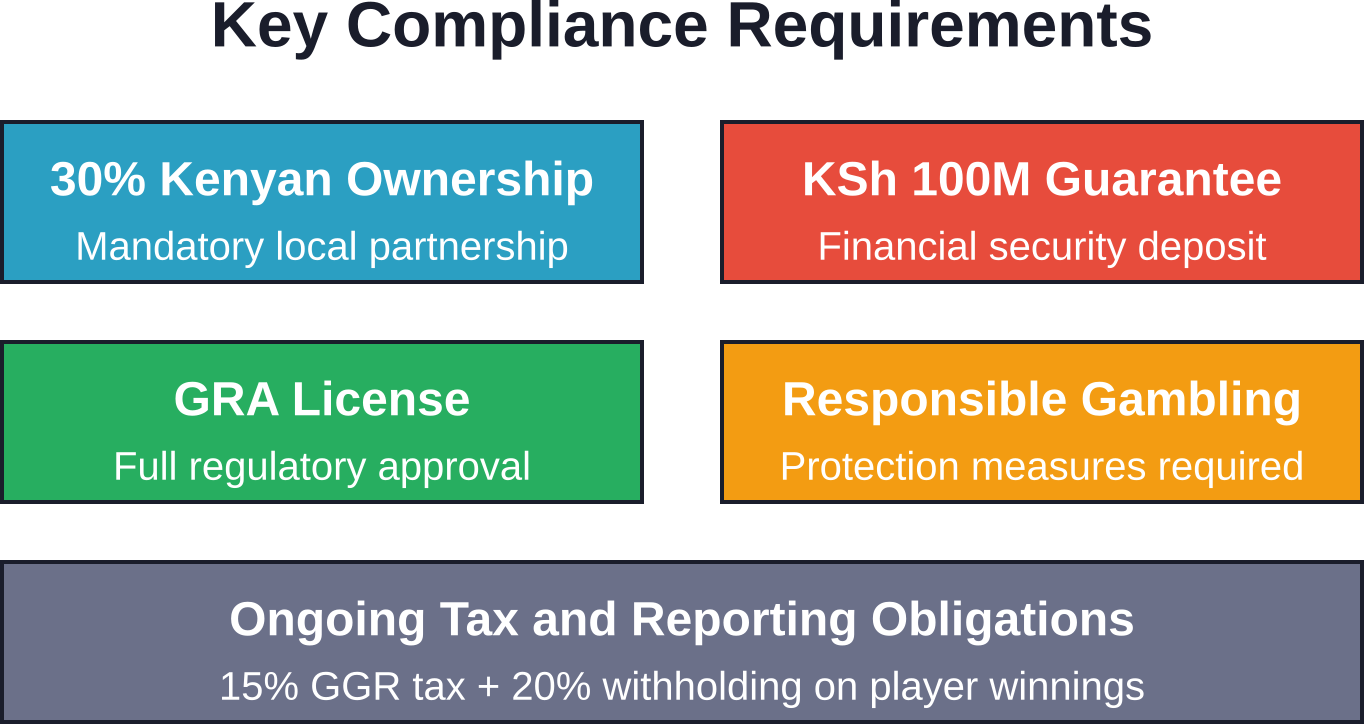
Some will leave. Others will consolidate. The market is likely to see fewer operators but more stable, better-capitalized ones. That’s probably the point—regulators want quality over quantity.
What Operators Should Do
For gambling operators trying to navigate the transition, the strategy is straightforward:
- Audit ownership structures immediately: If the company doesn’t meet the 30% Kenyan ownership requirement, start identifying potential local partners.
- Secure the financial guarantee: KSh 100 million is real money. Operators need to demonstrate they can meet this threshold.
- Engage with the GRA early: Regulatory relationships matter. Waiting until the last minute to apply for licensing creates unnecessary risk.
- Implement responsible gambling measures proactively: The Act emphasizes player protection, and regulators will scrutinize how operators prevent harm.
Kenya’s Poker and Live Casino Scene
Kenya has become the center of poker in East Africa. The country offers both robust online poker platforms and live card rooms, supported by the same regulatory framework that governs casinos.
Live poker venues operate in major cities, particularly Nairobi. These establishments hold casino licenses and offer cash games, tournaments, and poker festivals. The poker community is well-established, with regular events drawing both local players and international visitors.
Online poker sits in a slightly different regulatory space. Skill-based games occupy a gray area in some jurisdictions, but Kenya treats poker as gambling that requires licensing. Operators offering online poker need proper authorization from the GRA.
Locally licensed poker platforms have grown in popularity because they integrate with M-Pesa and local banking, making deposits and withdrawals seamless. This contrasts with international poker sites where payment processing can be complicated for Kenyan players.
Taxation and Revenue
Gambling is a significant revenue driver for the Kenyan government. The industry contributes through multiple tax channels: license fees, GGR taxes, withholding taxes on winnings, and corporate taxes on gambling operators.
Taxation remains a moving target. The Finance Act 2025 introduced shifts toward taxing betting-related deposits and withdrawals in addition to the standard GGR tax. These changes reflect the government’s ongoing effort to maximize revenue from the sector while managing its growth.
Real talk: the government views gambling as both an economic opportunity and a social challenge. The revenue is welcome, but concerns about problem gambling, youth participation, and social harm drive the increasingly strict regulatory approach.
What About Illegal Gambling?
Not all gambling in Kenya is legal. Unlicensed operators—both physical and online—continue to exist despite regulatory crackdowns. These illegal operations don’t pay taxes, don’t implement player protections, and operate outside regulatory oversight.
The GRA has broad powers to combat illegal gambling. This includes shutting down unlicensed venues, blocking access to unauthorized websites, and prosecuting individuals and companies operating without proper licenses.
For players, the risk of using illegal gambling sites is real. There’s no regulatory recourse if the operator refuses to pay winnings, manipulates games, or simply disappears. Licensed operators, by contrast, are subject to oversight and must meet fairness standards.
Future Outlook for Kenya’s Casino Industry
Kenya’s gambling market is at an inflection point. The 2025 regulatory overhaul sets the stage for a more mature, stable industry—but also a more competitive and costly one.
Several trends are likely to shape the market through 2026 and beyond:
- Market consolidation: Higher barriers to entry mean fewer operators. Expect mergers, acquisitions, and exits.
- Increased localization: The 30% ownership requirement pushes international brands toward partnerships with Kenyan investors and businesses.
- Enhanced player protection: Responsible gambling measures will become more sophisticated, driven by both regulatory requirements and industry best practices.
- Mobile-first innovation: Kenya’s gambling future is mobile. Operators will continue building platforms optimized for smartphone users and mobile money integration.
- Stricter advertising rules: Expect continued scrutiny of gambling advertising, particularly promotions targeting young people.
The government has signaled it wants a gambling industry that contributes economically without creating social problems. Whether that balance is achievable remains to be seen, but the regulatory framework is now built to try.
Frequently Asked Questions
Are casinos legal in Kenya in 2026?
Yes. Casinos are legal in Kenya under the Gambling Control Act, 2025. Both land-based casinos and online gambling operators may legally provide services if they obtain the required licenses from the Gambling Regulatory Authority (GRA) and comply with all regulatory requirements.
What replaced the Betting, Lotteries and Gaming Act?
The Gambling Control Act, 2025 replaced the Betting, Lotteries and Gaming Act (Cap. 131). The previous legislation was repealed on August 20, 2025, and the new Act came into force on August 26, 2025, creating a modern regulatory framework for Kenya’s gambling industry.
How much does a casino license cost in Kenya?
A land-based casino license costs KSh 20,000,000, while an online gambling license costs KSh 100,000,000. Other gambling activities have different licensing fees, including KSh 5,000,000 for totalisators and KSh 500,000 for betting shop premises.
What is the Gambling Regulatory Authority?
The Gambling Regulatory Authority (GRA) is the national regulator established under the Gambling Control Act, 2025. It replaced the Betting Control and Licensing Board and is responsible for licensing operators, enforcing gambling laws, monitoring compliance, and protecting consumers.
Do online casinos need to be 30% Kenyan-owned?
Yes. The Gambling Control Act requires licensed gambling operators, including online casinos, to maintain at least 30% Kenyan ownership. This requirement is intended to encourage local participation in the gambling industry.
How are gambling winnings taxed in Kenya?
Player winnings are subject to a 20% withholding tax, which is generally deducted by licensed operators before payouts are made. Gambling operators are also required to pay a 15% tax on gross gaming revenue.
Can international casino sites operate in Kenya?
Yes, but only if they obtain a license from the Gambling Regulatory Authority, satisfy the 30% Kenyan ownership requirement, and meet all licensing and compliance obligations. International operators that offer gambling services without a Kenyan license are considered illegal.
Conclusion
Casinos are absolutely legal in Kenya, but the legal landscape has fundamentally changed. The Gambling Control Act, 2025 represents a complete overhaul designed for modern gambling realities—particularly the dominance of online platforms.
The new framework demands more from operators: higher fees, local ownership, stronger player protections, and ongoing compliance. In exchange, the government offers a stable, regulated market where legitimate businesses can operate with clear rules.
For operators already in the market or considering entry, the message is clear: plan for the new requirements now. Check ownership structures, secure financial guarantees, and engage with the GRA early. The regulatory environment is stricter, but also more predictable.
For players, the benefit is a safer gambling environment with better protections and more accountable operators. Licensed casinos and online platforms must meet standards that unlicensed operations simply ignore.
Kenya’s gambling industry is entering a new era. The wild west days are over. What comes next is a more mature, regulated market—but one where legal, compliant operators can thrive. If operators are considering the Kenyan market, now is the time to ensure full compliance with the Gambling Control Act and establish relationships with the Gambling Regulatory Authority.
Related Articles

September 3, 2026Is the Casino Legal in Denmark? 2026 Guide

September 3, 2026Is the Casino Legal in Angola? What the 2026...