 Nothing found for the request
Is the Casino Legal in Mexico? 2026 Complete Guide
Sologe July 9, 2026
Share:


The Legal Framework: Understanding Mexico's Gambling Laws
Yes, casinos are absolutely legal in Mexico. But the devil’s in the details.
The regulatory foundation rests on the Federal Law on Games and Lotteries from 1947 and its implementing regulations from 2004. These documents establish the ground rules for all gambling activities throughout the country.
The General Directorate of Games and Lotteries (DGJS), operating under the federal government’s authority, serves as the primary regulatory body. This agency controls licensing, enforcement, and compliance monitoring for the entire industry.
Here’s what makes Mexico’s system unique: operators can’t just apply for a standalone online gambling license. Instead, they must partner with existing land-based license holders—a model that creates both opportunities and constraints for market entry.
What the Federal Law Actually Says
According to the official government documentation, certain gambling activities are explicitly prohibited nationwide unless properly licensed. The law doesn’t ban gambling outright—it bans unlicensed gambling.
That’s a crucial distinction.
Licensed operators can legally offer casino games, sports betting, poker rooms, and electronic gaming machines. They just need the paperwork in order and must follow strict operational guidelines.
Types of Gambling Allowed in Mexico
Mexican law permits a surprisingly broad range of gambling activities. Let’s break down what’s on the table.
Gambling Type | Legal Status | Licensing Requirement
|
|---|---|---|
Land-Based Casinos | Legal | DGJS direct license |
Online Casinos | Legal | Partnership with land-based license holder |
Sports Betting | Legal | DGJS license or partnership |
Poker Rooms | Legal | DGJS license or partnership |
Electronic Gaming Machines | Legal | DGJS license required |
State-Run Lotteries | Legal | Government operated |
Land-Based Casino Operations
Physical casinos operate throughout Mexico, from border towns to major tourist destinations. According to industry sources, resorts worth over $500 million could open in locations like Acapulco and Mazatlan as the market continues expanding.
Many Las Vegas gambling companies have shown keen interest in the Mexican market, viewing it as a natural extension of their North American operations.
Online Gambling: Remote Betting Takes Center Stage
Online gambling represents the fastest-growing segment. The regulatory structure allows remote betting, including online casino games, sports wagering, and poker.
But here’s where that partnership requirement comes into play. International operators can’t simply launch a Mexico-facing website and start accepting bets. They need a formal partnership agreement with a licensed Mexican entity.
This model has already proven successful for multiple operators who’ve entered the market legally. The system creates a controlled expansion that satisfies regulatory concerns while allowing innovation and competition.
Build Smarter Gaming Systems with Sologe
Mexico has an active gaming market, and businesses researching this space often need more than legal information. They need a clear view of available technology partners, payment options, software providers, and business services. Sologe brings different iGaming suppliers into one marketplace, helping companies review options across core business needs instead of searching for each category separately.
Sologe supports supplier research for:
- Casino platform providers
- Sports betting software
- Payment solutions
- Affiliate marketing and traffic providers
- Marketing software
- Analytics software
- B2B and B2C licensing services
- Certification services
👉Contact Sologe to review available providers and find B2B iGaming solutions that match your business requirements.
Licensing Requirements and Financial Obligations
Getting licensed in Mexico is a rigorous process with substantial requirements and significant ongoing financial obligations.
License holders and sub-licensees must pay a fee to the regulatory authority, typically ranging from 1% to 2% of their income from betting and gaming operations. This is not a one-time payment — it is an ongoing percentage based on revenue.
The tax situation adds another important layer. Under the 2026 fiscal reform, gambling and online betting operators are subject to a 50% federal excise tax (IEPS) on gross gaming revenue (GGR). Additionally, according to Mexican legislation, entities are evaluated based on the income tax rate in their jurisdiction. If that rate is at least 75% of the Mexican corporate income tax rate (30%), the entity generally avoids certain restrictions related to preferential tax regimes. However, other factors are also considered during the licensing process.
The Application Process
Applying for a Mexican gambling license involves extensive documentation, background checks, financial audits, and operational plan submissions. The DGJS reviews every aspect of the applicant’s business structure, ownership, funding sources, and compliance capabilities.
Processing times vary, but applicants should expect months rather than weeks. The government takes a cautious approach, prioritizing regulatory compliance over rapid market expansion.
What Travelers and Players Should Know
Real talk: if you’re visiting Mexico or living there as an expat, gambling laws affect you differently than they affect operators.
Playing at Licensed Venues
As a player, participating in gambling activities at licensed casinos—whether land-based or online—is perfectly legal. The key word there is licensed.
Unlicensed operations exist, particularly online. These sites operate in a legal gray zone or outright illegally. According to official government materials on preventing illegal gambling, players should verify licensing before engaging with any gambling platform.
Safety Considerations for Online Play
Online discussions and community forums frequently highlight concerns about unlicensed operators targeting Mexican players. These platforms may lack proper oversight, player protections, or fair gaming standards.
Before depositing money, check for:
- DGJS licensing information displayed on the website
- Clear terms and conditions in Spanish
- Established payment processing through recognized financial institutions
- Responsible gambling tools and resources
- Transparent contact information and customer support
Differences from U.S. and Canadian Regulations
Travelers from the United States or Canada will notice some distinctions. Mexico’s federal system means gambling laws apply uniformly across states, unlike the U.S. where each state sets its own rules.
The partnership requirement for online operators also differs significantly from many U.S. states that issue standalone online gambling licenses. And the minimum age for gambling in Mexico is typically 18, compared to 21 in many U.S. jurisdictions.
Market Size and Growth Trajectory
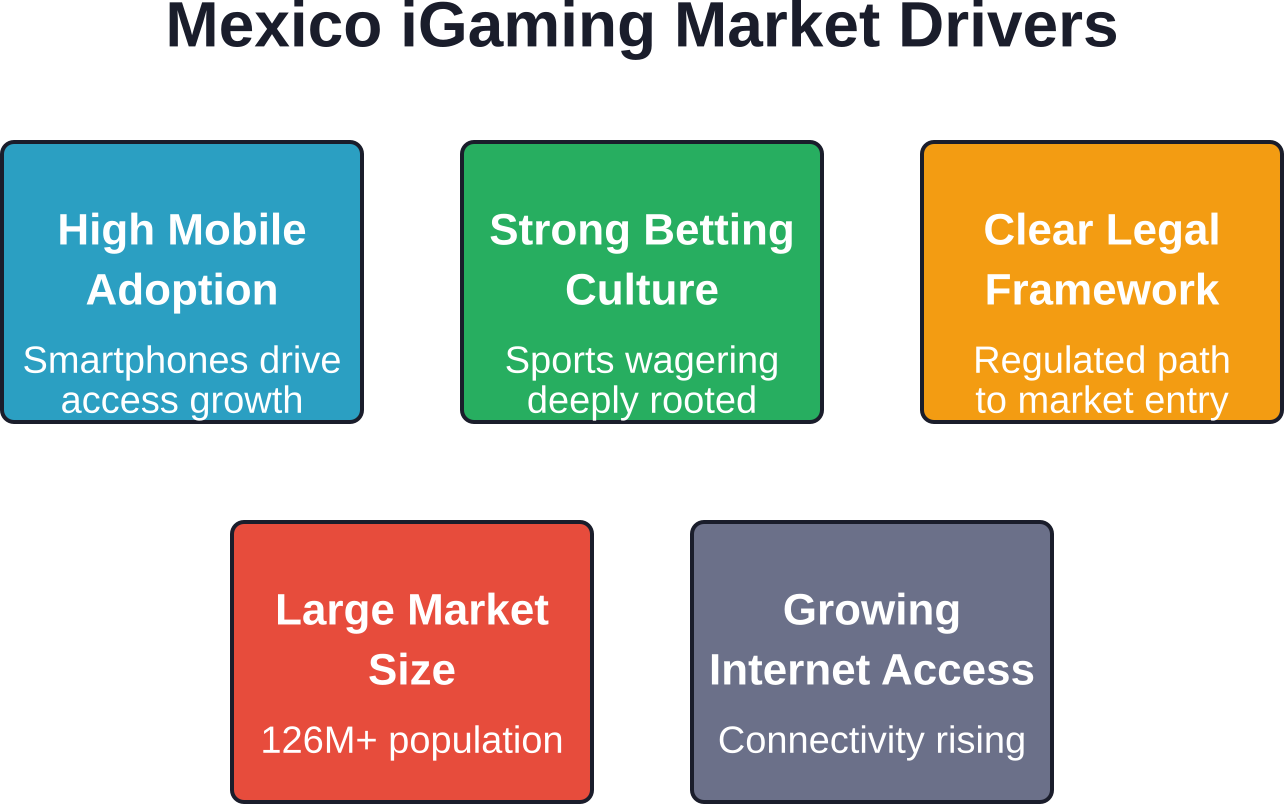
The Mexican gambling market is booming. Industry analyses indicate the market is expected to reach EUR 1.73 billion by 2030, according to industry analyses, driven primarily by mobile adoption and strong local betting culture.
Mexico combines several favorable market conditions: a large population with increasing internet penetration, widespread smartphone use, a cultural affinity for sports betting, and a regulatory framework that permits legal operation.
These factors position Mexico as one of Latin America’s most attractive gambling markets for both domestic and international operators.
Enforcement and Compliance
The DGJS doesn’t just issue licenses and walk away. Active enforcement mechanisms target unlicensed operators and ensure licensed entities maintain compliance standards.
Penalties for operating without proper authorization can be severe, including financial fines, criminal charges, and operational shutdowns. The government publishes information about combating illegal gambling, making it clear that enforcement is a priority.
Responsible Gambling Requirements
Licensed operators must implement responsible gambling measures, including self-exclusion programs, spending limits, and resources for problem gambling support. These aren’t optional extras—they’re licensing requirements.
The regulatory framework recognizes that legal gambling comes with social responsibilities. Operators who fail to provide adequate player protections risk losing their licenses.
Comparing Mexico to Other Latin American Markets
How does Mexico stack up against regional neighbors?
Country | Legal Status | Regulatory Maturity | Online Market
|
|---|---|---|---|
Mexico | Fully Legal | Established | Active and growing |
Brazil | Partially Legal | Evolving framework | Large but complex |
Argentina | Provincial Control | Fragmented | Province-dependent |
Colombia | Fully Legal | Mature system | Competitive market |
Mexico’s advantage lies in its federal structure and relatively mature regulatory environment. While countries like Brazil wrestle with legal uncertainty, Mexico offers a clear path to market entry.
Future Outlook: What’s Next for Mexican Gambling?
The trajectory points toward continued expansion. Economic factors favor growth, political support remains stable, and international operators continue viewing Mexico as a priority market.
Potential regulatory reforms could streamline licensing processes or adjust fee structures, but fundamental changes seem unlikely. The current framework works reasonably well for regulators, operators, and players.
One area to watch: potential casino developments in major metropolitan areas, particularly around Mexico City. As attitudes evolve and tourism infrastructure expands, new venues could reshape the geographic distribution of gambling activities.
Common Myths About Mexican Gambling Laws
Let’s dispel some persistent misconceptions:
- Myth: All online gambling is illegal in Mexico.
- Reality: Licensed online gambling through approved operators is perfectly legal.
- Myth: Foreign companies can’t operate in Mexico.
- Reality: Foreign companies can operate through partnerships with licensed Mexican entities.
- Myth: Mexican gambling laws are inconsistently enforced.
- Reality: The DGJS actively enforces regulations and penalizes unlicensed operations.
- Myth: Players face legal risk for using licensed sites.
- Reality: Playing at licensed, regulated sites carries no legal risk for individual players.
Frequently Asked Questions
Can tourists legally gamble in Mexican casinos?
Yes. Tourists can legally gamble at licensed land-based casinos in Mexico and use licensed online gambling platforms. To stay on the safe side, choose operators that hold a valid license issued by the Dirección General de Juegos y Sorteos (DGJS).
Do I need to pay taxes on gambling winnings in Mexico?
Mexican tax law covers gambling winnings, and tax withholding may apply depending on the circumstances. If you receive significant winnings or gamble professionally, it’s advisable to consult a tax professional familiar with Mexican tax regulations.
How can I verify if an online casino is legally licensed in Mexico?
Most licensed operators display their DGJS licensing details in the website footer or licensing section. You can also contact the Dirección General de Juegos y Sorteos to verify whether a specific operator holds a valid license.
What happens if I use an unlicensed gambling site?
Although enforcement generally focuses on operators rather than players, unlicensed gambling sites do not provide the consumer protections required of licensed casinos. Players may face issues with payments, fairness, or dispute resolution if problems arise.
Are cryptocurrency casinos legal in Mexico?
A casino’s legality depends on its licensing rather than its payment methods. If a gambling operator is properly licensed by the DGJS and complies with applicable regulations, accepting cryptocurrency does not automatically make it illegal.
Can Mexican residents work in the gambling industry?
Yes. Mexico’s licensed gambling industry provides employment in areas such as casino operations, customer service, security, management, technology, and regulatory compliance. Licensed operators must comply with applicable labor laws.
Will Mexico’s gambling laws change significantly soon?
As of mid-2026, no major reforms have been finalized. Mexico’s gambling framework has remained relatively stable, and any future legislative changes are expected to be gradual rather than a complete overhaul of the existing regulatory system.
Final Thoughts
So is the casino legal in Mexico? The answer is a definitive yes—with proper licensing and regulatory compliance.
Mexico’s gambling industry operates under a well-established legal framework that permits land-based casinos, online gaming, sports betting, and other forms of wagering. The DGJS oversees this ecosystem, ensuring operators meet standards while allowing market growth.
For players, this means access to legal, regulated gambling options with protections and recourse mechanisms. For operators, it means a clear (if demanding) path to one of Latin America’s most promising markets.
The key takeaway? Always verify licensing status before engaging with any gambling platform in Mexico. Stick to licensed operators, understand the rules, and enjoy the entertainment value that legal, regulated gambling provides.
Ready to explore Mexico’s legal gambling options? Start by checking official DGJS resources and verifying operator licenses. Whether visiting tourist destinations or accessing online platforms, informed choices lead to better experiences.
Related Articles

September 3, 2026Is the Casino Legal in Denmark? 2026 Guide

September 3, 2026Is the Casino Legal in Angola? What the 2026...